Close Menu
TechCentralTechCentral

    Subscribe to the newsletter

    Get the best South African technology news and analysis delivered to your e-mail inbox every morning.

    Facebook X (Twitter) YouTube LinkedIn
    WhatsApp Facebook X (Twitter) LinkedIn YouTube
    TechCentralTechCentral
    • News
      Digital authoritarianism grows as African states normalise internet blackouts

      Digital authoritarianism grows as African states normalise internet blackouts

      19 December 2025
      Starlink satellite anomaly creates debris in rare orbital mishap

      Starlink satellite anomaly creates debris in rare orbital mishap

      19 December 2025
      TechCentral's South African Newsmakers of 2025

      TechCentral’s South African Newsmakers of 2025

      18 December 2025
      Malatsi buries Post Office's long-dead monopoly

      Malatsi buries Post Office monopoly the market ignored

      18 December 2025
      China races to crack EUV as chip war with the West intensifies

      China races to crack EUV lithography as chip war with the West intensifies

      18 December 2025
    • World
      Trump space order puts the moon back at centre of US, China rivalry - US President Donald Trump

      Trump space order puts the moon back at centre of US, China rivalry

      19 December 2025
      Warner Bros slams the door on Paramount

      Warner Bros slams the door on Paramount

      17 December 2025
      X moves to block bid to revive Twitter brand

      X moves to block bid to revive Twitter brand

      17 December 2025
      Oracle’s AI ambitions face scrutiny on earnings miss

      Oracle’s AI ambitions face scrutiny on earnings miss

      11 December 2025
      China will get Nvidia H200 chips - but not without paying Washington first

      China will get Nvidia H200 chips – but not without paying Washington first

      9 December 2025
    • In-depth
      Black Friday goes digital in South Africa as online spending surges to record high

      Black Friday goes digital in South Africa as online spending surges to record high

      4 December 2025
      Canal+ plays hardball - and DStv viewers feel the pain

      Canal+ plays hardball – and DStv viewers feel the pain

      3 December 2025
      Jensen Huang Nvidia

      So, will China really win the AI race?

      14 November 2025
      Valve's Linux console takes aim at Microsoft's gaming empire

      Valve’s Linux console takes aim at Microsoft’s gaming empire

      13 November 2025
      iOCO's extraordinary comeback plan - Rhys Summerton

      iOCO’s extraordinary comeback plan

      28 October 2025
    • TCS
      TCS+ | Africa's digital transformation - unlocking AI through cloud and culture - Cliff de Wit Accelera Digital Group

      TCS+ | Cloud without culture won’t deliver AI: Accelera’s Cliff de Wit

      12 December 2025
      TCS+ | How Cloud on Demand helps partners thrive in the AWS ecosystem - Odwa Ndyaluvane and Xenia Rhode

      TCS+ | How Cloud On Demand helps partners thrive in the AWS ecosystem

      4 December 2025
      TCS | MTN Group CEO Ralph Mupita on competition, AI and the future of mobile

      TCS | Ralph Mupita on competition, AI and the future of mobile

      28 November 2025
      TCS | Dominic Cull on fixing South Africa's ICT policy bottlenecks

      TCS | Dominic Cull on fixing South Africa’s ICT policy bottlenecks

      21 November 2025
      TCS | BMW CEO Peter van Binsbergen on the future of South Africa's automotive industry

      TCS | BMW CEO Peter van Binsbergen on the future of South Africa’s automotive industry

      6 November 2025
    • Opinion
      Netflix, Warner Bros deal raises fresh headaches for MultiChoice - Duncan McLeod

      Netflix, Warner Bros deal raises fresh headaches for MultiChoice

      5 December 2025
      BIN scans, DDoS and the next cybercrime wave hitting South Africa's banks - Entersekt Gerhard Oosthuizen

      BIN scans, DDoS and the next cybercrime wave hitting South Africa’s banks

      3 December 2025
      Your data, your hardware: the DIY AI revolution is coming - Duncan McLeod

      Your data, your hardware: the DIY AI revolution is coming

      20 November 2025
      Zero Carbon Charge founder Joubert Roux

      The energy revolution South Africa can’t afford to miss

      20 November 2025
      It's time for a new approach to government IT spend in South Africa - Richard Firth

      It’s time for a new approach to government IT spend in South Africa

      19 November 2025
    • Company Hubs
      • Africa Data Centres
      • AfriGIS
      • Altron Digital Business
      • Altron Document Solutions
      • Altron Group
      • Arctic Wolf
      • AvertITD
      • Braintree
      • CallMiner
      • CambriLearn
      • CYBER1 Solutions
      • Digicloud Africa
      • Digimune
      • Domains.co.za
      • ESET
      • Euphoria Telecom
      • Incredible Business
      • iONLINE
      • IQbusiness
      • Iris Network Systems
      • LSD Open
      • NEC XON
      • Netstar
      • Network Platforms
      • Next DLP
      • Ovations
      • Paracon
      • Paratus
      • Q-KON
      • SevenC
      • SkyWire
      • Solid8 Technologies
      • Telit Cinterion
      • Tenable
      • Vertiv
      • Videri Digital
      • Vodacom Business
      • Wipro
      • Workday
      • XLink
    • Sections
      • AI and machine learning
      • Banking
      • Broadcasting and Media
      • Cloud services
      • Contact centres and CX
      • Cryptocurrencies
      • Education and skills
      • Electronics and hardware
      • Energy and sustainability
      • Enterprise software
      • Financial services
      • Information security
      • Internet and connectivity
      • Internet of Things
      • Investment
      • IT services
      • Lifestyle
      • Motoring
      • Public sector
      • Retail and e-commerce
      • Satellite communications
      • Science
      • SMEs and start-ups
      • Social media
      • Talent and leadership
      • Telecoms
    • Events
    • Advertise
    TechCentralTechCentral
    Home » News » SA scores highly for Internet freedom, but worrying signs emerge

    SA scores highly for Internet freedom, but worrying signs emerge

    By Duncan McLeod5 November 2019
    Twitter LinkedIn Facebook WhatsApp Email Telegram Copy Link
    News Alerts
    WhatsApp

    Though it has slipped by three points in the past year — from 75 to 72 — South Africa has a “free” Internet, according to a new report by Freedom House, a Washington-based pro-democracy group.

    The report, which was released on Tuesday, included 65 countries, or about 87% of Internet users. Freedom House concluded that global Internet freedom has declined for the ninth consecutive year.

    Internet freedom declined in South Africa during the coverage period, in part due to election-related factors, the group said. However, neither the state nor other actors block or filter Internet content, and there is no evidence of blocking or content filtering on mobile phones.

    There were no reported instances of blocking or filtering, nor restrictions on the use of social media for online mobilisation

    But self-censorship, online harassment and online manipulation all increased in the run-up to the general election in May 2019. “Though concerns persist about South Africa’s surveillance capabilities, there were no reported instances of blocking or filtering, nor restrictions on the use of social media for online mobilisation.”

    Freedom House said that although South Africa has “cultivated a reputation as a proponent of human rights and a leader on the African continent, in recent years the ruling ANC has been accused of undermining state institutions in order to protect corrupt officials and preserve its power as its support base began to wane”.

    The government does not have direct control over the country’s Internet backbone or its connection to the international Internet, and there have been no intentional disruptions to connectivity, it said.

    However, high data costs remain an obstacle to access. “Though mobile operators are gradually providing more low-cost data packages to lower-income customers, most South Africans without Internet access are those earning less than R7 200/month (representing 42% of the population). Those without Internet access have pinpointed the high costs as the main reason for their lack of connectivity.”
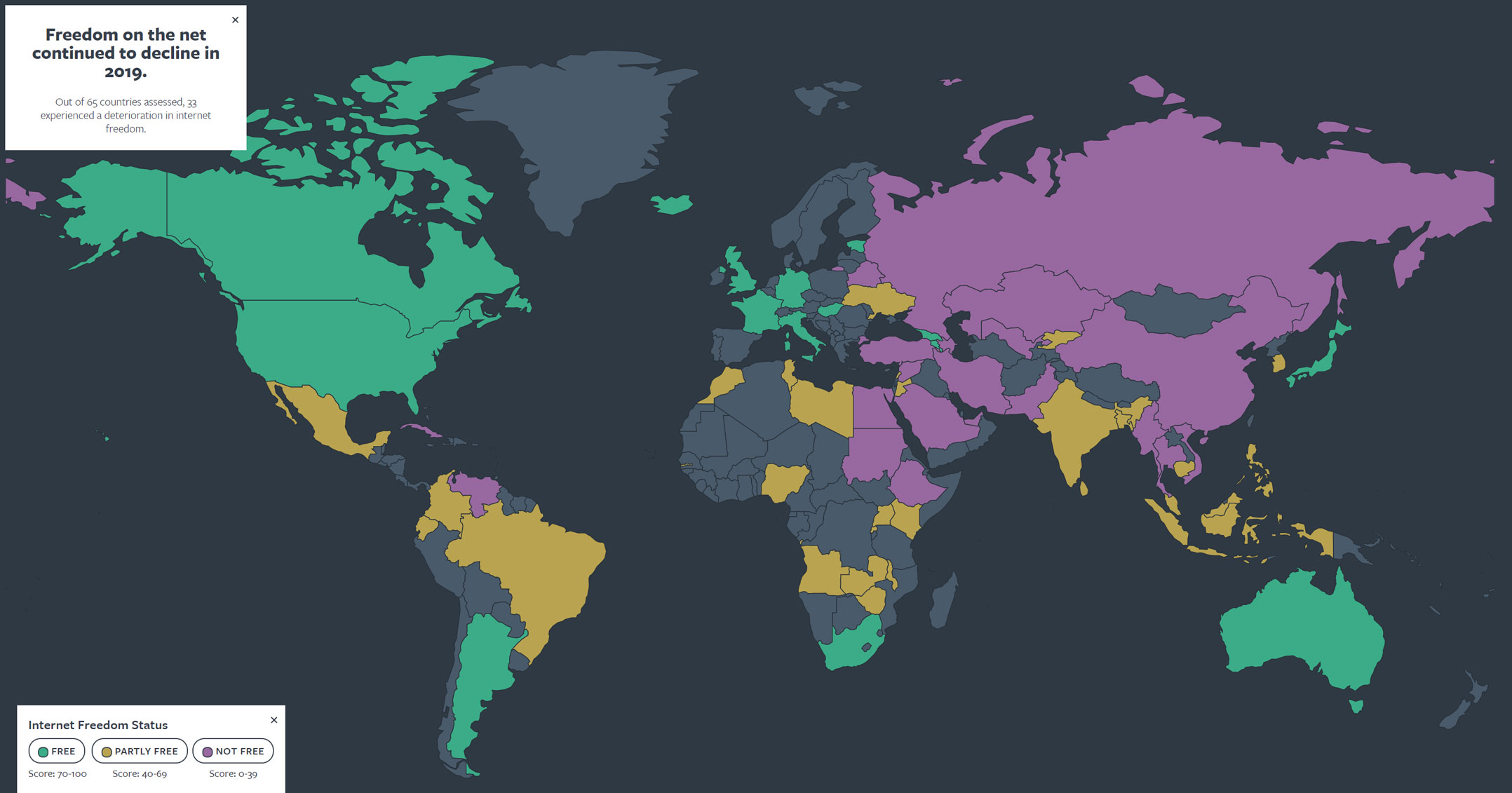
    Source: Freedom House website

    Freedom House said in its report:

    • The Electronic Communications Amendment Bill, which had been criticised for granting extensive regulatory powers to the department of telecommunications & postal services at the expense of communications regulator Icasa’s independence, was withdrawn in February 2019.
    • In March 2019, parliament passed the Films and Publications Amendment Bill, which would empower the Film and Publication Board to issue takedown orders for a wide range of content. The bill is meant to protect children from adult content and to prevent hate speech, but analysts have expressed concern that the vague wording of the legislation will make online content vulnerable to censorship.
    • In November 2018, parliament passed a substantially revised third version of the controversial Cybercrimes Bill. The version of the bill that passed dispensed with other provisions that had concerned rights activists.
    • Encroachments on privacy rights remain a major concern, especially regarding inadequacies in the legal framework surrounding surveillance and the interception of communications, lack of regulation of foreign signal interception and the continued delay in making the Information Regulator fully operational. Additionally, a 2018 report by Citizen Lab identified South Africa as one of 45 countries worldwide using Pegasus, a targeted spyware software developed by the Israeli technology firm NSO.
    • Online attacks against journalists intensified during the run-up to the May 2019 general election, which analysts believe contributed to increased self-censorship by the media.
    • South Africa has few restrictions on anonymous communication or encryption. There are no laws requiring Internet users, website owners or bloggers to register with the government. Users are also not required to use their real names when posting comments online, including on social media platforms.
    • Icasa’s independence has been compromised due to encroachments on its mandate by several government entities. The proliferation of regulatory bodies has led to redundancy and poor coordination and contributed to the perception that the country lacks a comprehensive approach to the regulation of the sector.
    • Restrictions on the Internet are generally transparent and proportional, with a few exceptions. The Internet Service Providers’ Association (Ispa) — which represents many of the country’s ISPs — takes a self-regulatory approach to restricting access to unlawful Internet and digital content hosted by its members. ISPs often err on the side of caution by taking down content upon receipt of a notice to avoid litigation and there is no incentive for providers to defend the rights of the original content creator if they believe the takedown notice was requested in bad faith. Takedown notifications lodged with Ispa increased from 464 in 2017 to 608 in 2018; of those, 233 were accepted (up from 210 in 2017), 366 rejected and nine withdrawn. Of the notices accepted, 216 requests resulted in content being removed. The main reasons for removals included copyright or trademark infringements, fraud, malware or phishing, defamation, hate speech, harassment, and invasion of privacy.

    Freedom House said an area of concern is South Africa’s technical capacity to undertake bulk and targeted surveillance. “This is particularly concerning because (interception legislation) Rica’s oversight applies only to domestic signal interception and not to the interception of foreign signals, which include communications such as e-mails,” it said. “Foreign signals are communications that originate from outside of South Africa but pass through or terminate in the country. The National Communication Centre is responsible for intercepting foreign signals and does so without oversight.”

    It added that the South African Police Service possesses the international mobile subscriber identity (IMSI) technology, known as “stingray”, for bulk interception, although the extent of its use is unknown. “The ministry of state security does not believe that the IMSI is governed by Rica, and its use is therefore unregulated. The government has claimed that the technology is only used for national security matters. Nonetheless, consistent weaknesses in oversight mechanisms within the state security departments leave surveillance open to abuse.”

    Journalists, it said, have been frequently targeted for surveillance by the state, usually as a means of identifying confidential sources. “For example, in May 2018 it emerged that the telephone conversations of investigative journalist Jacques Pauw had been intercepted while he was reporting on state capture during the Jacob Zuma administration. Non-state actors have also targeted journalists for surveillance purposes.”

    ‘Getting worse’

    Worldwide, the Internet is less free than it was a decade ago, and it’s getting worse as some governments expand efforts to use social media to manipulate elections and monitor citizens, according to the Freedom House report.

    While governments have monitored speech on social media for a long time, advances in artificial intelligence “have opened up new possibilities for automated mass surveillance”, said Adrian Shahbaz, Freedom House’s research director for technology and democracy. “Advances in AI are driving a booming, unregulated market for social media surveillance.”

    The report noted that in much of the world, there are obstacles and perils to using the Internet. More than half of Internet users live in countries where certain political, social or religious content was blocked online. In addition, 71% of Internet users live in countries where individuals were imprisoned for posting about political, social or religious issues online.

    China was ranked the worst abuser of Internet freedom for the fourth consecutive year, reaching what the report called ‘unprecedented extremes’

    China was ranked the worst abuser of Internet freedom for the fourth consecutive year, reaching what the report called “unprecedented extremes”. The country tightened information controls ahead of the 30th anniversary of the Tiananmen Square crackdown and amid pro-democracy protests in Hong Kong, according to the report.

    Even in many democratic countries, Internet freedom has declined. Freedom House slightly lowered its score for the US, noting increasing social media monitoring by law enforcement and immigration agencies, including around news gathering and peaceful protests. Freedom House also cited the use of disinformation around political events as an issue in the US.

    “The future of Internet freedom rests on our ability to fix social media,” said Shahbaz. “Since these are mainly American platforms, the US must be a leader in promoting transparency and accountability in the digital age. This is the only way to stop the Internet from becoming a Trojan horse for tyranny and oppression.”  — © 2019 NewsCentral Media, with additional reporting by Kiley Roache, © 2019 Bloomberg LP



    Adrian Shahbaz Freedom House Icasa Ispa Jacques Pauw National Communication Centre top
    Subscribe to TechCentral Subscribe to TechCentral
    Share. Facebook Twitter LinkedIn WhatsApp Telegram Email Copy Link
    Previous ArticleNew gov’t website to make it easier to register a business
    Next Article Telkom trading update sends share price tumbling

    Related Posts

    Telecoms industry backs Malatsi policy directive, warns on execution - ACT CEO Nomvuyiso Batyi

    Telecoms industry backs Malatsi policy directive, warns on execution

    17 December 2025
    ICT BEE fight deepens as MK, EFF target Malatsi - Colleen Makhubele

    ICT BEE fight deepens as MK, EFF target Malatsi

    15 December 2025
    ANC's attack on Solly Malatsi shows how BEE dogma trumps economic reality

    ANC’s attack on Solly Malatsi shows how BEE dogma trumps economic reality

    14 December 2025
    Company News
    Why TechCentral is the most powerful platform for reaching IT decision makers

    Why TechCentral is the most powerful platform for reaching IT decision makers

    17 December 2025
    Business trends to watch in 2026 - Domains.co.za

    Business trends to watch in 2026

    17 December 2025
    MTN Zambia launches world's first 4G cloud smartphone solution - Huawei

    MTN Zambia launches world’s first 4G cloud smartphone solution

    17 December 2025
    Opinion
    Netflix, Warner Bros deal raises fresh headaches for MultiChoice - Duncan McLeod

    Netflix, Warner Bros deal raises fresh headaches for MultiChoice

    5 December 2025
    BIN scans, DDoS and the next cybercrime wave hitting South Africa's banks - Entersekt Gerhard Oosthuizen

    BIN scans, DDoS and the next cybercrime wave hitting South Africa’s banks

    3 December 2025
    Your data, your hardware: the DIY AI revolution is coming - Duncan McLeod

    Your data, your hardware: the DIY AI revolution is coming

    20 November 2025

    Subscribe to Updates

    Get the best South African technology news and analysis delivered to your e-mail inbox every morning.

    Latest Posts
    Digital authoritarianism grows as African states normalise internet blackouts

    Digital authoritarianism grows as African states normalise internet blackouts

    19 December 2025
    Starlink satellite anomaly creates debris in rare orbital mishap

    Starlink satellite anomaly creates debris in rare orbital mishap

    19 December 2025
    Trump space order puts the moon back at centre of US, China rivalry - US President Donald Trump

    Trump space order puts the moon back at centre of US, China rivalry

    19 December 2025
    TechCentral's South African Newsmakers of 2025

    TechCentral’s South African Newsmakers of 2025

    18 December 2025
    © 2009 - 2025 NewsCentral Media
    • Cookie policy (ZA)
    • TechCentral – privacy and Popia

    Type above and press Enter to search. Press Esc to cancel.

    Manage consent

    TechCentral uses cookies to enhance its offerings. Consenting to these technologies allows us to serve you better. Not consenting or withdrawing consent may adversely affect certain features and functions of the website.

    Functional Always active
    The technical storage or access is strictly necessary for the legitimate purpose of enabling the use of a specific service explicitly requested by the subscriber or user, or for the sole purpose of carrying out the transmission of a communication over an electronic communications network.
    Preferences
    The technical storage or access is necessary for the legitimate purpose of storing preferences that are not requested by the subscriber or user.
    Statistics
    The technical storage or access that is used exclusively for statistical purposes. The technical storage or access that is used exclusively for anonymous statistical purposes. Without a subpoena, voluntary compliance on the part of your Internet Service Provider, or additional records from a third party, information stored or retrieved for this purpose alone cannot usually be used to identify you.
    Marketing
    The technical storage or access is required to create user profiles to send advertising, or to track the user on a website or across several websites for similar marketing purposes.
    • Manage options
    • Manage services
    • Manage {vendor_count} vendors
    • Read more about these purposes
    View preferences
    • {title}
    • {title}
    • {title}