

Close Menu
TechCentralTechCentral

    Subscribe to the newsletter

    Get the best South African technology news and analysis delivered to your e-mail inbox every morning.

    Facebook X (Twitter) YouTube LinkedIn
    WhatsApp Facebook X (Twitter) LinkedIn YouTube
    TechCentralTechCentral
    • News
      Digital authoritarianism grows as African states normalise internet blackouts

      Digital authoritarianism grows as African states normalise internet blackouts

      19 December 2025
      Starlink satellite anomaly creates debris in rare orbital mishap

      Starlink satellite anomaly creates debris in rare orbital mishap

      19 December 2025
      TechCentral's South African Newsmakers of 2025

      TechCentral’s South African Newsmakers of 2025

      18 December 2025
      Malatsi buries Post Office's long-dead monopoly

      Malatsi buries Post Office monopoly the market ignored

      18 December 2025
      China races to crack EUV as chip war with the West intensifies

      China races to crack EUV lithography as chip war with the West intensifies

      18 December 2025
    • World
      Trump space order puts the moon back at centre of US, China rivalry - US President Donald Trump

      Trump space order puts the moon back at centre of US, China rivalry

      19 December 2025
      Warner Bros slams the door on Paramount

      Warner Bros slams the door on Paramount

      17 December 2025
      X moves to block bid to revive Twitter brand

      X moves to block bid to revive Twitter brand

      17 December 2025
      Oracle’s AI ambitions face scrutiny on earnings miss

      Oracle’s AI ambitions face scrutiny on earnings miss

      11 December 2025
      China will get Nvidia H200 chips - but not without paying Washington first

      China will get Nvidia H200 chips – but not without paying Washington first

      9 December 2025
    • In-depth
      Black Friday goes digital in South Africa as online spending surges to record high

      Black Friday goes digital in South Africa as online spending surges to record high

      4 December 2025
      Canal+ plays hardball - and DStv viewers feel the pain

      Canal+ plays hardball – and DStv viewers feel the pain

      3 December 2025
      Jensen Huang Nvidia

      So, will China really win the AI race?

      14 November 2025
      Valve's Linux console takes aim at Microsoft's gaming empire

      Valve’s Linux console takes aim at Microsoft’s gaming empire

      13 November 2025
      iOCO's extraordinary comeback plan - Rhys Summerton

      iOCO’s extraordinary comeback plan

      28 October 2025
    • TCS
      TCS+ | Africa's digital transformation - unlocking AI through cloud and culture - Cliff de Wit Accelera Digital Group

      TCS+ | Cloud without culture won’t deliver AI: Accelera’s Cliff de Wit

      12 December 2025
      TCS+ | How Cloud on Demand helps partners thrive in the AWS ecosystem - Odwa Ndyaluvane and Xenia Rhode

      TCS+ | How Cloud On Demand helps partners thrive in the AWS ecosystem

      4 December 2025
      TCS | MTN Group CEO Ralph Mupita on competition, AI and the future of mobile

      TCS | Ralph Mupita on competition, AI and the future of mobile

      28 November 2025
      TCS | Dominic Cull on fixing South Africa's ICT policy bottlenecks

      TCS | Dominic Cull on fixing South Africa’s ICT policy bottlenecks

      21 November 2025
      TCS | BMW CEO Peter van Binsbergen on the future of South Africa's automotive industry

      TCS | BMW CEO Peter van Binsbergen on the future of South Africa’s automotive industry

      6 November 2025
    • Opinion
      Netflix, Warner Bros deal raises fresh headaches for MultiChoice - Duncan McLeod

      Netflix, Warner Bros deal raises fresh headaches for MultiChoice

      5 December 2025
      BIN scans, DDoS and the next cybercrime wave hitting South Africa's banks - Entersekt Gerhard Oosthuizen

      BIN scans, DDoS and the next cybercrime wave hitting South Africa’s banks

      3 December 2025
      Your data, your hardware: the DIY AI revolution is coming - Duncan McLeod

      Your data, your hardware: the DIY AI revolution is coming

      20 November 2025
      Zero Carbon Charge founder Joubert Roux

      The energy revolution South Africa can’t afford to miss

      20 November 2025
      It's time for a new approach to government IT spend in South Africa - Richard Firth

      It’s time for a new approach to government IT spend in South Africa

      19 November 2025
    • Company Hubs
      • Africa Data Centres
      • AfriGIS
      • Altron Digital Business
      • Altron Document Solutions
      • Altron Group
      • Arctic Wolf
      • AvertITD
      • Braintree
      • CallMiner
      • CambriLearn
      • CYBER1 Solutions
      • Digicloud Africa
      • Digimune
      • Domains.co.za
      • ESET
      • Euphoria Telecom
      • Incredible Business
      • iONLINE
      • IQbusiness
      • Iris Network Systems
      • LSD Open
      • NEC XON
      • Netstar
      • Network Platforms
      • Next DLP
      • Ovations
      • Paracon
      • Paratus
      • Q-KON
      • SevenC
      • SkyWire
      • Solid8 Technologies
      • Telit Cinterion
      • Tenable
      • Vertiv
      • Videri Digital
      • Vodacom Business
      • Wipro
      • Workday
      • XLink
    • Sections
      • AI and machine learning
      • Banking
      • Broadcasting and Media
      • Cloud services
      • Contact centres and CX
      • Cryptocurrencies
      • Education and skills
      • Electronics and hardware
      • Energy and sustainability
      • Enterprise software
      • Financial services
      • Information security
      • Internet and connectivity
      • Internet of Things
      • Investment
      • IT services
      • Lifestyle
      • Motoring
      • Public sector
      • Retail and e-commerce
      • Satellite communications
      • Science
      • SMEs and start-ups
      • Social media
      • Talent and leadership
      • Telecoms
    • Events
    • Advertise
    TechCentralTechCentral
    Home » Editor's pick » Your phone’s screen just won the Nobel Prize

    Your phone’s screen just won the Nobel Prize

    By The Conversation9 October 2014
    Twitter LinkedIn Facebook WhatsApp Email Telegram Copy Link
    News Alerts
    WhatsApp

    bl-640

    You’ve probably got the fruits of this year’s Nobel laureates’ handiwork in your pocket. In fact, if you’re reading this on your phone or a relatively recent flat-screen monitor, you’re more than likely staring at some of them right now.

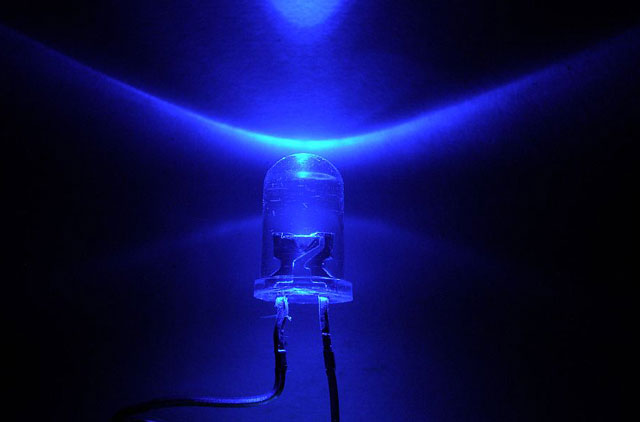
    But what is a light-emitting diode? Fundamentally, the simplest LEDs are two pieces of a semiconductor material sandwiched together. Semiconductors, as their name suggests, are materials which don’t conduct electricity all that well.

    This property might seem to demarcate them as thoroughly unremarkable, but in fact this propensity for unimpressive transmission of electrical currents has a huge advantage to technologists: its flexibility. If you take a semiconductor — silicon, for example — and mix in tiny amounts of impurities during manufacture, you can radically alter its electrical properties.

    The two broad types of semiconductor you can make are called n-type and p-type. To make an n-type semiconductor, the impurity you add needs to be something which has lots of electrons. This gives the semiconductor an excess of electrons, and makes it a slightly better conductor of electricity.

    A p-type semiconductor is the opposite: you add a chemical element which has a deficiency of electrons compared to the semiconductor around it, and you end up with an excess of “holes” — missing electrons, stolen from the semiconductor by the impurities you’ve added. (Counterintuitively, this also increases the conductivity, because these holes can carry current too!) But it’s when you stick n-type and p-type together that the real magic happens.

    Pass a current through your newly-manufactured p-n junction, and the electrons flow from the n-type material into the p-type, whereupon they promptly fall into the holes. As they plummet, they give off a tiny flash of light.

    The colour of that light is determined by the semiconductor you’ve used. Silicon, for example, while great for computer chips, isn’t so brilliant for lighting. Light emitted by a silicon LED would be deep into the infrared range, and invisible to the human eye. Infrared LEDs are nonetheless very useful: they’re how your remote control allows you to zap instructions to your TV from your sofa. But even here, silicon isn’t used because for quite subtle reasons it’s a very inefficient infrared light source.

    If you want to manufacture an LED that emits a certain colour of light, you just need to find a material which has the right properties to give off the colour of light you’re interested in. In some cases this turns out to be quite simple. Red LEDs were available from the early 1960s, using materials based on gallium arsenide. Green LEDs followed shortly thereafter using gallium phosphide. However, blue proved something of a challenge. The first commercially available blue LEDs came onto the market in 1989 and were based on silicon carbide but, much like pure silicon, they were phenomenally inefficient.

    This is where our Nobel laureates step in. A better choice for producing blue light is gallium nitride (as you’ve probably noticed, gallium something-ide is where it’s at when it comes to making light from electricity). Unfortunately, it’s far trickier to coax bright light from this than the other gallium compounds.

    First, it proved very hard to grow high-quality crystals of gallium nitride. Typically, it’s easiest to grow a crystal on a surface which has a similar crystal structure, but gallium nitride’s complex atomic layout makes that somewhat challenging. Then, making the LEDs more efficient requires a complex layering of even more materials, deviating somewhat from the idealised p-n junction LED we just met. Varying widths of the layers in this quantum sandwich can even alter the exact colour of light emitted (theoretically these “blue” LEDs could be tweaked to emit green, yellow or even orange light).
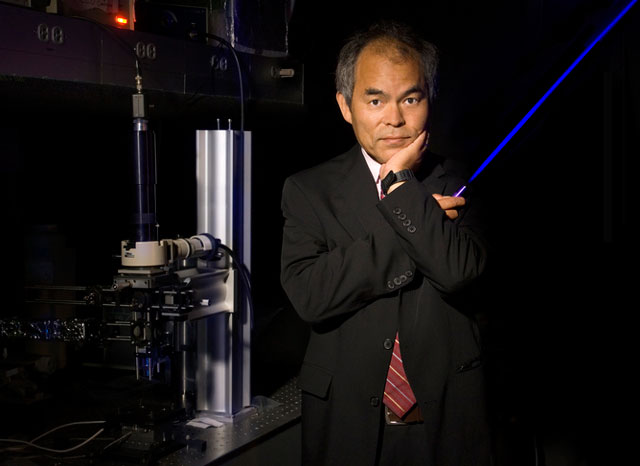
    Shuji Nakamura, one of the three prize winners. Image: UCSB/EPA
    Shuji Nakamura, one of the three prize winners. Image: UCSB/EPA

    In spite of their complex manufacture, blue LEDs are now ubiquitous. For example, they can be found inside Blu-ray players. Blue light has a short wavelength, which allows the pits on a Blu-ray disc to be smaller and closer together than on a DVD, which is read with red light. This means that we can pack over five times as much data onto a disk the same size as a DVD.

    Their biggest impact, however, is surely in giving us the ability to produce white LEDs. White light is actually a mixture of all the colours of the rainbow, as you can see if you split it up with a prism, or indeed if you catch a multicoloured reflection in the surface of a Blu-ray disc, DVD or CD. However, the human eye has just three types of colour receptor inside it: red, green and blue.

    We can therefore make something which looks like white light using only these three colours. Combining red and green LEDs with blue ones allows us to create highly efficient white lighting, providing around 20 times as much light as an equivalent incandescent bulb. White LEDs are slowly making their way onto ceilings of homes, shops and factories around the world, but their real ubiquity today is as the back-light for computer and phone screens. Unlock your phone or turn on a recent flat-screen monitor, and red, green and blue LEDs shining through a layer of liquid crystal allows you to browse the Web, watch movies, and even read this article.

    As well as being a technological marvel, Isamu Akasaki, Hiroshi Amano and Shuji Nakamura’s Nobel Prize is a testament to tenacity in experimental science. As much as deft theoretical insight, the development of blue LEDs required hours of trial and error in the lab, performing the same procedures under subtly different conditions, trying to maximise the efficiency and cost-effectiveness of this finicky process.

    The result is a technology which is all around us in the developed world, and making headway into the developing world, too. These laureates’ bright idea could well be the light source of the 21st century and, when the movie version comes out, we can even watch their story on Blu-ray on an LED-backlit TV.

    • Andrew Steele is post-doctoral research fellow at London Research Institute
    • This article was originally published on The Conversation


    Andrew Steele Hiroshi Amano Isamu Akasaki Shuji Nakamura
    Subscribe to TechCentral Subscribe to TechCentral
    Share. Facebook Twitter LinkedIn WhatsApp Telegram Email Copy Link
    Previous ArticleSamsung SB330 review: big sound, big price
    Next Article Vodacom firms up Deezer deal
    Company News
    Why TechCentral is the most powerful platform for reaching IT decision makers

    Why TechCentral is the most powerful platform for reaching IT decision makers

    17 December 2025
    Business trends to watch in 2026 - Domains.co.za

    Business trends to watch in 2026

    17 December 2025
    MTN Zambia launches world's first 4G cloud smartphone solution - Huawei

    MTN Zambia launches world’s first 4G cloud smartphone solution

    17 December 2025
    Opinion
    Netflix, Warner Bros deal raises fresh headaches for MultiChoice - Duncan McLeod

    Netflix, Warner Bros deal raises fresh headaches for MultiChoice

    5 December 2025
    BIN scans, DDoS and the next cybercrime wave hitting South Africa's banks - Entersekt Gerhard Oosthuizen

    BIN scans, DDoS and the next cybercrime wave hitting South Africa’s banks

    3 December 2025
    Your data, your hardware: the DIY AI revolution is coming - Duncan McLeod

    Your data, your hardware: the DIY AI revolution is coming

    20 November 2025

    Subscribe to Updates

    Get the best South African technology news and analysis delivered to your e-mail inbox every morning.

    Latest Posts
    Digital authoritarianism grows as African states normalise internet blackouts

    Digital authoritarianism grows as African states normalise internet blackouts

    19 December 2025
    Starlink satellite anomaly creates debris in rare orbital mishap

    Starlink satellite anomaly creates debris in rare orbital mishap

    19 December 2025
    Trump space order puts the moon back at centre of US, China rivalry - US President Donald Trump

    Trump space order puts the moon back at centre of US, China rivalry

    19 December 2025
    TechCentral's South African Newsmakers of 2025

    TechCentral’s South African Newsmakers of 2025

    18 December 2025
    © 2009 - 2025 NewsCentral Media
    • Cookie policy (ZA)
    • TechCentral – privacy and Popia

    Type above and press Enter to search. Press Esc to cancel.

    Manage consent

    TechCentral uses cookies to enhance its offerings. Consenting to these technologies allows us to serve you better. Not consenting or withdrawing consent may adversely affect certain features and functions of the website.

    Functional Always active
    The technical storage or access is strictly necessary for the legitimate purpose of enabling the use of a specific service explicitly requested by the subscriber or user, or for the sole purpose of carrying out the transmission of a communication over an electronic communications network.
    Preferences
    The technical storage or access is necessary for the legitimate purpose of storing preferences that are not requested by the subscriber or user.
    Statistics
    The technical storage or access that is used exclusively for statistical purposes. The technical storage or access that is used exclusively for anonymous statistical purposes. Without a subpoena, voluntary compliance on the part of your Internet Service Provider, or additional records from a third party, information stored or retrieved for this purpose alone cannot usually be used to identify you.
    Marketing
    The technical storage or access is required to create user profiles to send advertising, or to track the user on a website or across several websites for similar marketing purposes.
    • Manage options
    • Manage services
    • Manage {vendor_count} vendors
    • Read more about these purposes
    View preferences
    • {title}
    • {title}
    • {title}