Close Menu
TechCentralTechCentral

    Subscribe to the newsletter

    Get the best South African technology news and analysis delivered to your e-mail inbox every morning.

    Facebook X (Twitter) YouTube LinkedIn
    WhatsApp Facebook X (Twitter) LinkedIn YouTube
    TechCentralTechCentral
    • News
      Battlefield tech could save lives on South Africa's roads - Dithoto Modungwa

      Battlefield tech could save lives on South Africa’s roads

      10 July 2026
      Customers prefer ChatGPT to your company's AI chatbot

      Customers prefer ChatGPT to your company’s AI chatbot

      10 July 2026
      OpenAI debuts ChatGPT Work - and GPT-5.6 - in enterprise push

      OpenAI debuts ChatGPT Work – and GPT-5.6 – in enterprise push

      10 July 2026
      The fragile joint in the Capitec machine

      The fragile joint in the Capitec machine

      9 July 2026
      Ministerial churn hollowed out Sita, PSC probe finds

      Ministerial churn hollowed out Sita, PSC probe finds

      9 July 2026
    • World
      Swingeing jobs cuts at Microsoft's Xbox unit

      Swingeing jobs cuts at Microsoft’s Xbox unit

      6 July 2026

      SK Hynix ends Samsung’s 26-year reign at the top

      22 June 2026
      Google on the hook for what its AI tells users, court rules

      Google on the hook for what its AI tells users, court rules

      15 June 2026
      How Russians juggle VPNs to outwit the Kremlin

      How Russians juggle VPNs to outwit the Kremlin

      15 June 2026
      Amazon CEO flagged Anthropic AI risks to Washington - Andy Jassy

      Amazon CEO flagged Anthropic AI risks to Washington

      14 June 2026
    • In-depth
      AI boom sparks rally, frenzy and fear

      AI boom sparks rally, frenzy and fear

      11 June 2026
      Every plug-in hybrid on sale in South Africa, ranked by price - Lamborghini Temerario

      Every plug-in hybrid on sale in South Africa, ranked by price

      7 June 2026
      What Wi-Fi 8 will mean for wireless networks

      What Wi-Fi 8 will mean for wireless networks

      1 June 2026
      Alfa's electric rebel - Alfa Romeo Junior Elettrica Veloce

      Alfa’s electric rebel

      29 April 2026
      Africa switches on as Europe dims the lights

      Africa switches on as Europe dims the lights

      9 April 2026
    • TCS
      Watts & Wheels S1E7: 'Ferrari's EV breaks the internet'

      Watts & Wheels S1E7: ‘Ferrari’s EV breaks the internet’

      8 July 2026
      TCS+ | How Tracker is turning vehicle data into business strategy - Silvia Schollenberger

      TCS+ | How Tracker is turning vehicle data into business strategy

      1 July 2026
      TCS+ | IBM Bob: an AI-powered 'development partner' for the enterprise - David Spurway

      TCS+ | IBM Bob: an AI-powered development partner for the enterprise

      30 June 2026
      Watts & Wheels S1E6: 'A flawless Alfa and a bakkie that divides'

      Watts & Wheels S1E6: ‘A flawless Alfa and a bakkie that divides’

      17 June 2026
      Watts & Wheels S1E6: 'A flawless Alfa and a bakkie that divides'

      Watts & Wheels S1E5: ‘A Bentley of the bush and a car that swims’

      8 June 2026
    • Opinion
      The author, Fanie van Rooyen

      South Africa can still catch the AI wave – here’s how

      7 July 2026
      The author, Fanie van Rooyen

      The AI utopia South Africa can’t afford

      1 July 2026
      The author, Jannie van Zyl

      South Africa’s broadband future is being decided in orbit, not in Pretoria

      30 June 2026
      The author, Pambos Soteriades

      The pivot South Africa’s MVNOs cannot afford to miss

      23 June 2026
      Brazil's online gambling crackdown is a lesson for South Africa

      Brazil’s online gambling crackdown is a lesson for South Africa

      22 June 2026
    • Company Hubs
      • 1Stream
      • Africa Data Centres
      • AfriGIS
      • Altron Digital Business
      • Altron Document Solutions
      • Altron Group
      • Arctic Wolf
      • Ascent Technology
      • AvertITD
      • BBD
      • Braintree
      • CallMiner
      • CambriLearn
      • CM Telecom
      • Contactable
      • CYBER1 Solutions
      • Digicloud Africa
      • Digimune
      • Domains.co.za
      • ESET
      • Euphoria Telecom
      • HOSTAFRICA
      • Incredible Business
      • iONLINE
      • IQbusiness
      • Iris Network Systems
      • Kaspersky
      • LSD Open
      • Mitel
      • NEC XON
      • Netstar
      • Network Platforms
      • Next DLP
      • Ovations
      • Paracon
      • Paratus
      • Q-KON
      • SevenC
      • SkyWire
      • Solid8 Technologies
      • Telit Cinterion
      • Telviva
      • Tenable
      • Vertiv
      • Videri Digital
      • Vodacom Business
      • Wipro
      • Workday
      • XLink
    • Sections
      • AI and machine learning
      • Banking
      • Broadcasting and Media
      • Cloud services
      • Contact centres and CX
      • Cryptocurrencies
      • Education and skills
      • Electronics and hardware
      • Energy and sustainability
      • Enterprise software
      • Financial services
      • HealthTech
      • Information security
      • Internet and connectivity
      • Internet of Things
      • Investment
      • IT services
      • Lifestyle
      • Policy and regulation
      • Public sector
      • Retail and e-commerce
      • Satellite communications
      • Science
      • SMEs and start-ups
      • Social media
      • Talent and leadership
      • Telecoms
      • Watts & Wheels
    • Events
    • Advertise
    TechCentralTechCentral
    Home » Sections » Watts & Wheels » Battlefield tech could save lives on South Africa’s roads

    Battlefield tech could save lives on South Africa’s roads

    The engineering that keeps soldiers alive in landmine blasts should protect commuters, too, writes Dithoto Modungwa.
    By Dithoto Modungwa10 July 2026
    Twitter LinkedIn Facebook WhatsApp Email Telegram Copy Link
    News Alerts
    WhatsApp
    Battlefield tech could save lives on South Africa's roads - Dithoto Modungwa
    The author, the CSIR’s Dithoto Modungwa

    Somewhere in South Africa today, a family will get a phone call no one wants to receive. Around 12 000 people die on our roads every year – on the N3, on rural district roads, in taxis, on the way to school. We have grown so used to these numbers that they barely make the news anymore unless the crash is especially large.

    But here is something most South Africans don’t know: some of the most advanced life-saving vehicle technology in the world was invented right here, in South Africa, decades ago. We have simply never brought it home to our own roads.

    As a researcher at the CSIR, I work on the engineering that keeps soldiers alive in the most dangerous conditions imaginable. It might sound like a strange place to start a conversation about your daily commute. But the two are more connected than you might think.

    This is exactly the science that determines whether a person walks away from a collision or does not

    In the 1970s and 1980s, South African engineers designed a military vehicle called the Casspir, built to protect soldiers from landmines. Its signature feature was a V-shaped hull that deflects the force of an explosion away and around the vehicle, instead of straight up into the people inside. More than 2 000 Casspirs were built, and the design proved so effective that it went on to shape the international standard for what today’s armies call MRAPs – mine-resistant, ambush-protected vehicles – used by defence forces around the world. South Africa didn’t just take part in that story. We started it.

    Here is the point that matters for ordinary road users: the engineering knowledge built through the Casspir programme – how structures absorb and redirect energy, how occupants must be restrained, how a vehicle can be designed so that human beings survive extreme force – is directly relevant to what happens to a human body in a serious road crash.

    It works

    This is exactly the science that determines whether a person walks away from a collision or does not. We built this expertise. We proved it works. And it has never been deliberately carried across into the design standards, the taxis, the buses or the safety regulations that shape the vehicles most South Africans actually use.

    A sceptical engineer is right to ask what that transfer looks like in practice. The V-shaped hull itself is an underbody-blast solution – it redirects a pressure wave rising vertically from below – and that is a fundamentally different load case from the lateral or frontal impact managed by crumple zones, airbags and side-intrusion beams in a road crash. The legitimate transfer from the Casspir lineage is not the hull geometry. It is the family of subsystems engineered, tested and proven alongside it. Three of those translate directly into minibus taxis and scholar transport:

    • Energy-absorbing seating. Because a blast impulse travels upward through the floor into the seat, Casspir-derivative vehicles required seats mounted on energy-absorbing pylons – “stroking seats” – that limit the peak deceleration force transmitted to the occupant’s spine. That same principle, a seat that yields progressively rather than transmitting force rigidly into the passenger, is precisely what is missing from South African scholar transport, where children sit on rigid, poorly anchored benches with no restraint. Translating CSIR-derived stroking-seat specifications into a national standard for scholar transport would not require armour; it would require a design rule and an annual compliance check.
    • Restraint geometry. The biomechanical analysis underpinning four-point harness anchor placement in MRAPs – ensuring load runs through the pelvis and shoulder girdle, not the abdomen – is identical to the analysis needed to mandate correct seatbelt anchorage geometry in minibus taxis, where rear passengers routinely travel without any restraint at all.
    • Rollover integrity. The CSIR’s work on roof-crush resistance and occupant survival-space requirements for high-rollover-risk military vehicles maps directly onto a structural design standard for minibus taxi B-pillars and roof rails. Rollovers remain one of the highest-fatality crash modes on South African roads.

    This isn’t only about crash survival. It is about the bigger picture of a transport system many of us experience as unreliable and unsafe – potholed roads, ageing infrastructure, overloaded scholar transport, a rising cost of moving people and goods around the country. Transport also accounts for roughly one-tenth of South Africa’s greenhouse gas emissions, so decisions about how we build and power our vehicles matter for the climate, too, not just for road safety.

    Read: CSIR readies live cybercrime reporting system for banks, telcos

    I raised this argument in my opening address at the 44th Southern African Transport Conference, held from 6-9 July at the CSIR International Convention Centre in Pretoria – the country’s largest annual gathering of transport engineers, researchers and government policymakers. This year’s conference fell on a meaningful anniversary: 30 years of transport policy in our democracy. Three decades is long enough to take an honest look at what worked, and what we missed. One of the clearest things we missed is this: we let a genuinely world-class, homegrown safety innovation sit inside our defence sector instead of asking how it could save lives on our highways.

    To be precise about what this transfer does and does not mean: the proposal is not to weld armour plate into taxis. The added mass alone would price any such vehicle out of a market where operators compete on cents per kilometre. It is to carry across the engineering discipline itself – the occupant protection specifications, the stroking-seat load curves, the restraint-anchor geometry rules and the rollover structural standards that decades of military vehicle programmes forced into existence. These disciplines can be mandated in regulation at a cost of hundreds of rand per seat, not hundreds of thousands of rand per vehicle.
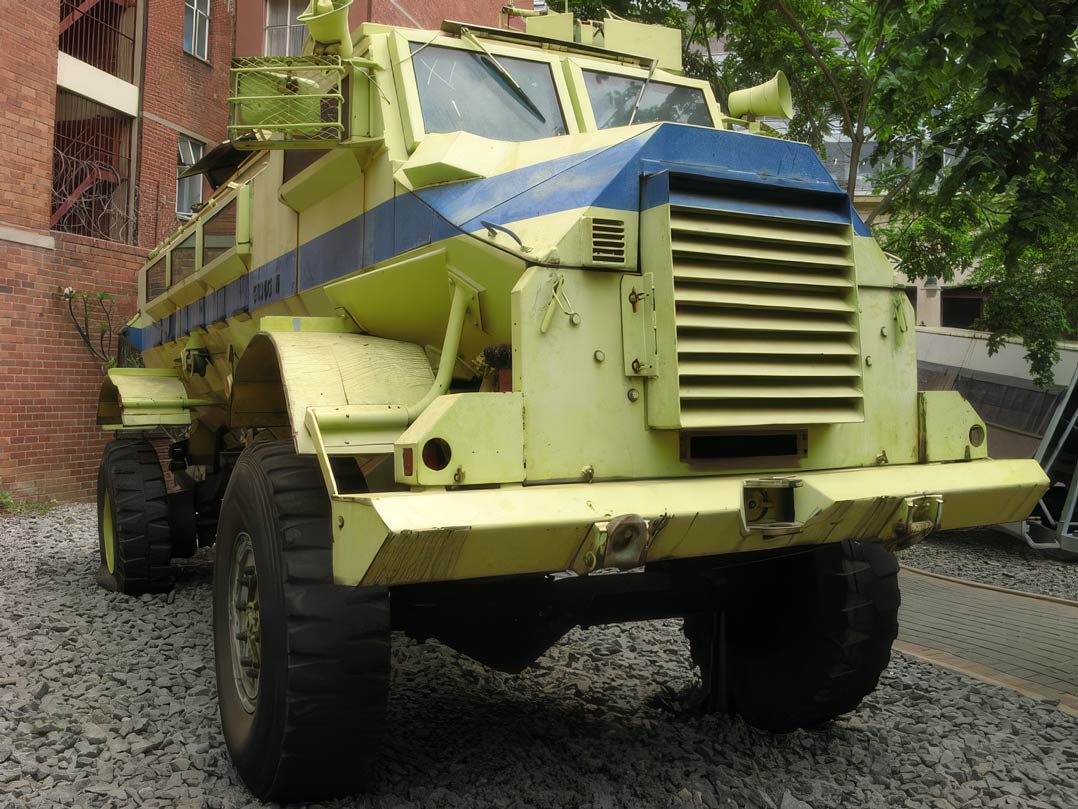
    A Casspir at the South African Police Museum, Pretoria
    A Casspir at the South African Police Museum, Pretoria. Image: Borisgorelik/CC BY-SA 3.0

    Fixing this is therefore not about inventing something new. It is about political and institutional will: getting the CSIR, Armscor, Denel, the department of transport and vehicle manufacturers into the same room, with a shared mandate to move proven safety knowledge from the battlefield into civilian design standards. I have proposed a practical framework for exactly this, built around five priorities – sovereignty, safety, security, sustainability and resilience – with concrete actions over the next three years and the decade beyond.

    South Africans deserve a transport system that doesn’t quietly accept 12 000 deaths a year as the cost of getting to work. We are not short of expertise. We are short of the bridge connecting what we already know how to build to the roads South Africans travel on every day. That bridge is buildable. The only question is whether we choose to build it.

    • The author, Dithoto Modungwa, is a defence and security researcher at the CSIR
    • Subscribe to TechCentral’s daily newsletter
    • Get breaking news alerts on WhatsApp

    Follow TechCentral on Google News Add TechCentral as your preferred source on Google


    Casspir CSIR Dithoto Modungwa
    WhatsApp YouTube
    Share. Facebook Twitter LinkedIn WhatsApp Telegram Email Copy Link
    Previous ArticleCustomers prefer ChatGPT to your company’s AI chatbot

    Related Posts

    South Africa's leap to modern Wi-Fi has barely begun

    Mobile operators locked out as Icasa opens 900MHz of spectrum

    27 May 2026
    Wapa's Paul Colmer said publication of the regulations is hugely significant

    South Africa’s dynamic spectrum breakthrough

    20 February 2026
    CSIR readies live cybercrime reporting system for banks, telcos

    CSIR readies live cybercrime reporting system for banks, telcos

    7 November 2025
    Company News
    Rain supercharges 5G with Huawei

    Rain supercharges 5G with Huawei

    10 July 2026
    Africa's data centres: AI, edge computing and new energy demands - Vertiv OADC Open Access Data Centres

    Africa’s data centres: AI, edge computing and new energy demands

    9 July 2026
    The best way to automate customer engagement using AI and WhatsApp - CM.com

    The best way to automate customer engagement using AI and WhatsApp

    9 July 2026
    Opinion
    The author, Fanie van Rooyen

    South Africa can still catch the AI wave – here’s how

    7 July 2026
    The author, Fanie van Rooyen

    The AI utopia South Africa can’t afford

    1 July 2026
    The author, Jannie van Zyl

    South Africa’s broadband future is being decided in orbit, not in Pretoria

    30 June 2026

    Subscribe to Updates

    Get the best South African technology news and analysis delivered to your e-mail inbox every morning.

    Latest Posts
    Battlefield tech could save lives on South Africa's roads - Dithoto Modungwa

    Battlefield tech could save lives on South Africa’s roads

    10 July 2026
    Customers prefer ChatGPT to your company's AI chatbot

    Customers prefer ChatGPT to your company’s AI chatbot

    10 July 2026
    Rain supercharges 5G with Huawei

    Rain supercharges 5G with Huawei

    10 July 2026
    OpenAI debuts ChatGPT Work - and GPT-5.6 - in enterprise push

    OpenAI debuts ChatGPT Work – and GPT-5.6 – in enterprise push

    10 July 2026
    © 2009 - 2026 NewsCentral Media
    Built and maintained by Chronon
    • Cookie policy (ZA)
    • TechCentral – privacy and Popia

    Type above and press Enter to search. Press Esc to cancel.

    Manage consent

    TechCentral uses cookies to enhance its offerings. Consenting to these technologies allows us to serve you better. Not consenting or withdrawing consent may adversely affect certain features and functions of the website.

    Functional Always active
    The technical storage or access is strictly necessary for the legitimate purpose of enabling the use of a specific service explicitly requested by the subscriber or user, or for the sole purpose of carrying out the transmission of a communication over an electronic communications network.
    Preferences
    The technical storage or access is necessary for the legitimate purpose of storing preferences that are not requested by the subscriber or user.
    Statistics
    The technical storage or access that is used exclusively for statistical purposes. The technical storage or access that is used exclusively for anonymous statistical purposes. Without a subpoena, voluntary compliance on the part of your Internet Service Provider, or additional records from a third party, information stored or retrieved for this purpose alone cannot usually be used to identify you.
    Marketing
    The technical storage or access is required to create user profiles to send advertising, or to track the user on a website or across several websites for similar marketing purposes.
    • Manage options
    • Manage services
    • Manage {vendor_count} vendors
    • Read more about these purposes
    View preferences
    • {title}
    • {title}
    • {title}