Close Menu
TechCentralTechCentral

    Subscribe to the newsletter

    Get the best South African technology news and analysis delivered to your e-mail inbox every morning.

    Facebook X (Twitter) YouTube LinkedIn
    WhatsApp Facebook X (Twitter) LinkedIn YouTube
    TechCentralTechCentral
    • News
      Sentech is in dire straits

      Sentech is in dire straits

      10 February 2026
      A million reasons monopolies don't work

      A million reasons monopolies don’t work

      10 February 2026
      South Africa's data centre market ripe for consolidation - Joshua Smythwood

      South Africa’s data centre market ripe for consolidation

      10 February 2026
      Watts & Wheels S1E4: 'We drive an electric Uber'

      Watts & Wheels S1E4: ‘We drive an electric Uber’

      10 February 2026
      Online sales can't save Pick n Pay from Black Friday hangover

      Online sales can’t save Pick n Pay from Black Friday hangover

      10 February 2026
    • World
      EU regulators take aim at WhatsApp

      EU regulators take aim at WhatsApp

      9 February 2026
      Musk hits brakes on Mars mission

      Musk hits brakes on Mars mission

      9 February 2026
      Crypto firm accidentally sends R700-billion in bitcoin to its users

      Crypto firm accidentally sends R700-billion in bitcoin to its users

      8 February 2026
      AI won't replace software, says Nvidia CEO amid market rout - Jensen Huang

      AI won’t replace software, says Nvidia CEO amid market rout

      4 February 2026
      Apple acquires audio AI start-up Q.ai

      Apple acquires audio AI start-up Q.ai

      30 January 2026
    • In-depth
      How liberalisation is rewiring South Africa's power sector

      How liberalisation is rewiring South Africa’s power sector

      21 January 2026
      The top-performing South African tech shares of 2025

      The top-performing South African tech shares of 2025

      12 January 2026
      Digital authoritarianism grows as African states normalise internet blackouts

      Digital authoritarianism grows as African states normalise internet blackouts

      19 December 2025
      TechCentral's South African Newsmakers of 2025

      TechCentral’s South African Newsmakers of 2025

      18 December 2025
      Black Friday goes digital in South Africa as online spending surges to record high

      Black Friday goes digital in South Africa as online spending surges to record high

      4 December 2025
    • TCS
      TCS+ | How Cloud On Demand is helping SA businesses succeed in the cloud - Xhenia Rhode, Dion Kalicharan

      TCS+ | Cloud On Demand and Consnet: inside a real-world AWS partner success story

      30 January 2026
      Watts & Wheels S1E4: 'We drive an electric Uber'

      Watts & Wheels S1E3: ‘BYD’s Corolla Cross challenger’

      30 January 2026
      Watts & Wheels S1E4: 'We drive an electric Uber'

      Watts & Wheels S1E2: ‘China attacks, BMW digs in, Toyota’s sublime supercar’

      23 January 2026

      TCS+ | Why cybersecurity is becoming a competitive advantage for SA businesses

      20 January 2026
      Watts & Wheels S1E4: 'We drive an electric Uber'

      Watts & Wheels: S1E1 – ‘William, Prince of Wheels’

      8 January 2026
    • Opinion
      South Africa's skills advantage is being overlooked at home - Richard Firth

      South Africa’s skills advantage is being overlooked at home

      29 January 2026
      Why Elon Musk's Starlink is a 'hard no' for me - Songezo Zibi

      Why Elon Musk’s Starlink is a ‘hard no’ for me

      26 January 2026
      South Africa's new fibre broadband battle - Duncan McLeod

      South Africa’s new fibre broadband battle

      20 January 2026
      AI moves from pilots to production in South African companies - Nazia Pillay SAP

      AI moves from pilots to production in South African companies

      20 January 2026
      South Africa's new fibre broadband battle - Duncan McLeod

      ANC’s attack on Solly Malatsi shows how BEE dogma trumps economic reality

      14 December 2025
    • Company Hubs
      • Africa Data Centres
      • AfriGIS
      • Altron Digital Business
      • Altron Document Solutions
      • Altron Group
      • Arctic Wolf
      • AvertITD
      • Braintree
      • CallMiner
      • CambriLearn
      • CYBER1 Solutions
      • Digicloud Africa
      • Digimune
      • Domains.co.za
      • ESET
      • Euphoria Telecom
      • Incredible Business
      • iONLINE
      • IQbusiness
      • Iris Network Systems
      • LSD Open
      • NEC XON
      • Netstar
      • Network Platforms
      • Next DLP
      • Ovations
      • Paracon
      • Paratus
      • Q-KON
      • SevenC
      • SkyWire
      • Solid8 Technologies
      • Telit Cinterion
      • Tenable
      • Vertiv
      • Videri Digital
      • Vodacom Business
      • Wipro
      • Workday
      • XLink
    • Sections
      • AI and machine learning
      • Banking
      • Broadcasting and Media
      • Cloud services
      • Contact centres and CX
      • Cryptocurrencies
      • Education and skills
      • Electronics and hardware
      • Energy and sustainability
      • Enterprise software
      • Financial services
      • Information security
      • Internet and connectivity
      • Internet of Things
      • Investment
      • IT services
      • Lifestyle
      • Motoring
      • Public sector
      • Retail and e-commerce
      • Satellite communications
      • Science
      • SMEs and start-ups
      • Social media
      • Talent and leadership
      • Telecoms
    • Events
    • Advertise
    TechCentralTechCentral
    Home » In-depth » Could AI be mankind’s undoing?

    Could AI be mankind’s undoing?

    By The Conversation7 December 2014
    Twitter LinkedIn Facebook WhatsApp Email Telegram Copy Link
    News Alerts
    WhatsApp

    AI-640

    The famous theoretical physicist, Stephen Hawking, has revived the debate on whether our search for improved artificial intelligence will one day lead to thinking machines that will take over from us.

    The British scientist made the claim during a wide-ranging interview with the BBC. Hawking has the motor neurone disease, amyotrophic lateral sclerosis (ALS), and the interview touched on new technology he is using to help him communicate.

    It works by modelling his previous word usage to predict what words he will use next, similar to predictive texting available on many smartphone devices.

    But Professor Hawking also mentioned his concern over the development of machines that might surpass us.

    “Once humans develop artificial intelligence, it would take off on its own and redesign itself at an ever increasing rate,” he reportedly told the BBC.

    “The development of full artificial intelligence could spell the end of the human race.”

    The issue of machine intelligence goes back at least as far as the British code-breaker and father of computer science, Alan Turing in 1950, when he considered the question: “Can machines think?”

    The issue of these intelligent machines taking over has been discussed in one way or another in a variety of popular media and culture. Think of the movies Colossus – the Forbin project (1970) and Westworld (1973), and — more recently — Skynet in the 1984 movie Terminator and sequels, to name just a few.

    Common to all of these is the issue of delegating responsibility to machines. The notion of the technological singularity (or machine super-intelligence) is something which goes back at least as far as artificial intelligence pioneer, Ray Solomonoff – who, in 1967, warned:

    Although there is no prospect of very intelligent machines in the near future, the dangers posed are very serious and the problems very difficult. It would be well if a large number of intelligent humans devote a lot of thought to these problems before they arise.
    It is my feeling that the realisation of artificial intelligence will be a sudden occurrence. At a certain point in the development of the research, we will have had no practical experience with machine intelligence of any serious level: a month or so later, we will have a very intelligent machine and all the problems and dangers associated with our inexperience.

    As well as giving this variant of Hawking’s warning back in 1967, in 1985 Solomonoff endeavoured to give a time scale for the technological singularity and reflect on social effects.

    I share the concerns of Solomonoff, Hawking and others regarding the consequences of faster and more intelligent machines — but American author, computer scientist and inventor Ray Kurzweil is one of many seeing the benefits.

    Whoever might turn out to be right (provided our planet isn’t destroyed by some other danger in the meantime), I think Solomonoff was prescient in 1967 in advocating we devote a lot of thought to this.

    Machines already taking over
    In the meantime, we see increasing amounts of responsibility being delegated to machines. On one hand, this might be handheld calculators, routine mathematical calculations or global positioning systems.

    On the other, this might be systems for air traffic control, guided missiles, driverless trucks on mine sites or the recent trial appearances of driverless cars on our roads.

    Humans delegate responsibility to machines for reasons including improving time, cost and accuracy. But nightmares that might occur regarding damage by, say a driverless vehicle, would include legal, insurance and attribution of responsibility.

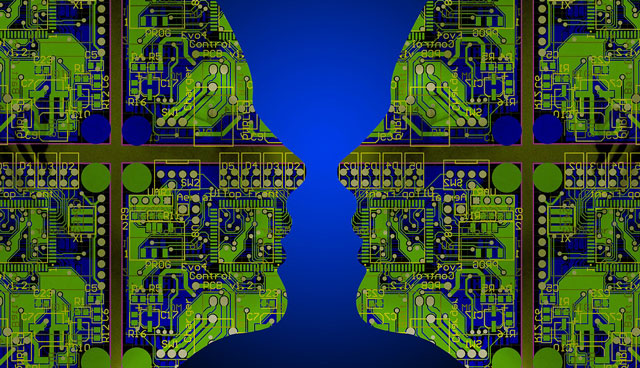
    It is argued that computers might take over when their intelligence supersedes that of humans. But there are also other risks with this delegation of responsibility.
    AI-2-640

    Some would contend that the stock market crash of 1987 was largely due to computer trading.

    There have also been power grid closures due to computer error. And, at a lower level, my intrusive spell checker sometimes “corrects” what I’ve written into something potentially offensive. Computer error?

    Hardware or software glitches can be hard to detect but they can still wreak havoc in large-scale systems — even without hackers or malevolent intent, and probably more so with them. So, just how much can we really trust machines with large responsibilities to do a better job than us?

    Even without computers consciously taking control, I can envisage a variety of paths whereby computer systems go out of control. These systems might be so fast with such small componentry that it might be hard to remedy and even hard to turn off.

    Partly in the spirit of Solomonoff’s 1967 paper, I’d like to see scriptwriters and artificial intelligence researchers collaborating to set out such scenarios — further stimulating public discussion.

    As but one possible scenario, maybe some speech gets converted badly to text, worsened in a bad automatic translation, leading to a subtle corruption of machine instructions, leading to whatever morass.

    A perhaps related can of worms might come from faster statistical and machine-learning analysis of big data on human brains. (And, as some would dare to add, are we humans the bastions of all that is good, moral and right?)

    As Solomonoff said in 1967, we need this public discussion — and, given the stakes, I think we now need it soon. The Conversation

    • David Dowe is associate professor in the Clayton School of Information Technology at Monash University
    • This article was originally published on The Conversation


    Alan Turing Ray Kurzweil Stephen Hawking
    WhatsApp YouTube Follow on Google News Add as preferred source on Google
    Share. Facebook Twitter LinkedIn WhatsApp Telegram Email Copy Link
    Previous ArticleFNB told to un-Steve itself
    Next Article Spectre of online censorship looms in SA

    Related Posts

    Go higher with Xerox Iridesse

    30 August 2022

    Automation: First, choose what not to do

    2 September 2021

    AI hysteria could set the technology back by decades

    24 July 2019
    Company News
    Breaking down the data silos: why single views require collaboration - Altron Digital Business

    Breaking down the data silos: why single views require collaboration

    10 February 2026
    How Avast and Gen Digital are raising the bar in cybersecurity

    How Avast and Gen Digital are raising the bar in cybersecurity

    10 February 2026
    How mobile platforms are transforming online trading - Exness

    How mobile platforms are transforming online trading

    10 February 2026
    Opinion
    South Africa's skills advantage is being overlooked at home - Richard Firth

    South Africa’s skills advantage is being overlooked at home

    29 January 2026
    Why Elon Musk's Starlink is a 'hard no' for me - Songezo Zibi

    Why Elon Musk’s Starlink is a ‘hard no’ for me

    26 January 2026
    South Africa's new fibre broadband battle - Duncan McLeod

    South Africa’s new fibre broadband battle

    20 January 2026

    Subscribe to Updates

    Get the best South African technology news and analysis delivered to your e-mail inbox every morning.

    Latest Posts
    Sentech is in dire straits

    Sentech is in dire straits

    10 February 2026
    A million reasons monopolies don't work

    A million reasons monopolies don’t work

    10 February 2026
    South Africa's data centre market ripe for consolidation - Joshua Smythwood

    South Africa’s data centre market ripe for consolidation

    10 February 2026
    Watts & Wheels S1E4: 'We drive an electric Uber'

    Watts & Wheels S1E4: ‘We drive an electric Uber’

    10 February 2026
    © 2009 - 2026 NewsCentral Media
    • Cookie policy (ZA)
    • TechCentral – privacy and Popia

    Type above and press Enter to search. Press Esc to cancel.

    Manage consent

    TechCentral uses cookies to enhance its offerings. Consenting to these technologies allows us to serve you better. Not consenting or withdrawing consent may adversely affect certain features and functions of the website.

    Functional Always active
    The technical storage or access is strictly necessary for the legitimate purpose of enabling the use of a specific service explicitly requested by the subscriber or user, or for the sole purpose of carrying out the transmission of a communication over an electronic communications network.
    Preferences
    The technical storage or access is necessary for the legitimate purpose of storing preferences that are not requested by the subscriber or user.
    Statistics
    The technical storage or access that is used exclusively for statistical purposes. The technical storage or access that is used exclusively for anonymous statistical purposes. Without a subpoena, voluntary compliance on the part of your Internet Service Provider, or additional records from a third party, information stored or retrieved for this purpose alone cannot usually be used to identify you.
    Marketing
    The technical storage or access is required to create user profiles to send advertising, or to track the user on a website or across several websites for similar marketing purposes.
    • Manage options
    • Manage services
    • Manage {vendor_count} vendors
    • Read more about these purposes
    View preferences
    • {title}
    • {title}
    • {title}