
Close Menu
TechCentralTechCentral

    Subscribe to the newsletter

    Get the best South African technology news and analysis delivered to your e-mail inbox every morning.

    Facebook X (Twitter) YouTube LinkedIn
    WhatsApp Facebook X (Twitter) LinkedIn YouTube
    TechCentralTechCentral
    • News
      Nedbank hires MTN's former tech chief as group CIO - Nikos Angelopoulos

      Nedbank hires MTN’s former tech chief as group CIO

      31 July 2026
      Eskom's diesel bill falls 86% as breakdowns hit eight-year low

      Eskom’s diesel bill falls 86% as breakdowns hit eight-year low

      31 July 2026
      Ramaphosa signs off on taking the grid away from Eskom

      Ramaphosa signs off on taking the grid away from Eskom

      31 July 2026
      Microsoft just had the biggest day in stock market history

      Microsoft just had the biggest day in stock market history

      31 July 2026
      MTN Nigeria's growth engine stalled in second quarter - Karl Toriola

      MTN Nigeria’s growth engine stalled in second quarter

      31 July 2026
    • World
      Meta AI will now tell parents if their teen is in crisis

      Meta AI will now tell parents if their teen is in crisis

      17 July 2026
      IBM shares crash 25% as AI upends software spending - Arvind Krishna

      IBM shares crash 25% as AI upends software spending

      15 July 2026
      Jony Ive's first OpenAI device: an AI smart speaker - Jony Ive and Sam Altman

      Jony Ive’s first OpenAI device: an AI smart speaker

      15 July 2026
      Stripe, Advent in talks to buy PayPal for $53-billion

      Stripe, Advent in talks to buy PayPal for $53-billion

      15 July 2026
      Memory crisis sends smartphone market into steep decline

      Memory crisis sends smartphone market into steep decline

      13 July 2026
    • In-depth
      The plan to stop AI from breaking the world - Google DeepMind CEO Demis Hassabis. Image: John Sears

      The plan to stop AI from breaking the world

      16 July 2026
      The internet has a Strait of Hormuz problem

      The internet has a Strait of Hormuz problem

      15 July 2026
      AI boom sparks rally, frenzy and fear

      AI boom sparks rally, frenzy and fear

      11 June 2026
      Every plug-in hybrid on sale in South Africa, ranked by price - Lamborghini Temerario

      Every plug-in hybrid on sale in South Africa, ranked by price

      7 June 2026
      What Wi-Fi 8 will mean for wireless networks

      What Wi-Fi 8 will mean for wireless networks

      1 June 2026
    • TCS
      TCS+ | Why South African workers must become supervisors of digital labour - Accelera Digital Group Cliff de Wit

      TCS+ | Why South African workers must become supervisors of digital labour

      31 July 2026
      TCS | Rapid deployment rules can't work without municipalities: ACT - Nomvuyiso Batyi

      TCS | Icasa’s rules skip the real bottleneck: ACT

      30 July 2026
      TCS+ | iStore Business on why Apple makes sense for SMEs - Sudesh Pillay and Tamia Nontsikelelo

      TCS+ | iStore Business on why Apple makes sense for SMEs

      30 July 2026
      TCS+ | A smarter approach to cloud for South African businesses - Joel Chacko and Jonathan Oaker

      TCS+ | A smarter approach to cloud for South African businesses

      28 July 2026
      TCS | How Optasia lends billions to people banks can't see - Salvador Anglada

      TCS | How Optasia lends billions to people banks can’t see

      23 July 2026
    • Opinion
      The author, Jannie van Zyl

      Selling vapour is corporate suicide in slow motion

      16 July 2026
      Brazil's online gambling crackdown is a lesson for South Africa

      How Amazon outmanoeuvred Starlink in South Africa

      15 July 2026
      The Popia problem with agentic AI - Herman Haasbroek

      The Popia problem with agentic AI

      14 July 2026
      The author, Fanie van Rooyen

      South Africa can still catch the AI wave – here’s how

      7 July 2026
      The author, Fanie van Rooyen

      The AI utopia South Africa can’t afford

      1 July 2026
    • Company Hubs
      • 1Stream
      • Africa Data Centres
      • AfriGIS
      • Altron Digital Business
      • Altron Document Solutions
      • Altron Group
      • Arctic Wolf
      • Ascent Technology
      • AvertITD
      • BBD
      • Braintree
      • CallMiner
      • CambriLearn
      • CM Telecom
      • Contactable
      • CYBER1 Solutions
      • Digicloud Africa
      • Digimune
      • Domains.co.za
      • ESET
      • Euphoria Telecom
      • HOSTAFRICA
      • Incredible Business
      • iONLINE
      • IQbusiness
      • Iris Network Systems
      • Kaspersky
      • LSD Open
      • Mitel
      • NEC XON
      • Netstar
      • Network Platforms
      • Next DLP
      • Ovations
      • Paracon
      • Paratus
      • Q-KON
      • SevenC
      • SkyWire
      • Solid8 Technologies
      • Telit Cinterion
      • Telviva
      • Tenable
      • Vertiv
      • Videri Digital
      • Vodacom Business
      • Vox
      • Wipro
      • Workday
      • XLink
    • Sections
      • AI and machine learning
      • Banking
      • Broadcasting and Media
      • Cloud services
      • Contact centres and CX
      • Cryptocurrencies
      • Education and skills
      • Electronics and hardware
      • Energy and sustainability
      • Enterprise software
      • Financial services
      • HealthTech
      • Information security
      • Internet and connectivity
      • Internet of Things
      • Investment
      • IT services
      • Lifestyle
      • Policy and regulation
      • Public sector
      • Retail and e-commerce
      • Satellite communications
      • Science
      • SMEs and start-ups
      • Social media
      • Talent and leadership
      • Telecoms
      • Watts & Wheels
    • Events
    • Advertise
    TechCentralTechCentral
    Home » In-depth » For mobile operators, sharing is caring

    For mobile operators, sharing is caring

    By Editor30 April 2015
    Twitter LinkedIn Facebook WhatsApp Email Telegram Copy Link
    News Alerts
    WhatsApp

    mobile-tower-640

    Co-location allows for a more sustainable financial model that can bolster operator revenues, take pressure off consumers and increase network penetration in underserviced areas.

    The telecommunications landscape has changed significantly in the past decade due to pricing pressure, rising network costs and evolving consumer demands.

    According to Ovum, average revenue per user (Arpu) is forecast to decline at 16% globally (and at a faster 19% in South Africa) between 2012 and 2019. Related to this, data demand will drive 4G/LTE traffic, to grow at a compound annual growth rate of 110% from 2014 to 2019. Data is also driving future revenue, with LTE revenues in the Middle East and Africa predicted to grow from 23% of total radio access network revenues in 2015 to 67% in 2019.

    To add to this, over-the-top services and increasing adoption of the Internet of things are presenting new challenges for operators.

    Essentially, operators find themselves in a “perfect storm”, with margin pressures weighing heavily on current business models. The net effect will be that consumers are increasingly bearing the costs of connectivity, as witnessed in the recent pricing adjustments by South African operators.

    In the circumstances, how can operators provide better services, supported by a financially sustainable business model?

    Significant opportunities can be found in an evolution of the operator value chain. Traditionally, operators owned all activities associated with the access network, through to customer and value-added services. This model has evolved, to the extent that various sections of the value chain now belong to different players (evident in the growth of over-the-top services). One such element, the access network, is experiencing increased collaboration between operators in the form of strategic partnerships in the interests of better efficiencies through specialisation.

    Network infrastructure sharing can be classified according to the different strategic and commercial rationales of operator partners:

    • Passive infrastructure sharing, or mast sharing, involves the sharing of tower structures on which active equipment is located (typically the mast, energy generation and site-related infrastructure). This is achieved through an inter-operator agreement or by using independent tower companies.
    • Radio access network sharing extends network sharing beyond passive equipment to active equipment, including antenna and transmission equipment.
    • Core network sharing is the most advanced form of network sharing, and entails sharing core network elements.

    Based on current economic and market trends, the South African telecoms industry is poised to explore market-wide passive infrastructure sharing opportunities.

    In 2014, the African tower market was estimated by TowerXchange at 165 000 towers — 25% of them owned and operated by tower companies. By the end of 2015, this figure will rise to 50%.

    Tower company infrastructure deal activity has been high (39 transactions took place between 2010 and 2014, involving about 45 000 towers). Although most transactions are structured as asset divestitures, operators still hold most of the towers on the continent, making collaboration a continued possibility. In South Africa, only about 10% of towers are under the control of tower companies, providing a large opportunity for collaboration between operators.

    Three models
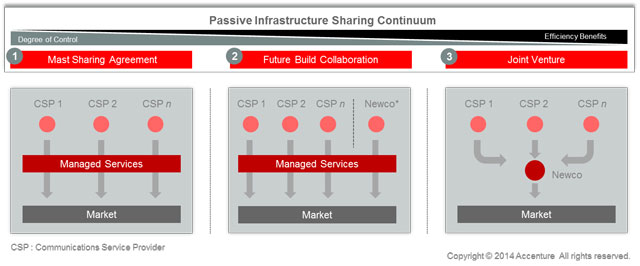
    Three passive infrastructure sharing models can be considered by operators, as illustrated below.
    inf-sharing-accenture

    There are three alternatives for operators: those who want to keep a high degree of control would prefer a mast sharing agreement (model 1). Standard terms and agreements allow for a facilities management vendor to be assigned to service the portfolio, in the interests of operational efficiencies and operating expenditure savings.

    Future build collaboration (model 2) involves the creation of a new company, jointly owned by all operators, that rolls out all new infrastructure. On top of the opex savings of model 1 for current and new infrastructure, model 2 offers capital expenditure savings on all new infrastructure.

    Lastly, a full joint venture (model 3) would see operators jointly creating an independent company which provides infrastructural services to the market. The new company will own, manage and commercialise the combined passive infrastructure portfolio, and roll out all future infrastructure. The regulator would play a strong role in providing guidelines on the fair market and competition considerations related to such a venture. It would enable all operators and related parties (consumers, the regulator and government) to unlock the full value of the infrastructure.

    Network infrastructure sharing has a beneficial impact as it lowers the cost to service subscribers. Even more importantly, the economic business case for rolling out communications infrastructure into underserviced (often rural) areas improves significantly, due to lower capex requirements. Industry estimates have indicated probable savings of up to 60% annually.

    In addition, it will allow operators to explore the deployment of newer technologies (such as 4G) at a lower cost and to a wider customer base, in turn improving the quality of service provided to customers.

    Other effects include a reduction in duplicate infrastructure, which has multiple negative economic and environmental impacts, including a higher carbon footprint and unsightly landscapes littered with mobile towers.

    Improved economics for the deployment of infrastructure in remote areas further support government’s ambitions to provide improved connectivity under the national broadband plan.

    cell-tower-640

    Opportunity
    Passive infrastructure sharing presents a great opportunity for everyone. Operators are, to a degree, relieved from their margin squeeze by realising improved operating efficiencies from their network and opex savings of up to 30%, according to GSMA numbers.

    Consumers further enjoy improved quality of service and increased network coverage, while operator cost savings frequently translate into more competitive pricing. The potential development of the independent tower company market also has the added benefit of job creation and upskilling.

    Regulators would welcome passive infrastructure sharing on this basis, and for reasons of increased market competition, due to network access for potential new entrants.

    There is need for increased engagement in the industry to determine the appropriate next steps to unlock the potential value that passive infrastructure sharing has to offer.

    • De Wet Bisschoff is MD of Accenture Communications, Media and Technology, while Hennie de Villiers  is senior manager: Accenture Strategy

    Follow TechCentral on Google News Add TechCentral as your preferred source on Google


    Accenture De Wet Bisschoff Hennie de Villiers
    WhatsApp YouTube
    Share. Facebook Twitter LinkedIn WhatsApp Telegram Email Copy Link
    Previous ArticleSpace junk threatens satellite communication
    Next Article Load shedding dominates SA Google searches

    Related Posts

    Nedbank hires MTN's former tech chief as group CIO - Nikos Angelopoulos

    Nedbank hires MTN’s former tech chief as group CIO

    31 July 2026
    How Chinese cars took over South African showrooms

    How Chinese cars took over South African showrooms

    30 July 2026
    Everything you wanted to know about EVs but were afraid to ask

    Everything you wanted to know about EVs but were afraid to ask

    22 July 2026
    Company News
    Domains.co.za launches self-hosted n8n VPS hosting

    Domains.co.za launches self-hosted n8n VPS hosting

    31 July 2026
    Smarter.tech '26 shows why smarter technology begins with context - Obsidian Systems

    Context is the missing piece in enterprise AI: Obsidian

    31 July 2026
    Huawei launches 12 intelligent transport solutions in South Africa - Sam Tang

    Huawei launches 12 intelligent transport solutions in South Africa

    30 July 2026
    Opinion
    The author, Jannie van Zyl

    Selling vapour is corporate suicide in slow motion

    16 July 2026
    Brazil's online gambling crackdown is a lesson for South Africa

    How Amazon outmanoeuvred Starlink in South Africa

    15 July 2026
    The Popia problem with agentic AI - Herman Haasbroek

    The Popia problem with agentic AI

    14 July 2026

    Subscribe to Updates

    Get the best South African technology news and analysis delivered to your e-mail inbox every morning.

    Latest Posts
    Nedbank hires MTN's former tech chief as group CIO - Nikos Angelopoulos

    Nedbank hires MTN’s former tech chief as group CIO

    31 July 2026
    Eskom's diesel bill falls 86% as breakdowns hit eight-year low

    Eskom’s diesel bill falls 86% as breakdowns hit eight-year low

    31 July 2026
    Ramaphosa signs off on taking the grid away from Eskom

    Ramaphosa signs off on taking the grid away from Eskom

    31 July 2026
    TCS+ | Why South African workers must become supervisors of digital labour - Accelera Digital Group Cliff de Wit

    TCS+ | Why South African workers must become supervisors of digital labour

    31 July 2026
    © 2009 - 2026 NewsCentral Media
    Built and maintained by Chronon
    • Cookie policy (ZA)
    • TechCentral – privacy and Popia

    Type above and press Enter to search. Press Esc to cancel.

    Manage consent

    TechCentral uses cookies to enhance its offerings. Consenting to these technologies allows us to serve you better. Not consenting or withdrawing consent may adversely affect certain features and functions of the website.

    Functional Always active
    The technical storage or access is strictly necessary for the legitimate purpose of enabling the use of a specific service explicitly requested by the subscriber or user, or for the sole purpose of carrying out the transmission of a communication over an electronic communications network.
    Preferences
    The technical storage or access is necessary for the legitimate purpose of storing preferences that are not requested by the subscriber or user.
    Statistics
    The technical storage or access that is used exclusively for statistical purposes. The technical storage or access that is used exclusively for anonymous statistical purposes. Without a subpoena, voluntary compliance on the part of your Internet Service Provider, or additional records from a third party, information stored or retrieved for this purpose alone cannot usually be used to identify you.
    Marketing
    The technical storage or access is required to create user profiles to send advertising, or to track the user on a website or across several websites for similar marketing purposes.
    • Manage options
    • Manage services
    • Manage {vendor_count} vendors
    • Read more about these purposes
    View preferences
    • {title}
    • {title}
    • {title}