The most interesting thing at Apple’s September iPhone keynote might not be the iPhone.
That is an odd thing to say in a year when Apple is expected to introduce its first folding smartphone, possibly called the iPhone Ultra. Alongside it should come the iPhone 18 Pro and Pro Max, while the standard iPhone 18 is reportedly held over until next year. Even the Pro models are expected to be evolutionary: better cameras, an A20 Pro built on a 2nm process, the usual refinements.
The event, scheduled for 9 September, will also be John Ternus’s first keynote as CEO having taken over from Tim Cook on 1 September.
The foldable will attract enormous attention. But if you want to understand where Apple is heading over the next few years, pay closer attention to everything happening around the iPhone. In particular, watch the home.
Apple has spent years looking strangely uncommitted to the smart home. HomeKit has been around since 2014. Apple TV and its HomePod speakers can already act as home hubs. Apple has backed Matter enthusiastically. Yet next to Amazon and Google, whose smart displays have been AI-first products for years, its ambitions have looked tentative.
That is all about to change. Apple is widely reported to be preparing a new Apple TV, a refreshed HomePod mini and, most intriguingly, a smart-home display unofficially called the HomePad: a roughly seven-inch square screen with a speaker, camera and presence detection, running an operating system derived from tvOS, in wall-mounted and tabletop versions.
The HomePad may not appear on 9 September. Reports suggest it could arrive anywhere between October and year-end. What matters is that the pieces are finally in place.
The missing piece
The missing piece was Siri. Apple’s home hub was delayed repeatedly because the old assistant simply wasn’t clever enough to be its primary interface. That stopped being theoretical in June, when Apple unveiled Siri AI, rebuilt around foundation models that run partly on the device and, for heavier work, on its Private Cloud Compute infrastructure. South Africa is on the initial launch list, alongside Australia, Canada, India, Ireland, New Zealand, Singapore and the UK.
The first generation of the consumer AI boom has been overwhelmingly cloud-based. We type extraordinarily personal information into enormous models running in remote data centres operated by OpenAI, Google and Anthropic.
For many tasks that makes sense. Frontier models need absurd quantities of computing power. But switching off the kitchen lights does not need a frontier model. Neither does checking what time the geyser came on, whether the garage door is open, which room somebody is in, or telling the house to lock up and kill the music because you are going to bed.
Much of the intelligence a smart home needs is narrow, repetitive and intensely personal. It involves knowing who is home, which rooms they are in, their routines, their cameras and microphones, their appliances, their electricity consumption, and perhaps eventually their health. That is precisely the data people will grow least willing to shovel into the public cloud.
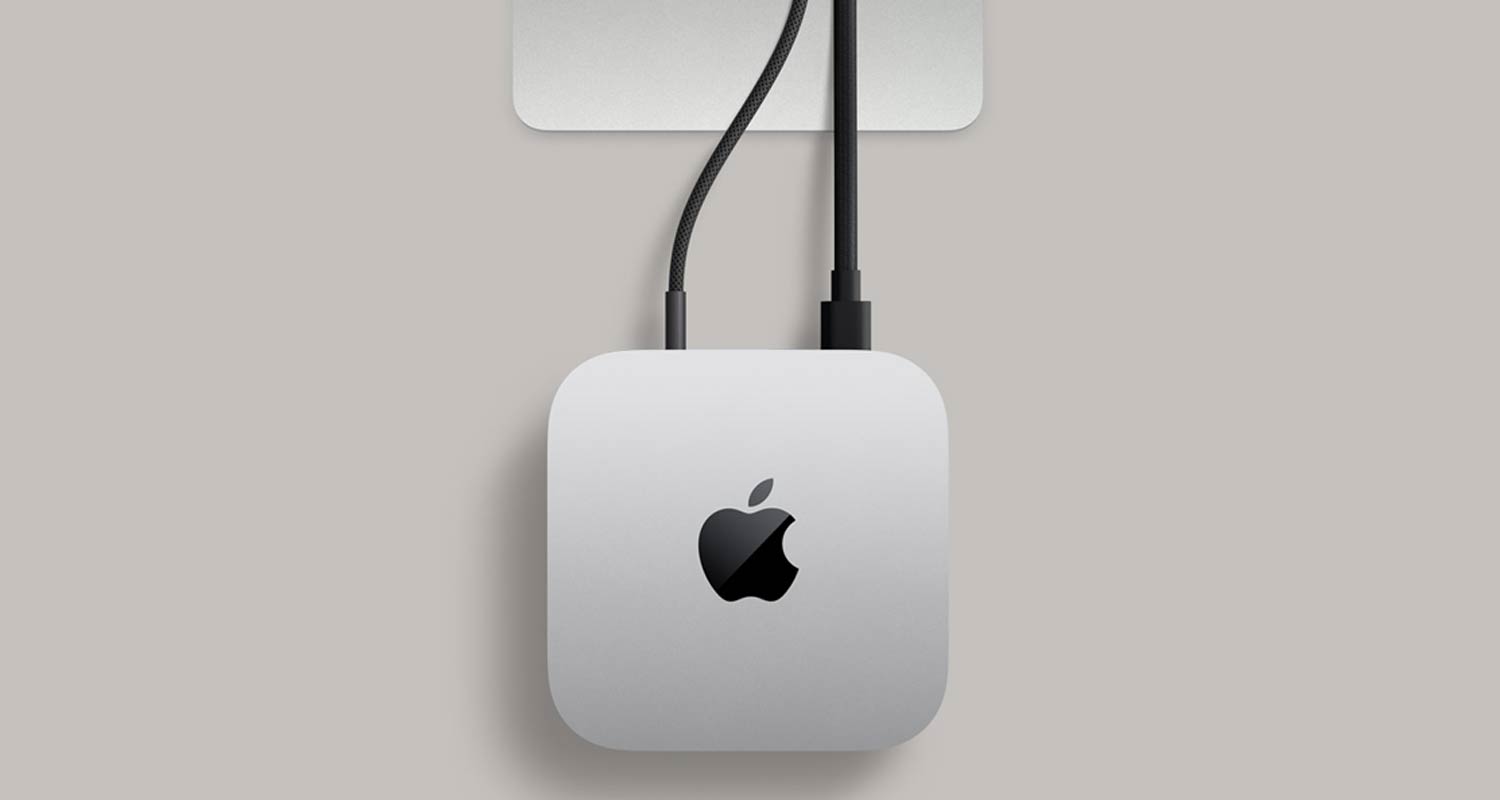
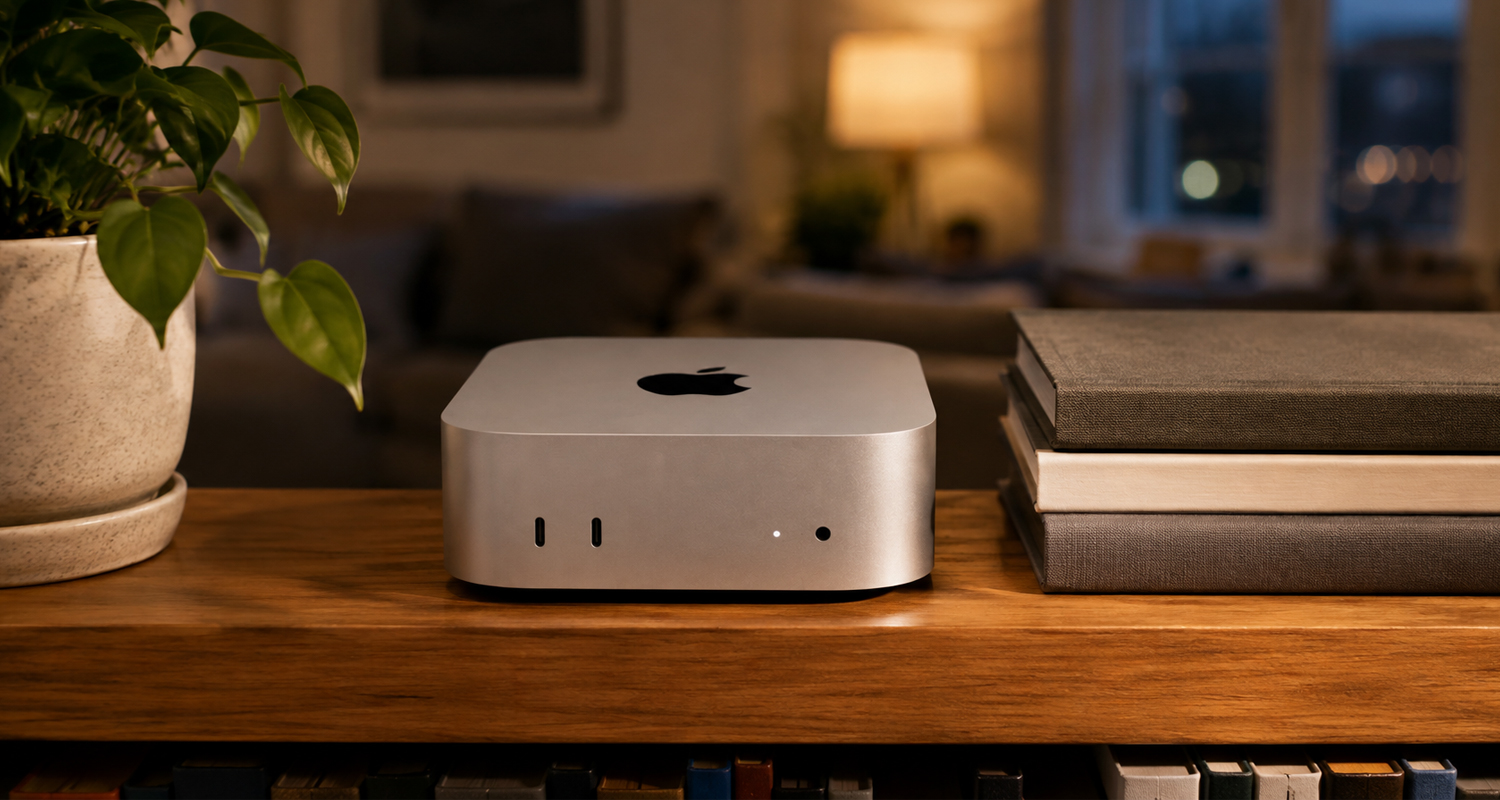
Which brings us to the machine Apple announced on Tuesday without an event. The headline on Apple’s own press release describes the new Mac mini as “supercharging the leading desktop for always-on agentic computing”. Note it did not say video editing or photography. Rather, Apple’s marketing pitch is AI agents, running continuously.
The entry model uses the new M6, with a dual 16-core “Neural Engine” – a first – and neural accelerators in every GPU core. Apple says it processes LLM prompts in LM Studio 4.8 times faster than the M4 mini, and 13.5 times faster than the M1 of just six years ago. The M5 Pro version takes up to 64GB of unified memory at 307GB/s, which Apple says allows “even larger local AI models”. And Thunderbolt 5 lets you cluster several Mac minis together to run large models entirely on device.
LM Studio is not an Apple product. It is an application for running other people’s language models on your own machine. Apple is now marketing a desktop computer on how fast it runs somebody else’s local AI.
Apple does not have to make the Mac mini the official brain of the Apple smart home for this to matter. The interesting thing is what the machine says about the hardware trajectory. For six years, Apple has relentlessly improved performance per watt in its own silicon. CPUs, GPUs, neural processors and increasingly specialised accelerators now share very fast unified memory in machines that draw little power and generate little heat. A Mac mini is almost comically well suited to sitting in a house, on all day, running local models.
There is one catch: these machines are no longer the steal they once were – and, ironically, AI is to blame. When the M4 Mac mini launched in October 2024 it cost US$599. Apple raised that to $799 in June, and the new M6 model starts at $899 – a 50% increase in under two years. The M4 Pro version started at $1 399; the M5 Pro machine is $1 699.
RAM shortage
The same data centre build-out driving demand for Nvidia accelerators has drained the supply of memory. Conventional DRAM contract prices rose 90-95% quarter on quarter in the first three months of this year and another 58-63% in the second, according to TrendForce, which expects a further 13-18% jump in the third. Cook called it a 100-year flood on memory pricing.
Running a model locally is a memory problem before it is a compute problem, and AI is making the computers we would need to escape the AI cloud more expensive. Moving the new Mac mini from 16GB to 32GB costs $400. On the M5 Pro, 64GB costs $1 000.
Apple has spent much of the generative-AI era being portrayed as a laggard. Siri became an industry joke. The first Apple Intelligence roll-out was messy and the promised Siri overhaul was embarrassingly late.
But Apple has never made most of its money selling chatbots. Its great skill is turning technology into hardware ecosystems that ordinary people actually buy. If AI migrates out of browser tabs and phone apps into the physical environment around us, Apple will find itself on far more familiar ground. It controls the silicon, the operating systems, the phones, watches, televisions, speakers and computers. It has a well-established privacy pitch. And it has hundreds of millions of customers who already own several pieces of the set.

The next Apple TV is expected to gain a much faster processor and support for Siri AI. The HomePad would put that intelligence on walls and countertops. HomePods provide microphones and speakers. Watches and iPhones provide identity, location and personal context. Macs provide serious local compute when something needs it.
The smart home has spent 15 years as a hobby for people willing to fiddle with hubs, automations, incompatible standards and badly designed apps. AI finally offers a way to hide that complexity behind ordinary language. Instead of programming the house, you talk to it.
If Apple can make that work reliably, and keep enough of the conversation inside the house, the smart home may finally escape the enthusiast niche and become a mainstream computing platform.
So, by all means watch the keynote on 9 September for the folding iPhone. But watch more closely when the presentation moves away from the phone. The most important product Apple is building may not be the one you hold in your hand. – © 2026 NewsCentral Media
- The author, Duncan McLeod, is editor of TechCentral
- Subscribe to TechCentral’s daily newsletter
- Get breaking news alerts on WhatsApp