
Close Menu
TechCentralTechCentral

    Subscribe to the newsletter

    Get the best South African technology news and analysis delivered to your e-mail inbox every morning.

    Facebook X (Twitter) YouTube LinkedIn
    WhatsApp Facebook X (Twitter) LinkedIn YouTube
    TechCentralTechCentral
    • News
      Free calls, dead voice and Shameel Joosub's Spanish ghost

      Free calls, dead voice and Shameel Joosub’s Spanish ghost

      22 April 2026
      Capitec CEO Graham Lee

      Capitec blows up MVNO pricing with free on-net calls

      22 April 2026
      Eskom developing bitcoin mining plan but needs Nersa's nod - Agnes Mlambo

      Eskom developing bitcoin mining plan but needs Nersa’s nod

      22 April 2026
      Capitec bets big on AI - and keeps hiring

      Capitec bets big on AI – and keeps hiring

      22 April 2026
      Eskom to decide fate of older coal stations by September - Dan Marokane

      Eskom to decide fate of older coal stations by September

      22 April 2026
    • World
      More organic compounds detected on Mars - Nasa Curiosity rover

      More organic compounds detected on Mars

      21 April 2026
      Adobe bets on AI agents to fend off cheaper rivals

      Adobe bets on AI agents to fend off cheaper rivals

      16 April 2026
      Google poised to lose ad crown to Meta

      Google poised to lose ad crown to Meta

      14 April 2026
      Grand Theft Data - hackers hit Rockstar Games - Grand Theft Auto

      Grand Theft Data – hackers hit Rockstar Games

      14 April 2026
      UK PM Keir Starmer declares war on doomscrolling

      UK PM Keir Starmer declares war on doomscrolling

      13 April 2026
    • In-depth
      Africa switches on as Europe dims the lights

      Africa switches on as Europe dims the lights

      9 April 2026
      The biggest untapped EV market on Earth is hiding in plain sight

      The biggest untapped EV market on Earth is hiding in plain sight

      1 April 2026
      The R18-billion tech giant hiding in plain sight - Jens Montanana

      The R16-billion tech giant hiding in plain sight

      26 March 2026
      The last generation of coders

      The last generation of coders

      18 February 2026
      Sentech is in dire straits

      Sentech is in dire straits

      10 February 2026
    • TCS

      TCS+ | ‘The ISP for ISPs’: Vox’s shift to wholesale aggregator

      20 April 2026
      TCS | Werner Lindemann on how AI is rewriting the infosec rulebook

      TCS | Werner Lindemann on how AI is rewriting the infosec rulebook

      15 April 2026
      TCS | Donovan Marsh on AI and the future of filmmaking

      TCS | Donovan Marsh on AI and the future of filmmaking

      7 April 2026
      TCS+ | Vodacom Business moves to crack the SME tech gap - Andrew Fulton, Sannesh Beharie

      TCS+ | Vodacom Business moves to crack the SME tech gap

      7 April 2026
      TCS | MTN's Divysh Joshi on the strategy behind Pi - Divyesh Joshi

      TCS | MTN’s Divyesh Joshi on the strategy behind Pi

      1 April 2026
    • Opinion
      The conflict of interest at the heart of PayShap's slow adoption - Cheslyn Jacobs

      The conflict of interest at the heart of PayShap’s slow adoption

      26 March 2026
      South Africa's energy future hinges on getting wheeling right - Aishah Gire

      South Africa’s energy future hinges on getting wheeling right

      10 March 2026
      Hold the doom: the case for a South African comeback - Duncan McLeod

      Apple just dropped a bomb on the Windows world

      5 March 2026
      R230-million in the bag for Endeavor's third Harvest Fund - Alison Collier

      VC’s centre of gravity is shifting – and South Africa is in the frame

      3 March 2026
      Hold the doom: the case for a South African comeback - Duncan McLeod

      Hold the doom: the case for a South African comeback

      26 February 2026
    • Company Hubs
      • 1Stream
      • Africa Data Centres
      • AfriGIS
      • Altron Digital Business
      • Altron Document Solutions
      • Altron Group
      • Arctic Wolf
      • Ascent Technology
      • AvertITD
      • BBD
      • Braintree
      • CallMiner
      • CambriLearn
      • CYBER1 Solutions
      • Digicloud Africa
      • Digimune
      • Domains.co.za
      • ESET
      • Euphoria Telecom
      • HOSTAFRICA
      • Incredible Business
      • iONLINE
      • IQbusiness
      • Iris Network Systems
      • Kaspersky
      • LSD Open
      • Mitel
      • NEC XON
      • Netstar
      • Network Platforms
      • Next DLP
      • Ovations
      • Paracon
      • Paratus
      • Q-KON
      • SevenC
      • SkyWire
      • Solid8 Technologies
      • Telit Cinterion
      • Telviva
      • Tenable
      • Vertiv
      • Videri Digital
      • Vodacom Business
      • Wipro
      • Workday
      • XLink
    • Sections
      • AI and machine learning
      • Banking
      • Broadcasting and Media
      • Cloud services
      • Contact centres and CX
      • Cryptocurrencies
      • Education and skills
      • Electronics and hardware
      • Energy and sustainability
      • Enterprise software
      • Financial services
      • HealthTech
      • Information security
      • Internet and connectivity
      • Internet of Things
      • Investment
      • IT services
      • Lifestyle
      • Motoring
      • Policy and regulation
      • Public sector
      • Retail and e-commerce
      • Satellite communications
      • Science
      • SMEs and start-ups
      • Social media
      • Talent and leadership
      • Telecoms
    • Events
    • Advertise
    TechCentralTechCentral
    Home » Opinion » Duncan McLeod » Let’s not build another monopoly

    Let’s not build another monopoly

    By Duncan McLeod20 February 2017
    Twitter LinkedIn Facebook WhatsApp Email Telegram Copy Link
    News Alerts
    WhatsApp

    There is a prevailing view in government — or certainly in the department of telecommunications & postal services — that infrastructure competition in providing broadband is bad.

    Nothing could be further from the truth.

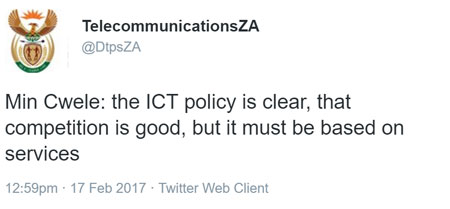
    At a meeting on Friday with industry players, telecoms minister Siyabonga Cwele said that government’s national integrated ICT policy white paper — which sets out proposed policy for the ICT sector for the next decade — states clearly that competition is good, but that it must be based on services.

    The idea is that infrastructure competition is a waste of money, that duplication of networks makes no sense. In fact, rivalry between infrastructure providers is crucial to ensuring South Africa doesn’t become an also-ran in ICT. It is the building of a single wholesale network to the exclusion of all other models — as proposed in the white paper — that’s the terrible idea, the one that is very likely to cost us dearly as a nation.

    Without proper interrogation, the idea of a single national network might appear to make some sort of sense. After all, South Africa is not a rich country: can it afford to duplicate networks? It’s more sensible, advocates of a single network model will argue, for operators to pool their investments, reducing their costs in the process and passing on those benefits to end users. Nice in theory.

    But there are a myriad problems with creating a single national network, or Woan (wholesale open-access network) as government calls it.

    Firstly, and most obviously, the state, in effect, wants to create a new infrastructure monopoly. Has it not learnt its lesson from the 1990s, when Telkom — granted a legislated monopoly — rode roughshod over both competitors and consumers?

    Ah, but government will argue, the Woan is different. It’s open access, meaning (in theory) that anyone can use it, and, anyway, the real need is for competition at the services level rather than at the infrastructure layer.

    But what if the Woan — which, in terms of the proposed policy, will get access to all future “high-demand” spectrum assignments — chooses a technology that fails to take off in the rest of the world (remember WiMax, Dr Cwele?). If there are multiple infrastructure providers, other network operators might choose to invest in different technologies. There are then alternatives. The Woan’s failure to invest in the right technology might doom it, but at least it won’t take the whole country down with it.
    And then there’s the fact that monopolies — no matter how well-intentioned they might be — are inefficient. Even with multiple shareholders, what incentive will the Woan have to provide access at the lowest cost? Competition keeps prices in check, not regulators. If government expects to keep the Woan’s prices down through regulation, then it should ask the industry how successful Icasa and its predecessor Satra were at keeping Telkom’s prices in check between 1995 and 2005.

    I’m not saying that there should be a complete duplication of infrastructure in all cases. It makes no sense, for example, for 10 companies to dig up the same suburb to provide fibre to the home. And having every operator building fibre between Johannesburg and Cape Town is equally nonsensical. But it should be up to the market to decide where duplication makes sense and where it doesn’t. When money is involved, operators will tend to eschew duplication of basic infrastructure like fibre sleeves and phone towers. This is especially true in an environment where margins are under pressure.

    A key principle behind the white paper and the proposed Woan is that smaller industry players will be able to invest in infrastructure. This is where the concept makes some sense, provided it’s not done to the exclusion of alternative network infrastructure.

    Government, through Icasa, could reserve a chunk of spectrum (by no means all of it) for a multi-shareholder consortium made up of smaller industry players interested in participating (government should not be one of the shareholders).

    Such a network could provide the price competition that government is seeking, without damaging the sector through the creation of a new infrastructure monopoly.

    Vodacom, MTN, Telkom, Cell C and other interested network operators should still be able to get access to exclusive-use spectrum, but a (reasonable) portion of sub-900MHz (digital dividend) spectrum, and perhaps some spectrum at 2,6GHz (for use in denser urban areas), could be set aside for smaller players outside an expensive spectrum auction process.

    Beyond that regulatory “favour”, however, investors in the new network should compete with the big boys on the network’s merits. Too much regulation distorts markets and leads to unintended outcomes. The market, for the most part, should be left to sort itself out.

    At the same time, to expand coverage in rural areas, a spectrum auction for the big players should require them to reach certain rural roll-out targets (defined by Icasa and based on a proper study) before they’re allowed to use the newly allocated spectrum in the cities. Germany did this to great effect; there’s no reason to believe it won’t work here.

    For the sake of the industry and consumers — and the broader economy — let’s not experiment with an all-or-nothing model that hasn’t been tested successfully anywhere else in the world (oft-quoted examples Mexico and Rwanda have not had demonstrable successes with similar approaches). Monopolies — including the open-access wholesale kind — should be rejected because, in the long term, they will do much more harm than good.

    • Duncan McLeod is editor of TechCentral. Find him on Twitter

    Follow TechCentral on Google News Add TechCentral as your preferred source on Google


    Cell C Duncan McLeod MTN Siyabonga Cwele Telkom Vodacom
    WhatsApp YouTube
    Share. Facebook Twitter LinkedIn WhatsApp Telegram Email Copy Link
    Previous ArticleBig growth in online shopping in SA
    Next Article Zuma, Gordhan battle takes centre stage

    Related Posts

    Free calls, dead voice and Shameel Joosub's Spanish ghost

    Free calls, dead voice and Shameel Joosub’s Spanish ghost

    22 April 2026
    Capitec CEO Graham Lee

    Capitec blows up MVNO pricing with free on-net calls

    22 April 2026
    Specialists leave mobile operators behind on home internet - Vox

    Specialists leave mobile operators behind on home internet

    20 April 2026
    Company News
    How AnyDesk is redefining remote access for African enterprises

    How AnyDesk is redefining remote access for African enterprises

    22 April 2026
    Centracom's Pindrop takes the pain out of wholesale fibre

    Centracom’s Pindrop takes the pain out of wholesale fibre

    22 April 2026
    Conversational AI is rewriting the customer service playbook - CallMiner

    Conversational AI is rewriting the customer service playbook

    22 April 2026
    Opinion
    The conflict of interest at the heart of PayShap's slow adoption - Cheslyn Jacobs

    The conflict of interest at the heart of PayShap’s slow adoption

    26 March 2026
    South Africa's energy future hinges on getting wheeling right - Aishah Gire

    South Africa’s energy future hinges on getting wheeling right

    10 March 2026
    Hold the doom: the case for a South African comeback - Duncan McLeod

    Apple just dropped a bomb on the Windows world

    5 March 2026

    Subscribe to Updates

    Get the best South African technology news and analysis delivered to your e-mail inbox every morning.

    Latest Posts
    Free calls, dead voice and Shameel Joosub's Spanish ghost

    Free calls, dead voice and Shameel Joosub’s Spanish ghost

    22 April 2026
    Capitec CEO Graham Lee

    Capitec blows up MVNO pricing with free on-net calls

    22 April 2026
    Eskom developing bitcoin mining plan but needs Nersa's nod - Agnes Mlambo

    Eskom developing bitcoin mining plan but needs Nersa’s nod

    22 April 2026
    Capitec bets big on AI - and keeps hiring

    Capitec bets big on AI – and keeps hiring

    22 April 2026
    © 2009 - 2026 NewsCentral Media
    • Cookie policy (ZA)
    • TechCentral – privacy and Popia

    Type above and press Enter to search. Press Esc to cancel.

    Manage consent

    TechCentral uses cookies to enhance its offerings. Consenting to these technologies allows us to serve you better. Not consenting or withdrawing consent may adversely affect certain features and functions of the website.

    Functional Always active
    The technical storage or access is strictly necessary for the legitimate purpose of enabling the use of a specific service explicitly requested by the subscriber or user, or for the sole purpose of carrying out the transmission of a communication over an electronic communications network.
    Preferences
    The technical storage or access is necessary for the legitimate purpose of storing preferences that are not requested by the subscriber or user.
    Statistics
    The technical storage or access that is used exclusively for statistical purposes. The technical storage or access that is used exclusively for anonymous statistical purposes. Without a subpoena, voluntary compliance on the part of your Internet Service Provider, or additional records from a third party, information stored or retrieved for this purpose alone cannot usually be used to identify you.
    Marketing
    The technical storage or access is required to create user profiles to send advertising, or to track the user on a website or across several websites for similar marketing purposes.
    • Manage options
    • Manage services
    • Manage {vendor_count} vendors
    • Read more about these purposes
    View preferences
    • {title}
    • {title}
    • {title}