
Close Menu
TechCentralTechCentral

    Subscribe to the newsletter

    Get the best South African technology news and analysis delivered to your e-mail inbox every morning.

    Facebook X (Twitter) YouTube LinkedIn
    WhatsApp Facebook X (Twitter) LinkedIn YouTube
    TechCentralTechCentral
    • News
      Vuyani Jarana: Mobile coverage masks a deeper broadband failure

      Vuyani Jarana: Mobile coverage masks a deeper broadband failure

      30 January 2026
      SABC Plus to flight Microsoft AI training videos

      SABC Plus to flight Microsoft AI training videos

      30 January 2026
      Fibre ducts

      Fibre industry consolidation in KZN

      30 January 2026
      Watts & Wheels S1E3: 'BYD's Corolla Cross challenger'

      Watts & Wheels S1E3: ‘BYD’s Corolla Cross challenger’

      30 January 2026
      What ordinary South Africans really think of AI

      What ordinary South Africans really think of AI

      30 January 2026
    • World
      Apple acquires audio AI start-up Q.ai

      Apple acquires audio AI start-up Q.ai

      30 January 2026
      SpaceX IPO may be largest in history

      SpaceX IPO may be largest in history

      28 January 2026
      Nvidia throws AI at the weather

      Nvidia throws AI at weather forecasting

      27 January 2026
      Debate erupts over value of in-flight Wi-Fi

      Debate erupts over value of in-flight Wi-Fi

      26 January 2026
      Intel takes another hit - Intel CEO Lip-Bu Tan. Laure Andrillon/Reuters

      Intel takes another hit

      23 January 2026
    • In-depth
      How liberalisation is rewiring South Africa's power sector

      How liberalisation is rewiring South Africa’s power sector

      21 January 2026
      The top-performing South African tech shares of 2025

      The top-performing South African tech shares of 2025

      12 January 2026
      Digital authoritarianism grows as African states normalise internet blackouts

      Digital authoritarianism grows as African states normalise internet blackouts

      19 December 2025
      TechCentral's South African Newsmakers of 2025

      TechCentral’s South African Newsmakers of 2025

      18 December 2025
      Black Friday goes digital in South Africa as online spending surges to record high

      Black Friday goes digital in South Africa as online spending surges to record high

      4 December 2025
    • TCS
      TCS+ | How Cloud On Demand is helping SA businesses succeed in the cloud - Xhenia Rhode, Dion Kalicharan

      TCS+ | Cloud On Demand and Consnet: inside a real-world AWS partner success story

      30 January 2026
      Watts & Wheels S1E3: 'BYD's Corolla Cross challenger'

      Watts & Wheels S1E2: ‘China attacks, BMW digs in, Toyota’s sublime supercar’

      23 January 2026

      TCS+ | Why cybersecurity is becoming a competitive advantage for SA businesses

      20 January 2026
      Watts & Wheels S1E3: 'BYD's Corolla Cross challenger'

      Watts & Wheels: S1E1 – ‘William, Prince of Wheels’

      8 January 2026
      TCS+ | Africa's digital transformation - unlocking AI through cloud and culture - Cliff de Wit Accelera Digital Group

      TCS+ | Cloud without culture won’t deliver AI: Accelera’s Cliff de Wit

      12 December 2025
    • Opinion
      South Africa's skills advantage is being overlooked at home - Richard Firth

      South Africa’s skills advantage is being overlooked at home

      29 January 2026
      Why Elon Musk's Starlink is a 'hard no' for me - Songezo Zibi

      Why Elon Musk’s Starlink is a ‘hard no’ for me

      26 January 2026
      South Africa's new fibre broadband battle - Duncan McLeod

      South Africa’s new fibre broadband battle

      20 January 2026
      AI moves from pilots to production in South African companies - Nazia Pillay SAP

      AI moves from pilots to production in South African companies

      20 January 2026
      South Africa's new fibre broadband battle - Duncan McLeod

      ANC’s attack on Solly Malatsi shows how BEE dogma trumps economic reality

      14 December 2025
    • Company Hubs
      • Africa Data Centres
      • AfriGIS
      • Altron Digital Business
      • Altron Document Solutions
      • Altron Group
      • Arctic Wolf
      • AvertITD
      • Braintree
      • CallMiner
      • CambriLearn
      • CYBER1 Solutions
      • Digicloud Africa
      • Digimune
      • Domains.co.za
      • ESET
      • Euphoria Telecom
      • Incredible Business
      • iONLINE
      • IQbusiness
      • Iris Network Systems
      • LSD Open
      • NEC XON
      • Netstar
      • Network Platforms
      • Next DLP
      • Ovations
      • Paracon
      • Paratus
      • Q-KON
      • SevenC
      • SkyWire
      • Solid8 Technologies
      • Telit Cinterion
      • Tenable
      • Vertiv
      • Videri Digital
      • Vodacom Business
      • Wipro
      • Workday
      • XLink
    • Sections
      • AI and machine learning
      • Banking
      • Broadcasting and Media
      • Cloud services
      • Contact centres and CX
      • Cryptocurrencies
      • Education and skills
      • Electronics and hardware
      • Energy and sustainability
      • Enterprise software
      • Financial services
      • Information security
      • Internet and connectivity
      • Internet of Things
      • Investment
      • IT services
      • Lifestyle
      • Motoring
      • Public sector
      • Retail and e-commerce
      • Satellite communications
      • Science
      • SMEs and start-ups
      • Social media
      • Talent and leadership
      • Telecoms
    • Events
    • Advertise
    TechCentralTechCentral
    Home » Opinion » Hilton Tarrant » Mobile operators have an SMS addiction

    Mobile operators have an SMS addiction

    By Hilton Tarrant29 January 2016
    Twitter LinkedIn Facebook WhatsApp Email Telegram Copy Link
    News Alerts
    WhatsApp

    hilton-tarrant-180Let’s start at a common point of departure: the mere notion of mobile operators hoping that so-called “over-the-top” (OTT) services be regulated is insanity. One can understand how an operator and its executives can think this rational, though. After all, an operator only knows how to be an operator. This explains their endless failed attempts to be anything but an operator. Think media businesses (remember Yebo Radio?), financial services businesses, music download businesses. There are exceptions that prove the rule, but the cold hard truth is that none of this is in their DNA.

    From the perspective of an operator, these “pesky” OTT services mean a loss of revenue. Average revenue per user — the industry measure for how much revenue each subscriber generates in a month — has been declining steadily for years. Mobile voice tariffs have dropped sharply (thanks to hefty cuts mandated by communications regulator Icasa). Data costs have been falling, too, and messaging apps (“OTT services”) have practically supplanted SMS. Again, it’s logical that we’re seeing this response, especially from the two largest operators in South Africa: bizarre statements, sabre-rattling and hints of lobbying.

    Never mind that it’s illogical, impractical, unfeasible and — quite frankly — impossible to implement. How do you regulate Skype and WhatsApp but not WeChat, for argument’s sake? Or Telegram? Is Apple’s iMessage an OTT provider? Facebook Messenger? Instagram, because it has messaging functionality? Twitter? Where do you draw the line and how do you try keep up with progress? Just look at how governments and regulators are battling to regulate Uber. And that’s a fairly definable, distinct service.

    But I digress. SMS pricing remains stubbornly high. After the cratering of voice tariffs and natural decline in data costs, it’s effectively one of only two levers the operators have left (the other is the monthly base contract tariff, and you’ll recall those increased practically across the board last year).

    Even Cell C, with all of its recent spin around OTT services, charges 50c/SMS on prepaid plans and contracts

    On Vodacom, prepaid (and contract) SMS pricing largely remains at the 50c mark (on a few plans, it’s 80c in peak periods and 35c in off-peak). MTN also charges 50c/SMS on most of its plans (some are 75c). On contracts, it’s the same (on some, there are bundled/free messages included). Even Cell C, with all of its recent spin around OTT services, charges 50c/SMS on prepaid plans and contracts.

    The margins on SMS are eye-watering. It’s a drug. And the operators are hooked.

    What these stubbornly-high SMS prices have done is create a distorted market. Airtime is effectively cheaper than SMS. On many (most?) tariff plans, you’ll be able to have at least a 30-second call for the price of a text message. And don’t even attempt to compare the 50c to the underlying cost of data to send the same message. The distortions extend to post-paid plans, too, where consumers are force-fed practically worthless — and endless — SMS bundles. Who, in 2016, uses 200 SMSes a month, not to mention limitless SMSes, which operators seem to believe is a compelling value proposition.

    SMS has become the ultimate digital grudge purchase.

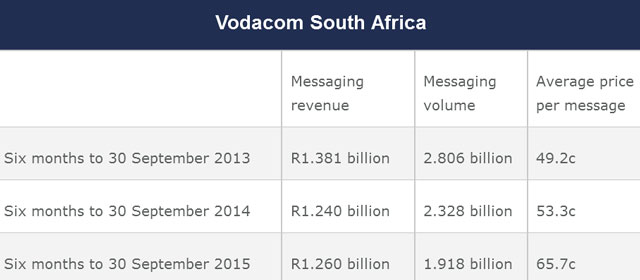
    Yet, it is still a big money maker for operators, given its high margins. In the six months to 30 September 2015, Vodacom generated almost R1,3bn in “messaging revenue” in South Africa. To put that in perspective, it’s “only” 5% of Vodacom’s total service revenue in South Africa. SMS volumes have cratered — they’ve halved in the last two years — but somehow revenue inched up when compared to the same period in 2014. This means the average price per SMS is actually increasing!
    vodacom-sms-640

    Look at that jump in the average price per SMS between 2014 and 2015 … it’s 23%! No wonder operators are bleating about OTT providers.

    It’s a vicious circle. Not only are services like WhatsApp and iMessage completely entrenched in user behaviour, consumers have become conditioned to know that SMSes are expensive (relative to other options), so we avoid using them, whether consciously or not. The latter likely helped cement the former.

    One other oft-overlooked dynamic in the SMS market is that a good chunk of this messaging volume is made up of bulk SMSes (those sent by banks, insurers, retailers, call centres and security companies). Here, pricing is discounted, but not by as much as you think.

    At the 100 000 messages a month level, big messaging providers are still charging in the region of 20-25c per message. Some of this will be their margin, but that’s likely only the differential between the rate they’re paying for their consolidated number of messages across all client, and these retail prices. There’s not much discounting here from the operators. Vodacom charges anywhere between 24c and 29c in its bulk tariff plans.

    What if…
    But what if SMS was (near) free? What if there was as a steady a decline in the price of SMSes as there’s been in the price of voice calls? If 50c became 40c became 30c became 20c became 10c (or 5c)? Would we have avoided sending SMSes at these prices? Would there have been as much friction? Probably not.

    But any increase or stabilisation in volumes would likely not offset the decline in prices to achieve the same revenue outcome. This is why operators have reacted in the way they have over the last few years. To try keep SMS pricing as high as possible to soften the decline in revenue (and to incredibly somehow increase the average price per message) has been rational and predictable. I’m sure the global management and telecommunications consultants have run countless models for the operators to vindicate this deliberate decision.

    SMS-on-screen-640

    But there comes a point where the base and entire use-case is eroded to such a point that the stubborn defence of this pricing (and pricing model) no longer makes sense and it collapses. It’s called disruption (an over-used word, which I hate). The announcement by WhatsApp this month that it would allow business to use its platform to message customers will mark that inflection point, particularly in South Africa. Will banks and retailers still pay a toll of 15c, 20c or 25c per SMS message when WhatsApp offers a similar way to reach the same user at a fraction of that price? (We’ve already seen brands and businesses offload their SMS messaging to WeChat in other markets, especially China.)

    Back to that tipping point for operators… We’re probably past it already.

    • Hilton Tarrant works at immedia. He owns shares in Vodacom, first purchased in June 2013
    • This piece was first published on Moneyweb and is used here with permission


    Apple Cell C Facebook Hilton Tarrant Instagram MTN Skype Telegram Twitter Vodacom WeChat WhatsApp
    WhatsApp YouTube Follow on Google News Add as preferred source on Google
    Share. Facebook Twitter LinkedIn WhatsApp Telegram Email Copy Link
    Previous ArticleWhy Seacom went down for a second time
    Next Article Gareth Cliff victorious in battle with M-Net

    Related Posts

    Apple acquires audio AI start-up Q.ai

    Apple acquires audio AI start-up Q.ai

    30 January 2026
    Chip shortage will get worse, Samsung warns

    Chip shortage will get worse, Samsung warns

    29 January 2026
    Reports of the smartphone's impending death are greatly exaggerated

    Reports of the smartphone’s impending death are greatly exaggerated

    28 January 2026
    Company News
    Huawei turns 25 in South Africa, celebrates with major device discounts

    Huawei turns 25 in South Africa, celebrates with major device discounts

    30 January 2026
    Phishing has not disappeared, but it has grown up - KnowBe4

    Phishing has not disappeared, but it has grown up

    30 January 2026
    Smartphone affordability: South Africa's new economic divide - PayJoy

    Smartphone affordability: South Africa’s new economic divide

    29 January 2026
    Opinion
    South Africa's skills advantage is being overlooked at home - Richard Firth

    South Africa’s skills advantage is being overlooked at home

    29 January 2026
    Why Elon Musk's Starlink is a 'hard no' for me - Songezo Zibi

    Why Elon Musk’s Starlink is a ‘hard no’ for me

    26 January 2026
    South Africa's new fibre broadband battle - Duncan McLeod

    South Africa’s new fibre broadband battle

    20 January 2026

    Subscribe to Updates

    Get the best South African technology news and analysis delivered to your e-mail inbox every morning.

    Latest Posts
    Vuyani Jarana: Mobile coverage masks a deeper broadband failure

    Vuyani Jarana: Mobile coverage masks a deeper broadband failure

    30 January 2026
    TCS+ | How Cloud On Demand is helping SA businesses succeed in the cloud - Xhenia Rhode, Dion Kalicharan

    TCS+ | Cloud On Demand and Consnet: inside a real-world AWS partner success story

    30 January 2026
    Huawei turns 25 in South Africa, celebrates with major device discounts

    Huawei turns 25 in South Africa, celebrates with major device discounts

    30 January 2026
    SABC Plus to flight Microsoft AI training videos

    SABC Plus to flight Microsoft AI training videos

    30 January 2026
    © 2009 - 2026 NewsCentral Media
    • Cookie policy (ZA)
    • TechCentral – privacy and Popia

    Type above and press Enter to search. Press Esc to cancel.

    Manage consent

    TechCentral uses cookies to enhance its offerings. Consenting to these technologies allows us to serve you better. Not consenting or withdrawing consent may adversely affect certain features and functions of the website.

    Functional Always active
    The technical storage or access is strictly necessary for the legitimate purpose of enabling the use of a specific service explicitly requested by the subscriber or user, or for the sole purpose of carrying out the transmission of a communication over an electronic communications network.
    Preferences
    The technical storage or access is necessary for the legitimate purpose of storing preferences that are not requested by the subscriber or user.
    Statistics
    The technical storage or access that is used exclusively for statistical purposes. The technical storage or access that is used exclusively for anonymous statistical purposes. Without a subpoena, voluntary compliance on the part of your Internet Service Provider, or additional records from a third party, information stored or retrieved for this purpose alone cannot usually be used to identify you.
    Marketing
    The technical storage or access is required to create user profiles to send advertising, or to track the user on a website or across several websites for similar marketing purposes.
    • Manage options
    • Manage services
    • Manage {vendor_count} vendors
    • Read more about these purposes
    View preferences
    • {title}
    • {title}
    • {title}