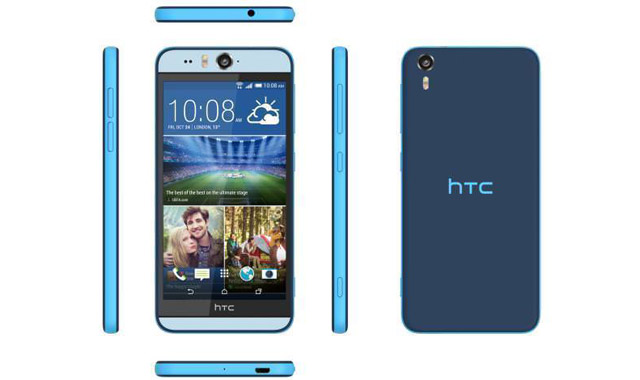
Taiwan’s HTC was one of the first smartphone manufacturers to discover that, in order to sell huge volumes of smartphones, you simply have to equip them with an impressive front-facing camera. If you think of it, that actually makes perfect sense, since the camera has become one of the most distinctive aspects on a modern smartphone.
While smartphone manufacturers focused their efforts and resources primarily on the rear camera, an increasing number of people started using the front camera for making self-portraits, or “selfies”. In response to this, a few smartphone brands recently began fitting their devices with relatively high-quality front-facing cameras — witness the recently launched Samsung Galaxy A5, the Sony Xperia C3 and the Microsoft Lumia 735. And now there’s the HTC Desire Eye to add to the list.
To find out how the new HTC Desire Eye performs and handles in practice, I used it for typical home and office activities such as e-mail, Skype, browsing, watching YouTube in high definition, playing modern 3D games and working with all sorts of office-related documents.
 To get valuable insight into the actual performance of the internal hardware of the Desire Eye — the CPU and the battery, for example — I used a set of specialised benchmark tools. I measured the quality of the screen by using dedicated hardware. The quality of the front and rear camera modules was tested by simply shooting various pictures in different scenarios and settings.
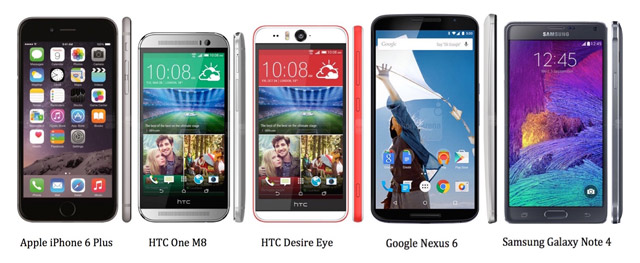
In this review, I primarily compared the HTC Desire Eye with four other competitive smartphones that fall within the 5-inch display range.
Look and feel: plastic but solid
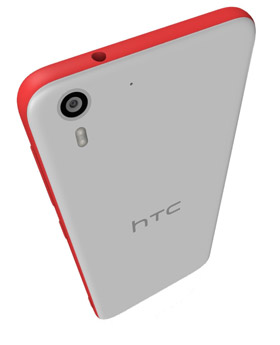
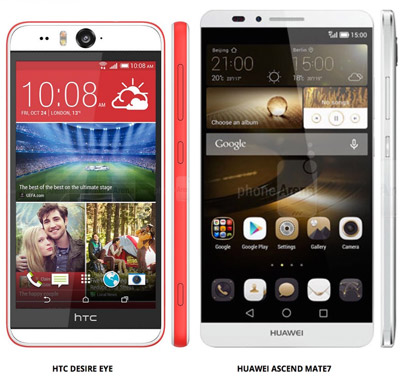
The outside frame (the bezel) surrounding the Eye’s 5,2-inch screen is relatively big, making the phone large, too. Just 66% of the front of the device is taken up by the display itself, considerably lower than rivals like the 6-inch Huawei Ascend Mate 7 (78%). There is also a black square encompassing the screen with only HTC’s logo in it. This is an old HTC trick to make the screen look bigger than it actually is. I first encountered this visual ruse while reviewing the first HTC Desire model back in 2010.
The Desire Eye has something to offer that other HTC smartphones do not: it is waterproof. Although HTC doesn’t actively promote this feature on the Eye’s product page, it is IPX7-rated. This means it should survive in water, without getting damaged, for 30 minutes at a maximum of 1m depth. Opposed to many other devices that claim to be waterproof, like the Sony Xperia Z3 tablet compact, the Desire Eye is also foolproof. You don’t have to manually and properly close all the separate ports before accidentally dropping it in the pool or toilet.
Obviously, I was eager to try this waterproof claim myself so I put the HTC Desire Eye at the bottom of a 1m deep swimming pool for exactly 30 minutes. Because the Desire Eye that I used for this review was a review sample that had to be returned (in fully functional order) to HTC, I couldn’t seek its actual waterproof limits. Nonetheless, the HTC Desire Eye survived my little waterproof test.
The Desire Eye weighs 154g, making it a medium weight smartphone. However, because its weight is almost perfectly balanced it feels lighter than it actually is. Because of that, and the fact that its exterior is made out of plastic, it may come across as a plastic toy to some. Nonetheless, the Eye feels sturdy and solid enough.
At the front, the Desire Eye has been fitted with two subtle integrated BoomSound speakers. I compared the sound quality and maximum volume directly to that of the HTC One M8. Both phones deliver the exact same sound and volume properties, which are excellent in almost all cases. Only the low-frequency range leaves much to be desired, but that can be expected of a smartphone this thin (8,5mm).
 Hardware: previous generation quad-core
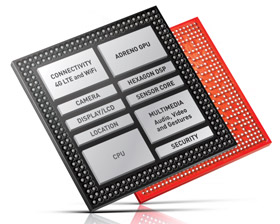
Under the hood, the HTC Desire Eye looks practically identical to the HTC One M8. It houses the same Qualcomm Snapdragon 801 chip with four cores, each running at a maximum of 2,3GHz, as well as the Adreno 330 GPU. Both the CPU and GPU aren’t the latest in the Snapdragon range, but should still provide for adequate performance. Just as with the One M8, it houses 2GB of RAM and a Qualcomm MDM9625 modem that supports 4G, but lacks 4G+ technology. Although the Desire Eye ships with a meagre 16GB of storage space, of which only 9GB is available for user content, it can easily be expanded with an optional micro SD card of maximum capacity 128GB.
Benchmarks: trouble keeping up
To determine the Eye’s hardware capabilities, I used a set of specialised benchmarking tools to quantify its real-life performance. The test results were subsequently compared to competitive smartphones that also reside within the 5-inch screen range.
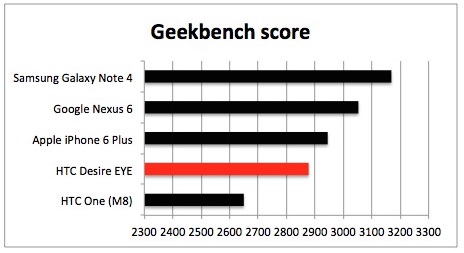
First up is Geekbench, a benchmark tool that simulates real-world business and consumer scenarios to determine and quantify the actual multi-core processing power of the Desire Eye. It shows that it outperforms the high-end 5-inch HTC One M8, but can’t keep up with the 5,5-inch Apple iPhone 6 Plus, 5,96-inch Google Nexus 6 and 5,7-inch Samsung Galaxy Note 4.
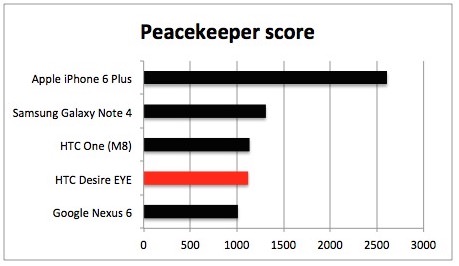
Next was a benchmark tool called Peacekeeper, which also factors in the performance of the operating system and browser, aside from the hardware. It shows that the Desire Eye performs almost identically to all other devices, with the exception of the iPhone 6, which leaves its Android rivals biting the dust.
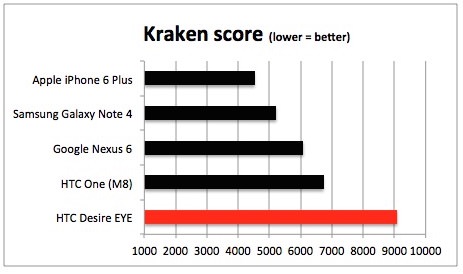
The final benchmark tool to measure the Desire Eye’s generic performance was Kraken. This one also takes the hardware, operating system and browser into account. It accurately measures the time it takes to complete an array of tasks. The less time it takes, the better the performance. Unfortunately, the HTC Desire Eye shows disappointing results, all other devices proved to be considerably faster.
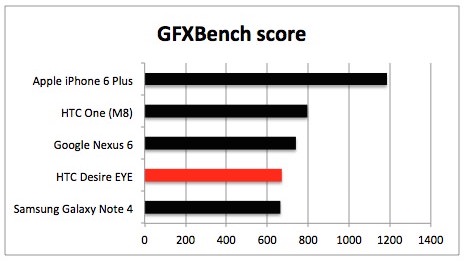
I also wanted to know how well the HTC Desire Eye handled complex graphics. For that, I used a free and multi-platform program called GFXBench. It specifically tests the raw processing power of the GPU, but the quality of the RAM and speed of the CPU also play a role during this benchmark. Again, the HTC Desire Eye couldn’t impress, unlike the iPhone 6 Plus, which again blew away all the Android-based smartphones.
Screen: great brightness and colour reproduction
The 5,2-inch screen of the HTC Desire Eye uses LCD technology and can display a resolution of 1 920×1 080 pixels, also known as full HD. It should be able to resist scratches as a result of Gorilla Glass 3 technology, but I haven’t been able to determine how scratchproof it really is. The review model that I used had to go back to HTC in the same state I got it.
To determine the actual quality of the Eye’s screen, I used a Spectracal C6 Colorimeter to measure brightness, contrast and the ability to display colours accurately.
Its maximum brightness of 554 candelas per square metre is very impressive. To put that number into context, the HTC One M8 can display 512cd/m2, the iPhone 6 Plus 510cd/m2 and the Nexus 6 a mere 355cd/m2. Only the Galaxy Note 4 is able to show even higher brightness values of 610cd/m2.
The measured contrast value of 1 009:1 is good, but nothing special. As a result of these properties, you won’t have any trouble viewing the screen content on a sunny day. The Desire Eye’s screen is also more than capable of displaying very accurate colours. I measured minute deviations in colour reproduction, but they are too small to be visible to the naked eye. At the end, the Desire Eye’s screen capabilities match those of the slightly more expensive HTC One M8.
Battery life: all day long
In all their wisdom, the designers at HTC decided to fit the Desire Eye with a battery that has a slightly lower (2 400mAh) capacity than the one in the HTC One M8 (2 600mAh). It won’t come as a surprise that this concession has a negative effect on battery life. Comparable devices such as the Samsung Galaxy Note 4 (3 220mAh) and iPhone 6 Plus (2 915mAh) are equipped with significantly higher capacity batteries.
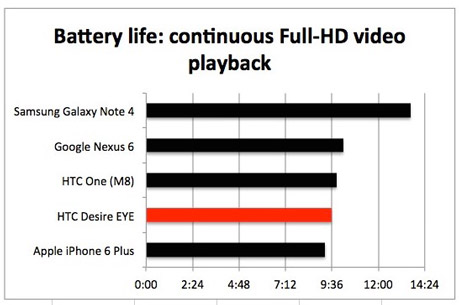
To find out how long the battery of the HTC Desire Eye actually lasts, I exposed it to two separate tests that each aim to drain the battery as fast as possible. The first test continuously plays a full HD movie until there is no more energy left. The second test simulates typical home and office activities such as communicating, browsing and editing documents.
After a decent nine hours and 35 minutes of continuous full HD video playback, the Desire Eye was completely drained of all energy. The other smartphones lasted between nine and 10,5 hours, with the exception of the Galaxy Note 4, which survived for a whopping 13 hours and 40 minutes.

When using the HTC Desire Eye for nonstop home and office activities — which includes rendering of websites, text and images and also involves a lot of scrolling — the Eye lasts for almost seven hours and 30 minutes on a fully charged battery. That’s a pretty good score, but then again the One M8 lasts 1,5 hours longer.
Since with typical smartphone use the screen isn’t switched on all the time and the phone itself also goes into idle mode quite frequently, the HTC Desire Eye should have no trouble reaching the end of a long day at home or the office and still have some energy left for you to play Angry Birds.
Cameras: filled with features
The Eye’s front and rear cameras don’t just appear alike, they practically are. Both are based on Sony’s IMX214 13-megapixel stacked CMOS image sensor that’s also found in the Google Nexus 6 smartphone recently reviewed on TechCentral. This relatively compact (1/3,06) IMX214 sensor utilises pixels that measure 1,12µm in width and length, smaller than those on the iPhone 6 (1,4µm).
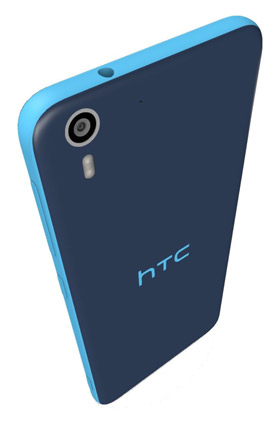 Both the front and rear camera modules are accompanied by a dual-LED flash. Since the LEDs have a slightly different colour temperature, the Desire Eye is better able to capture objects during low-light situations.
Unfortunately, the HTC Desire Eye doesn’t have optical image stabilisation. Although the front and rear cameras are basically the same, there is one important difference. The front camera has a slightly wider angle, probably to get as many people as humanly possible on group selfies.
Compared to front cameras of other, similarly sized smartphones, the one on the Desire Eye beats them all hands down. It is able to take awesome pictures with excellent detail and colour, more than enough for even the most professional of selfie-takers. Another innovative feature is that you only need to give the phone a voice command, or simply smile at the camera, and it will take a selfie. When using the front camera for video conferencing, the camera can also automatically track your face so you will always be in the picture. The Eye’s front camera can even be successfully used for macrophotography, the art of taking close-up pictures of really tiny objects.
Finally, there’s a feature called Face Unlock that uses facial recognition technology to unlock the phone. Since this feature relies heavily on the actual quality of the front camera, which is excellent on the Desire Eye, gaining access to your phone by simply looking at the screen works considerably better than on other phones.
| PROS | CONS |
|---|---|
| 13-megapixel front and rear cameras | Relatively low performer |
| Decent speaker quality | No optical image stabilisation |
| Expandable storage capacity | Only 16GB storage capacity |
| Both cameras have dual-LED flash | Big housing for its screen size |
| Waterproof and foolproof design | |
| High brightness screen and accurate colours | |
| Sturdy design | |
| Face unlocking |
Conclusion
There is absolutely no doubt about this: if you love taking selfies, then this phone was made for you. It has the best front camera of any smartphone to date.
But it doesn’t stop there. The HTC Desire Eye won’t quit on you when accidentally dropped it the toilet, and it offers a good set of speakers and an excellent screen. It also feels solid and durable, despite the plastic exterior.
The bad news is that the Desire Eye isn’t the fastest horse on the track. However, navigating through all the options, menus and apps is as smooth as can be. The Desire Eye also comes with just 16GB of storage space. This can easily be expanded, but that will cost you extra.
There’s no optical image stabilisation, but even without that the camera quality is really good.
Our overall rating? Eight of out 10. — (c) 2015 NewsCentral Media
- A launch data of the Desire Eye in South Africa has not been confirmed. It is available to purchase online, however, with the Orange store selling it for R5 950 at the time of publication.