Close Menu
TechCentralTechCentral

    Subscribe to the newsletter

    Get the best South African technology news and analysis delivered to your e-mail inbox every morning.

    Facebook X (Twitter) YouTube LinkedIn
    WhatsApp Facebook X (Twitter) LinkedIn YouTube
    TechCentralTechCentral
    • News
      Nedbank hires MTN's former tech chief as group CIO - Nikos Angelopoulos

      Nedbank hires MTN’s former tech chief as group CIO

      31 July 2026
      Eskom's diesel bill falls 86% as breakdowns hit eight-year low

      Eskom’s diesel bill falls 86% as breakdowns hit eight-year low

      31 July 2026
      Ramaphosa signs off on taking the grid away from Eskom

      Ramaphosa signs off on taking the grid away from Eskom

      31 July 2026
      Microsoft just had the biggest day in stock market history

      Microsoft just had the biggest day in stock market history

      31 July 2026
      MTN Nigeria's growth engine stalled in second quarter - Karl Toriola

      MTN Nigeria’s growth engine stalled in second quarter

      31 July 2026
    • World
      Meta AI will now tell parents if their teen is in crisis

      Meta AI will now tell parents if their teen is in crisis

      17 July 2026
      IBM shares crash 25% as AI upends software spending - Arvind Krishna

      IBM shares crash 25% as AI upends software spending

      15 July 2026
      Jony Ive's first OpenAI device: an AI smart speaker - Jony Ive and Sam Altman

      Jony Ive’s first OpenAI device: an AI smart speaker

      15 July 2026
      Stripe, Advent in talks to buy PayPal for $53-billion

      Stripe, Advent in talks to buy PayPal for $53-billion

      15 July 2026
      Memory crisis sends smartphone market into steep decline

      Memory crisis sends smartphone market into steep decline

      13 July 2026
    • In-depth
      The plan to stop AI from breaking the world - Google DeepMind CEO Demis Hassabis. Image: John Sears

      The plan to stop AI from breaking the world

      16 July 2026
      The internet has a Strait of Hormuz problem

      The internet has a Strait of Hormuz problem

      15 July 2026
      AI boom sparks rally, frenzy and fear

      AI boom sparks rally, frenzy and fear

      11 June 2026
      Every plug-in hybrid on sale in South Africa, ranked by price - Lamborghini Temerario

      Every plug-in hybrid on sale in South Africa, ranked by price

      7 June 2026
      What Wi-Fi 8 will mean for wireless networks

      What Wi-Fi 8 will mean for wireless networks

      1 June 2026
    • TCS
      TCS+ | Why South African workers must become supervisors of digital labour - Accelera Digital Group Cliff de Wit

      TCS+ | Why South African workers must become supervisors of digital labour

      31 July 2026
      TCS | Rapid deployment rules can't work without municipalities: ACT - Nomvuyiso Batyi

      TCS | Icasa’s rules skip the real bottleneck: ACT

      30 July 2026
      TCS+ | iStore Business on why Apple makes sense for SMEs - Sudesh Pillay and Tamia Nontsikelelo

      TCS+ | iStore Business on why Apple makes sense for SMEs

      30 July 2026
      TCS+ | A smarter approach to cloud for South African businesses - Joel Chacko and Jonathan Oaker

      TCS+ | A smarter approach to cloud for South African businesses

      28 July 2026
      TCS | How Optasia lends billions to people banks can't see - Salvador Anglada

      TCS | How Optasia lends billions to people banks can’t see

      23 July 2026
    • Opinion
      The author, Jannie van Zyl

      Selling vapour is corporate suicide in slow motion

      16 July 2026
      Brazil's online gambling crackdown is a lesson for South Africa

      How Amazon outmanoeuvred Starlink in South Africa

      15 July 2026
      The Popia problem with agentic AI - Herman Haasbroek

      The Popia problem with agentic AI

      14 July 2026
      The author, Fanie van Rooyen

      South Africa can still catch the AI wave – here’s how

      7 July 2026
      The author, Fanie van Rooyen

      The AI utopia South Africa can’t afford

      1 July 2026
    • Company Hubs
      • 1Stream
      • Africa Data Centres
      • AfriGIS
      • Altron Digital Business
      • Altron Document Solutions
      • Altron Group
      • Arctic Wolf
      • Ascent Technology
      • AvertITD
      • BBD
      • Braintree
      • CallMiner
      • CambriLearn
      • CM Telecom
      • Contactable
      • CYBER1 Solutions
      • Digicloud Africa
      • Digimune
      • Domains.co.za
      • ESET
      • Euphoria Telecom
      • HOSTAFRICA
      • Incredible Business
      • iONLINE
      • IQbusiness
      • Iris Network Systems
      • Kaspersky
      • LSD Open
      • Mitel
      • NEC XON
      • Netstar
      • Network Platforms
      • Next DLP
      • Ovations
      • Paracon
      • Paratus
      • Q-KON
      • SevenC
      • SkyWire
      • Solid8 Technologies
      • Telit Cinterion
      • Telviva
      • Tenable
      • Vertiv
      • Videri Digital
      • Vodacom Business
      • Vox
      • Wipro
      • Workday
      • XLink
    • Sections
      • AI and machine learning
      • Banking
      • Broadcasting and Media
      • Cloud services
      • Contact centres and CX
      • Cryptocurrencies
      • Education and skills
      • Electronics and hardware
      • Energy and sustainability
      • Enterprise software
      • Financial services
      • HealthTech
      • Information security
      • Internet and connectivity
      • Internet of Things
      • Investment
      • IT services
      • Lifestyle
      • Policy and regulation
      • Public sector
      • Retail and e-commerce
      • Satellite communications
      • Science
      • SMEs and start-ups
      • Social media
      • Talent and leadership
      • Telecoms
      • Watts & Wheels
    • Events
    • Advertise
    TechCentralTechCentral
    Home » Sections » Telecoms » Sim card insanity in South Africa
    Sim card insanity in South Africa
    Image: Dall-E

    Sim card insanity in South Africa

    By Nkosinathi Ndlovu5 November 2024

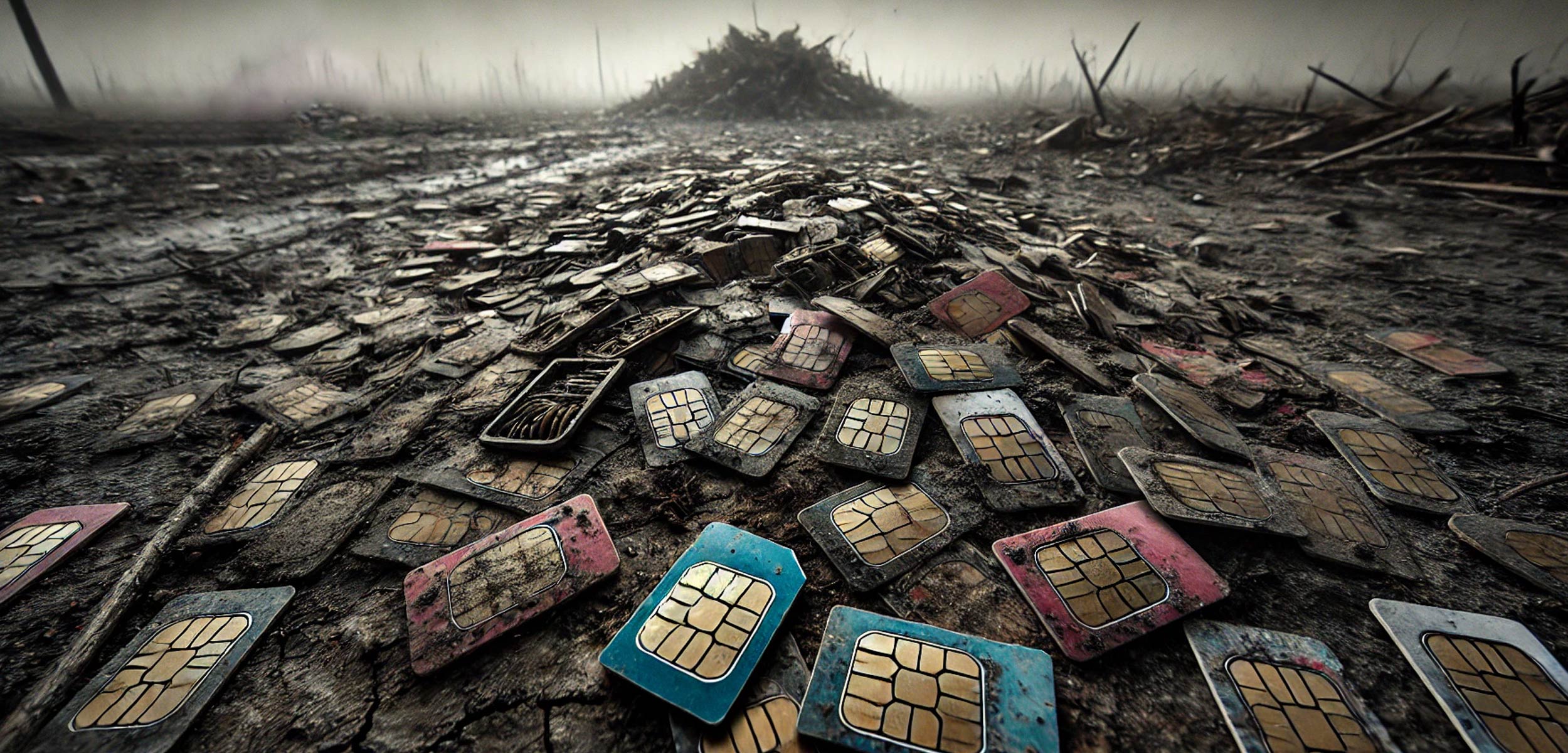
    South Africa’s mobile network operators produce an estimated 180 million Sim cards each year, around three times the country’s population.

    This figure – from a well-placed industry source – is due to high churn in the mass market, with prepaid consumers regularly switching between networks to take advantage of pricing and special offers. Many of these cards soon up as waste, discarded in the veld or in landfill sites.

    So, what are MTN, Vodacom, Telkom and Cell C doing to combat this problem?

    Among other initiatives, the Sim packaging is biodegradable and we have reduced the Sim card size by half

    “We procure Sim cards relative to our market share based on sales forecasts, subscriber growth year on year and the number of Sims registered via Rica and activated within the prepaid space,” a Telkom spokesman told TechCentral.

    “Among other initiatives, the Sim packaging is biodegradable and we have reduced the Sim card size by half. All returned/unusable Sim cards are scrapped and destroyed in an environmentally friendly manner.”

    According to the Telkom spokesman, South Africa’s consumer market – and particularly the informal market – is characterised by “washing machine churn”, where consumers frequently change their Sim cards due to rotation among the different networks, depending on which network they consider to offer the best value at the time. This leads to “dormant” Sims, which are eventually disconnected for non-utilisation.

    Toxic substances

    Sim cards contribute to e-waste in a variety of ways.

    The first is material waste. The materials that make up a Sim card include plastic, metals such as copper and gold, and silicon – none of which is biodegradable. This means disposing of Sim cards via landfill sites is not sustainable as the Sims don’t break down naturally in the environment.

    Also, despite their relatively small size, Sim cards contain trace amounts of toxic substances that can seep into the soil and contaminate water. The single-use packaging, usually plastic, adds more to a Sim card’s waste profile.

    Read: Pressure on South Africa to introduce ‘right to repair’ rules

    Telkom, MTN, Vodacom and Cell C have all reduced the size of their Sim cards in an effort to reduce the amount of waste. Modern Sims can also be clipped out to different sizes so one Sim fits different Sim tray slots for standard, micro and nano Sim sizes, for example.

    The unused portion of the Sim is, however, usually disposed of immediately after opening. According to a Cell C spokesman, the mobile operator is trying to get users to keep the unused materials instead of throwing them away.
    “Many customers retain the Sim casing for reference purposes as it displays important details like the call centre number, USSD strings and the phone number. We also offer raw Sims that are not packaged into flow wraps to reduce the packaging,” said the spokesman.

    Of all the mobile operators, only Telkom was prepared to reveal the number of Sims it produced in its most recent financial year: a staggering 43 million. MTN and Vodacom refused to divulge their figures, citing competitor sensitivity. Based on Telkom’s numbers, though, it’s reasonable to assume the figure for each company is well north of 43 million a year.

    “Physical/plastic Sim card demand is driven by the different channels and partners as well as Sim sales in the wholesale environment. The industry is working to optimise distribution,” said Vodacom.

    The mass market relies heavily on feature phones and basic smartphones, which aren’t yet eSim compatible

    Cell C, on the other hand, said it produces less than 20% of the Sim cards in the market and is focused on managing efficiencies while meeting demand. However, like MTN and Vodacom, it would also not say how many Sims it produces annually.

    Embedded Sims – more often known as eSims – are a digital form of a Sim card that might eventually solve the environmental problem associated with physical Sim cards.

    Telkom said it has around 90 000 of its 20.4-million subscribers using eSims. Vodacom, MTN and Cell C did not disclose how many eSim customers they each have on their networks, but across the board eSim adoption in South Africa is constrained by device penetration as the feature is only available on newer, more expensive devices.

    Programmes

    “While we’re seeing significant eSim uptake in our branded stores and contract markets, the mass market relies heavily on feature phones and basic smartphones, which aren’t yet eSim compatible,” said Cell C’s spokesman.

    Both Vodacom and MTN said they have programmes where customers can dispose of their Sim waste in environmentally friendly ways, including having the waste picked up from the comfort of their own home. Both operators also drive awareness programmes on the topic of e-waste. MTN said it is an active member of the producer responsibility organisation, Circular Energy.

    “Through Vodacom’s Redlovesgreen programmes, Vodacom encourages customers to adopt sustainable practices and to recycle responsibly. We have partnerships to promote public awareness of recycling points nationwide,” said Vodacom.  – © 2024 NewsCentral Media

    Don’t miss:

    eSims: a threat to mobile operators?

    Follow TechCentral on Google News Add TechCentral as your preferred source on Google


    Cell C MTN MTN South Africa Telkom Vodacom Vodacom South Africa
    WhatsApp YouTube
    Share. Facebook Twitter LinkedIn WhatsApp Telegram Email Copy Link
    Previous ArticleMultiChoice takes down piracy operations in Gauteng
    Next Article South Africa is working on unique digital identity for citizens

    Related Posts

    MTN Nigeria's growth engine stalled in second quarter - Karl Toriola

    MTN Nigeria’s growth engine stalled in second quarter

    31 July 2026
    The retailer that is about to become your bank

    The retailer that is about to become your bank

    30 July 2026
    Cisco hands Africa business to partner veteran Ossama Eldeeb

    Cisco hands Africa business to partner veteran Ossama Eldeeb

    30 July 2026
    Company News
    Domains.co.za launches self-hosted n8n VPS hosting

    Domains.co.za launches self-hosted n8n VPS hosting

    31 July 2026
    Smarter.tech '26 shows why smarter technology begins with context - Obsidian Systems

    Context is the missing piece in enterprise AI: Obsidian

    31 July 2026
    Huawei launches 12 intelligent transport solutions in South Africa - Sam Tang

    Huawei launches 12 intelligent transport solutions in South Africa

    30 July 2026
    Opinion
    The author, Jannie van Zyl

    Selling vapour is corporate suicide in slow motion

    16 July 2026
    Brazil's online gambling crackdown is a lesson for South Africa

    How Amazon outmanoeuvred Starlink in South Africa

    15 July 2026
    The Popia problem with agentic AI - Herman Haasbroek

    The Popia problem with agentic AI

    14 July 2026

    Subscribe to Updates

    Get the best South African technology news and analysis delivered to your e-mail inbox every morning.

    Latest Posts
    Nedbank hires MTN's former tech chief as group CIO - Nikos Angelopoulos

    Nedbank hires MTN’s former tech chief as group CIO

    31 July 2026
    Eskom's diesel bill falls 86% as breakdowns hit eight-year low

    Eskom’s diesel bill falls 86% as breakdowns hit eight-year low

    31 July 2026
    Ramaphosa signs off on taking the grid away from Eskom

    Ramaphosa signs off on taking the grid away from Eskom

    31 July 2026
    TCS+ | Why South African workers must become supervisors of digital labour - Accelera Digital Group Cliff de Wit

    TCS+ | Why South African workers must become supervisors of digital labour

    31 July 2026
    © 2009 - 2026 NewsCentral Media
    Built and maintained by Chronon
    • Cookie policy (ZA)
    • TechCentral – privacy and Popia

    Type above and press Enter to search. Press Esc to cancel.

    Manage consent

    TechCentral uses cookies to enhance its offerings. Consenting to these technologies allows us to serve you better. Not consenting or withdrawing consent may adversely affect certain features and functions of the website.

    Functional Always active
    The technical storage or access is strictly necessary for the legitimate purpose of enabling the use of a specific service explicitly requested by the subscriber or user, or for the sole purpose of carrying out the transmission of a communication over an electronic communications network.
    Preferences
    The technical storage or access is necessary for the legitimate purpose of storing preferences that are not requested by the subscriber or user.
    Statistics
    The technical storage or access that is used exclusively for statistical purposes. The technical storage or access that is used exclusively for anonymous statistical purposes. Without a subpoena, voluntary compliance on the part of your Internet Service Provider, or additional records from a third party, information stored or retrieved for this purpose alone cannot usually be used to identify you.
    Marketing
    The technical storage or access is required to create user profiles to send advertising, or to track the user on a website or across several websites for similar marketing purposes.
    • Manage options
    • Manage services
    • Manage {vendor_count} vendors
    • Read more about these purposes
    View preferences
    • {title}
    • {title}
    • {title}