
Close Menu
TechCentralTechCentral

    Subscribe to the newsletter

    Get the best South African technology news and analysis delivered to your e-mail inbox every morning.

    Facebook X (Twitter) YouTube LinkedIn
    WhatsApp Facebook X (Twitter) LinkedIn YouTube
    TechCentralTechCentral
    • News
      ByteDance goes big - very big - on AI

      ByteDance goes big – very big – on AI

      7 August 2026
      ICT is becoming the centre of gravity at Reunert - Anthonie de Beer and Rob Godlonton

      ICT is becoming the centre of gravity at Reunert

      6 August 2026
      Why Discovery is going slow on AI coding agents - Derek Wilcocks

      Why Discovery is going slow on AI coding agents

      6 August 2026
      Google's Gemini leadership team has left the building - Demis Hassabis

      Google’s Gemini leadership team has left the building

      6 August 2026
      SpaceX shares keep sliding - Elon Musk

      SpaceX shares keep sliding

      6 August 2026
    • World
      Meta AI will now tell parents if their teen is in crisis

      Meta AI will now tell parents if their teen is in crisis

      17 July 2026
      IBM shares crash 25% as AI upends software spending - Arvind Krishna

      IBM shares crash 25% as AI upends software spending

      15 July 2026
      Jony Ive's first OpenAI device: an AI smart speaker - Jony Ive and Sam Altman

      Jony Ive’s first OpenAI device: an AI smart speaker

      15 July 2026
      Stripe, Advent in talks to buy PayPal for $53-billion

      Stripe, Advent in talks to buy PayPal for $53-billion

      15 July 2026
      Memory crisis sends smartphone market into steep decline

      Memory crisis sends smartphone market into steep decline

      13 July 2026
    • In-depth
      The plan to stop AI from breaking the world - Google DeepMind CEO Demis Hassabis. Image: John Sears

      The plan to stop AI from breaking the world

      16 July 2026
      The internet has a Strait of Hormuz problem

      The internet has a Strait of Hormuz problem

      15 July 2026
      AI boom sparks rally, frenzy and fear

      AI boom sparks rally, frenzy and fear

      11 June 2026
      Every plug-in hybrid on sale in South Africa, ranked by price - Lamborghini Temerario

      Every plug-in hybrid on sale in South Africa, ranked by price

      7 June 2026
      What Wi-Fi 8 will mean for wireless networks

      What Wi-Fi 8 will mean for wireless networks

      1 June 2026
    • TCS
      TCS+ | How AI is turning hardware into a subscription service - Shane van der Merwe Merchant West

      TCS+ | How AI is turning hardware into a subscription service

      6 August 2026
      TCS+ | Why South African workers must become supervisors of digital labour - Accelera Digital Group Cliff de Wit

      TCS+ | Why South African workers must become supervisors of digital labour

      31 July 2026
      TCS | Rapid deployment rules can't work without municipalities: ACT - Nomvuyiso Batyi

      TCS | Icasa’s rules skip the real bottleneck: ACT

      30 July 2026
      TCS+ | iStore Business on why Apple makes sense for SMEs - Sudesh Pillay and Tamia Nontsikelelo

      TCS+ | iStore Business on why Apple makes sense for SMEs

      30 July 2026
      TCS+ | A smarter approach to cloud for South African businesses - Joel Chacko and Jonathan Oaker

      TCS+ | A smarter approach to cloud for South African businesses

      28 July 2026
    • Opinion
      The author, Jannie van Zyl

      Selling vapour is corporate suicide in slow motion

      16 July 2026
      Brazil's online gambling crackdown is a lesson for South Africa

      How Amazon outmanoeuvred Starlink in South Africa

      15 July 2026
      The Popia problem with agentic AI - Herman Haasbroek

      The Popia problem with agentic AI

      14 July 2026
      The author, Fanie van Rooyen

      South Africa can still catch the AI wave – here’s how

      7 July 2026
      The author, Fanie van Rooyen

      The AI utopia South Africa can’t afford

      1 July 2026
    • Company Hubs
      • 1Stream
      • Africa Data Centres
      • AfriGIS
      • Altron Digital Business
      • Altron Document Solutions
      • Altron Group
      • Arctic Wolf
      • Ascent Technology
      • AvertITD
      • BBD
      • Braintree
      • CallMiner
      • CambriLearn
      • CM Telecom
      • Contactable
      • CYBER1 Solutions
      • Digicloud Africa
      • Digimune
      • Domains.co.za
      • ESET
      • Euphoria Telecom
      • HOSTAFRICA
      • Incredible Business
      • iONLINE
      • IQbusiness
      • Iris Network Systems
      • Kaspersky
      • LSD Open
      • Mitel
      • NEC XON
      • Netstar
      • Network Platforms
      • Next DLP
      • Ovations
      • Paracon
      • Paratus
      • Q-KON
      • SevenC
      • SkyWire
      • Solid8 Technologies
      • Telit Cinterion
      • Telviva
      • Tenable
      • Vertiv
      • Videri Digital
      • Vodacom Business
      • Vox
      • Wipro
      • Workday
      • XLink
    • Sections
      • AI and machine learning
      • Banking
      • Broadcasting and Media
      • Cloud services
      • Contact centres and CX
      • Cryptocurrencies
      • Education and skills
      • Electronics and hardware
      • Energy and sustainability
      • Enterprise software
      • Financial services
      • HealthTech
      • Information security
      • Internet and connectivity
      • Internet of Things
      • Investment
      • IT services
      • Lifestyle
      • Policy and regulation
      • Public sector
      • Retail and e-commerce
      • Satellite communications
      • Science
      • SMEs and start-ups
      • Social media
      • Talent and leadership
      • Telecoms
      • Watts & Wheels
    • Events
    • Advertise
    TechCentralTechCentral
    Home » Sections » Information security » Some security apps worse for privacy than nothing at all

    Some security apps worse for privacy than nothing at all

    By The Conversation23 October 2018
    Twitter LinkedIn Facebook WhatsApp Email Telegram Copy Link
    News Alerts
    WhatsApp

    It’s been a busy few weeks for cybersecurity researchers and reporters. There was the Facebook hack, the Google+ data breach, and allegations that the Chinese government implanted spying chips in hardware components.

    In the midst of all this, some other important news was overlooked. In early September, Apple removed several Trend Micro anti-malware tools from the Mac app store after they were found to be collecting unnecessary personal information from users, such as browser history. Trend Micro has now removed this function from the apps.

    It’s a good reminder that not all security apps will make your online movements more secure — and, in some cases, they could be worse than doing nothing at all. It’s wise to do your due diligence before you download that ad-blocker or VPN — read on for some tips.

    Security apps

    There are range of tools people use to protect themselves from cyber threats:

    Virtual private networks (VPNs) allow you to establish a secure connection with a remote server and route all your traffic through it so it can’t be tracked by your Internet service provider. VPNs are commonly used to access geo-blocked content, and for additional privacy.

    Ad-blockers prevent advertisements from appearing on the websites you visit.

    App-lockers allow you to set passwords for individual apps. For example, if somebody borrowed your phone to make a call, and then tried to access your Facebook app.

    Tor hides your identity while you browse the Internet, by encrypting and moving your traffic across multiple Tor nodes.

    Know the risks

    There are multiple dangers in using these kinds of security software, especially without the proper background knowledge. The risks include:

    Accessing unnecessary data
    Many security tools request access to your personal information. In many cases, they need to do this to protect your device. For example, antivirus software requires information such as browser history, personal files and unique identifiers to function. But in some cases, tools request more access than they need for functionality. This was the case with the Trend Micro apps.

    Creating a false sense of security
    It makes sense that if you download a security app, you believe your online data is more secure. But sometimes mobile security tools don’t provide security at the expected levels, or don’t provide the claimed services at all. If you think you can install a state-of-the-art mobile malware detection tool and then take risks online, you are mistaken.

    For example, a 2017 study showed it was not hard to create malware that can bypass 95% of commercial Android antivirus tools. Another study showed that 18% of mobile VPN apps did not encrypt user traffic at all. And if you are using Tor, there are many mistakes you can make that will compromise your anonymity and privacy — especially if you are not familiar with the Tor setup and try to modify its configurations.

    Lately, there have been reports of fake antivirus software, which opens backdoors for spyware, ransomware and adware, occupying the top spots on the app charts. Earlier this year it was reported that 20 million Google Chrome users had downloaded fake ad-blocker extensions.

    Software going rogue
    Numerous free — or even paid — security software is available in app stores created by enthusiastic individual developers or small companies. While this software can provide handy features, it can be poorly maintained. More importantly, it can be hijacked or bought by attackers, and then used to harvest personal information or propagate malware. This mainly happens in the case of browser extensions.

    Know what you’re giving away

    The table below shows what sort of personal data are being requested by the top 10 antivirus, app-locker and ad-blocking apps in the Android app store. As you can see, antivirus tools have access to almost all the data stored in the mobile phone.
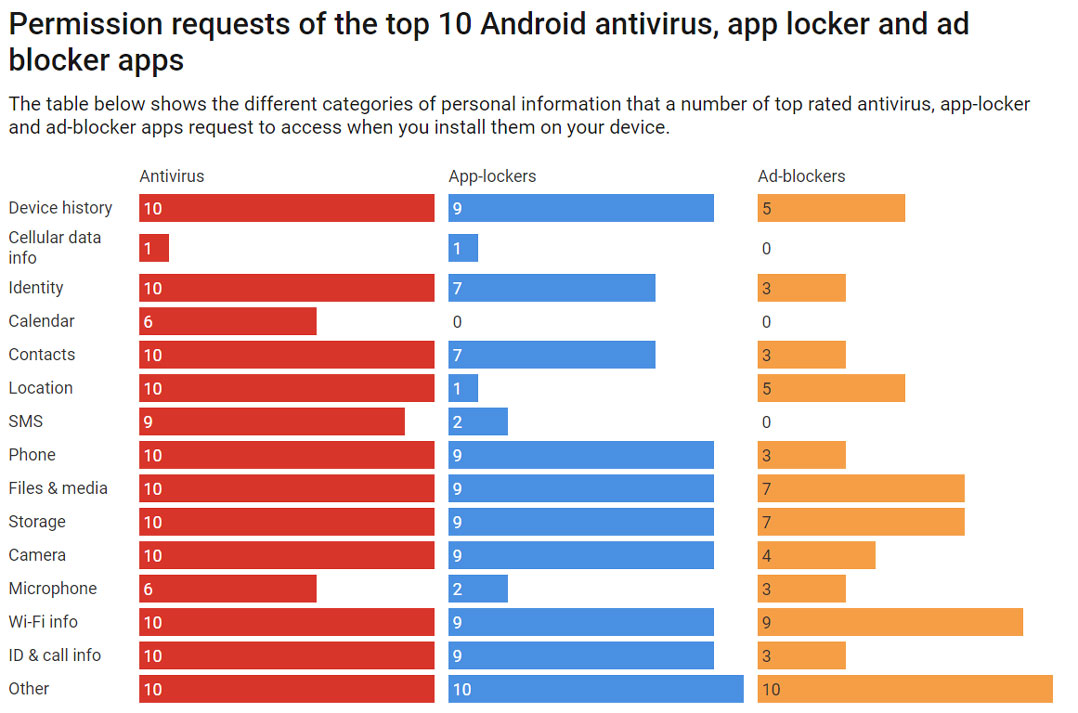
    Chart: Shelley Hepworth Source: Google Play

    That doesn’t necessarily mean any of these apps are doing anything bad, but it’s worth noting just how much personal information we are entrusting to these apps without knowing much about them.

    How to be safer

    Follow these pointers to do a better job of keeping your smart devices secure:

    Consider whether you need a security app
    If you stick to the official apps stores, install few apps and browse only a routine set of websites, you probably don’t need extra security software. Instead, simply stick to the security guidelines provided by the manufacturer, be diligent about updating your operating system, and don’t click links from untrusted sources.

    If you do, use antivirus software
    But before you select one, read product descriptions and online reviews. Stick to solutions from well-known vendors. Find out what it does, and most importantly, what it doesn’t do. Then read the permissions it requests and see whether they make sense. Once installed, update the software as required.

    Be careful with other security tools
    Only install other security tools, such as ad-blockers, app-lockers and VPN clients, if it is absolutely necessary and you trust the developer. The returns from such software can be minimal when compared with the associated risks.The Conversation

    • Written by Suranga Seneviratne, lecturer in security, University of Sydney
    • This article is republished from The Conversation

    Follow TechCentral on Google News Add TechCentral as your preferred source on Google


    Apple Google Suranga Seneviratne top Trend Micro
    WhatsApp YouTube
    Share. Facebook Twitter LinkedIn WhatsApp Telegram Email Copy Link
    Previous ArticleNetflix denies tailoring movie artwork based on race
    Next Article Gartner under fire in Sars probe

    Related Posts

    Google's Gemini leadership team has left the building - Demis Hassabis

    Google’s Gemini leadership team has left the building

    6 August 2026
    Google Cloud, AI adoption gain momentum in Africa - Digicloud Africa

    Google Cloud, AI adoption gain momentum in Africa

    3 August 2026
    TCS+ | iStore Business on why Apple makes sense for SMEs - Sudesh Pillay and Tamia Nontsikelelo

    TCS+ | iStore Business on why Apple makes sense for SMEs

    30 July 2026
    Company News
    What a cloud review reveals about how a company actually runs - LSD Open

    What a cloud review reveals about how a company actually runs

    6 August 2026
    Manufacturing from a garage is now a realistic business plan - MaxLaser

    Manufacturing from a garage is now a realistic business plan

    6 August 2026
    South Africa agrees on a shared language for location - AfriGIS

    South Africa agrees on a shared language for location

    5 August 2026
    Opinion
    The author, Jannie van Zyl

    Selling vapour is corporate suicide in slow motion

    16 July 2026
    Brazil's online gambling crackdown is a lesson for South Africa

    How Amazon outmanoeuvred Starlink in South Africa

    15 July 2026
    The Popia problem with agentic AI - Herman Haasbroek

    The Popia problem with agentic AI

    14 July 2026

    Subscribe to Updates

    Get the best South African technology news and analysis delivered to your e-mail inbox every morning.

    Latest Posts
    ByteDance goes big - very big - on AI

    ByteDance goes big – very big – on AI

    7 August 2026
    ICT is becoming the centre of gravity at Reunert - Anthonie de Beer and Rob Godlonton

    ICT is becoming the centre of gravity at Reunert

    6 August 2026
    Why Discovery is going slow on AI coding agents - Derek Wilcocks

    Why Discovery is going slow on AI coding agents

    6 August 2026
    Google's Gemini leadership team has left the building - Demis Hassabis

    Google’s Gemini leadership team has left the building

    6 August 2026
    © 2009 - 2026 NewsCentral Media
    Built and maintained by Chronon
    • Cookie policy (ZA)
    • TechCentral – privacy and Popia

    Type above and press Enter to search. Press Esc to cancel.

    Manage consent

    TechCentral uses cookies to enhance its offerings. Consenting to these technologies allows us to serve you better. Not consenting or withdrawing consent may adversely affect certain features and functions of the website.

    Functional Always active
    The technical storage or access is strictly necessary for the legitimate purpose of enabling the use of a specific service explicitly requested by the subscriber or user, or for the sole purpose of carrying out the transmission of a communication over an electronic communications network.
    Preferences
    The technical storage or access is necessary for the legitimate purpose of storing preferences that are not requested by the subscriber or user.
    Statistics
    The technical storage or access that is used exclusively for statistical purposes. The technical storage or access that is used exclusively for anonymous statistical purposes. Without a subpoena, voluntary compliance on the part of your Internet Service Provider, or additional records from a third party, information stored or retrieved for this purpose alone cannot usually be used to identify you.
    Marketing
    The technical storage or access is required to create user profiles to send advertising, or to track the user on a website or across several websites for similar marketing purposes.
    • Manage options
    • Manage services
    • Manage {vendor_count} vendors
    • Read more about these purposes
    View preferences
    • {title}
    • {title}
    • {title}