Close Menu
TechCentralTechCentral

    Subscribe to the newsletter

    Get the best South African technology news and analysis delivered to your e-mail inbox every morning.

    Facebook X (Twitter) YouTube LinkedIn
    WhatsApp Facebook X (Twitter) LinkedIn YouTube
    TechCentralTechCentral
    • News
      Global PHP scramble reaches the Union Buildings

      Global PHP scramble reaches the Union Buildings

      23 October 2026
      The roof that powers two malls and an office park

      The roof that powers two malls and an office park

      23 October 2026
      TCS | The Cape Town firm quietly connecting Eskom, Pep and 6 000 ATMs - Réan van Niekerk, Metacom

      TCS | The Cape Town firm quietly connecting Eskom, Pep and 6 000 ATMs

      23 October 2026
      Openserve, Huawei test fibre-ready state housing in KZN

      Openserve, Huawei test fibre-ready state housing in KZN

      23 October 2026
      Anthropic's IPO stands alone

      Anthropic’s IPO stands alone

      23 October 2026
    • World
      OpenAI turns the tables on Apple in trade secrets fight

      OpenAI turns the tables on Apple in trade secrets fight

      15 October 2026
      Google's Gemini 4 Argon is finally here

      Google’s Gemini 4 Argon is finally here

      14 October 2026
      Apple's new HomeView smart home hub

      Apple takes another shot at the smart home

      13 October 2026
      AI

      AI is now propping up the world economy, says IMF

      12 October 2026
      SpaceX takes aim at US wireless carriers with spectrum acquisition

      Starlink is coming for your mobile operator

      9 October 2026
    • In-depth

      10 days that changed the course of AI

      21 September 2026
      Meta to the AI industry: slow down without us - Mark Zuckerberg

      Meta to the AI industry: slow down without us

      16 September 2026
      Google DeepMind CEO Demis Hassabis. Image: John Sears

      The plan to stop AI from breaking the world

      16 July 2026
      The internet has a Strait of Hormuz problem

      The internet has a Strait of Hormuz problem

      15 July 2026
      AI boom sparks rally, frenzy and fear

      AI boom sparks rally, frenzy and fear

      11 June 2026
    • TCS
      TCS+ | Boards are underestimating the cost of a cyberattack, says Arctic Wolf - Jason Oehley and Andre Den Hond

      TCS+ | Boards are underestimating the cost of a cyberattack, says Arctic Wolf

      22 October 2026
      W&W | LDV's Gerhard Moolman on electric bakkies, fleet orders and 'school fees'

      W&W | LDV’s Gerhard Moolman on electric bakkies and fleets

      9 October 2026
      TCS | Frogfoot sees bigger fibre deals coming - TechCentral Show guests Abraham van der Merwe and Shane Chorley

      TCS | Frogfoot sees bigger fibre deals coming

      8 October 2026
      Meet the CIO | Vodacom's Mohamed Sami on the agentic future

      Meet the CIO | Vodacom’s Mohamed Sami on the agentic future

      5 October 2026
      Lexi Novitske, general partner at Norrsken22, on the TechCentral Show

      TCS | Norrsken22’s Lexi Novitske on how China is winning African tech

      1 October 2026
    • Opinion
      Before South Africa licenses Starlink, it should look at Ukraine - Duncan McLeod

      Before South Africa licenses Starlink, it should look at Ukraine

      21 October 2026
      Nonkqubela Thathakahle Jordan-Dyani

      Why cybersecurity is now a national security issue for South Africa

      15 October 2026
      When a machine can choose, who does it become? Fanie van Rooyen

      When a machine can choose, who does it become?

      9 October 2026
      Let South Africans jailbreak their way to digital sovereignty - Dirk de Vos

      Let South Africans jailbreak their way to digital sovereignty

      5 October 2026
      South Africa's next energy crisis is in the accounts department - Craig Holmes

      South Africa’s next energy crisis is in the accounts department

      29 September 2026
    • Company News
      • 1Stream
      • Africa Data Centres
      • AfriGIS
      • Altron Digital Business
      • Altron Document Solutions
      • Altron Group
      • Arctic Wolf
      • Ascent Technology
      • AvertITD
      • BBD
      • Braintree
      • CallMiner
      • CambriLearn
      • CM.com
      • Contactable
      • CYBER1 Solutions
      • Digicloud Africa
      • Digimune
      • Domains.co.za
      • ESET
      • Euphoria Telecom
      • HOSTAFRICA
      • Incredible Business
      • iONLINE
      • IQbusiness
      • Iris Network Systems
      • Kaspersky
      • LSD Open
      • Mitel
      • NEC XON
      • Netstar
      • Network Platforms
      • Next DLP
      • Ovations
      • Paracon
      • Paratus
      • Publishared
      • Q-KON
      • SevenC
      • SkyWire
      • Solid8 Technologies
      • Telit Cinterion
      • Telviva
      • Tenable
      • Vertiv
      • Videri Digital
      • Vodacom Business
      • Vox
      • Wipro
      • Workday
      • XLink
    • Sections
      • AI and machine learning
      • Banking
      • Broadcasting and media
      • Cloud services
      • Contact centres and CX
      • Cryptocurrencies
      • Education and skills
      • Electronics and hardware
      • Energy and sustainability
      • Enterprise software
      • Fintech and payments
      • HealthTech
      • Information security
      • Internet and connectivity
      • Internet of things
      • Investment
      • IT services
      • Lifestyle
      • Policy and regulation
      • Public sector
      • Retail and e-commerce
      • Satellite communications
      • Science
      • SMEs and start-ups
      • Social media
      • Talent and leadership
      • Telecoms
      • Watts & Wheels
    • Events
    • Advertise
    TechCentralTechCentral
    Home » Sections » Telecoms » The lone ship guarding Africa’s internet

    The lone ship guarding Africa’s internet

    A landmark report has warned Africa that is “critically underserved” for undersea cable repairs.
    By Fanie van Rooyen14 July 2026
    Twitter LinkedIn Facebook WhatsApp Email Telegram Copy Link
    Get breaking news on WhatsApp

    The lone ship guarding Africa's internet - Léon Thévenin
    The Léon Thévenin in Cape Town in an undated file photo

    Africa’s entire submarine cable network is served by just one permanently stationed repair vessel – based in Cape Town – leaving the continent exposed to lengthy internet outages, a major international report has warned.

    The final report of the International Advisory Body on Submarine Cable Resilience (IAB), established in 2024 by the International Telecommunication Union (ITU) and the International Cable Protection Committee (ICPC), was adopted in Geneva on 10 July, capping a two-year work programme involving 175 experts from government, industry and academia.

    “Despite growth in internet connectivity, Africa remains critically underserved by submarine cable repair infrastructure,” the report said. “Many of this region’s cables traverse vast stretches of unprotected waters, with only one permanently stationed repair vessel, based in South Africa, to serve the entire region.”

    At over 10 000km, the immense transit distance would be a journey comparable to a transoceanic route

    Though the report does not name the ship, it is Orange Marine’s Léon Thévenin, the Cape Town-based cable layer that has criss-crossed the continent’s coastline for years to fix broken cables, from rockfall-damaged cables off the Congo River to breaks off East Africa.

    The report spelt out what that single-ship dependency means in practice: “Should a fault occur near Dakar, West Africa, while the vessel is repairing a cable in Mombasa, East Africa, the response time would be extremely lengthy. At over 10 000km, the immense transit distance would be a journey comparable to a transoceanic route, like Shanghai to Los Angeles.”

    Africa, the South Atlantic and the Pacific islands together host only about 13% of the world’s active cable repair vessels, against roughly 40% each for Asia-Pacific and the North America/Europe/North Atlantic region. The South Indian Ocean and south-east Pacific have no permanently stationed repair vessels at all.

    ‘Imbalance’

    “This geographical and institutional imbalance shows that access to timely repair resources is not globally equitable,” the report said.

    Between 2012 and 2024, the average repair response time worldwide more than doubled, from less than 20 days to more than 50, according to ICPC data cited in the report – even though repair volumes and the number of available vessels remained stable. The key culprit, it found, was regulation: complex and lengthy permitting, cabotage rules designed for other maritime industries, and taxes and duties on repair vessels and spares.

    Read: The lessons Seacom learnt from its massive 2024 outage

    The faults themselves are overwhelmingly mundane. The global network suffers 150-200 faults a year, and more than 80% of them are caused by human maritime activity – primarily commercial fishing gear and dragged ship anchors.

    Meanwhile, the repair fleet meant to respond is ageing, with older vessels losing 15-20% of their annual operational availability to more frequent dry-docking. New purpose-built repair ships cost US$100-million to $150-million (R1.6-billion to R2.5-billion), which the report said “acts as a significant barrier to fleet renewal”. Compounding the problem, the lucrative demand for laying new cables draws the world’s limited pool of specialised vessels away from maintenance work.
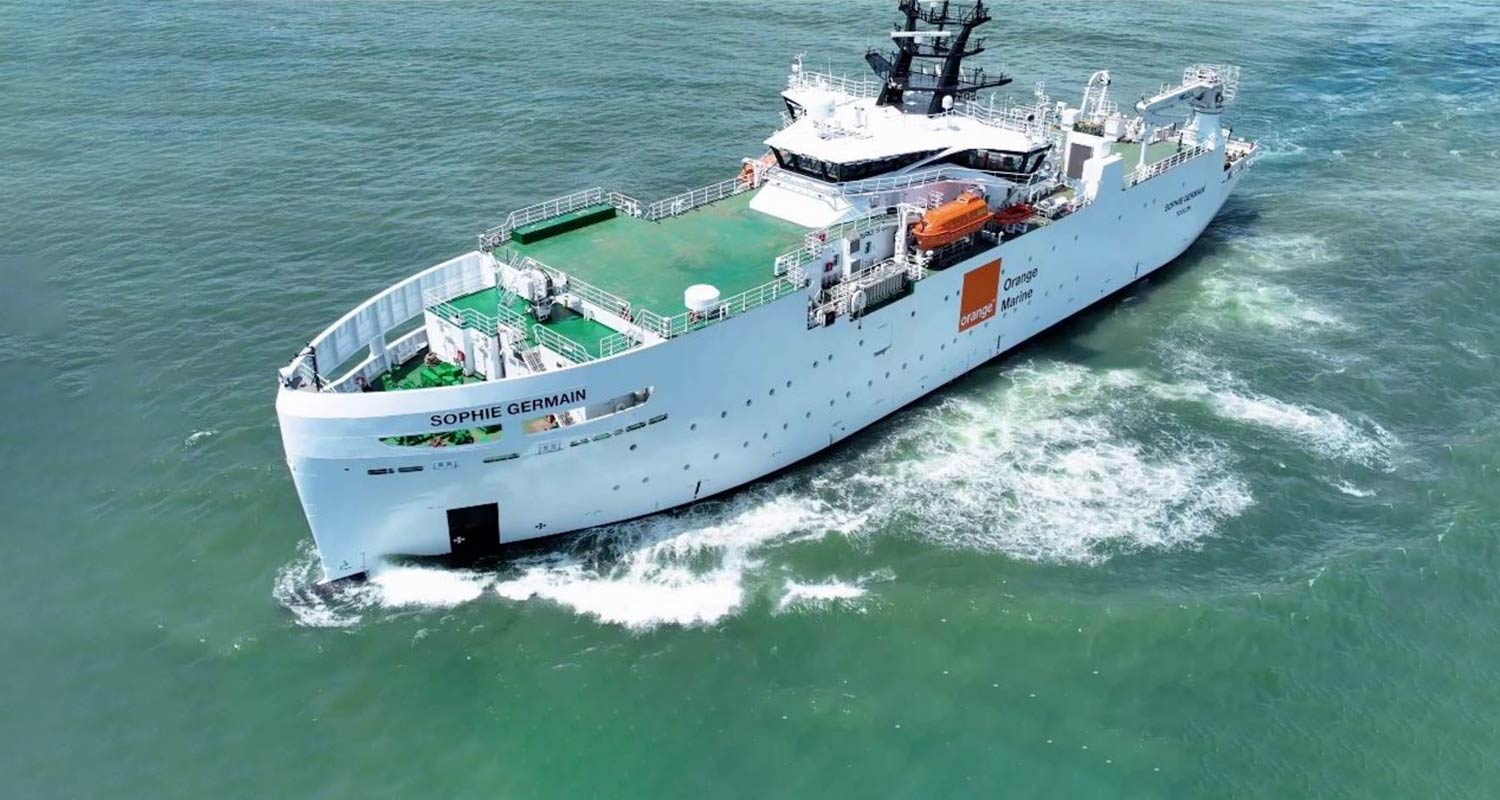
    Ships like Orange Marine's Sophie Germaine are sent out to repair cable breaks when they occur
    Orange Marine’s newer vessel, the Sophie Germaine, is stationed in France

    Orange Marine has begun renewing its own fleet. Its €50-million (about R1-billion) Sophie Germain, in service since 2023, repairs cables in the Mediterranean and Red Sea – including North and East African routes – but is stationed in the south of France.

    More significantly for South Africa, the company in November 2025 ordered two new hybrid-powered cable ships from Sri Lanka’s Colombo Dockyard to replace the 43-year-old Léon Thévenin and the Italy-based Antonio Meucci. Delivery is expected only in 2028 and 2029, however, meaning no relief for Africa for at least another two years.

    “The ageing of the cable ship fleet is a major concern for all players in the submarine cable industry,” Orange Marine president Didier Dillard said at the time.

    The ageing of the cable ship fleet is a major concern for all players in the submarine cable industry

    Yet amid the gloom, South Africa is a standout performer. Citing ICPC repair data covering 2007 to 2024, the report found the country has the world’s shortest “commencement time” – the gap between a fault occurring and a repair vessel mobilising.

    “The fastest responders, such as South Africa (1.95 days) and the UK (3.66 days), benefit from proximity to cable depots and streamlined permitting processes,” it said. The global median is eight days; the global average, skewed by extreme outliers, is 22.7 days.

    South Africa is also singled out, alongside the Netherlands and the UK, for its pre-authorisation arrangements for repair vessels, which shorten administrative delays when cables break. And Google’s Equiano cable, which landed at Melkbosstrand in 2022, is held up as a best-practice example of open access “reducing regulatory uncertainty and certification costs”.

    Case studies

    The region’s own outages feature prominently as case studies. The report cited the dual cable breaks of 2020 and 2023, caused by rockfalls in the Congo Canyon, which left South African users with severely throttled connectivity that “disrupted financial markets, cloud services and cross-border data flows”. It flagged the Congo River system as an area where climate change could make submarine landslides more likely.

    Read: Google plots E Cape as southern anchor of four-hub Africa network

    It also pointed to the March 2024 event in which four cables were severed off West Africa, disrupting connectivity to 12 countries along the continent’s western coast, with one country alone – Nigeria, according to the report’s sources – losing an estimated $590-million (R9.7-billion) over four days. That economies survived these incidents at all, the report noted, was thanks to route diversity and rerouting – as African ISPs demonstrated. The losses, it added, “vastly outweigh the annualised cost of deploying redundancy cable infrastructure”.  – © 2026 NewsCentral Media

    • Subscribe to TechCentral’s daily newsletter
    • Get breaking news alerts on WhatsApp

    Add TechCentral as a preferred source on GoogleFollow TechCentral on Google NewsGet breaking news on WhatsApp


    Bosun Tijani Broadband Infraco Colombo Dockyard Didier Dillard Google ICPC ITU Leon Thevenin Nonkqubela Jordan-Dyani Orange Marine Sagren Naidoo Sandra Maximiano
    WhatsApp YouTube
    Share. Facebook Twitter LinkedIn WhatsApp Telegram Email Copy Link
    Previous ArticleThe Popia problem with agentic AI
    Next Article Fintech takes ATM fight to competition regulator

    Related Posts

    SpaceX could swallow Tesla - Elon Musk

    SpaceX could swallow Tesla

    21 October 2026
    Data sovereignty in South Africa is not an address - Ascent Technology, Johan Lamberts

    Data sovereignty in South Africa is not an address

    15 October 2026
    Google's Gemini 4 Argon is finally here

    Google’s Gemini 4 Argon is finally here

    14 October 2026
    Company News
    Stop turning CEOs into content creators - Natania Pio

    Stop turning CEOs into content creators

    23 October 2026
    Innovex 2026: taking opportunity to where potential lives

    Innovex 2026: taking opportunity to where potential lives

    21 October 2026
    How to choose a .co.za domain without paying more later

    How to choose a .co.za domain without paying more later

    20 October 2026
    Opinion
    Before South Africa licenses Starlink, it should look at Ukraine - Duncan McLeod

    Before South Africa licenses Starlink, it should look at Ukraine

    21 October 2026
    Nonkqubela Thathakahle Jordan-Dyani

    Why cybersecurity is now a national security issue for South Africa

    15 October 2026
    When a machine can choose, who does it become? Fanie van Rooyen

    When a machine can choose, who does it become?

    9 October 2026

    Subscribe to Updates

    Get the best South African technology news and analysis delivered to your e-mail inbox every morning.

    Latest Posts
    Global PHP scramble reaches the Union Buildings

    Global PHP scramble reaches the Union Buildings

    23 October 2026
    The roof that powers two malls and an office park

    The roof that powers two malls and an office park

    23 October 2026
    TCS | The Cape Town firm quietly connecting Eskom, Pep and 6 000 ATMs - Réan van Niekerk, Metacom

    TCS | The Cape Town firm quietly connecting Eskom, Pep and 6 000 ATMs

    23 October 2026
    Openserve, Huawei test fibre-ready state housing in KZN

    Openserve, Huawei test fibre-ready state housing in KZN

    23 October 2026
    © 2009 - 2026 NewsCentral Media
    Built and maintained by Chronon
    • Cookie policy (ZA)
    • TechCentral – privacy and Popia

    Type above and press Enter to search. Press Esc to cancel.

    Manage consent

    TechCentral uses cookies to enhance its offerings. Consenting to these technologies allows us to serve you better. Not consenting or withdrawing consent may adversely affect certain features and functions of the website.

    Functional Always active
    The technical storage or access is strictly necessary for the legitimate purpose of enabling the use of a specific service explicitly requested by the subscriber or user, or for the sole purpose of carrying out the transmission of a communication over an electronic communications network.
    Preferences
    The technical storage or access is necessary for the legitimate purpose of storing preferences that are not requested by the subscriber or user.
    Statistics
    The technical storage or access that is used exclusively for statistical purposes. The technical storage or access that is used exclusively for anonymous statistical purposes. Without a subpoena, voluntary compliance on the part of your Internet Service Provider, or additional records from a third party, information stored or retrieved for this purpose alone cannot usually be used to identify you.
    Marketing
    The technical storage or access is required to create user profiles to send advertising, or to track the user on a website or across several websites for similar marketing purposes.
    • Manage options
    • Manage services
    • Manage {vendor_count} vendors
    • Read more about these purposes
    View preferences
    • {title}
    • {title}
    • {title}
    🇿🇦 Sign up to the TechCentral newsletter