Close Menu
TechCentralTechCentral

    Subscribe to the newsletter

    Get the best South African technology news and analysis delivered to your e-mail inbox every morning.

    Facebook X (Twitter) YouTube LinkedIn
    WhatsApp Facebook X (Twitter) LinkedIn YouTube
    TechCentralTechCentral
    • News
      Africa's most popular phones have a tracking problem

      Africa’s most popular phones have a tracking problem

      24 July 2026
      Vodacom taps UJ, AWS to build its AI talent pipeline - Vodacom Group CEO Shameel Joosub

      Vodacom taps UJ, AWS to build its AI talent pipeline

      24 July 2026
      Intel is back in the game - Intel CEO Lip-Bu Tan. Laure Andrillon/Reuters

      Intel is back in the game

      24 July 2026
      Fat bonuses at Telkom despite group missing own targets - Serame Taukobong

      Fat bonuses at Telkom despite group missing own targets

      23 July 2026
      Massive changes coming to Amazon Prime Video - Jeff Bezos

      Massive changes coming to Amazon Prime Video

      23 July 2026
    • World
      Meta AI will now tell parents if their teen is in crisis

      Meta AI will now tell parents if their teen is in crisis

      17 July 2026
      IBM shares crash 25% as AI upends software spending - Arvind Krishna

      IBM shares crash 25% as AI upends software spending

      15 July 2026
      Jony Ive's first OpenAI device: an AI smart speaker - Jony Ive and Sam Altman

      Jony Ive’s first OpenAI device: an AI smart speaker

      15 July 2026
      Stripe, Advent in talks to buy PayPal for $53-billion

      Stripe, Advent in talks to buy PayPal for $53-billion

      15 July 2026
      Memory crisis sends smartphone market into steep decline

      Memory crisis sends smartphone market into steep decline

      13 July 2026
    • In-depth
      The plan to stop AI from breaking the world - Google DeepMind CEO Demis Hassabis. Image: John Sears

      The plan to stop AI from breaking the world

      16 July 2026
      The internet has a Strait of Hormuz problem

      The internet has a Strait of Hormuz problem

      15 July 2026
      AI boom sparks rally, frenzy and fear

      AI boom sparks rally, frenzy and fear

      11 June 2026
      Every plug-in hybrid on sale in South Africa, ranked by price - Lamborghini Temerario

      Every plug-in hybrid on sale in South Africa, ranked by price

      7 June 2026
      What Wi-Fi 8 will mean for wireless networks

      What Wi-Fi 8 will mean for wireless networks

      1 June 2026
    • TCS
      TCS | How Optasia lends billions to people banks can't see - Salvador Anglada

      TCS | How Optasia lends billions to people banks can’t see

      23 July 2026
      The rands-and-cents case for electric trucks - William Kelly Watts & Wheels with Wills

      The rands-and-cents case for electric trucks

      20 July 2026
      Watts & Wheels S1E7: 'Ferrari's EV breaks the internet'

      Watts & Wheels S1E7: ‘Ferrari’s EV breaks the internet’

      8 July 2026
      TCS | Pick n Pay's Enrico Ferigolli on Penny, the AI that shops for you

      TCS | Pick n Pay’s Enrico Ferigolli on Penny, the AI that shops for you

      2 July 2026
      TCS+ | How Tracker is turning vehicle data into business strategy - Silvia Schollenberger

      TCS+ | How Tracker is turning vehicle data into business strategy

      1 July 2026
    • Opinion
      Selling vapour is corporate suicide in slow motion - Jannie van Zyl

      Selling vapour is corporate suicide in slow motion

      16 July 2026
      Brazil's online gambling crackdown is a lesson for South Africa

      How Amazon outmanoeuvred Starlink in South Africa

      15 July 2026
      The Popia problem with agentic AI - Herman Haasbroek

      The Popia problem with agentic AI

      14 July 2026
      The author, Fanie van Rooyen

      South Africa can still catch the AI wave – here’s how

      7 July 2026
      The author, Fanie van Rooyen

      The AI utopia South Africa can’t afford

      1 July 2026
    • Company Hubs
      • 1Stream
      • Africa Data Centres
      • AfriGIS
      • Altron Digital Business
      • Altron Document Solutions
      • Altron Group
      • Arctic Wolf
      • Ascent Technology
      • AvertITD
      • BBD
      • Braintree
      • CallMiner
      • CambriLearn
      • CM Telecom
      • Contactable
      • CYBER1 Solutions
      • Digicloud Africa
      • Digimune
      • Domains.co.za
      • ESET
      • Euphoria Telecom
      • HOSTAFRICA
      • Incredible Business
      • iONLINE
      • IQbusiness
      • Iris Network Systems
      • Kaspersky
      • LSD Open
      • Mitel
      • NEC XON
      • Netstar
      • Network Platforms
      • Next DLP
      • Ovations
      • Paracon
      • Paratus
      • Q-KON
      • SevenC
      • SkyWire
      • Solid8 Technologies
      • Telit Cinterion
      • Telviva
      • Tenable
      • Vertiv
      • Videri Digital
      • Vodacom Business
      • Vox
      • Wipro
      • Workday
      • XLink
    • Sections
      • AI and machine learning
      • Banking
      • Broadcasting and Media
      • Cloud services
      • Contact centres and CX
      • Cryptocurrencies
      • Education and skills
      • Electronics and hardware
      • Energy and sustainability
      • Enterprise software
      • Financial services
      • HealthTech
      • Information security
      • Internet and connectivity
      • Internet of Things
      • Investment
      • IT services
      • Lifestyle
      • Policy and regulation
      • Public sector
      • Retail and e-commerce
      • Satellite communications
      • Science
      • SMEs and start-ups
      • Social media
      • Talent and leadership
      • Telecoms
      • Watts & Wheels
    • Events
    • Advertise
    TechCentralTechCentral
    Home » Sections » Internet and connectivity » The new way of working – an Mweb study

    The new way of working – an Mweb study

    Promoted | Fibre is the new backbone of productive remote work, according to an Mweb survey conducted across South Africa.
    By Mweb9 February 2026
    Twitter LinkedIn Facebook WhatsApp Email Telegram Copy Link
    News Alerts
    WhatsApp

    The new way of working - an Mweb study

    At the start of 2020, the Covid-19 pandemic caused the entire world to shut down. Overnight, our offices and schools went virtual, gyms launched YouTube channels and family gatherings morphed into video chats.

    The lockdown changed the rhythm of everyday life and highlighted how technology could allow us to live and work in ways that we previously didn’t think possible.

    For more, visit www.mweb.co.za

    For businesses, the pandemic ushered in an entirely new world of work, one characterised by remote and distributed teams, collaborating via video calls and instant messages. Employees had to learn how to balance professional and personal responsibilities under one roof.

    Hybrid work has forced businesses to rethink how, where and when work gets done

    While the dust has largely settled five years down the line, hybrid work has emerged as the new normal for many. It has forced businesses to rethink how, where and when work gets done.

    For South Africa, with a stubbornly high unemployment and skills shortage, remote work holds incredible opportunities. But this is only possible if:

    • Gaps in access are addressed;
    • Critical infrastructure reliability is improved;
    • Policy evolves to unlock the full potential of remote work; and
    • Necessary support mechanisms, from the right training to the required tools are in place.

    Five years after the pandemic, Mweb, which adopted a fully remote business model in 2024, wanted to understand how much the world of work has really changed and how South Africans view the many opportunities and obstacles associated with working remotely. To find out, we recently conducted an online survey across more than 40 000 digitally active South Africans. We found three key takeaways from the results.

    Value of fibre is clear

    The success of remote and hybrid work depends on being able to work outside of the office in the same way as you would if you were in the office. To bridge the gap between the office and remote spaces, the right mix of tools and technologies is key. This includes:

    • Fast and reliable internet;
    • Backup power solutions;
    • VPNs and secure networks;
    • Video conferencing tools;
    • Chat and messaging apps;
    • Project management software;
    • Cloud-based file storage and sharing applications and core business tools (CRM, ERP, HR systems);
    • Productivity and workflow tools;
    • Hardware; and
    • Cybersecurity solutions.

    The new way of working – an Mweb study

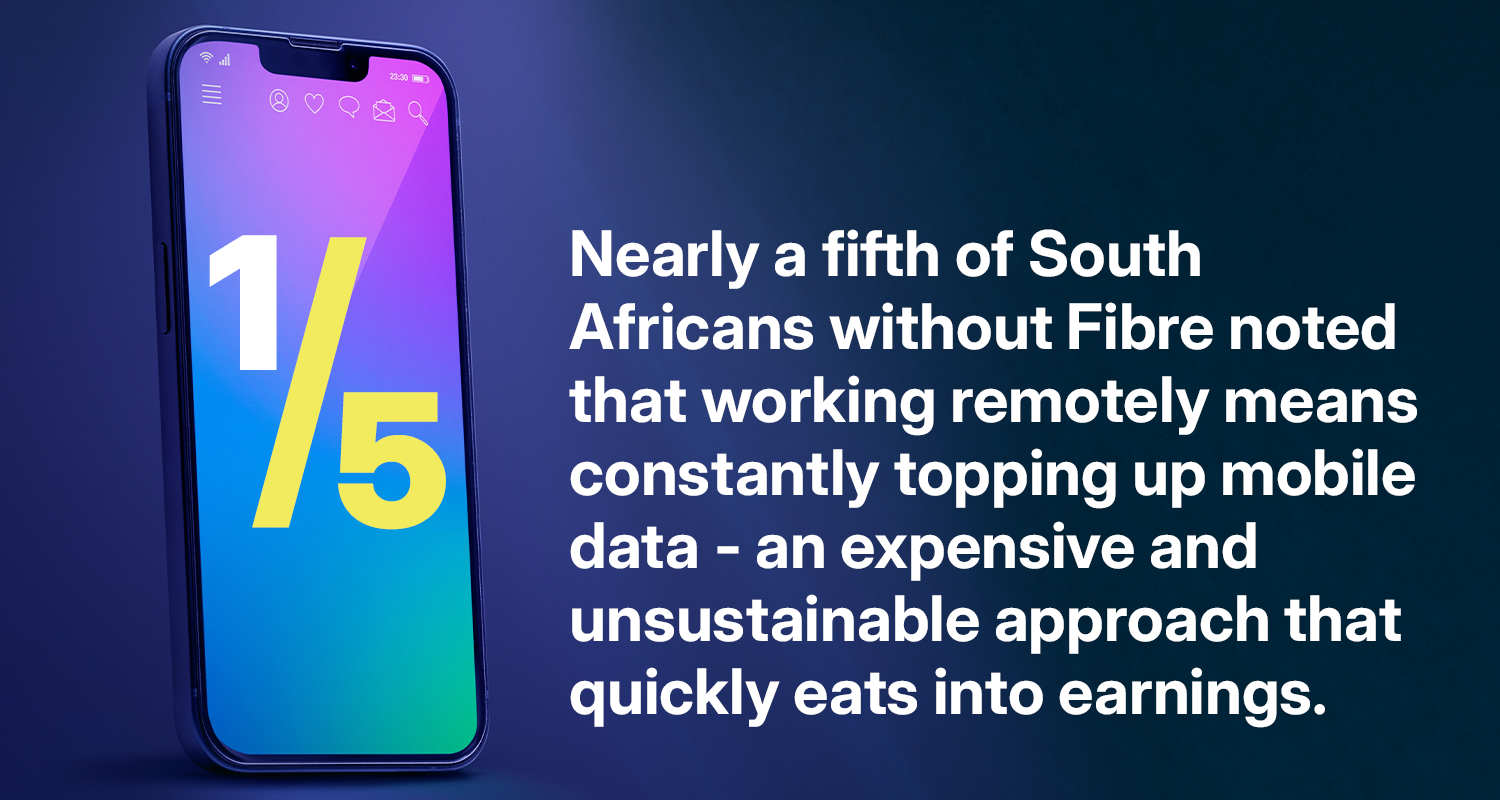
    While everything listed above is important, connectivity is the backbone of remote work success. In fact, the Mweb survey found that 48% of fully remote households have upgraded their internet because they needed increased speed to meet their usage needs. Nearly a fifth of South Africans without fibre noted that working remotely means constantly topping up mobile data – an expensive and unsustainable approach.

    While Mweb’s survey results show that South Africans use the internet for everything from playing games and streaming videos to shopping and social media, 54% of respondents revealed that they use the internet to work from home. Additionally, the survey results revealed that four in 10 households with fibre believe it has made them more productive and improved their work-from-home experience.

    New world of career opportunities

    In recent years, digital-first and tech careers have expanded dramatically, driven by investments in digital infrastructure (fibre networks, cloud services, etc.) totalling around US$11.4-billion in South Africa between 2019 and 2024. This digital infrastructure is the backbone of the modern gig economy; a labour market characterised by:

    • Short-term contracts or freelance work;
    • Mediated by digital platforms; and
    • Limited or no employment benefits.

    In 2024, it is estimated that over 350 000 freelancers were working remotely in South Africa. Many of these people are dependent on fibre. Fibre has supported a new generation of digital professionals, like:

    • Graphic designers, writers and marketing professionals;
    • Software developers, coders, engineers and data analysts;
    • Customer service staff and BPO agents;
    • Online tutors and digital educators;
    • Influencers, podcasters and content creators;
    • Virtual assistants and remote administrative staff; and
    • E-commerce entrepreneurs running their businesses from home.

    But not everyone is equally suited to remote work. Research by BPO provider Merchants shows that top remote performers tend to be detail-oriented, disciplined, empathetic, and respectful, while the best office-based staff are more adaptable, articulate and motivated to make a positive impact. By understanding these behavioural traits, businesses can better match people to roles and design training programmes that set employees up for success, wherever they work.

    Connectivity as a gateway to freedom, flexibility

    Some of the big benefits of remote and hybrid work are detailed below:

    • The flexibility, cost savings and access to new opportunities offered by hybrid and remote work can make it easier for women to stay in the workforce rather than leaving to raise children.
    • Remote and hybrid work allows employees to have greater control over their work environment and schedule; this leads to greater job satisfaction and happiness.
    • One in four of the survey respondents were unemployed. Of these, 43% were youth aged 18–34. For these unemployed people, hybrid and remote work opens up countless new opportunities because people are no longer limited by geography. Similarly, by avoiding the costs associated with a daily commute and possibly relocation expenses, job opportunities become more affordable and accessible.
    • Remote work has also enabled professionals to relocate from congested metros to smaller towns that offer a better lifestyle. This trend, known as “semigration”, is reshaping property markets and urban planning. For these workers, the rollout of fibre more broadly has added to the viability of these relocations.
    • But it’s not only employees who are benefiting from hybrid and remote work; employers are also realising that offering their teams greater flexibility boosts retention and expands access to talent.

    The new way of working – an Mweb study

    When it comes to hybrid and remote work, there is no one-size-fits-all solution. Every organisation is different, which means simply copying another company’s model won’t guarantee success. The businesses that thrive will be the ones that take deliberate steps to identify what blend of in-office and remote work best suits their people and their goals. One thing that is universal is the very real need to equip hybrid and remote teams with all the necessary resources they need to work successfully, no matter where they are.

    About Mweb
    Founded in 1997, the internet service provider, Mweb has a long history of connecting homes and businesses across South Africa with reliable internet services and digital solutions. Today the company offers a comprehensive portfolio of connectivity options – fibre, fixed LTE and fixed 5G – alongside web hosting, domain registration, internet security, VoIP and premium mailboxes. Mweb works with a wide range of infrastructure partners to deliver high-performance internet solutions and continues to innovate and expand its services to meet the evolving needs of South African consumers and enterprises. For more information, visit www.mweb.co.za or follow Mweb on Facebook, Instagram and YouTube.

    • This promoted content was paid for by the party concerned

    Follow TechCentral on Google News Add TechCentral as your preferred source on Google


    Merchants MWeb YouTube
    WhatsApp YouTube
    Share. Facebook Twitter LinkedIn WhatsApp Telegram Email Copy Link
    Previous ArticleBeyond the prompt: Why the future of enterprise AI is hybrid and agentic
    Next Article Paratus lights up new East Africa fibre highway linking Goma and Mombasa

    Related Posts

    World's first teen social media ban is failing

    World’s first teen social media ban is failing

    7 July 2026
    Why online learning is the future of education - Mweb

    Why online learning is the future of education

    20 May 2026
    Fibre: the backbone of South Africa's digital health ecosystem - Mweb

    Fibre: the backbone of South Africa’s digital health ecosystem

    16 April 2026
    Add A Comment

    Comments are closed.

    Company News
    Why Europe is turning to South Africa for cross-border innovation - BBD Software

    Why Europe is turning to South Africa for cross-border innovation

    24 July 2026
    Green dashboards, stalled change: the CIO's blind spot - Change Logic Marchant van den Heever

    Green dashboards, stalled change: the CIO’s blind spot

    24 July 2026
    Why Africa's cloud needs more than one path - Africa Data Centres

    Why Africa’s cloud needs more than one path

    23 July 2026
    Opinion
    Selling vapour is corporate suicide in slow motion - Jannie van Zyl

    Selling vapour is corporate suicide in slow motion

    16 July 2026
    Brazil's online gambling crackdown is a lesson for South Africa

    How Amazon outmanoeuvred Starlink in South Africa

    15 July 2026
    The Popia problem with agentic AI - Herman Haasbroek

    The Popia problem with agentic AI

    14 July 2026

    Subscribe to Updates

    Get the best South African technology news and analysis delivered to your e-mail inbox every morning.

    Latest Posts
    Africa's most popular phones have a tracking problem

    Africa’s most popular phones have a tracking problem

    24 July 2026
    Vodacom taps UJ, AWS to build its AI talent pipeline - Vodacom Group CEO Shameel Joosub

    Vodacom taps UJ, AWS to build its AI talent pipeline

    24 July 2026
    Intel is back in the game - Intel CEO Lip-Bu Tan. Laure Andrillon/Reuters

    Intel is back in the game

    24 July 2026
    Why Europe is turning to South Africa for cross-border innovation - BBD Software

    Why Europe is turning to South Africa for cross-border innovation

    24 July 2026
    © 2009 - 2026 NewsCentral Media
    Built and maintained by Chronon
    • Cookie policy (ZA)
    • TechCentral – privacy and Popia

    Type above and press Enter to search. Press Esc to cancel.

    Manage consent

    TechCentral uses cookies to enhance its offerings. Consenting to these technologies allows us to serve you better. Not consenting or withdrawing consent may adversely affect certain features and functions of the website.

    Functional Always active
    The technical storage or access is strictly necessary for the legitimate purpose of enabling the use of a specific service explicitly requested by the subscriber or user, or for the sole purpose of carrying out the transmission of a communication over an electronic communications network.
    Preferences
    The technical storage or access is necessary for the legitimate purpose of storing preferences that are not requested by the subscriber or user.
    Statistics
    The technical storage or access that is used exclusively for statistical purposes. The technical storage or access that is used exclusively for anonymous statistical purposes. Without a subpoena, voluntary compliance on the part of your Internet Service Provider, or additional records from a third party, information stored or retrieved for this purpose alone cannot usually be used to identify you.
    Marketing
    The technical storage or access is required to create user profiles to send advertising, or to track the user on a website or across several websites for similar marketing purposes.
    • Manage options
    • Manage services
    • Manage {vendor_count} vendors
    • Read more about these purposes
    View preferences
    • {title}
    • {title}
    • {title}