
Close Menu
TechCentralTechCentral

    Subscribe to the newsletter

    Get the best South African technology news and analysis delivered to your e-mail inbox every morning.

    Facebook X (Twitter) YouTube LinkedIn
    WhatsApp Facebook X (Twitter) LinkedIn YouTube
    TechCentralTechCentral
    • News
      Vuyani Jarana: Mobile coverage masks a deeper broadband failure

      Vuyani Jarana: Mobile coverage masks a deeper broadband failure

      30 January 2026
      SABC Plus to flight Microsoft AI training videos

      SABC Plus to flight Microsoft AI training videos

      30 January 2026
      Fibre ducts

      Fibre industry consolidation in KZN

      30 January 2026
      Watts & Wheels S1E3: 'BYD's Corolla Cross challenger'

      Watts & Wheels S1E3: ‘BYD’s Corolla Cross challenger’

      30 January 2026
      What ordinary South Africans really think of AI

      What ordinary South Africans really think of AI

      30 January 2026
    • World
      Apple acquires audio AI start-up Q.ai

      Apple acquires audio AI start-up Q.ai

      30 January 2026
      SpaceX IPO may be largest in history

      SpaceX IPO may be largest in history

      28 January 2026
      Nvidia throws AI at the weather

      Nvidia throws AI at weather forecasting

      27 January 2026
      Debate erupts over value of in-flight Wi-Fi

      Debate erupts over value of in-flight Wi-Fi

      26 January 2026
      Intel takes another hit - Intel CEO Lip-Bu Tan. Laure Andrillon/Reuters

      Intel takes another hit

      23 January 2026
    • In-depth
      How liberalisation is rewiring South Africa's power sector

      How liberalisation is rewiring South Africa’s power sector

      21 January 2026
      The top-performing South African tech shares of 2025

      The top-performing South African tech shares of 2025

      12 January 2026
      Digital authoritarianism grows as African states normalise internet blackouts

      Digital authoritarianism grows as African states normalise internet blackouts

      19 December 2025
      TechCentral's South African Newsmakers of 2025

      TechCentral’s South African Newsmakers of 2025

      18 December 2025
      Black Friday goes digital in South Africa as online spending surges to record high

      Black Friday goes digital in South Africa as online spending surges to record high

      4 December 2025
    • TCS
      TCS+ | How Cloud On Demand is helping SA businesses succeed in the cloud - Xhenia Rhode, Dion Kalicharan

      TCS+ | Cloud On Demand and Consnet: inside a real-world AWS partner success story

      30 January 2026
      Watts & Wheels S1E3: 'BYD's Corolla Cross challenger'

      Watts & Wheels S1E2: ‘China attacks, BMW digs in, Toyota’s sublime supercar’

      23 January 2026

      TCS+ | Why cybersecurity is becoming a competitive advantage for SA businesses

      20 January 2026
      Watts & Wheels S1E3: 'BYD's Corolla Cross challenger'

      Watts & Wheels: S1E1 – ‘William, Prince of Wheels’

      8 January 2026
      TCS+ | Africa's digital transformation - unlocking AI through cloud and culture - Cliff de Wit Accelera Digital Group

      TCS+ | Cloud without culture won’t deliver AI: Accelera’s Cliff de Wit

      12 December 2025
    • Opinion
      South Africa's skills advantage is being overlooked at home - Richard Firth

      South Africa’s skills advantage is being overlooked at home

      29 January 2026
      Why Elon Musk's Starlink is a 'hard no' for me - Songezo Zibi

      Why Elon Musk’s Starlink is a ‘hard no’ for me

      26 January 2026
      South Africa's new fibre broadband battle - Duncan McLeod

      South Africa’s new fibre broadband battle

      20 January 2026
      AI moves from pilots to production in South African companies - Nazia Pillay SAP

      AI moves from pilots to production in South African companies

      20 January 2026
      South Africa's new fibre broadband battle - Duncan McLeod

      ANC’s attack on Solly Malatsi shows how BEE dogma trumps economic reality

      14 December 2025
    • Company Hubs
      • Africa Data Centres
      • AfriGIS
      • Altron Digital Business
      • Altron Document Solutions
      • Altron Group
      • Arctic Wolf
      • AvertITD
      • Braintree
      • CallMiner
      • CambriLearn
      • CYBER1 Solutions
      • Digicloud Africa
      • Digimune
      • Domains.co.za
      • ESET
      • Euphoria Telecom
      • Incredible Business
      • iONLINE
      • IQbusiness
      • Iris Network Systems
      • LSD Open
      • NEC XON
      • Netstar
      • Network Platforms
      • Next DLP
      • Ovations
      • Paracon
      • Paratus
      • Q-KON
      • SevenC
      • SkyWire
      • Solid8 Technologies
      • Telit Cinterion
      • Tenable
      • Vertiv
      • Videri Digital
      • Vodacom Business
      • Wipro
      • Workday
      • XLink
    • Sections
      • AI and machine learning
      • Banking
      • Broadcasting and Media
      • Cloud services
      • Contact centres and CX
      • Cryptocurrencies
      • Education and skills
      • Electronics and hardware
      • Energy and sustainability
      • Enterprise software
      • Financial services
      • Information security
      • Internet and connectivity
      • Internet of Things
      • Investment
      • IT services
      • Lifestyle
      • Motoring
      • Public sector
      • Retail and e-commerce
      • Satellite communications
      • Science
      • SMEs and start-ups
      • Social media
      • Talent and leadership
      • Telecoms
    • Events
    • Advertise
    TechCentralTechCentral
    Home » Sections » Telecoms » Vodacom and Maziv: a contrarian viewpoint

    Vodacom and Maziv: a contrarian viewpoint

    By Paul Colmer6 November 2024

    Since the news broke last week that Vodacom, South Africa’s largest cellular network operator, had its bid to buy fibre network operator Maziv blocked by the Competition Commission, we’ve been inundated by sob stories of how this “setback” will “widen digital exclusion” in the country’s rural and underserviced areas.

    To be direct: digital exclusion isn’t an issue in rural areas. Some of these communities are well served by smaller wireless data operators – it’s just that the large cellular providers with extensive coverage and with high pricing models aren’t one of them, and have created that exclusion.

    Wapa – the Wireless Access Providers’ Association – applauds the recent decision by the Competition Commission, which we believe is in the best interests of consumers getting a fair price for their broadband internet connection. The idea that blocking the Vodacom-Maziv deal is a setback for the entire industry is nonsense; it is only a setback for the companies involved in the deal.

    Vodacom’s 30-year legacy and significant headstart have allowed it to dominate the market

    To understand why concerns about “underserved communities” may be more about marketing than substance, let’s take a closer look at recent history.

    Vodacom, launched in 1994, rose to the top of the telecommunications industry in South Africa, building a behemoth network primarily fuelled by voice traffic revenue. As data overtook voice as the primary traffic on these networks, the shift brought in increased profit margins.

    Vodacom’s 30-year legacy and significant headstart have allowed it to dominate the market, and its CEO, Shameel Joosub, has been with the company from the start. A Harvard graduate with nearly a decade as CEO, Joosub has steadily pushed Vodacom towards deeper market consolidation.

    Not its first rodeo

    Let’s be clear: this isn’t Vodacom’s first rodeo with attempted mergers to tighten its market grip. In 2015, Vodacom’s proposed acquisition of Neotel fell apart after industry outcry and intervention from its competitors with regards to the transfer of spectrum. Despite this, Vodacom hasn’t let up on its mission to secure a stranglehold on internet infrastructure in South Africa.

    Now, with Maziv – the parent of Dark Fibre Africa and Vumatel – the company set its sights on a fibre goldmine. Maziv has already invested R30-billion into its fibre network, with another R10-billion planned, positioning it as a linchpin in South Africa’s broadband future.

    Read: Vodacom signs its first MVNO customer

    But Maziv is also R25-billion in debt, recently refinanced by Standard Bank in one of the largest deals of its kind. And let’s not ignore that Vodacom already owns its own fibre network – one of the few in the country that remains closed access.

    Vodacom has trotted out a tired promise: that buying Maziv would help them “connect the unconnected” in rural and underserved areas. This is, to put it bluntly, PR nonsense. Fibre simply doesn’t make financial sense in sparsely populated rural regions, where both the installation costs and potential subscriber pool render it unsustainable.
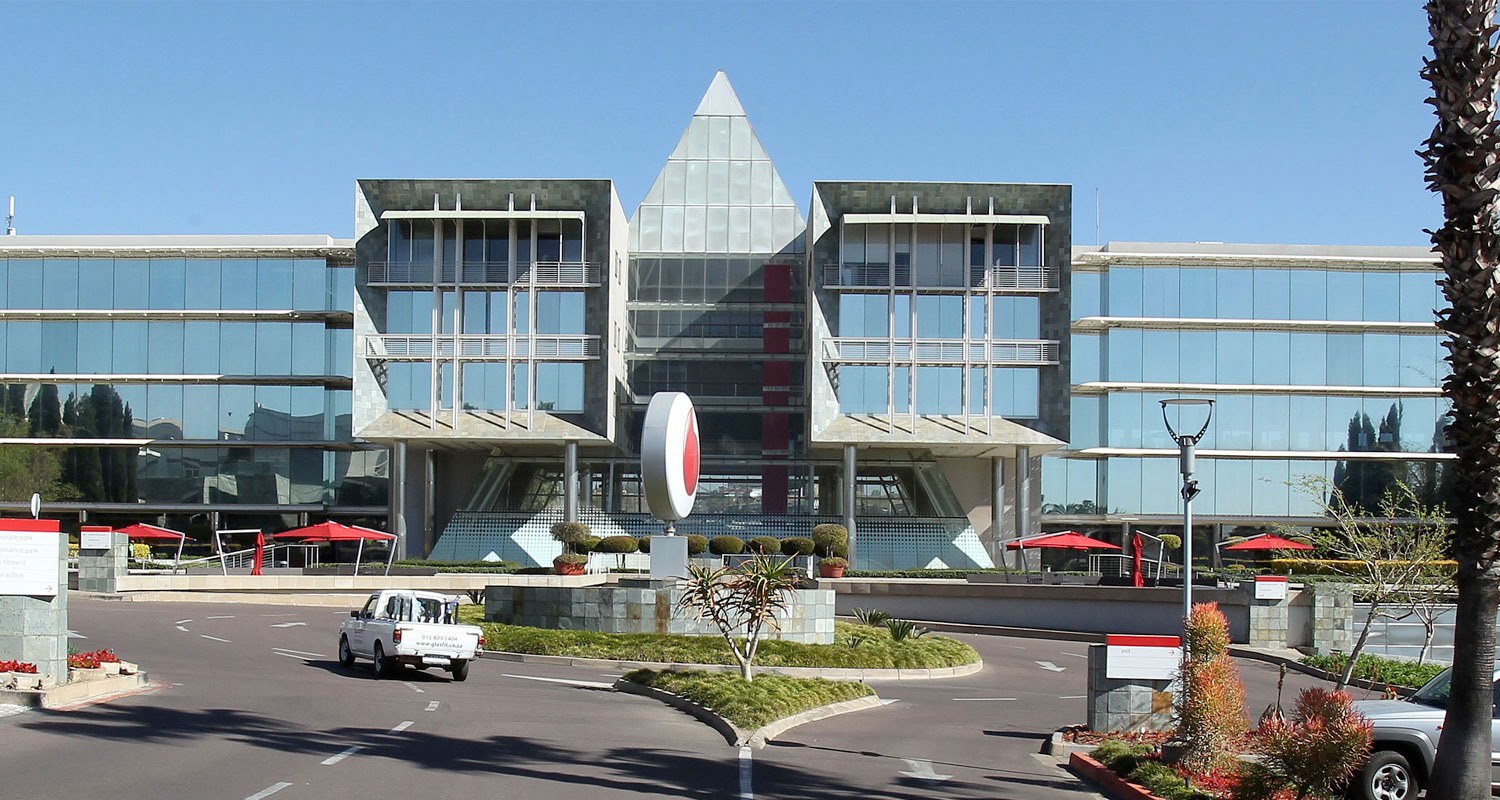
    Vodacom Group’s head office in Midrand, Johannesburg

    What’s more, the claim that Vodacom suddenly wants to provide affordable broadband for rural South Africans rings hollow. Just two years ago, the company argued against the “data must fall” movement, claiming it couldn’t cut data prices without more spectrum. When they finally secured spectrum in the 2022 auction, they not only declined to lower data costs – they increased them, funnelling the extra revenue into their 5G network. This hardly reflects a company committed to affordable, accessible broadband for the masses.

    The 2022 auction even featured a unique spectrum allocation lot in sub-1GHz that required rural roll-out before it could be used in urban areas. And what did Vodacom do? Ignored it, as did the other operators. The spectrum remains unsold and there is little evidence of any rural roll-out since then.

    The red and yellow rainbow

    With MTN eyeing Telkom’s network, Vodacom’s acquisition of Maziv would solidify a two-giant monopoly. Together these two players could hike prices and squeeze smaller providers out of the market. Smaller operators like those represented by Wapa, which has been bringing broadband to underserved areas for years, would be shut out by Vodacom’s deep pockets and aggressive pricing.

    Vodacom’s closed-access network has been a persistent thorn in the side of open-access proponents, and Maziv’s network was open access, meaning it allows other providers to use its infrastructure. Government’s open-access directive aimed at fostering competition could be undermined if Vodacom took control of Maziv and decided to tighten the gates. Why would Vodacom, which has shown zero commitment to open networks, suddenly prioritise sharing resources with competitors?

    This isn’t about creating a “Rainbow Nation” of internet access for all. It’s about creating a closed-loop between Vodacom and MTN, where they could set the terms, keep prices high and lock out innovation. If Wapa and smaller providers are squeezed out, rural South Africans will feel the brunt.

    The author, Wapa’s Paul Colmer

    Let’s remember that South Africa’s telecoms landscape only saw real disruption when companies like Cell C and Rain entered the market. By introducing more affordable, uncapped LTE options, these smaller players shook up the status quo set by Vodacom and MTN. Without them, Vodacom and MTN might have continued with their high-priced offerings, catering mainly to higher-income, urban customers.

    The Competition Commission’s decision isn’t anti-growth; it’s pro-competition. In a free market, the price should be set by competition, not monopolistic giants with inflated pricing strategies. Smaller internet service providers have already established footholds in rural areas – footholds that are sustainable, cost-effective and cater to the communities Vodacom ignores.

    Read: Blocked Vodacom-Maziv deal derails telecoms M&A

    Let’s face it, Vodacom’s services are already available in under-connected areas, but most rural populations simply can’t afford them. And why should they have to? Just as Wapa and its members bring access at a fair price, competition – not monopolistic dominance – will ensure underserved communities stay connected affordably.

    If Vodacom had succeeded in this deal, poorer, rural South Africans would be the ones to suffer. So, let’s be thankful the Competition Commission saw through the thin veil of promises. Rural communities don’t need monopolistic giants. They need competition that drives affordable access for all, and this blocking move has ensured that, for now at least, they’ll have just that.

    • The author, Paul Colmer, is executive committee member at the Wireless Access Providers’ Association
    • Read more articles by Paul Colmer on TechCentral

    Don’t miss:

    South Africa’s competition authorities must be reined in


    Maziv Paul Colmer Vodacom Wapa
    WhatsApp YouTube Follow on Google News Add as preferred source on Google
    Share. Facebook Twitter LinkedIn WhatsApp Telegram Email Copy Link
    Previous ArticlePayShap payment limit raised to R50 000
    Next Article Munsoft survey shows municipal leaders prioritise service delivery over clean audits

    Related Posts

    Starlink hype vs reality in South Africa

    Starlink hype vs reality in South Africa

    26 January 2026
    Mobile operators face tougher rules on data and billing

    Mobile operators face tougher rules on data and billing

    26 January 2026
    South Africa's new fibre broadband battle - Duncan McLeod

    South Africa’s new fibre broadband battle

    20 January 2026
    Company News
    Huawei turns 25 in South Africa, celebrates with major device discounts

    Huawei turns 25 in South Africa, celebrates with major device discounts

    30 January 2026
    Phishing has not disappeared, but it has grown up - KnowBe4

    Phishing has not disappeared, but it has grown up

    30 January 2026
    Smartphone affordability: South Africa's new economic divide - PayJoy

    Smartphone affordability: South Africa’s new economic divide

    29 January 2026
    Opinion
    South Africa's skills advantage is being overlooked at home - Richard Firth

    South Africa’s skills advantage is being overlooked at home

    29 January 2026
    Why Elon Musk's Starlink is a 'hard no' for me - Songezo Zibi

    Why Elon Musk’s Starlink is a ‘hard no’ for me

    26 January 2026
    South Africa's new fibre broadband battle - Duncan McLeod

    South Africa’s new fibre broadband battle

    20 January 2026

    Subscribe to Updates

    Get the best South African technology news and analysis delivered to your e-mail inbox every morning.

    Latest Posts
    Vuyani Jarana: Mobile coverage masks a deeper broadband failure

    Vuyani Jarana: Mobile coverage masks a deeper broadband failure

    30 January 2026
    TCS+ | How Cloud On Demand is helping SA businesses succeed in the cloud - Xhenia Rhode, Dion Kalicharan

    TCS+ | Cloud On Demand and Consnet: inside a real-world AWS partner success story

    30 January 2026
    Huawei turns 25 in South Africa, celebrates with major device discounts

    Huawei turns 25 in South Africa, celebrates with major device discounts

    30 January 2026
    SABC Plus to flight Microsoft AI training videos

    SABC Plus to flight Microsoft AI training videos

    30 January 2026
    © 2009 - 2026 NewsCentral Media
    • Cookie policy (ZA)
    • TechCentral – privacy and Popia

    Type above and press Enter to search. Press Esc to cancel.

    Manage consent

    TechCentral uses cookies to enhance its offerings. Consenting to these technologies allows us to serve you better. Not consenting or withdrawing consent may adversely affect certain features and functions of the website.

    Functional Always active
    The technical storage or access is strictly necessary for the legitimate purpose of enabling the use of a specific service explicitly requested by the subscriber or user, or for the sole purpose of carrying out the transmission of a communication over an electronic communications network.
    Preferences
    The technical storage or access is necessary for the legitimate purpose of storing preferences that are not requested by the subscriber or user.
    Statistics
    The technical storage or access that is used exclusively for statistical purposes. The technical storage or access that is used exclusively for anonymous statistical purposes. Without a subpoena, voluntary compliance on the part of your Internet Service Provider, or additional records from a third party, information stored or retrieved for this purpose alone cannot usually be used to identify you.
    Marketing
    The technical storage or access is required to create user profiles to send advertising, or to track the user on a website or across several websites for similar marketing purposes.
    • Manage options
    • Manage services
    • Manage {vendor_count} vendors
    • Read more about these purposes
    View preferences
    • {title}
    • {title}
    • {title}