Close Menu
TechCentralTechCentral

    Subscribe to the newsletter

    Get the best South African technology news and analysis delivered to your e-mail inbox every morning.

    Facebook X (Twitter) YouTube LinkedIn
    WhatsApp Facebook X (Twitter) LinkedIn YouTube
    TechCentralTechCentral
    • News
      Nedbank hires MTN's former tech chief as group CIO - Nikos Angelopoulos

      Nedbank hires MTN’s former tech chief as group CIO

      31 July 2026
      Eskom's diesel bill falls 86% as breakdowns hit eight-year low

      Eskom’s diesel bill falls 86% as breakdowns hit eight-year low

      31 July 2026
      Ramaphosa signs off on taking the grid away from Eskom

      Ramaphosa signs off on taking the grid away from Eskom

      31 July 2026
      Microsoft just had the biggest day in stock market history

      Microsoft just had the biggest day in stock market history

      31 July 2026
      MTN Nigeria's growth engine stalled in second quarter - Karl Toriola

      MTN Nigeria’s growth engine stalled in second quarter

      31 July 2026
    • World
      Meta AI will now tell parents if their teen is in crisis

      Meta AI will now tell parents if their teen is in crisis

      17 July 2026
      IBM shares crash 25% as AI upends software spending - Arvind Krishna

      IBM shares crash 25% as AI upends software spending

      15 July 2026
      Jony Ive's first OpenAI device: an AI smart speaker - Jony Ive and Sam Altman

      Jony Ive’s first OpenAI device: an AI smart speaker

      15 July 2026
      Stripe, Advent in talks to buy PayPal for $53-billion

      Stripe, Advent in talks to buy PayPal for $53-billion

      15 July 2026
      Memory crisis sends smartphone market into steep decline

      Memory crisis sends smartphone market into steep decline

      13 July 2026
    • In-depth
      The plan to stop AI from breaking the world - Google DeepMind CEO Demis Hassabis. Image: John Sears

      The plan to stop AI from breaking the world

      16 July 2026
      The internet has a Strait of Hormuz problem

      The internet has a Strait of Hormuz problem

      15 July 2026
      AI boom sparks rally, frenzy and fear

      AI boom sparks rally, frenzy and fear

      11 June 2026
      Every plug-in hybrid on sale in South Africa, ranked by price - Lamborghini Temerario

      Every plug-in hybrid on sale in South Africa, ranked by price

      7 June 2026
      What Wi-Fi 8 will mean for wireless networks

      What Wi-Fi 8 will mean for wireless networks

      1 June 2026
    • TCS
      TCS+ | Why South African workers must become supervisors of digital labour - Accelera Digital Group Cliff de Wit

      TCS+ | Why South African workers must become supervisors of digital labour

      31 July 2026
      TCS | Rapid deployment rules can't work without municipalities: ACT - Nomvuyiso Batyi

      TCS | Icasa’s rules skip the real bottleneck: ACT

      30 July 2026
      TCS+ | iStore Business on why Apple makes sense for SMEs - Sudesh Pillay and Tamia Nontsikelelo

      TCS+ | iStore Business on why Apple makes sense for SMEs

      30 July 2026
      TCS+ | A smarter approach to cloud for South African businesses - Joel Chacko and Jonathan Oaker

      TCS+ | A smarter approach to cloud for South African businesses

      28 July 2026
      TCS | How Optasia lends billions to people banks can't see - Salvador Anglada

      TCS | How Optasia lends billions to people banks can’t see

      23 July 2026
    • Opinion
      The author, Jannie van Zyl

      Selling vapour is corporate suicide in slow motion

      16 July 2026
      Brazil's online gambling crackdown is a lesson for South Africa

      How Amazon outmanoeuvred Starlink in South Africa

      15 July 2026
      The Popia problem with agentic AI - Herman Haasbroek

      The Popia problem with agentic AI

      14 July 2026
      The author, Fanie van Rooyen

      South Africa can still catch the AI wave – here’s how

      7 July 2026
      The author, Fanie van Rooyen

      The AI utopia South Africa can’t afford

      1 July 2026
    • Company Hubs
      • 1Stream
      • Africa Data Centres
      • AfriGIS
      • Altron Digital Business
      • Altron Document Solutions
      • Altron Group
      • Arctic Wolf
      • Ascent Technology
      • AvertITD
      • BBD
      • Braintree
      • CallMiner
      • CambriLearn
      • CM Telecom
      • Contactable
      • CYBER1 Solutions
      • Digicloud Africa
      • Digimune
      • Domains.co.za
      • ESET
      • Euphoria Telecom
      • HOSTAFRICA
      • Incredible Business
      • iONLINE
      • IQbusiness
      • Iris Network Systems
      • Kaspersky
      • LSD Open
      • Mitel
      • NEC XON
      • Netstar
      • Network Platforms
      • Next DLP
      • Ovations
      • Paracon
      • Paratus
      • Q-KON
      • SevenC
      • SkyWire
      • Solid8 Technologies
      • Telit Cinterion
      • Telviva
      • Tenable
      • Vertiv
      • Videri Digital
      • Vodacom Business
      • Vox
      • Wipro
      • Workday
      • XLink
    • Sections
      • AI and machine learning
      • Banking
      • Broadcasting and Media
      • Cloud services
      • Contact centres and CX
      • Cryptocurrencies
      • Education and skills
      • Electronics and hardware
      • Energy and sustainability
      • Enterprise software
      • Financial services
      • HealthTech
      • Information security
      • Internet and connectivity
      • Internet of Things
      • Investment
      • IT services
      • Lifestyle
      • Policy and regulation
      • Public sector
      • Retail and e-commerce
      • Satellite communications
      • Science
      • SMEs and start-ups
      • Social media
      • Talent and leadership
      • Telecoms
      • Watts & Wheels
    • Events
    • Advertise
    TechCentralTechCentral
    Home » Top » Apple sues Qualcomm in antitrust case

    Apple sues Qualcomm in antitrust case

    By Agency Staff23 January 2017
    Twitter LinkedIn Facebook WhatsApp Email Telegram Copy Link
    News Alerts
    WhatsApp

    Apple has sued Qualcomm, accusing it of monopolising the market for chips for wireless devices and withholding US$1bn in retaliation for cooperating with South Korean antitrust authorities.

    Apple is demanding Qualcomm hand over money that was supposed to be a rebate for licensing fees. Qualcomm is holding back the money as punishment for Apple cooperating with Korean antitrust regulators, according to the complaint filed in San Diego, California where Qualcomm is based.

    Apple also wants back some of the billions of dollars it claims it was overcharged in “Qualcomm’s illegal scheme” to control the market for mobile phone chips. It wants a court to change how Qualcomm charges for its technology in the future.

    Qualcomm, the largest maker of mobile phone chips, has been under fire by regulators around the world for its patent licensing practices. The lawsuit filed on Friday is the first direct challenge by one of its biggest customers and threatens to upend how royalties are calculated by any owner of a patent on technology that underlies modern electronics.

    Apple is facing pressure to squeeze more profit out of every iPhone after revenue declined last year for the first time since 2001, dragged down by lower handset sales. It typically sources the same component from several suppliers, which helps secure lower prices by forcing the manufacturers to compete on price.

    “It is quite clear that Apple’s claims are baseless,” Qualcomm general counsel Don Rosenberg said in a statement. “Apple has intentionally mischaracterised our agreements and negotiations, as well as the enormity and value of the technology we have invented, contributed and shared with all mobile device makers through our licensing programme.”

    Qualcomm also accused Apple of encouraging regulators to attack it in “various jurisdictions around the world” by “misrepresenting facts and withholding information”.

    “Qualcomm built its business on older, legacy, standards but reinforces its dominance through exclusionary tactics and excessive royalties,” Apple said in a statement. “Despite being just one of over a dozen companies which contributed to basic cellular standards, Qualcomm insists on charging Apple at least five times more in payments than all the other cellular patent licensors we have agreements with combined.”

    The complaint also challenges the validity of some key Qualcomm patents for wireless technologies. Apple asks the court to rule that, if the patents are upheld, that the royalty amount is significantly lower than what Qualcomm charges now.

    In December, South Korea, home to two of Qualcomm’s largest customers, fined the company 1,03 trillion won ($890m) and described its practices as monopolistic. Qualcomm has said it will appeal the decision.

    Under the agreement with Qualcomm, Apple said it was forced to refrain from taking any steps to challenge Qualcomm’s business model.
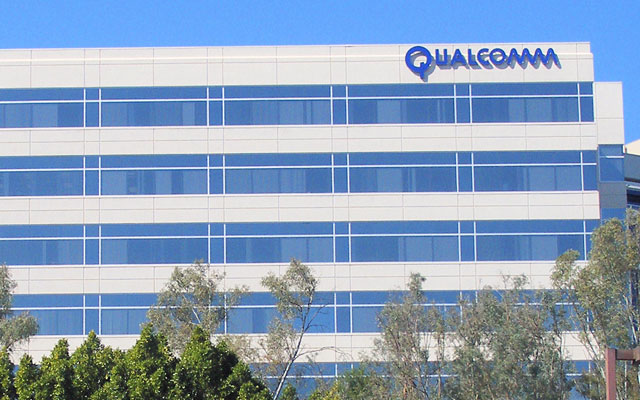
    Qualcomm’s head office in San Diego, California

    Apple complied with investigation demands from Korean regulators, an action Qualcomm claimed was in violation of the agreement. In retaliation, Qualcomm withheld money that it was due to pay Apple in royalty rebates, the iPhone maker said.

    Qualcomm offered to pay the money “if Apple retracted and corrected its statements to government agencies”, according to the complaint.

    More trouble

    South Korean regulators aren’t the only authorities investigating Qualcomm.

    The US Federal Trade Commission on 17 January filed its own antitrust suit against Qualcomm. The chip maker is also being investigated by the European Union and Taiwanese authorities.

    At the heart of the dispute between Apple and Qualcomm is a push by phone makers with the support of regulators to reduce the patent royalties Qualcomm charges.

    Qualcomm gets the bulk of its revenue from selling chips, but more than half of its profit from the separate licensing business. Its patents cover the fundamentals of cellular technology, allowing it to rake in billions in licensing fees. In other words, the chip maker gets paid regardless of whether its chips are used in mobile phones or not.

    One common thread in all of the cases is the contention that royalty rates should be calculated as a percentage of the price of the components in the phone that Qualcomm invents and sells — measured in tens of dollars. Currently licensing is a percentage of the price of the entire phone, which is usually in the hundreds of dollars.

    Companies collaborate to develop industry standards so that the devices can communicate with each other. Since they have the ability to ensure their inventions get included in the standards, they pledge to license on “fair, reasonable and non-discriminatory” terms.

    Qualcomm has breached that pledge by refusing to license its patents to Intel, a rival chip maker that’s been providing some chips to Apple for the past year, according to the complaint.

    Bullying accusations

    Apple accused Qualcomm of bullying it, threatening to withhold chip supply, forcing it to agree not to challenge Qualcomm’s patents and using Apple innovations to help its competitors.

    Much of the money Qualcomm collects on the iPhone or iPad is paid by third-party manufacturers who pass along the cost, according to the complaint. Apple said Qualcomm can demand higher royalties because those manufacturers “have no incentive to negotiate”.

    Apple said it’s not allowed to see those agreements, and believes Qualcomm gets paid multiple times on the same device. Since Qualcomm won’t give Apple a direct licence, it instead agreed to give Apple a rebate — money that it’s now withholding.  — (c) 2017 Bloomberg LP

    Follow TechCentral on Google News Add TechCentral as your preferred source on Google


    Apple Qualcomm Samsung
    WhatsApp YouTube
    Share. Facebook Twitter LinkedIn WhatsApp Telegram Email Copy Link
    Previous ArticleRevealed: why the Note7 caught fire
    Next Article Apple’s Qualcomm assault is margin grab

    Related Posts

    TCS+ | iStore Business on why Apple makes sense for SMEs - Sudesh Pillay and Tamia Nontsikelelo

    TCS+ | iStore Business on why Apple makes sense for SMEs

    30 July 2026
    Apple at Work: business technology that works as one

    Apple at Work: business technology that works as one

    29 July 2026
    Apple's next CEO plants his flag in Hollywood - John Ternus and Tim Cook

    Apple’s next CEO plants his flag in Hollywood

    28 July 2026
    Company News
    Domains.co.za launches self-hosted n8n VPS hosting

    Domains.co.za launches self-hosted n8n VPS hosting

    31 July 2026
    Smarter.tech '26 shows why smarter technology begins with context - Obsidian Systems

    Context is the missing piece in enterprise AI: Obsidian

    31 July 2026
    Huawei launches 12 intelligent transport solutions in South Africa - Sam Tang

    Huawei launches 12 intelligent transport solutions in South Africa

    30 July 2026
    Opinion
    The author, Jannie van Zyl

    Selling vapour is corporate suicide in slow motion

    16 July 2026
    Brazil's online gambling crackdown is a lesson for South Africa

    How Amazon outmanoeuvred Starlink in South Africa

    15 July 2026
    The Popia problem with agentic AI - Herman Haasbroek

    The Popia problem with agentic AI

    14 July 2026

    Subscribe to Updates

    Get the best South African technology news and analysis delivered to your e-mail inbox every morning.

    Latest Posts
    Nedbank hires MTN's former tech chief as group CIO - Nikos Angelopoulos

    Nedbank hires MTN’s former tech chief as group CIO

    31 July 2026
    Eskom's diesel bill falls 86% as breakdowns hit eight-year low

    Eskom’s diesel bill falls 86% as breakdowns hit eight-year low

    31 July 2026
    Ramaphosa signs off on taking the grid away from Eskom

    Ramaphosa signs off on taking the grid away from Eskom

    31 July 2026
    TCS+ | Why South African workers must become supervisors of digital labour - Accelera Digital Group Cliff de Wit

    TCS+ | Why South African workers must become supervisors of digital labour

    31 July 2026
    © 2009 - 2026 NewsCentral Media
    Built and maintained by Chronon
    • Cookie policy (ZA)
    • TechCentral – privacy and Popia

    Type above and press Enter to search. Press Esc to cancel.

    Manage consent

    TechCentral uses cookies to enhance its offerings. Consenting to these technologies allows us to serve you better. Not consenting or withdrawing consent may adversely affect certain features and functions of the website.

    Functional Always active
    The technical storage or access is strictly necessary for the legitimate purpose of enabling the use of a specific service explicitly requested by the subscriber or user, or for the sole purpose of carrying out the transmission of a communication over an electronic communications network.
    Preferences
    The technical storage or access is necessary for the legitimate purpose of storing preferences that are not requested by the subscriber or user.
    Statistics
    The technical storage or access that is used exclusively for statistical purposes. The technical storage or access that is used exclusively for anonymous statistical purposes. Without a subpoena, voluntary compliance on the part of your Internet Service Provider, or additional records from a third party, information stored or retrieved for this purpose alone cannot usually be used to identify you.
    Marketing
    The technical storage or access is required to create user profiles to send advertising, or to track the user on a website or across several websites for similar marketing purposes.
    • Manage options
    • Manage services
    • Manage {vendor_count} vendors
    • Read more about these purposes
    View preferences
    • {title}
    • {title}
    • {title}