Close Menu
TechCentralTechCentral

    Subscribe to the newsletter

    Get the best South African technology news and analysis delivered to your e-mail inbox every morning.

    Facebook X (Twitter) YouTube LinkedIn
    WhatsApp Facebook X (Twitter) LinkedIn YouTube
    TechCentralTechCentral
    • News

      Hollard client data dumped on the dark web

      18 September 2026
      Vumatel operating profit jumps 57% as the Vodacom deal lands

      Vumatel operating profit jumps 57% as the Vodacom deal lands

      18 September 2026
      SA's two biggest MVNOs, two very different strategies - FNB Connect Capitec Connect

      Capitec and FNB are running the same MVNO playbook

      18 September 2026
      Solar and EVs in South Africa: what the numbers actually say

      Solar and EVs in South Africa: what the numbers actually say

      18 September 2026
      The AI that builds AI has gone from 1% to 26% in five months

      The AI that builds AI has gone from 1% to 26% in five months

      18 September 2026
    • World
      'This is not circular': Jensen Huang defends $3.5-billion MediaTek deal

      ‘This is not circular’: Jensen Huang defends $3.5-billion MediaTek deal

      2 September 2026
      AI-generated music banned from Australian charts

      AI-generated music banned from Australian charts

      26 August 2026
      Traders brace for a R4.5-trillion swing in Nvidia's value

      Traders brace for a R4.5-trillion swing in Nvidia’s value

      25 August 2026
      Russia building its own Starlink - and faster than expected - Vadym Skibitskyi

      Russia building its own Starlink – and faster than expected

      11 August 2026
      Meta AI will now tell parents if their teen is in crisis

      Meta AI will now tell parents if their teen is in crisis

      17 July 2026
    • In-depth
      Google DeepMind CEO Demis Hassabis. Image: John Sears

      The plan to stop AI from breaking the world

      16 July 2026
      The internet has a Strait of Hormuz problem

      The internet has a Strait of Hormuz problem

      15 July 2026
      AI boom sparks rally, frenzy and fear

      AI boom sparks rally, frenzy and fear

      11 June 2026
      Every plug-in hybrid on sale in South Africa, ranked by price - Lamborghini Temerario

      Every plug-in hybrid on sale in South Africa, ranked by price

      7 June 2026
      What Wi-Fi 8 will mean for wireless networks

      What Wi-Fi 8 will mean for wireless networks

      1 June 2026
    • TCS
      TCS | Octotel's Trevor van Zyl on the fibre merger question

      TCS | Octotel’s Trevor van Zyl on the MetroFibre merger question

      16 September 2026
      Meet the CIO | Shoprite's Chris Shortt on what a supermarket becomes

      Meet the CIO | Shoprite’s Chris Shortt on what a supermarket becomes

      9 September 2026
      Rubicon's EV charging network is profitable - and growing fast - Watts & Wheels

      Rubicon’s EV charging network is profitable – and growing fast

      8 September 2026
      Winstone Jordaan on building a national EV charging network

      Winstone Jordaan on building a national EV charging network

      2 September 2026
      Watts & Wheels S1E8: 'Tesla lands in Africa, just not here'

      Watts & Wheels S1E8: ‘Tesla lands in Africa, just not here’

      24 August 2026
    • Opinion
      The end is nigh, and the shares go on sale in October - Duncan McLeod

      The end is nigh, and the shares go on sale in October

      14 September 2026
      The fragile joint in the Capitec machine - Pambos Soteriades

      The R197-billion market the banks can’t reach

      25 August 2026
      South African tech's compounding debt problem - Jannie van Zyl

      Management consulting as we know it is over

      21 August 2026
      South African tech's compounding debt problem - Jannie van Zyl

      The most dangerous customer is the quiet one

      10 August 2026
      South African tech's compounding debt problem - Jannie van Zyl

      South African tech’s compounding debt problem

      29 July 2026
    • Company Hubs
      • 1Stream
      • Africa Data Centres
      • AfriGIS
      • Altron Digital Business
      • Altron Document Solutions
      • Altron Group
      • Arctic Wolf
      • Ascent Technology
      • AvertITD
      • BBD
      • Braintree
      • CallMiner
      • CambriLearn
      • CM.com
      • Contactable
      • CYBER1 Solutions
      • Digicloud Africa
      • Digimune
      • Domains.co.za
      • ESET
      • Euphoria Telecom
      • HOSTAFRICA
      • Incredible Business
      • iONLINE
      • IQbusiness
      • Iris Network Systems
      • Kaspersky
      • LSD Open
      • Mitel
      • NEC XON
      • Netstar
      • Network Platforms
      • Next DLP
      • Ovations
      • Paracon
      • Paratus
      • Q-KON
      • SevenC
      • SkyWire
      • Solid8 Technologies
      • Telit Cinterion
      • Telviva
      • Tenable
      • Vertiv
      • Videri Digital
      • Vodacom Business
      • Vox
      • Wipro
      • Workday
      • XLink
    • Sections
      • AI and machine learning
      • Banking
      • Broadcasting and Media
      • Cloud services
      • Contact centres and CX
      • Cryptocurrencies
      • Education and skills
      • Electronics and hardware
      • Energy and sustainability
      • Enterprise software
      • Financial services
      • HealthTech
      • Information security
      • Internet and connectivity
      • Internet of Things
      • Investment
      • IT services
      • Lifestyle
      • Policy and regulation
      • Public sector
      • Retail and e-commerce
      • Satellite communications
      • Science
      • SMEs and start-ups
      • Social media
      • Talent and leadership
      • Telecoms
      • Watts & Wheels
    • Events
    • Advertise
    TechCentralTechCentral
    Home » Gadgets & Reviews » Asus Zenbook UX305FA: elegant lightweight

    Asus Zenbook UX305FA: elegant lightweight

    By Andre Schild2 March 2015
    Twitter LinkedIn Facebook WhatsApp Email Telegram Copy Link
    Get breaking news on WhatsApp

    asus-zenbook-640-4

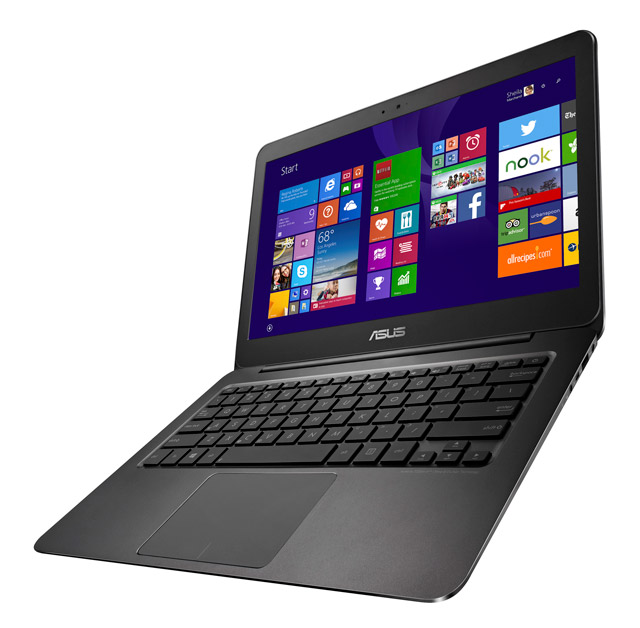
    The Asus UX305FA is the first Zenbook to feature Intel’s new Core M technology. As a result, Asus clearly breaks tradition with previous Zenbook models, which were all equipped with much faster Intel Core i processors. On the upside, the new machine is a lot cheaper than most other Zenbooks. So, how does it compare to similar devices from competitive brands?

    To find that out, I used it for all sorts of typical home- and business-related tasks like browsing, communicating, handling documents and watching HD video. I also confronted the device with three tough benchmark tests and submitted it to two battery torture tests. The screen quality was measured with the help of dedicated equipment.

    Although Asus offers various configurations of the new Zenbook, the specific model I used for this review is the UX305FA-FC007H. It features an Intel Core-M5Y10 chip, 4GB RAM, 1 920×1 080-pixel screen and a 128GB SSD storage. Models with deviating specifications may produce different test results.

    Look and feel: durable and comfortable
    Asus Zenbooks have a reputation of being one of the thinnest and most elegant notebooks money can buy, and with the UX305FA that remains true. Previous Zenbook models, like the UX32VD, suddenly look big and clumsy when placed next to the 12mm-thin UX305FA. Not only does the slim-line design look good, it also affects the weight of the device, which is only 1,2kg.

    The thinner a notebook gets, the more important a good and solid exterior becomes. It is what gives the device durability and robustness. To that end, Asus designed the Zenbook UX305FA with a complete metal casing that feels incredibly solid and rigid. It also gives the machine a premium look. At no point during our week with the UX305FA did it show any sign of bending, unlike most ultra-thin notebooks made of plastic.


    asus-zenbook-640-1

    asus-zenbook-640-2

    As a result of the solid, metal exterior, the machine delivers a pretty comfortable typing experience. It is well suited for hours of nonstop work on long documents. Too bad there is no keyboard backlight. It does have an integrated light sensor so its screen brightness will automatically adjust accordingly to save energy. The Zenbook UX305FA’s touchpad is equally comfortable to work with, even for long periods of time. It supports multi-touch gestures, which can be customised using bundled software.

    Despite the slim-line design, Asus managed to cram all sorts of connectors in the UX305FA. On the left side are two USB 3 connectors and an SD card reader. A third USB 3 port is located on the right side. This port can be used to charge other USB devices, even when the Zenbook UX305FA is turned off. There’s also a micro HDMI connector to hook the device up to an external screen. Unfortunately, there wasn’t enough space left to include an integrated Ethernet adapter on the Zenbook UX305FA. Instead, a USB to Ethernet adapter is included. You even get a simple but effective sleeve to protect the computer.

    Hardware: new microarchitecture
    Every new generation of Asus Zenbooks is traditionally fitted with the latest hardware and technology. In that light, the Zenbook UX305FA is based on the new 14nm Broadwell microarchitecture that is the result of Intel’s renowned Tick-Tock research and manufacturing model.

    The Zenbook UX305FA features an Intel Core M-5Y10 (dual-core) chip that operates at a base frequency of 0,8MHz/core and can briefly turbo-charge to 2GHz when needed. The UX305FA also has 4GB of DDR3 RAM, which is the absolute minimum for Windows 8.1 to be useful. For graphics, the UX305FA relies on an Intel HD 5300 GPU that is known for its ultra-low power consumption, but falls short in raw performance.

    Our review model was equipped with a (removable) 128GB Sandisk solid-state disk, but models with 256GB or 512GB of storage capacity are also available at a higher price. I also discovered that the 4GB of RAM on this specific review-model was soldered onto the mainboard, making future memory expansion a no-go. If you can afford it, Asus offers a version of the UX305FA with 8GB of RAM, making the device more futureproof. There’s also the option of a slightly faster Intel Core M-5Y71 chip that runs at a base frequency of 1,2GHz/core and that can briefly turbo-charge up to 2,9GHz when the situation requires it.

    Benchmarks: can’t cope with heavy workloads
    To find out how all the hardware inside the Zenbook UX305FA translates into real-life performance, I ran a set of benchmark tests. In order to keep the comparison with other devices both honest and interesting I stacked the UX305FA up to similarly priced, as well as more expensive devices.

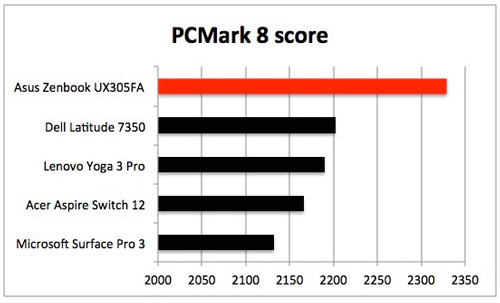
    I started the performance tests with PCMark 8, which is considered an industry-standard benchmark tool for the Windows platform. PCMark 8 accurately measures performance using real-world tasks and applications that reflect typical home and business use. It showed me that the UX305FA not only managed to outperform the Acer Aspire Switch 12 (R13 000) and the Microsoft Surface Pro 3 (R13 000), but also the more expensive Lenovo Yoga 3 Pro (R25 000) and the Dell Latitude 7350 (R30 000).

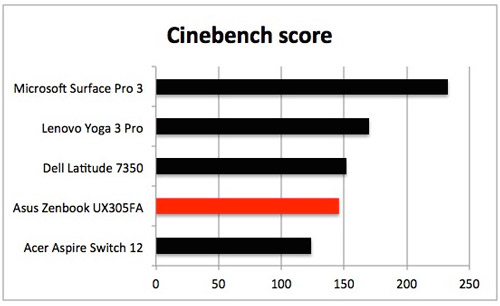
    According to Cinebench, a program that primarily measures the maximum performance of the CPU and GPU during heavy workloads, the UX305FA definitely isn’t the fastest horse on the track.
    PCMark-8-score

    Cinebench-score

    3DMark-score

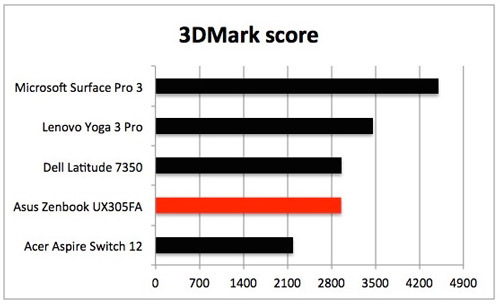
    Finally, I used 3DMark, a test that not only focuses on heavy workload and processing intensive tasks, but also specifically measures complex 3D graphics performance. It resulted in the exact same ranking as initially produced by Cinebench.
    At the end, the performance delivered by the Asus Zenbook UX305FA can best be described as ideal for typical home and business activities, but not the best choice for heavy, processor intensive tasks. For that, the Microsoft Surface Pro 3 seems to be a much better candidate.

    Battery life: impressive
    The Asus Zenbook UX305FA is fitted with a relatively high-capacity 45Wh battery. Most of the other devices I used for comparison all have lower-capacity batteries: 36Wh (Aspire Switch 12), 42Wh (Surface Pro 3) and 44Wh (Yoga 3 Pro). Only the Dell Latitude 7350, that houses two separate batteries, has a slightly higher total capacity of 50Wh.

    The first battery test continuously plays a 1080p movie until there is no energy left. The second test simulates typical business activities like communicating, browsing and editing documents. Both torture tests aim to drain the battery as fast as possible, effectively creating a worst-case scenario — the minimum time you can expect the Zenbook UX305FA to function under two completely different user scenarios.

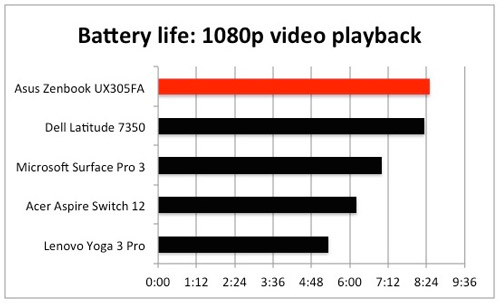
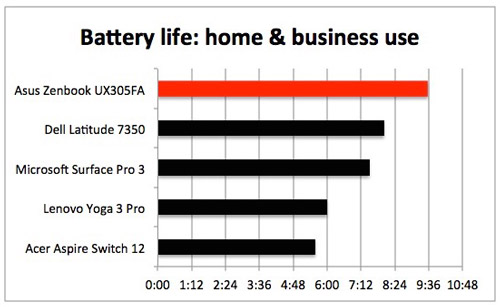
    According to these tests, the machine can play a full-HD video nonstop for eight hours and 30 minutes, beating all the other devices I used in the comparison. Despite the fact that typical (continuous) home and business activities tend to strain the hardware a bit more, the UX305FA lasts even longer. According to the second torture test, the UX305FA can hold out for nine hours and 30 minutes while continuously being used for typical home and business tasks. Again, that’s longer than all the other devices and the best score of all Asus Zenbooks ever produced.
    Battery-life---1080p-video-playback

    Battery-life---home-&-business-use

    Realistically, most people don’t use their computer for nine hours straight, so there will also be idle time when the device will blank its screen to save some energy. Based on that assumption, I calculated that the UX305FA should last for an impressive 11 hours and 45 minutes.

    In search for a plausible explanation for this impressive battery life, I discovered that the UX305FA uses a relatively new technology called panel self-refresh. Essentially, this technology shuts down the GPU and all associated circuitry when the screen image is static, like when reading a document. That way, precious energy can be saved, apparently resulting in longer battery life.

    Screen: no more reflections
    As mentioned earlier, the Asus Zenbook UX305FA is available in various configurations. The one I used for this review featured a 13,3-inch, 1 920×1 080-pixel, non-reflective display with a pixel density of 166ppi. For a higher price, Asus also offers a model with an increased resolution of 3 200×1 800 pixels and 276ppi.

    To determine the actual quality of the UX305FA’s screen, I used a Spectracal C6 Colorimeter to measure brightness, contrast and the ability to display colours accurately.
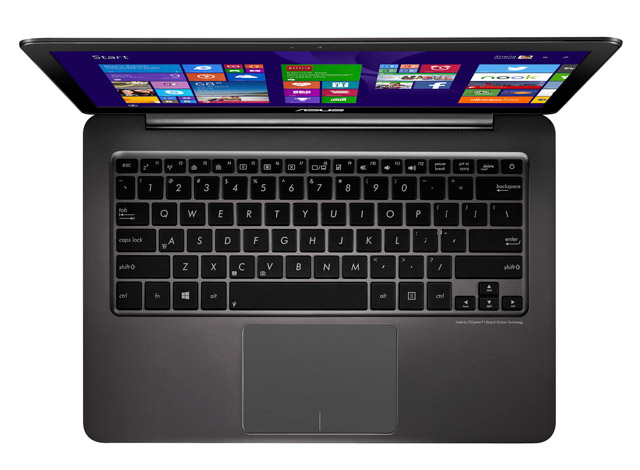
    asus-zenbook-640-3

    It appears the Asus Zenbook UX305FA can display a maximum screen brightness of 374 candelas per square metre, which is quite high for a device like this. As a result, the UX305FA can comfortably be used in light-intensive situations, like during a bright and sunny day.
    Next up, its contrast. Again, I was positively impressed. The Asus Zenbook UX305FA was able to produce high contrast levels of 1 302:1, resulting in great looking and vivid colours.

    Good contrast values are great, but what about how accurate these colours are displayed? This is especially important for anyone who plans to use the Zenbook UX305FA for semi-serious image editing. To be blunt, on this particular aspect the UX305FA leaves plenty of room for improvement. To put things into perspective, though, the Intel Core M-5Y10 chip inside the UX305FA simply isn’t powerful enough for proper image editing. The 4GB RAM and 128GB SSD are also factors that make the UX305FA plain unsuitable for this task.

    Keeping that in mind, the lack of accurate colour reproduction won’t pose a big problem.
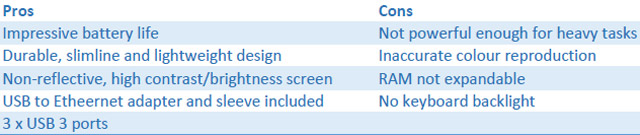
    asus-pros-cons

    Conclusion
    The relatively cheap Asus Zenbook UX305FA has proved to be an impressive piece of work that not only looks good but is also very thin, durable, lightweight and surprisingly comfortable to work with. Although it can’t impress with high computing performance, the superb battery life more than makes up for that. To top it all off, the UX305FA offers an excellent, non-reflective screen and has plenty of USB connectors to hand.

    It’s a shame that the internal memory isn’t expandable, making it less futureproof than other devices. Nonetheless, the UX305FA is a great device and an affordable choice for anyone who is looking to buy a notebook that won’t be used for heavy tasks like gaming or image editing.

    TechCentral’s score? A solid eight out of 10.  — © 2015 NewsCentral Media

    • The Zenbook US305FA is expected to retail for R12 999 and will go on sale in South Africa in April or May 2015

    Add TechCentral as a preferred source on GoogleFollow TechCentral on Google NewsGet breaking news on WhatsApp


    Asus Asus Zenbook Asus Zenbook UX305FA
    WhatsApp YouTube
    Share. Facebook Twitter LinkedIn WhatsApp Telegram Email Copy Link
    Previous ArticleSamsung hopes Galaxy S6 gives it the edge
    Next Article What the great Sim heist means for you

    Related Posts

    Asus ExpertBook P5 G2 packs AI performance into a 1.27kg laptop

    ASUS ExpertBook P5 G2 packs AI performance into a 1.27kg laptop

    15 September 2026
    The ASUS ExpertCenter Pro ET900N from Altron Arrow

    A petaflop on a desk – rethinking AI infrastructure for South Africa

    9 September 2026
    ASUS PE1100N – a compact industrial workhorse built for the realities of edge AI

    Built for the factory floor: inside the ASUS PE1100N edge AI computer

    9 June 2026
    Company News
    Support ended for SQL Server 2016 - and so did the Microsoft subsidy

    Support ended for SQL Server 2016 – and so did the Microsoft subsidy

    18 September 2026
    GovTech turns 20 - and sets out to build South Africa's digital future - GovTech 2026

    GovTech turns 20 and sets out to build South Africa’s digital future

    18 September 2026
    ITA presents LEO satellite solutions for the oil and gas sector - From left, Suzanette Cruz, account manager, sales B2B; Nuno de Oliveira, sales operations analyst, sales; and Andrea Aragão, marketing manager

    ITA presents LEO satellite solutions for the oil and gas sector

    18 September 2026
    Opinion
    The end is nigh, and the shares go on sale in October - Duncan McLeod

    The end is nigh, and the shares go on sale in October

    14 September 2026
    The fragile joint in the Capitec machine - Pambos Soteriades

    The R197-billion market the banks can’t reach

    25 August 2026
    South African tech's compounding debt problem - Jannie van Zyl

    Management consulting as we know it is over

    21 August 2026

    Subscribe to Updates

    Get the best South African technology news and analysis delivered to your e-mail inbox every morning.

    Latest Posts

    Hollard client data dumped on the dark web

    18 September 2026
    Vumatel operating profit jumps 57% as the Vodacom deal lands

    Vumatel operating profit jumps 57% as the Vodacom deal lands

    18 September 2026
    SA's two biggest MVNOs, two very different strategies - FNB Connect Capitec Connect

    Capitec and FNB are running the same MVNO playbook

    18 September 2026
    Solar and EVs in South Africa: what the numbers actually say

    Solar and EVs in South Africa: what the numbers actually say

    18 September 2026
    © 2009 - 2026 NewsCentral Media
    Built and maintained by Chronon
    • Cookie policy (ZA)
    • TechCentral – privacy and Popia

    Type above and press Enter to search. Press Esc to cancel.

    Manage consent

    TechCentral uses cookies to enhance its offerings. Consenting to these technologies allows us to serve you better. Not consenting or withdrawing consent may adversely affect certain features and functions of the website.

    Functional Always active
    The technical storage or access is strictly necessary for the legitimate purpose of enabling the use of a specific service explicitly requested by the subscriber or user, or for the sole purpose of carrying out the transmission of a communication over an electronic communications network.
    Preferences
    The technical storage or access is necessary for the legitimate purpose of storing preferences that are not requested by the subscriber or user.
    Statistics
    The technical storage or access that is used exclusively for statistical purposes. The technical storage or access that is used exclusively for anonymous statistical purposes. Without a subpoena, voluntary compliance on the part of your Internet Service Provider, or additional records from a third party, information stored or retrieved for this purpose alone cannot usually be used to identify you.
    Marketing
    The technical storage or access is required to create user profiles to send advertising, or to track the user on a website or across several websites for similar marketing purposes.
    • Manage options
    • Manage services
    • Manage {vendor_count} vendors
    • Read more about these purposes
    View preferences
    • {title}
    • {title}
    • {title}