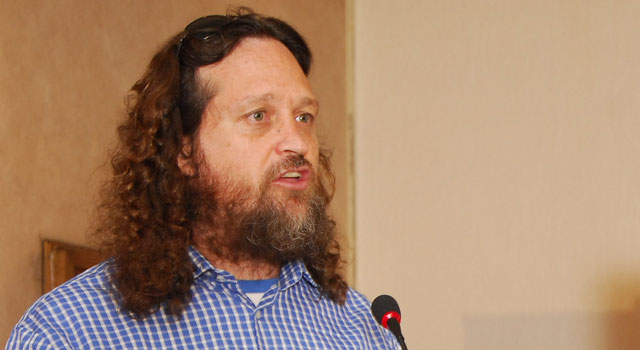
Justin Arenstein, 42, is an award-winning journalist, digital media strategist and media rights activist who believes the media’s role may become less one of reportage and more one of analysis as digital media grows and traditional media is forced to adapt or close shop.
Key to the shift that Arenstein believes is already underway is “data journalism”, which requires data of all kinds to be made available to the public.
An avid cook and science-fiction fanatic, Kenya-based Arenstein spends about a week a month in SA and the rest of the time travelling around Africa working for Google and the Washington-based International Center for Journalists.
He visits the US once every couple of months for work and to catch up with friends and peers having recently spent time there on a fellowship to Stanford University.
Despite attending one of the most prestigious universities in the US, Arenstein says his early academic career was anything but illustrious. He dropped out of a journalism course at a Pretoria technikon in the early 1990s and moved to Mpumalanga to get involved in political and investigative reporting.
“I cut my teeth at a small outfit where I basically ran the whole show,” he says. “We were doing some good pieces that the Mail & Guardian started picking up on. [Parent] Caxton didn’t really like the route we were going, and when we started asking for equal pay for black and white staff they fired me and forced me to go off with the guys being dismissed.”
Arenstein then started African Eye News Service (AENS) and worked for the Sunday Times and the Mail & Guardian. Sharon Hammond, another former Caxton employee and now Arenstein’s life partner, resigned in protest at Arenstein’s dismissal. The two sued, won, and used the money to grow the news agency.
“I was forced to be entrepreneurial. AENS didn’t have much money, so we had to find more effective and cost-efficient means to produce stories. If it wasn’t for e-mail, I probably wouldn’t have a career,” Arenstein explains. “That appreciation early on opened my eyes to the potential benefits of digital media.”
Within a year of its founding, a number of UK and US publications were running AENS content. Soon the company was also supplying content to Chinese, Indian and Australian media outlets.
“We established ourselves as a staff-owned, journalist collective,” says Arenstein. “Then we started signing up members in 16 countries all over sub-Saharan Africa, as far north as Kenya.” It wasn’t long before big news agencies such as the SA Press Association and Agence France-Presse were picking up AENS content.
“What no one else had done was consistently apply investigative standards from the national press to rural areas,” says Arenstein. “Because we were embedded in these areas we had a better sense of context and a deeper understanding of them.”
A number of political figures were dismissed or disciplined as a result of AENS stories, but Arenstein was nevertheless becoming disillusioned. “Eventually, after doing political muck-raking for going on 12 years and, realising that, substantively, nothing much was changing, I was facing burnout.”
Media activism
Arenstein shifted his focus to media activism and to creating networks and organisations to improve the quality and sustainability of investigative journalism.
This led to him cofounding the Forum for African Investigative Reporters, the Association for Independent Publishers — a township association of media owners seeking equal access to premium rates — and Safrea, the SA Freelancers Association, which seeks to set minimum rates for freelancers and set up guidelines for issues like copyright.
Arenstein and Hammond also partnered with an Mpumalanga-based entrepreneur, Louis van der Merwe, to start regional magazines designed to showcase and talk to “sophisticated rural lifestyles” in Limpopo, Mpumalanga and KwaZulu-Natal.
Arenstein was also part of a consortium that secured the only commercial license granted to an Mpumalanga radio station and helped to start MPowerFM, which is still operating today.
“Initially the titles did very well and we got a number of buy-out offers, but then the recession hit and advertising dried up.” Arenstein says both the radio station and the magazines faced the same problem: access to national advertising through conglomerate-owned or controlled procurement agencies, and in the case of the magazines, access to conglomerate-controlled distribution companies.
“It’s not just publishers or broadcasters that control the public’s access to information,” Arenstein says. “Behind each media vehicle are advertising procurement agencies, distribution companies, or even printers that are owned or beholden to large media companies. If you’re a small player and you’re not in one of the big cities it’s a struggle to get any face time with these gatekeepers.”
Stanford sojourn
In 2009, Arenstein was offered a fellowship by the prestigious Knight Foundation that took him to Stanford University in Palo Alto, the heart of Silicon Valley in California. He spent a year there, working in the computer science, business and engineering faculties, and looking into subjects such as augmented reality and mobile-based news development.
“The fellowship offered a journalism programme at a university without a journalism school,” says Arenstein. “The idea is to embed midcareer journos into what is a technology-focused university and allow us to rethink our approach to the profession or craft.”
The programme had traditionally involved studying politics or literature, but in Arenstein’s year the university decided that fellows would have to work on “tangible projects”.
Arenstein used his time at Stanford to create partnerships and networks that he used to kick-start data journalism and innovation projects when he returned to Africa.
He now works as a consulting strategist for Google and for the International Center for Journalists in Washington where he is embedded in its African Media Initiative (AMI).
The AMI is Africa’s largest umbrella association of media owners and includes 800 of the largest media companies on the continent. Heading up AMI’s digital programme, Arenstein says the ultimate goal is not simply to create a handful of projects, but to create an “ecosystem of cross-pollinating and interdependent initiatives that will build a robust and self-sustaining system that doesn’t need external support”.
The future of media
Arenstein explains that what happened to “legacy” media in Europe and the US is they didn’t understand that the shifting of audiences meant their business models needed to change, too.
When eyeballs moved online, advertising followed. Listings, property, tenders and other advertisements had been the backbone of the traditional media. Arenstein says even established titles with healthy followings and content inventories, couldn’t “repurpose” quickly enough.
Africa, meanwhile, was spared much of the trauma because the shift didn’t happen at the same time and wasn’t as rapid. But advertising has shifted to other companies, especially mobile operators. “Even in SA, the largest advertising platforms are no longer legacy media but now mobile companies. Operators are now larger platforms than the likes of Avusa and Naspers.”
Arenstein believes Africa has the opportunity to leapfrog some of the disruption seen elsewhere by learning where it happens and the remedial measures that have paid dividends. African media houses can try to replicate the best solutions here, tailored to local market conditions. “This is what my digital programme is trying to create.”
One of the AMI’s projects, Code4Kenya, is putting developers in newsrooms to start turning editorial inventory into structured data. Arenstein likens the process to reprocessing the mine dumps around Johannesburg.
By digitising content, adding geo-tags and other metadata and opening the archives of data to third parties for development, Arenstein says traditional media outlets can engage in revenue share models where their existing data can be “repurposed”.
Arenstein says some African publications now opt for a “digital-first” rather than a “print-first” approach to their content, but they should instead adopt a “data-first” approach.
Contemporary media revenue models can’t rely only on advertising. “There’s a need for new revenue streams – from syndicating original content to creating robust data services that disaggregate and atomise content into raw data so that it is platform agnostic.”
SA resisting change
Despite success in East Africa, Arenstein says SA media outlets are resistant to the idea of data-led journalism, largely due to what he calls “complacency and arrogance”.
“There’s the problem of SA believing it doesn’t have much to learn from Africa, when in fact many other African markets outpace SA, at least when it comes to innovation, and there’s the complacency, especially from the big, entrenched players, that they’re too big to fail. That’s simply not true.”
Arenstein says SA is seeing the same downward spiral and fragmentation of advertising revenue that happened in developed markets, with margins being squeezed dramatically.
“Traditional media is often threatened by citizen reporting,” Arenstein says. “But if we can outsource the day-to-day reportage and focus on the ‘why’, we can fulfil a valuable niche.”
SA tends to report issues like service delivery protests as if they were traffic accidents, with only information about the details of time and place and demands, but without analysis of the causes, triggers, or consideration of other data like census information or studies of living conditions, he says.
“Can we predict where these things will happen? We have the data, we just need to use it analytically. The SA media is failing the public because it’s not telling those stories in a meaningful way.”
Even a simple data scraper could take information automatically from stories and pin it to digital maps and timelines. Arenstein says the same is true of issues like corruption, government budgets, procurement and business.
“Even the blue-chip media outlets … are not looking at the more important underlying trends. They report the corruption but don’t dig down to see what’s causing it. A media that fails to do that, well, should it even have a future?”
Open data
Arenstein says all data of public interest should be made available, from school results to municipalities’ performances to local projects and spending.
“Opening up school data could impact the property industry.”
Arenstein says he’s starting to see these unexpected effects of making this data available in places like Kenya. “Access to this information builds more civic engagement with government,” he says. “But it also promotes political discourse, which is where the media play. They stop being reporters and become analysts and arbitrators. It forces the media to evolve up the food chain.”
Perhaps the role of the media is to become what Arenstein calls “sense makers” –the people who make sense of the overwhelming flood of information we’re forced to contend with daily. — (c) 2012 NewsCentral Media