Close Menu
TechCentralTechCentral

    Subscribe to the newsletter

    Get the best South African technology news and analysis delivered to your e-mail inbox every morning.

    Facebook X (Twitter) YouTube LinkedIn
    WhatsApp Facebook X (Twitter) LinkedIn YouTube
    TechCentralTechCentral
    • News
      Vula Medical named as South Africa's 2025 app of the year

      Vula Medical named as South Africa’s 2025 app of the year

      5 December 2025
      Netflix, Warner Bros talks raise fresh headaches for MultiChoice

      Netflix, Warner Bros talks raise fresh headaches for MultiChoice

      5 December 2025
      Big Microsoft 365 price increases coming next year

      Big Microsoft price increases coming next year

      5 December 2025
      Vodacom to take control of Safaricom in R36-billion deal - Shameel Joosub

      Vodacom to take control of Safaricom in R36-billion deal

      4 December 2025
      Black Friday goes digital in South Africa as online spending surges to record high

      Black Friday goes digital in South Africa as online spending surges to record high

      4 December 2025
    • World
      Amazon and Google launch multi-cloud service for faster connectivity

      Amazon and Google launch multi-cloud service for faster connectivity

      1 December 2025
      Google makes final court plea to stop US breakup

      Google makes final court plea to stop US breakup

      21 November 2025
      Bezos unveils monster rocket: New Glenn 9x4 set to dwarf Saturn V

      Bezos unveils monster rocket: New Glenn 9×4 set to dwarf Saturn V

      21 November 2025
      Tech shares turbocharged by Nvidia's stellar earnings

      Tech shares turbocharged by stellar Nvidia earnings

      20 November 2025
      Config file blamed for Cloudflare meltdown that disrupted the web

      Config file blamed for Cloudflare meltdown that disrupted the web

      19 November 2025
    • In-depth
      Jensen Huang Nvidia

      So, will China really win the AI race?

      14 November 2025
      Valve's Linux console takes aim at Microsoft's gaming empire

      Valve’s Linux console takes aim at Microsoft’s gaming empire

      13 November 2025
      iOCO's extraordinary comeback plan - Rhys Summerton

      iOCO’s extraordinary comeback plan

      28 October 2025
      Why smart glasses keep failing - no, it's not the tech - Mark Zuckerberg

      Why smart glasses keep failing – it’s not the tech

      19 October 2025
      BYD to blanket South Africa with megawatt-scale EV charging network - Stella Li

      BYD to blanket South Africa with megawatt-scale EV charging network

      16 October 2025
    • TCS
      TCS+ | How Cloud on Demand helps partners thrive in the AWS ecosystem - Odwa Ndyaluvane and Xenia Rhode

      TCS+ | How Cloud On Demand helps partners thrive in the AWS ecosystem

      4 December 2025
      TCS | MTN Group CEO Ralph Mupita on competition, AI and the future of mobile

      TCS | Ralph Mupita on competition, AI and the future of mobile

      28 November 2025
      TCS | Dominic Cull on fixing South Africa's ICT policy bottlenecks

      TCS | Dominic Cull on fixing South Africa’s ICT policy bottlenecks

      21 November 2025
      TCS | BMW CEO Peter van Binsbergen on the future of South Africa's automotive industry

      TCS | BMW CEO Peter van Binsbergen on the future of South Africa’s automotive industry

      6 November 2025
      TCS | Why Altron is building an AI factory - Bongani Andy Mabaso

      TCS | Why Altron is building an AI factory in Johannesburg

      28 October 2025
    • Opinion
      Your data, your hardware: the DIY AI revolution is coming - Duncan McLeod

      Your data, your hardware: the DIY AI revolution is coming

      20 November 2025
      Zero Carbon Charge founder Joubert Roux

      The energy revolution South Africa can’t afford to miss

      20 November 2025
      It's time for a new approach to government IT spend in South Africa - Richard Firth

      It’s time for a new approach to government IT spend in South Africa

      19 November 2025
      How South Africa's broken Rica system fuels murder and mayhem - Farhad Khan

      How South Africa’s broken Rica system fuels murder and mayhem

      10 November 2025
      South Africa's AI data centre boom risks overloading a fragile grid - Paul Colmer

      South Africa’s AI data centre boom risks overloading a fragile grid

      30 October 2025
    • Company Hubs
      • Africa Data Centres
      • AfriGIS
      • Altron Digital Business
      • Altron Document Solutions
      • Altron Group
      • Arctic Wolf
      • AvertITD
      • Braintree
      • CallMiner
      • CambriLearn
      • CYBER1 Solutions
      • Digicloud Africa
      • Digimune
      • Domains.co.za
      • ESET
      • Euphoria Telecom
      • Incredible Business
      • iONLINE
      • IQbusiness
      • Iris Network Systems
      • LSD Open
      • NEC XON
      • Netstar
      • Network Platforms
      • Next DLP
      • Ovations
      • Paracon
      • Paratus
      • Q-KON
      • SevenC
      • SkyWire
      • Solid8 Technologies
      • Telit Cinterion
      • Tenable
      • Vertiv
      • Videri Digital
      • Vodacom Business
      • Wipro
      • Workday
      • XLink
    • Sections
      • AI and machine learning
      • Banking
      • Broadcasting and Media
      • Cloud services
      • Contact centres and CX
      • Cryptocurrencies
      • Education and skills
      • Electronics and hardware
      • Energy and sustainability
      • Enterprise software
      • Financial services
      • Information security
      • Internet and connectivity
      • Internet of Things
      • Investment
      • IT services
      • Lifestyle
      • Motoring
      • Public sector
      • Retail and e-commerce
      • Satellite communications
      • Science
      • SMEs and start-ups
      • Social media
      • Talent and leadership
      • Telecoms
    • Events
    • Advertise
    TechCentralTechCentral
    Home » Editor's pick » How mankind landed a robot on a comet

    How mankind landed a robot on a comet

    By The Conversation13 November 2014
    Twitter LinkedIn Facebook WhatsApp Email Telegram Copy Link
    News Alerts
    WhatsApp
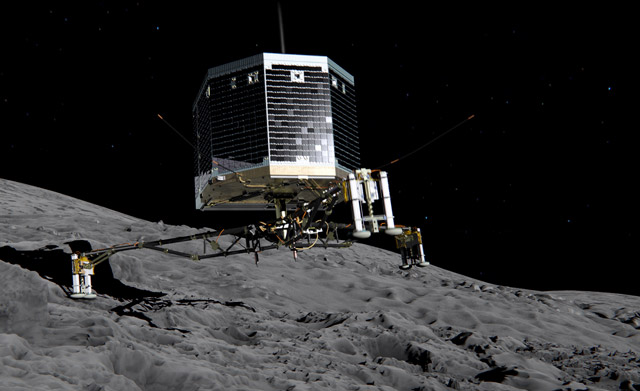
    Still image from animation of Philae separating from Rosetta and descending to the surface of comet 67P/Churyumov-Gerasimenko in November 2014 (image c/o ESA/ATG medialab)
    Still image from animation of Philae separating from Rosetta and descending to the surface of comet 67P/Churyumov-Gerasimenko in November 2014 (ESA/ATG medialab)

    Imagine launching a robotic spacecraft on a 10-year mission to land on a comet 600m kilometres from Earth knowing that you will not be able to make any physical repairs to the craft during the journey. This daunting engineering challenge has been the ultimate goal of the European Space Agency’s (ESA’s) Rosetta mission.

    We know now that the landing has at least been in part successful, with the Philae lander touching down on the comet.

    This ground-breaking mission hopes to improve our understanding of the origin of the solar system, by performing direct measurements on the rocky, icy surface of comet 67P/Churyumov-Gerasimenko, which orbits the sun between Earth and Jupiter.

    In order to reach the comet, the Rosetta satellite has travelled a total distance of 6,4bn kilometres, gaining speed by swinging through the gravitational pull of Earth (three times) and Mars (once) along the way. Rosetta caught up with the comet in August 2014, and slowly entered a complex orbit.

    Rosetta deployed the Philae lander on the morning of 12 November. After a seven-hour descent and a tense wait in the control room, Philae touched down and radioed Earth via Rosetta to confirm success. Radio signals take 30 minutes to travel from Rosetta to Earth, and so the separation, descent and landing all happened semi-autonomously.

    The 100kg lander has 10 main scientific instruments on board, including gas, acoustic and magnetic sensors, two cameras, and three spectrometers, covering a wide range of wavelengths and compositions.

    The Rosetta and Philae craft have now survived 10 years in space, travelling at speeds up to 50 000km/h, without maintenance or repairs. It is rare that any piece of comparably sophisticated earthbound technology continues to work for 10 years without maintenance — to do it in space is an enormous technical accomplishment.
    Image of Comet 67P/Churyumov-Gerasimenko on 21 September 2014 (image: ESA/Rosetta/NAVCAM)
    Image of Comet 67P/Churyumov-Gerasimenko on 21 September 2014 (ESA/Rosetta/NAVCAM)

    In order to guarantee astronomical reliability, the craft were subjected to extensive lifetime and robustness testing on Earth. The aptly named Multishaker facility in the Netherlands, as well as the ESA’s Large Space Simulator, Europe’s largest vacuum chamber, put Rosetta through a series of gruelling vibration, thermal and vacuum tests prior to launch. The spacecraft was subjected to temperatures as low as -180°C and as high as 150°C.

    Despite these efforts, a number of unexpected difficulties emerged during the journey. In 2006, problems were identified in the system of thrusters and flywheels used to steer and orientate Rosetta, including a fuel leak and anomalous friction. In order to monitor thruster problems, Rosetta even used an on-board mass spectrometer to “sniff” its own exhaust.

    These issues have since been a considerable cause for concern, but are not catastrophic. Shortly before Philae’s descent, it emerged that the cold gas thruster used to push the lander towards the surface of the comet had failed, requiring a passive fall to the ground. Upon landing, Philae was supposed to use a system of harpoons to anchor itself, ensuring stability in the comet’s low gravity, but these may not have worked or failed. Philae is now clinging on using a less sophisticated technology: a set of three screws, which are driven into the comet’s surface.

    Philae will now rely on battery power to complete the first few days of experiments. After that, secondary batteries that are recharged by solar panels will provide power for a period of up to three months.

    This will be a fascinating time for the project, as Philae rides the warming, melting comet towards the sun. How long will the lander survive on the surface? To a large extent this will be determined by how much dust settles on the solar panels. Our research shows that dust can have a dramatic effect on the amount of power generated by solar panels in dry regions on Earth, even when the panel is perpendicular to the surface, such that dust has the least chance of sticking to the panels.

    Dust in the sun
    Part of the uncertainty comes from the fact that it is difficult to predict how much dust exists in the region of the comet, and how the local conditions affect its transport. In the case of Nasa’s Spirit rover, the mission lifetime was significantly extended by so-called “cleaning events” where the build-up of dust on the Rover’s solar array was removed by wind. These allowed the Rover to operate for much longer than the planned three-month mission.

    Not only do the solar panels provide power for the mission, but they also allow the Earth ground team to determine Philae’s orientation on the comet immediately after landing on the comet. By examining the generated power distribution from the solar panels, it is possible to determine their position relative to the sun from which Philae’s orientation can be deduced. The ground team can then move the lander such that the orientation of the solar panels is optimised, powering the mobile laboratory as efficiently as possible.

    Rosetta mission’s lifetime will stretch to March 2015 at the latest, when the comet is closer to the sun and the temperature will rise above practical operating conditions. But Philae will probably have been lost by that time. As Comet 67P gets closer to the sun, its interior will heat up, releasing dust and gas in the form of geysers and there is a good chance Philae might be hit by one of these and thrown into space.

    The ambitious nature of the Rosetta mission has captured the imaginations of millions of people around the world. As we cast our eyes to the sky in awe, it is important we stop to remember the vital multidisciplinary contribution of the scientists and engineers who have designed and created the essential instrumentation that could be vital to the ultimate success and lifetime of this thrilling endeavour.

    • The ConversationNeil Beattie is senior lecturer at Northumbria University, Newcastle
    • This article was originally published on The Conversation

    ESA European Space Agency Nasa Rosetta
    Subscribe to TechCentral Subscribe to TechCentral
    Share. Facebook Twitter LinkedIn WhatsApp Telegram Email Copy Link
    Previous ArticleCourt to rule on Cell C application
    Next Article Content, price crucial to Africa smartphone growth

    Related Posts

    Low-Earth orbit satellites - the way forward for Africa

    Why car companies like Toyota are turning to space

    14 February 2025

    Bookmarks | The number of new mobile internet users is stalling

    25 November 2024
    Bookmarks | Firefox at 20 - does Mozilla's browser still matter?

    Bookmarks | Firefox at 20 – does Mozilla’s browser still matter?

    14 November 2024
    Company News
    Beat the summer heat with Samsung's WindFree air conditioners

    Beat the summer heat with Samsung’s WindFree air conditioners

    5 December 2025
    AI is not a technology problem - iqbusiness

    AI is not a technology problem – iqbusiness

    5 December 2025
    Telcos are sitting on a data gold mine - but few know what do with it - Phillip du Plessis

    Telcos are sitting on a data gold mine – but few know what do with it

    4 December 2025
    Opinion
    Your data, your hardware: the DIY AI revolution is coming - Duncan McLeod

    Your data, your hardware: the DIY AI revolution is coming

    20 November 2025
    Zero Carbon Charge founder Joubert Roux

    The energy revolution South Africa can’t afford to miss

    20 November 2025
    It's time for a new approach to government IT spend in South Africa - Richard Firth

    It’s time for a new approach to government IT spend in South Africa

    19 November 2025

    Subscribe to Updates

    Get the best South African technology news and analysis delivered to your e-mail inbox every morning.

    Latest Posts
    Vula Medical named as South Africa's 2025 app of the year

    Vula Medical named as South Africa’s 2025 app of the year

    5 December 2025
    Beat the summer heat with Samsung's WindFree air conditioners

    Beat the summer heat with Samsung’s WindFree air conditioners

    5 December 2025
    Netflix, Warner Bros talks raise fresh headaches for MultiChoice

    Netflix, Warner Bros talks raise fresh headaches for MultiChoice

    5 December 2025
    Big Microsoft 365 price increases coming next year

    Big Microsoft price increases coming next year

    5 December 2025
    © 2009 - 2025 NewsCentral Media
    • Cookie policy (ZA)
    • TechCentral – privacy and Popia

    Type above and press Enter to search. Press Esc to cancel.

    Manage consent

    TechCentral uses cookies to enhance its offerings. Consenting to these technologies allows us to serve you better. Not consenting or withdrawing consent may adversely affect certain features and functions of the website.

    Functional Always active
    The technical storage or access is strictly necessary for the legitimate purpose of enabling the use of a specific service explicitly requested by the subscriber or user, or for the sole purpose of carrying out the transmission of a communication over an electronic communications network.
    Preferences
    The technical storage or access is necessary for the legitimate purpose of storing preferences that are not requested by the subscriber or user.
    Statistics
    The technical storage or access that is used exclusively for statistical purposes. The technical storage or access that is used exclusively for anonymous statistical purposes. Without a subpoena, voluntary compliance on the part of your Internet Service Provider, or additional records from a third party, information stored or retrieved for this purpose alone cannot usually be used to identify you.
    Marketing
    The technical storage or access is required to create user profiles to send advertising, or to track the user on a website or across several websites for similar marketing purposes.
    • Manage options
    • Manage services
    • Manage {vendor_count} vendors
    • Read more about these purposes
    View preferences
    • {title}
    • {title}
    • {title}