Close Menu
TechCentralTechCentral

    Subscribe to the newsletter

    Get the best South African technology news and analysis delivered to your e-mail inbox every morning.

    Facebook X (Twitter) YouTube LinkedIn
    WhatsApp Facebook X (Twitter) LinkedIn YouTube
    TechCentralTechCentral
    • News
      AI literacy goes mainstream in South Africa's jobs market

      AI literacy goes mainstream in South Africa’s jobs market

      14 April 2026
      Anthropic tightens the screws on OpenAI

      Anthropic tightens the screws on OpenAI

      14 April 2026
      The end of MultiChoice as we know it

      The end of MultiChoice as we know it

      13 April 2026
      Thyspunt emerges as frontrunner for new Eskom nuclear plant

      Thyspunt emerges as frontrunner for new Eskom nuclear plant

      13 April 2026
      Streaming platform bags rights for Fifa World Cup in South Africa

      Streaming platform bags rights for Fifa World Cup in South Africa

      13 April 2026
    • World
      Google poised to lose ad crown to Meta

      Google poised to lose ad crown to Meta

      14 April 2026
      Grand Theft Data - hackers hit Rockstar Games - Grand Theft Auto

      Grand Theft Data – hackers hit Rockstar Games

      14 April 2026
      UK PM Keir Starmer declares war on doomscrolling

      UK PM Keir Starmer declares war on doomscrolling

      13 April 2026
      Big Tech is going nuclear

      Big Tech is going nuclear

      10 April 2026
      Software rout deepens as AI fears grip investors

      Software rout deepens as AI fears grip investors

      10 April 2026
    • In-depth
      Africa switches on as Europe dims the lights

      Africa switches on as Europe dims the lights

      9 April 2026
      The biggest untapped EV market on Earth is hiding in plain sight

      The biggest untapped EV market on Earth is hiding in plain sight

      1 April 2026
      The R18-billion tech giant hiding in plain sight - Jens Montanana

      The R16-billion tech giant hiding in plain sight

      26 March 2026
      The last generation of coders

      The last generation of coders

      18 February 2026
      Sentech is in dire straits

      Sentech is in dire straits

      10 February 2026
    • TCS
      TCS+ | Vodacom Business moves to crack the SME tech gap - Andrew Fulton, Sannesh Beharie

      TCS+ | Vodacom Business moves to crack the SME tech gap

      7 April 2026
      TCS | MTN's Divysh Joshi on the strategy behind Pi - Divyesh Joshi

      TCS | MTN’s Divyesh Joshi on the strategy behind Pi

      1 April 2026
      Anoosh Rooplal

      TCS | Anoosh Rooplal on the Post Office’s last stand

      27 March 2026
      Meet the CIO | HealthBridge CTO Anton Fatti on the future of digital health

      Meet the CIO | Healthbridge CTO Anton Fatti on the future of digital health

      23 March 2026
      TCS+ | Arctic Wolf unpacks the evolving threat landscape for SA businesses - Clare Loveridge and Jason Oehley

      TCS+ | Arctic Wolf unpacks the evolving threat landscape for SA businesses

      19 March 2026
    • Opinion
      The conflict of interest at the heart of PayShap's slow adoption - Cheslyn Jacobs

      The conflict of interest at the heart of PayShap’s slow adoption

      26 March 2026
      South Africa's energy future hinges on getting wheeling right - Aishah Gire

      South Africa’s energy future hinges on getting wheeling right

      10 March 2026
      Hold the doom: the case for a South African comeback - Duncan McLeod

      Apple just dropped a bomb on the Windows world

      5 March 2026
      R230-million in the bag for Endeavor's third Harvest Fund - Alison Collier

      VC’s centre of gravity is shifting – and South Africa is in the frame

      3 March 2026
      Hold the doom: the case for a South African comeback - Duncan McLeod

      Hold the doom: the case for a South African comeback

      26 February 2026
    • Company Hubs
      • 1Stream
      • Africa Data Centres
      • AfriGIS
      • Altron Digital Business
      • Altron Document Solutions
      • Altron Group
      • Arctic Wolf
      • Ascent Technology
      • AvertITD
      • BBD
      • Braintree
      • CallMiner
      • CambriLearn
      • CYBER1 Solutions
      • Digicloud Africa
      • Digimune
      • Domains.co.za
      • ESET
      • Euphoria Telecom
      • HOSTAFRICA
      • Incredible Business
      • iONLINE
      • IQbusiness
      • Iris Network Systems
      • Kaspersky
      • LSD Open
      • Mitel
      • NEC XON
      • Netstar
      • Network Platforms
      • Next DLP
      • Ovations
      • Paracon
      • Paratus
      • Q-KON
      • SevenC
      • SkyWire
      • Solid8 Technologies
      • Telit Cinterion
      • Telviva
      • Tenable
      • Vertiv
      • Videri Digital
      • Vodacom Business
      • Wipro
      • Workday
      • XLink
    • Sections
      • AI and machine learning
      • Banking
      • Broadcasting and Media
      • Cloud services
      • Contact centres and CX
      • Cryptocurrencies
      • Education and skills
      • Electronics and hardware
      • Energy and sustainability
      • Enterprise software
      • Financial services
      • HealthTech
      • Information security
      • Internet and connectivity
      • Internet of Things
      • Investment
      • IT services
      • Lifestyle
      • Motoring
      • Policy and regulation
      • Public sector
      • Retail and e-commerce
      • Satellite communications
      • Science
      • SMEs and start-ups
      • Social media
      • Talent and leadership
      • Telecoms
    • Events
    • Advertise
    TechCentralTechCentral
    Home » Sections » Internet and connectivity » Google’s internet balloons failed – but the concept lives on

    Google’s internet balloons failed – but the concept lives on

    A third of the world’s population lacks internet connectivity. Airborne communications stations could still change that.
    By The Conversation31 August 2024
    Twitter LinkedIn Facebook WhatsApp Email Telegram Copy Link
    News Alerts
    WhatsApp
    Google's internet balloons failed - but the concept lives on
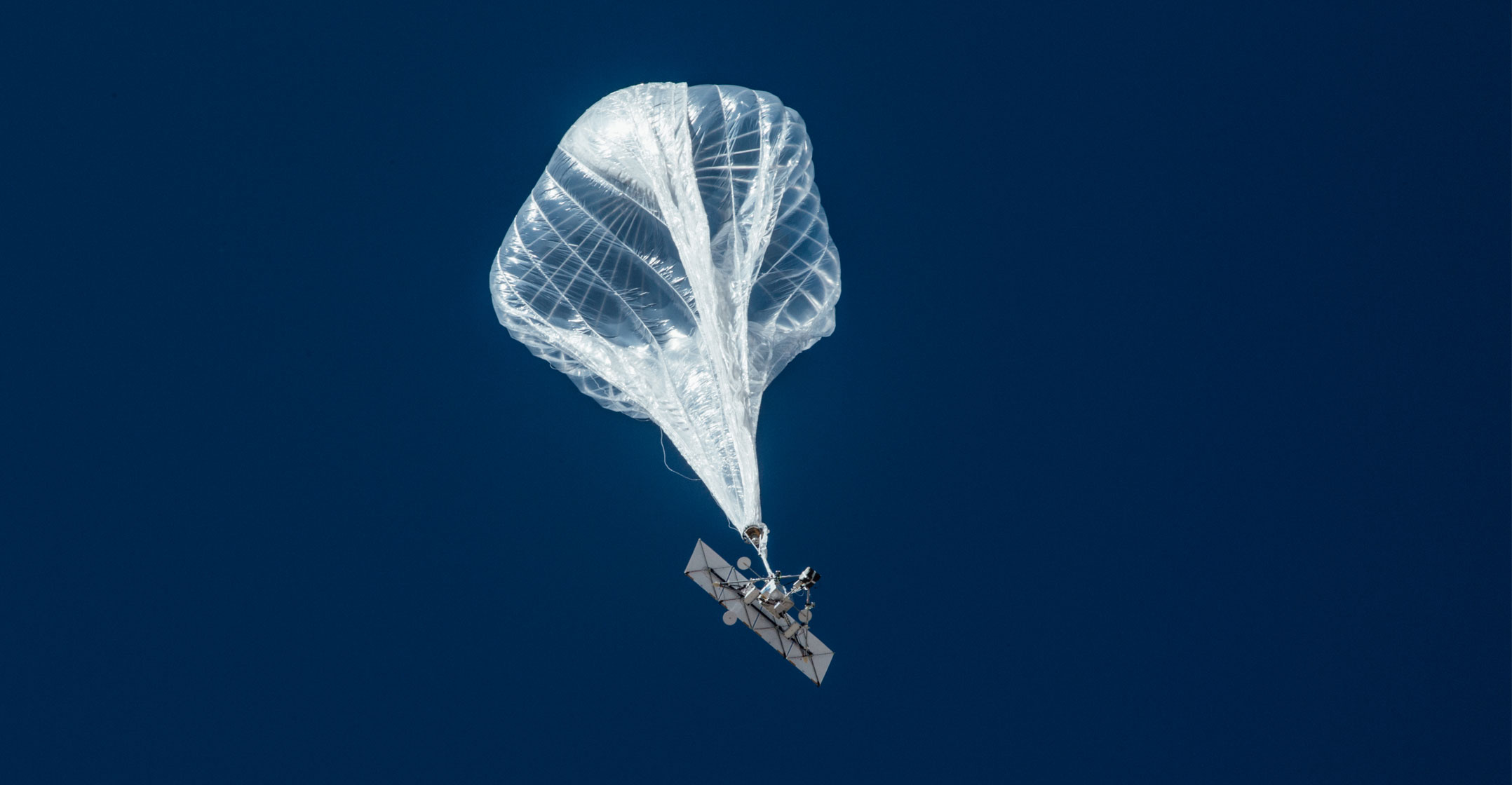
    A Project Loon internet balloon. Google pulled the plug on the project

    About a third of the global population, around three billion people, don’t have access to the internet or have poor connections because of infrastructure limitations, economic disparities and geographic isolation.

    Today’s satellites and ground-based networks leave communications gaps where, because of geography, setting up traditional ground-based communications equipment would be too expensive.

    High-altitude platform stations – telecommunications equipment positioned high in the air, on uncrewed balloons, airships, gliders and aeroplanes – could increase social and economic equality by filling internet connectivity gaps in ground and satellite coverage. This could allow more people to participate fully in the digital age.

    Early attempts by Facebook and Google to commercially deploy platform stations were unsuccessful

    One of us, Mohamed-Slim Alouini, is an electrical engineer who contributed to an experiment that showed it is possible to provide high data rates and ubiquitous 5G coverage from the stratosphere. The stratosphere is the second lowest layer of the atmosphere, ranging from 6.5km to 48km above the Earth. Commercial planes usually fly in the lower part of the stratosphere. The experiment measured signals between platform stations and users on the ground in three scenarios: a person staying in one place, a person driving a car and a person operating a boat.

    My colleagues measured how strong the signal is in relation to interference and background noise levels. This is one of the measures of network reliability. The results showed that the platform stations can support high-data-rate applications such as streaming 4K resolution videos and can cover 15-20x the area of standard terrestrial towers.

    Changing the equation

    Early attempts by Facebook and Google to commercially deploy platform stations were unsuccessful. But recent investments, technological improvements and interest from traditional aviation companies and specialised aerospace startups may change the equation.

    The goal is global connectivity, a cause that brought the platform stations idea recognition in the World Economic Forum’s 2024 Top 10 Emerging Technologies report. The international industry initiative HAPS Alliance, which includes academic partners, is also pushing towards that goal.

    Read: Tethered balloons to connect rural Africa in new trial

    Platform stations would be faster, more cost effective and more flexible than satellite-based systems. Because they keep communications equipment closer to Earth than satellites, the stations could offer stronger, higher-capacity signals. This would enable real-time communications speedy enough to communicate with standard smartphones, high-resolution capabilities for imaging tasks and greater sensitivity for sensing applications. They transmit data via free-space optics, or light beams, and large-scale antenna array systems, which can send large amounts of data quickly.

    Satellites can be vulnerable to eavesdropping or jamming when their orbits bring them over adversarial countries. But platform stations remain within the airspace of a single country, which reduces that risk.

    High-altitude platform stations are also easier to put in place than satellites, which have high launch and maintenance costs. And the regulatory requirements and compliance procedures required to secure spots in the stratosphere are likely to be simpler than the complex international laws governing satellite orbits. Platform stations are also easier to upgrade, so improvements could be deployed more quickly.

    Platform stations are also potentially less polluting than satellite mega-constellations because satellites burn up upon re-entry and can release harmful metals into the atmosphere, while platform stations can be powered by clean energy sources such as solar and green hydrogen.

    The key challenges to practical platform stations are increasing the amount of time they can stay aloft to months at a time, boosting green onboard power and improving reliability – especially during automated take-off and landing through the lower turbulent layers of the atmosphere.

    Beyond satellites

    Platform stations could play a critical role in emergency and humanitarian situations by supporting relief efforts when ground-based networks are damaged or inoperative.

    The stations could also connect internet of things (IoT) devices and sensors in remote settings to better monitor the environment and manage resources.

    In agriculture, the stations could use imaging and sensing technologies to help farmers monitor crop health, soil conditions and water resources.

    Their capability for high-resolution imaging could also support navigation and mapping activities crucial for cartography, urban planning and disaster response.

    The stations could also do double duty by carrying instruments for atmospheric monitoring, climate studies and remote sensing of Earth’s surface features, vegetation and oceans.

    Satellite solutions aren’t all they’re cracked up to be

    From balloons to airplanes

    Platform stations could be based on different types of aircraft.

    Balloons offer stable, long-duration operation at high altitudes and can be tethered or free-floating. Airships, also known as dirigibles or blimps, use lighter-than-air gases and are larger and more manoeuvrable than balloons. They’re especially well-suited for surveillance, communications and research.

    Gliders and powered aircraft can be controlled more precisely than balloons, which are sensitive to variations in wind speed. In addition, powered aircraft, which include drones and fixed-wing airplanes, can provide electricity to communication equipment, sensors and cameras.

    Next-generation power

    Platform stations could make use of diverse power sources, including increasingly lightweight and efficient solar cells, high-energy-density batteries, green hydrogen internal combustion engines, green hydrogen fuel cells, which are now at the testing stage, and eventually, laser beam powering from ground- or space-based solar stations.

    The evolution of lightweight aircraft designs coupled with advancements in high-efficiency motors and propellers enable planes to fly longer and carry heavier payloads. These cutting-edge lightweight planes could lead to platform stations capable of manoeuvring in the stratosphere for extended periods.

    Meanwhile, improvements in stratospheric weather models and atmospheric models make it easier to predict and simulate the conditions under which the platform stations would operate.

    Bridging the global digital divide

    Commerical deployment of platform stations, at least for post-disaster or emergency situations, could be in place by the end of the decade. For instance, a consortium in Japan, a country with remote mountainous and island communities, has earmarked US$100-million for solar-powered, high-altitude platform stations.

    Platform stations could bridge the digital divide by increasing access to critical services such as education and health care, providing new economic opportunities and improving emergency response and environmental monitoring. As advances in technology continue to drive their evolution, platform stations are set to play a crucial role in a more inclusive and resilient digital future.The Conversation

    • The authors are Mohamed-Slim Alouini, distinguished professor of electrical & computer engineering, King Abdullah University of Science and Technology, and Mariette DiChristina, dean and professor of the practice in journalism, College of Communication, Boston University
    • This article is republished from The Conversation under a Creative Commons licence

    Don’t miss:

    Is it a barrage balloon? No, it’s a Stellenbosch airship

    Follow TechCentral on Google News Add TechCentral as your preferred source on Google


    Facebook Google Mariette DiChristina Mohamed-Slim Alouini Project Loon
    WhatsApp YouTube
    Share. Facebook Twitter LinkedIn WhatsApp Telegram Email Copy Link
    Previous ArticleBehind the arrest of Telegram boss Pavel Durov
    Next Article Former MTN Group CEO Sifiso Dabengwa has died

    Related Posts

    Google poised to lose ad crown to Meta

    Google poised to lose ad crown to Meta

    14 April 2026
    Anthropic tightens the screws on OpenAI

    Anthropic tightens the screws on OpenAI

    14 April 2026
    Big Tech is going nuclear

    Big Tech is going nuclear

    10 April 2026
    Company News
    South Africa's identity and payments shift that most businesses missed - Contactable

    South Africa’s identity and payments shift that most businesses missed

    14 April 2026
    Simplify Microsoft Teams calling with Telviva - Rob Lith

    Simplify Microsoft Teams calling with Telviva

    14 April 2026
    The hidden risk in South Africa's payment infrastructure - AfriGIS

    The hidden risk in South Africa’s payment infrastructure

    14 April 2026
    Opinion
    The conflict of interest at the heart of PayShap's slow adoption - Cheslyn Jacobs

    The conflict of interest at the heart of PayShap’s slow adoption

    26 March 2026
    South Africa's energy future hinges on getting wheeling right - Aishah Gire

    South Africa’s energy future hinges on getting wheeling right

    10 March 2026
    Hold the doom: the case for a South African comeback - Duncan McLeod

    Apple just dropped a bomb on the Windows world

    5 March 2026

    Subscribe to Updates

    Get the best South African technology news and analysis delivered to your e-mail inbox every morning.

    Latest Posts
    AI literacy goes mainstream in South Africa's jobs market

    AI literacy goes mainstream in South Africa’s jobs market

    14 April 2026
    South Africa's identity and payments shift that most businesses missed - Contactable

    South Africa’s identity and payments shift that most businesses missed

    14 April 2026
    Simplify Microsoft Teams calling with Telviva - Rob Lith

    Simplify Microsoft Teams calling with Telviva

    14 April 2026
    The hidden risk in South Africa's payment infrastructure - AfriGIS

    The hidden risk in South Africa’s payment infrastructure

    14 April 2026
    © 2009 - 2026 NewsCentral Media
    • Cookie policy (ZA)
    • TechCentral – privacy and Popia

    Type above and press Enter to search. Press Esc to cancel.

    Manage consent

    TechCentral uses cookies to enhance its offerings. Consenting to these technologies allows us to serve you better. Not consenting or withdrawing consent may adversely affect certain features and functions of the website.

    Functional Always active
    The technical storage or access is strictly necessary for the legitimate purpose of enabling the use of a specific service explicitly requested by the subscriber or user, or for the sole purpose of carrying out the transmission of a communication over an electronic communications network.
    Preferences
    The technical storage or access is necessary for the legitimate purpose of storing preferences that are not requested by the subscriber or user.
    Statistics
    The technical storage or access that is used exclusively for statistical purposes. The technical storage or access that is used exclusively for anonymous statistical purposes. Without a subpoena, voluntary compliance on the part of your Internet Service Provider, or additional records from a third party, information stored or retrieved for this purpose alone cannot usually be used to identify you.
    Marketing
    The technical storage or access is required to create user profiles to send advertising, or to track the user on a website or across several websites for similar marketing purposes.
    • Manage options
    • Manage services
    • Manage {vendor_count} vendors
    • Read more about these purposes
    View preferences
    • {title}
    • {title}
    • {title}