Close Menu
TechCentralTechCentral

    Subscribe to the newsletter

    Get the best South African technology news and analysis delivered to your e-mail inbox every morning.

    Facebook X (Twitter) YouTube LinkedIn
    WhatsApp Facebook X (Twitter) LinkedIn YouTube
    TechCentralTechCentral
    • News
      Eskom fixed the fleet and the customers left

      Eskom fixed the fleet and the customers left

      7 August 2026
      DStv chops channels as Canal+ leans harder on sport

      DStv chops channels as Canal+ leans harder on sport

      7 August 2026
      Starlink LEO rival gaining momentum

      Starlink LEO rival gaining momentum

      7 August 2026
      ByteDance goes big - very big - on AI

      ByteDance goes big – very big – on AI

      7 August 2026
      ICT is becoming the centre of gravity at Reunert - Anthonie de Beer and Rob Godlonton

      ICT is becoming the centre of gravity at Reunert

      6 August 2026
    • World
      Meta AI will now tell parents if their teen is in crisis

      Meta AI will now tell parents if their teen is in crisis

      17 July 2026
      IBM shares crash 25% as AI upends software spending - Arvind Krishna

      IBM shares crash 25% as AI upends software spending

      15 July 2026
      Jony Ive's first OpenAI device: an AI smart speaker - Jony Ive and Sam Altman

      Jony Ive’s first OpenAI device: an AI smart speaker

      15 July 2026
      Stripe, Advent in talks to buy PayPal for $53-billion

      Stripe, Advent in talks to buy PayPal for $53-billion

      15 July 2026
      Memory crisis sends smartphone market into steep decline

      Memory crisis sends smartphone market into steep decline

      13 July 2026
    • In-depth
      The plan to stop AI from breaking the world - Google DeepMind CEO Demis Hassabis. Image: John Sears

      The plan to stop AI from breaking the world

      16 July 2026
      The internet has a Strait of Hormuz problem

      The internet has a Strait of Hormuz problem

      15 July 2026
      AI boom sparks rally, frenzy and fear

      AI boom sparks rally, frenzy and fear

      11 June 2026
      Every plug-in hybrid on sale in South Africa, ranked by price - Lamborghini Temerario

      Every plug-in hybrid on sale in South Africa, ranked by price

      7 June 2026
      What Wi-Fi 8 will mean for wireless networks

      What Wi-Fi 8 will mean for wireless networks

      1 June 2026
    • TCS
      TCS+ | Specops' Darren James on continuous trust in an AI world

      TCS+ | Specops’ Darren James on continuous trust in an AI world

      7 August 2026
      TCS+ | How AI is turning hardware into a subscription service - Shane van der Merwe Merchant West

      TCS+ | How AI is turning hardware into a subscription service

      6 August 2026
      TCS+ | Why South African workers must become supervisors of digital labour - Accelera Digital Group Cliff de Wit

      TCS+ | Why South African workers must become supervisors of digital labour

      31 July 2026
      TCS | Rapid deployment rules can't work without municipalities: ACT - Nomvuyiso Batyi

      TCS | Icasa’s rules skip the real bottleneck: ACT

      30 July 2026
      TCS+ | iStore Business on why Apple makes sense for SMEs - Sudesh Pillay and Tamia Nontsikelelo

      TCS+ | iStore Business on why Apple makes sense for SMEs

      30 July 2026
    • Opinion
      The author, Jannie van Zyl

      Selling vapour is corporate suicide in slow motion

      16 July 2026
      Brazil's online gambling crackdown is a lesson for South Africa

      How Amazon outmanoeuvred Starlink in South Africa

      15 July 2026
      The Popia problem with agentic AI - Herman Haasbroek

      The Popia problem with agentic AI

      14 July 2026
      The author, Fanie van Rooyen

      South Africa can still catch the AI wave – here’s how

      7 July 2026
      The author, Fanie van Rooyen

      The AI utopia South Africa can’t afford

      1 July 2026
    • Company Hubs
      • 1Stream
      • Africa Data Centres
      • AfriGIS
      • Altron Digital Business
      • Altron Document Solutions
      • Altron Group
      • Arctic Wolf
      • Ascent Technology
      • AvertITD
      • BBD
      • Braintree
      • CallMiner
      • CambriLearn
      • CM Telecom
      • Contactable
      • CYBER1 Solutions
      • Digicloud Africa
      • Digimune
      • Domains.co.za
      • ESET
      • Euphoria Telecom
      • HOSTAFRICA
      • Incredible Business
      • iONLINE
      • IQbusiness
      • Iris Network Systems
      • Kaspersky
      • LSD Open
      • Mitel
      • NEC XON
      • Netstar
      • Network Platforms
      • Next DLP
      • Ovations
      • Paracon
      • Paratus
      • Q-KON
      • SevenC
      • SkyWire
      • Solid8 Technologies
      • Telit Cinterion
      • Telviva
      • Tenable
      • Vertiv
      • Videri Digital
      • Vodacom Business
      • Vox
      • Wipro
      • Workday
      • XLink
    • Sections
      • AI and machine learning
      • Banking
      • Broadcasting and Media
      • Cloud services
      • Contact centres and CX
      • Cryptocurrencies
      • Education and skills
      • Electronics and hardware
      • Energy and sustainability
      • Enterprise software
      • Financial services
      • HealthTech
      • Information security
      • Internet and connectivity
      • Internet of Things
      • Investment
      • IT services
      • Lifestyle
      • Policy and regulation
      • Public sector
      • Retail and e-commerce
      • Satellite communications
      • Science
      • SMEs and start-ups
      • Social media
      • Talent and leadership
      • Telecoms
      • Watts & Wheels
    • Events
    • Advertise
    TechCentralTechCentral
    Home » Sections » Energy and sustainability » Load shedding: Difficult few months lie ahead for South Africa

    Load shedding: Difficult few months lie ahead for South Africa

    By Staff Reporter5 January 2021
    Twitter LinkedIn Facebook WhatsApp Email Telegram Copy Link
    News Alerts
    WhatsApp

    Eskom has taken Unit One of Koeberg offline earlier than planned for scheduled maintenance after “an increasing leak rate was observed on one of three steam generators”.

    The unit had been scheduled to be taken offline for refuelling and routine maintenance starting in February. Eskom says it expects the unit “to return to service during May 2021”.

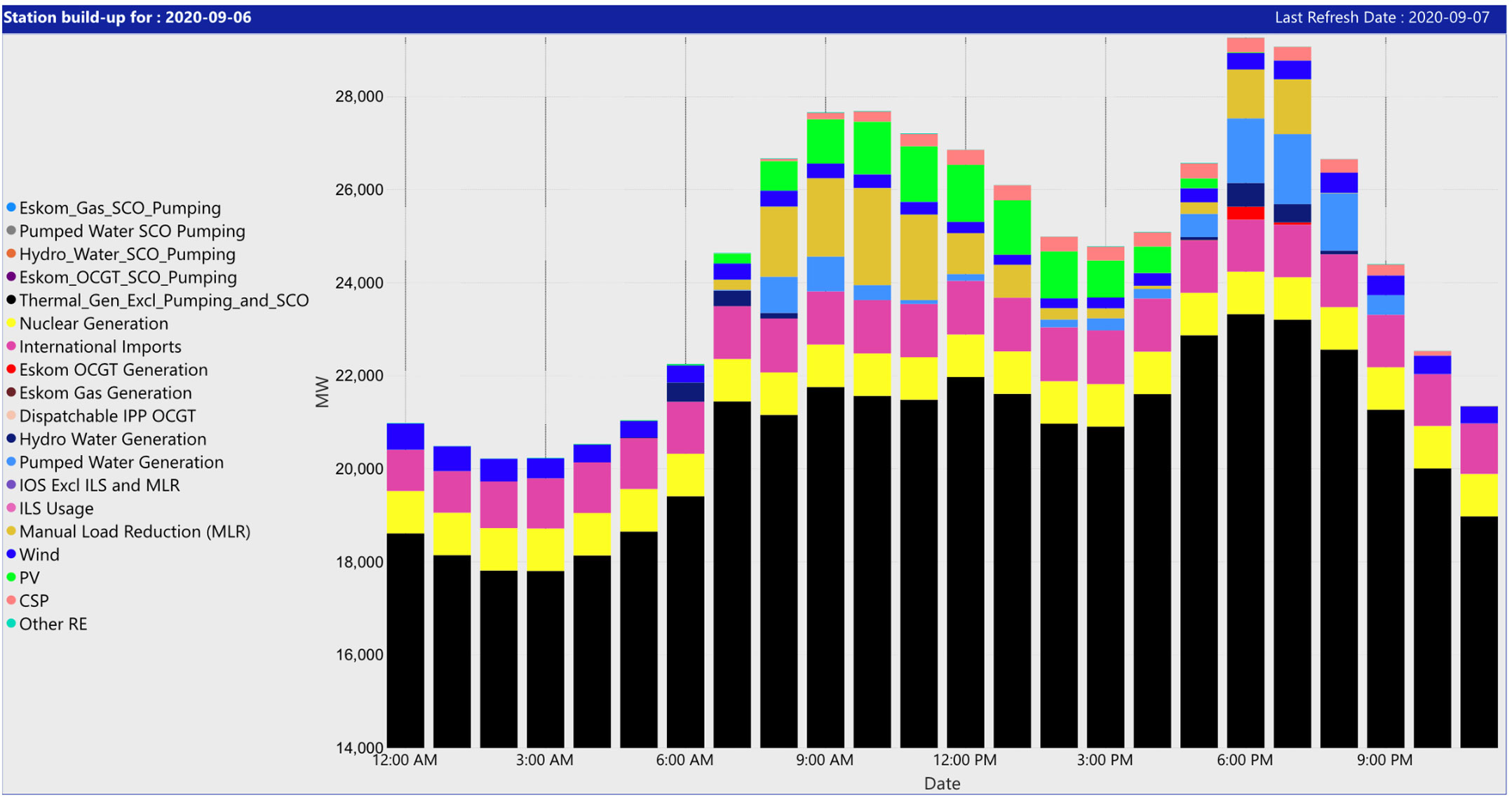
    Koeberg supplies stable and predictable baseload power generation of just more than 1.8GW, which halved after 6pm on Sunday evening when the unit was taken offline (yellow in the chart below). Of concern is the fact that it now has to replace the about 900MW shortfall, especially during the evening peak.

    Source: Eskom

    It continues to use pumped storage schemes — designed for peak periods — for baseload power generation. On Sunday, for example, it used these to generate between 500MW and 1.8GW throughout the day. Once Koeberg 1 was removed from the grid, the usage of these peaked at 2 071MW (at 7pm). Pumped storage schemes are net consumers of power in that they use more electricity to operate than each unit of power they produce. This is what makes them such effective peaking plants – “excess” power is used to pump water uphill overnight when demand is low.

    Last week — historically the lowest-demand period of the year (lockdown level 5, excluded) — the utility was forced to implement stage 2 load shedding overnight. It said this was to “preserve its emergency generation reserves”. From its publicly available dashboards, it is clear that Eskom simply did not have sufficient headroom overnight to use baseload power to replenish its pumped storage schemes (which it was using to augment baseload power throughout the day).
    Source: Eskom

    From its unplanned outage dashboard, it is clear that these outages spiked from around the 9GW level towards 12GW between 28 December and 30 December. It would typically be able to cope with this number of plant breakdowns (and partial losses), but it has deliberately ramped up planned maintenance to the highest level in at least a year. A total in excess of 9GW of capacity was taken out of service last week as the utility continues to catch up on maintenance which was simply not done in past years.

    As plant breakdowns spiked, from its own data one can see that Eskom was forced into using its open-cycle gas turbines (OCGTs) overnight on Monday (28 December). Usage of these peaked at more than 1.3GW before it made the call to implement load shedding. During the evening peak on 29 December, it also made use of interruptible load supply (ILS) where it cut nearly 700MW from its large industrial customers. It did this again during the evening peaks on 30 and 31 December. On 30 December, it called on the independent operators of gas peaking plants to augment supply (in addition to its own OCGT usage of around 1GW).

    Eskom has been relying on approximately 1GW of so-called ‘non-commercial generation’ capacity since 23 December

    Of further concern is that Eskom has been relying on approximately 1GW (and as much as 1.3GW) of so-called “non-commercial generation” capacity since 23 December. These are units at Kusile (Units 2 and 3) and Medupi (Unit 1) that are not yet in commercial operation. In the week prior, it used none of these units. The two Kusile units are slated to achieve commercial operation this month (Unit 2, 800MW) and in March (Unit 3, 800MW) which will go some way to alleviating the generation shortfall. However, all of this capacity is not actually available. The utility identified design defects at both new power plants in November 2018 and work has begun to remedy these.

    Now, with the 900MW shortfall from taking the one unit at Koeberg offline, Eskom will be forced into recalculating its generation plan. It always planned on having these additional units available in early 2021 (plus this doesn’t really change the supply picture as it has been able to call on these units in a similar way to other plants in its fleet).

    Only two levers

    It really only has two levers to work with: Some planned maintenance can be deferred (although this is partly why the utility has such an unreliable coal fleet to begin with), and it can use emergency OCGTs to meet peak demand.

    This is the balancing act it will need to perform for the coming weeks as demand ramps up from the 25GW/26GW level now towards 29GW by mid-month. By the end of this week, those figures are already forecast to be between 26GW and 27GW (the difference between so-called residual demand and contracted demand is made up by renewables).

    Before the forced Koeberg outage, Eskom’s official three-month outlook looked manageable. In its planned risk level, with unplanned outages of 12GW plus a 2.2GW operating reserve, it may be slightly short at certain peaks in the week. It is able to work around this with its available emergency generation resources (pumped storage schemes, its own OCGTs as well as IPP diesel/gas peaking plants and ILS).

    Source: Eskom system status report for week 52 of 2020

    The only way Eskom avoids load shedding is to give itself more headroom (by doing less planned maintenance, which is unlikely) or by ensuring (read: hoping) that it can keep unplanned breakdowns well below the 12GW level. We’ll know whether it’s chosen the former once its weekly system status reports for this week and next are published.

    It’s going to be difficult few months.

    • This article was originally published on Moneyweb and is used here with permission

    Follow TechCentral on Google News Add TechCentral as your preferred source on Google


    Eskom top
    WhatsApp YouTube
    Share. Facebook Twitter LinkedIn WhatsApp Telegram Email Copy Link
    Previous ArticleSatellite alerts seen helping fight deforestation in Africa
    Next Article Bitcoin at record above $35 000 as wild price swings resume

    Related Posts

    Eskom fixed the fleet and the customers left

    Eskom fixed the fleet and the customers left

    7 August 2026
    The debate about the grid is over

    The debate about the grid is over

    3 August 2026
    Eskom's diesel bill falls 86% as breakdowns hit eight-year low

    Eskom’s diesel bill falls 86% as breakdowns hit eight-year low

    31 July 2026
    Company News
    African Bank signs on as GEC+Africa 2026 partner

    African Bank signs on as GEC+Africa 2026 partner

    7 August 2026
    What a cloud review reveals about how a company actually runs - LSD Open

    What a cloud review reveals about how a company actually runs

    6 August 2026
    Manufacturing from a garage is now a realistic business plan - MaxLaser

    Manufacturing from a garage is now a realistic business plan

    6 August 2026
    Opinion
    The author, Jannie van Zyl

    Selling vapour is corporate suicide in slow motion

    16 July 2026
    Brazil's online gambling crackdown is a lesson for South Africa

    How Amazon outmanoeuvred Starlink in South Africa

    15 July 2026
    The Popia problem with agentic AI - Herman Haasbroek

    The Popia problem with agentic AI

    14 July 2026

    Subscribe to Updates

    Get the best South African technology news and analysis delivered to your e-mail inbox every morning.

    Latest Posts
    Eskom fixed the fleet and the customers left

    Eskom fixed the fleet and the customers left

    7 August 2026
    DStv chops channels as Canal+ leans harder on sport

    DStv chops channels as Canal+ leans harder on sport

    7 August 2026
    TCS+ | Specops' Darren James on continuous trust in an AI world

    TCS+ | Specops’ Darren James on continuous trust in an AI world

    7 August 2026
    Starlink LEO rival gaining momentum

    Starlink LEO rival gaining momentum

    7 August 2026
    © 2009 - 2026 NewsCentral Media
    Built and maintained by Chronon
    • Cookie policy (ZA)
    • TechCentral – privacy and Popia

    Type above and press Enter to search. Press Esc to cancel.

    Manage consent

    TechCentral uses cookies to enhance its offerings. Consenting to these technologies allows us to serve you better. Not consenting or withdrawing consent may adversely affect certain features and functions of the website.

    Functional Always active
    The technical storage or access is strictly necessary for the legitimate purpose of enabling the use of a specific service explicitly requested by the subscriber or user, or for the sole purpose of carrying out the transmission of a communication over an electronic communications network.
    Preferences
    The technical storage or access is necessary for the legitimate purpose of storing preferences that are not requested by the subscriber or user.
    Statistics
    The technical storage or access that is used exclusively for statistical purposes. The technical storage or access that is used exclusively for anonymous statistical purposes. Without a subpoena, voluntary compliance on the part of your Internet Service Provider, or additional records from a third party, information stored or retrieved for this purpose alone cannot usually be used to identify you.
    Marketing
    The technical storage or access is required to create user profiles to send advertising, or to track the user on a website or across several websites for similar marketing purposes.
    • Manage options
    • Manage services
    • Manage {vendor_count} vendors
    • Read more about these purposes
    View preferences
    • {title}
    • {title}
    • {title}