Close Menu
TechCentralTechCentral

    Subscribe to the newsletter

    Get the best South African technology news and analysis delivered to your e-mail inbox every morning.

    Facebook X (Twitter) YouTube LinkedIn
    WhatsApp Facebook X (Twitter) LinkedIn YouTube
    TechCentralTechCentral
    • News
      Netflix, Warner Bros talks raise fresh headaches for MultiChoice

      Netflix, Warner Bros talks raise fresh headaches for MultiChoice

      5 December 2025
      Big Microsoft 365 price increases coming next year

      Big Microsoft price increases coming next year

      5 December 2025
      Vodacom to take control of Safaricom in R36-billion deal - Shameel Joosub

      Vodacom to take control of Safaricom in R36-billion deal

      4 December 2025
      Black Friday goes digital in South Africa as online spending surges to record high

      Black Friday goes digital in South Africa as online spending surges to record high

      4 December 2025
      BYD takes direct aim at Toyota with launch of sub-R500 000 Sealion 5 PHEV

      BYD takes direct aim at Toyota with launch of sub-R500 000 Sealion 5 PHEV

      4 December 2025
    • World
      Amazon and Google launch multi-cloud service for faster connectivity

      Amazon and Google launch multi-cloud service for faster connectivity

      1 December 2025
      Google makes final court plea to stop US breakup

      Google makes final court plea to stop US breakup

      21 November 2025
      Bezos unveils monster rocket: New Glenn 9x4 set to dwarf Saturn V

      Bezos unveils monster rocket: New Glenn 9×4 set to dwarf Saturn V

      21 November 2025
      Tech shares turbocharged by Nvidia's stellar earnings

      Tech shares turbocharged by stellar Nvidia earnings

      20 November 2025
      Config file blamed for Cloudflare meltdown that disrupted the web

      Config file blamed for Cloudflare meltdown that disrupted the web

      19 November 2025
    • In-depth
      Jensen Huang Nvidia

      So, will China really win the AI race?

      14 November 2025
      Valve's Linux console takes aim at Microsoft's gaming empire

      Valve’s Linux console takes aim at Microsoft’s gaming empire

      13 November 2025
      iOCO's extraordinary comeback plan - Rhys Summerton

      iOCO’s extraordinary comeback plan

      28 October 2025
      Why smart glasses keep failing - no, it's not the tech - Mark Zuckerberg

      Why smart glasses keep failing – it’s not the tech

      19 October 2025
      BYD to blanket South Africa with megawatt-scale EV charging network - Stella Li

      BYD to blanket South Africa with megawatt-scale EV charging network

      16 October 2025
    • TCS
      TCS+ | How Cloud on Demand helps partners thrive in the AWS ecosystem - Odwa Ndyaluvane and Xenia Rhode

      TCS+ | How Cloud On Demand helps partners thrive in the AWS ecosystem

      4 December 2025
      TCS | MTN Group CEO Ralph Mupita on competition, AI and the future of mobile

      TCS | Ralph Mupita on competition, AI and the future of mobile

      28 November 2025
      TCS | Dominic Cull on fixing South Africa's ICT policy bottlenecks

      TCS | Dominic Cull on fixing South Africa’s ICT policy bottlenecks

      21 November 2025
      TCS | BMW CEO Peter van Binsbergen on the future of South Africa's automotive industry

      TCS | BMW CEO Peter van Binsbergen on the future of South Africa’s automotive industry

      6 November 2025
      TCS | Why Altron is building an AI factory - Bongani Andy Mabaso

      TCS | Why Altron is building an AI factory in Johannesburg

      28 October 2025
    • Opinion
      Your data, your hardware: the DIY AI revolution is coming - Duncan McLeod

      Your data, your hardware: the DIY AI revolution is coming

      20 November 2025
      Zero Carbon Charge founder Joubert Roux

      The energy revolution South Africa can’t afford to miss

      20 November 2025
      It's time for a new approach to government IT spend in South Africa - Richard Firth

      It’s time for a new approach to government IT spend in South Africa

      19 November 2025
      How South Africa's broken Rica system fuels murder and mayhem - Farhad Khan

      How South Africa’s broken Rica system fuels murder and mayhem

      10 November 2025
      South Africa's AI data centre boom risks overloading a fragile grid - Paul Colmer

      South Africa’s AI data centre boom risks overloading a fragile grid

      30 October 2025
    • Company Hubs
      • Africa Data Centres
      • AfriGIS
      • Altron Digital Business
      • Altron Document Solutions
      • Altron Group
      • Arctic Wolf
      • AvertITD
      • Braintree
      • CallMiner
      • CambriLearn
      • CYBER1 Solutions
      • Digicloud Africa
      • Digimune
      • Domains.co.za
      • ESET
      • Euphoria Telecom
      • Incredible Business
      • iONLINE
      • IQbusiness
      • Iris Network Systems
      • LSD Open
      • NEC XON
      • Netstar
      • Network Platforms
      • Next DLP
      • Ovations
      • Paracon
      • Paratus
      • Q-KON
      • SevenC
      • SkyWire
      • Solid8 Technologies
      • Telit Cinterion
      • Tenable
      • Vertiv
      • Videri Digital
      • Vodacom Business
      • Wipro
      • Workday
      • XLink
    • Sections
      • AI and machine learning
      • Banking
      • Broadcasting and Media
      • Cloud services
      • Contact centres and CX
      • Cryptocurrencies
      • Education and skills
      • Electronics and hardware
      • Energy and sustainability
      • Enterprise software
      • Financial services
      • Information security
      • Internet and connectivity
      • Internet of Things
      • Investment
      • IT services
      • Lifestyle
      • Motoring
      • Public sector
      • Retail and e-commerce
      • Satellite communications
      • Science
      • SMEs and start-ups
      • Social media
      • Talent and leadership
      • Telecoms
    • Events
    • Advertise
    TechCentralTechCentral
    Home » In-depth » Morse code marks 175 years of dots and dashes

    Morse code marks 175 years of dots and dashes

    By The Conversation22 May 2019
    Twitter LinkedIn Facebook WhatsApp Email Telegram Copy Link
    News Alerts
    WhatsApp
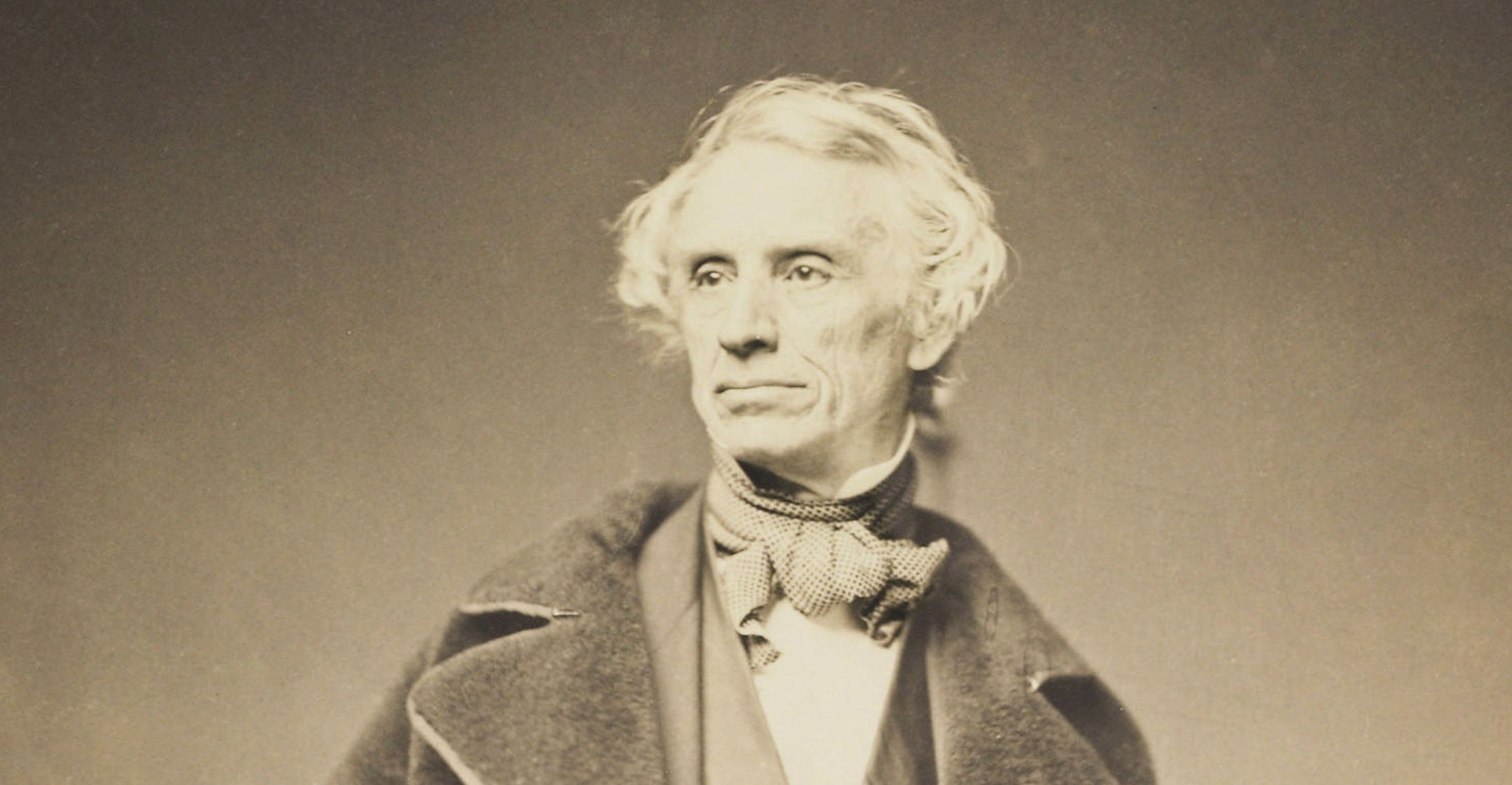
    Samuel Morse

    The first message sent by Morse code’s dots and dashes across a long distance travelled from Washington, DC to Baltimore on Friday, 24 May 1844 — 175 years ago. It signalled the first time in human history that complex thoughts could be communicated at long distances almost instantaneously. Until then, people had to have face-to-face conversations; send coded messages through drums, smoke signals and semaphore systems; or read printed words.

    Thanks to Samuel FB Morse, communication changed rapidly, and has been changing ever faster since. He invented the electric telegraph in 1832. It took six more years for him to standardise a code for communicating over telegraph wires. In 1843, the US congress gave him US$30 000 to string wires between the nation’s capital and nearby Baltimore. When the line was completed, he conducted a public demonstration of long-distance communication.

    Morse wasn’t the only one working to develop a means of communicating over the telegraph, but his is the one that has survived. The wires, magnets and keys used in the initial demonstration have given way to smartphones’ on-screen keyboards, but Morse code has remained fundamentally the same, and is still — perhaps surprisingly — relevant in the 21st century. Although I have learned, and relearnt, it many times as a Boy Scout, an amateur radio operator and a pilot, I continue to admire it and strive to master it.

    Morse’s key insight in constructing the code was considering how frequently each letter is used in English

    Morse’s key insight in constructing the code was considering how frequently each letter is used in English. The most commonly used letters have shorter symbols: “E”, which appears most often, is signified by a single “dot”. By contrast, “Z”, the least-used letter in English, was signified by the much longer and more complex “dot-dot-dot (pause) dot”.

    In 1865, the International Telecommunication Union changed the code to account for different character frequencies in other languages. There have been other tweaks since, but “E” is still “dot”, though “Z” is now “dash-dash-dot-dot”.

    The reference to letter frequency makes for extremely efficient communications: simple words with common letters can be transmitted very quickly. Longer words can still be sent, but they take more time.

    Metal wires

    The communications system that Morse code was designed for — analogue connections over metal wires that carried a lot of interference and needed a clear on-off type signal to be heard — has evolved significantly.

    The first big change came just a few decades after Morse’s demonstration. In the late 19th century, Guglielmo Marconi invented radio-telegraph equipment, which could send Morse code over radio waves, rather than wires.
    The shipping industry loved this new way to communicate with ships at sea, either from ship to ship or to shore-based stations. By 1910, US law required many passenger ships in US waters to carry wireless sets for sending and receiving messages.

    After the Titanic sank in 1912, an international agreement required some ships to assign a person to listen for radio distress signals at all times. That same agreement designated “SOS” — “dot-dot-dot dash-dash-dash dot-dot-dot” — as the international distress signal, not as an abbreviation for anything but because it was a simple pattern that was easy to remember and transmit. The Coast Guard discontinued monitoring in 1995. The requirement that ships monitor for distress signals was removed in 1999, though the US Navy still teaches at least some sailors to read, send and receive Morse code.

    Above: US Navy pilot Jeremiah Denton, a prisoner of war, blinks Morse code spelling out “torture” during a forced interview with his captors

    Aviators also use Morse code to identify automated navigational aids. These are radio beacons that help pilots follow routes, travelling from one transmitter to the next on aeronautical charts. They transmit their identifiers — such as “BAL” for Baltimore — in Morse code. Pilots often learn to recognise familiar-sounding patterns of beacons in areas they fly frequently.

    There is a thriving community of amateur radio operators who treasure Morse code, too. Among amateur radio operators, Morse code is a cherished tradition tracing back to the earliest days of radio. Some of them may have begun in the Boy Scouts, which has made learning Morse variably optional or required over the years. The Federal Communications Commission used to require all licensed amateur radio operators to demonstrate proficiency in Morse code, but that ended in 2007. The FCC does still issue commercial licences that require Morse proficiency, but no jobs require it anymore.

    Because its signals are so simple – on or off, long or short – Morse code can also be used by flashing lights

    Because its signals are so simple — on or off, long or short — Morse code can also be used by flashing lights. Many navies around the world use blinker lights to communicate from ship to ship when they don’t want to use radios or when radio equipment breaks down. The US Navy is actually testing a system that would let a user type words and convert it to blinker light. A receiver would read the flashes and convert it back to text.

    Skills learnt in the military helped an injured man communicate with his wife across a rocky beach using only his flashlight in 2017.

    Perhaps the most notable modern use of Morse code was by Navy pilot Jeremiah Denton, while he was a prisoner of war in Vietnam. In 1966, about one year into a nearly eight-year imprisonment, Denton was forced by his North Vietnamese captors to participate in a video interview about his treatment. While the camera focused on his face, he blinked the Morse code symbols for “torture”, confirming for the first time US fears about the treatment of service members held captive in North Vietnam.

    Learning Morse code

    Blinking Morse code is slow, but has also helped people with medical conditions that prevent them from speaking or communicating in other ways. A number of devices — including iPhones and Android smartphones — can be set up to accept Morse code input from people with limited motor skills.

    There are still many ways people can learn Morse code, and practice using it, even online. In emergency situations, it can be the only mode of communications that will get through. Beyond that, there is an art to Morse code, a rhythmic, musical fluidity to the sound. Sending and receiving it can have a soothing or meditative feeling, too, as the person focuses on the flow of individual characters, words and sentences. Overall, sometimes the simplest tool is all that’s needed to accomplish the task.The Conversation

    • Written by Eddie King, PhD student in electrical engineering, University of South Carolina
    • This article is republished from The Conversation under a Creative Commons licence


    Morse code Samuel Morse top
    Subscribe to TechCentral Subscribe to TechCentral
    Share. Facebook Twitter LinkedIn WhatsApp Telegram Email Copy Link
    Previous ArticleFemale-voiced AI assistants reinforce gender bias, UN says
    Next Article Apple WWDC set for 3 June – here’s what to expect

    Related Posts

    18GW in unplanned breakdowns cripple Eskom

    2 November 2021

    Nersa kicks the Karpowership can down the road

    13 September 2021

    If you think South African load shedding is bad, try Zimbabwe’s

    13 September 2021
    Company News
    Beat the summer heat with Samsung's WindFree air conditioners

    Beat the summer heat with Samsung’s WindFree air conditioners

    5 December 2025
    AI is not a technology problem - iqbusiness

    AI is not a technology problem – iqbusiness

    5 December 2025
    Telcos are sitting on a data gold mine - but few know what do with it - Phillip du Plessis

    Telcos are sitting on a data gold mine – but few know what do with it

    4 December 2025
    Opinion
    Your data, your hardware: the DIY AI revolution is coming - Duncan McLeod

    Your data, your hardware: the DIY AI revolution is coming

    20 November 2025
    Zero Carbon Charge founder Joubert Roux

    The energy revolution South Africa can’t afford to miss

    20 November 2025
    It's time for a new approach to government IT spend in South Africa - Richard Firth

    It’s time for a new approach to government IT spend in South Africa

    19 November 2025

    Subscribe to Updates

    Get the best South African technology news and analysis delivered to your e-mail inbox every morning.

    Latest Posts
    Beat the summer heat with Samsung's WindFree air conditioners

    Beat the summer heat with Samsung’s WindFree air conditioners

    5 December 2025
    Netflix, Warner Bros talks raise fresh headaches for MultiChoice

    Netflix, Warner Bros talks raise fresh headaches for MultiChoice

    5 December 2025
    Big Microsoft 365 price increases coming next year

    Big Microsoft price increases coming next year

    5 December 2025
    AI is not a technology problem - iqbusiness

    AI is not a technology problem – iqbusiness

    5 December 2025
    © 2009 - 2025 NewsCentral Media
    • Cookie policy (ZA)
    • TechCentral – privacy and Popia

    Type above and press Enter to search. Press Esc to cancel.

    Manage consent

    TechCentral uses cookies to enhance its offerings. Consenting to these technologies allows us to serve you better. Not consenting or withdrawing consent may adversely affect certain features and functions of the website.

    Functional Always active
    The technical storage or access is strictly necessary for the legitimate purpose of enabling the use of a specific service explicitly requested by the subscriber or user, or for the sole purpose of carrying out the transmission of a communication over an electronic communications network.
    Preferences
    The technical storage or access is necessary for the legitimate purpose of storing preferences that are not requested by the subscriber or user.
    Statistics
    The technical storage or access that is used exclusively for statistical purposes. The technical storage or access that is used exclusively for anonymous statistical purposes. Without a subpoena, voluntary compliance on the part of your Internet Service Provider, or additional records from a third party, information stored or retrieved for this purpose alone cannot usually be used to identify you.
    Marketing
    The technical storage or access is required to create user profiles to send advertising, or to track the user on a website or across several websites for similar marketing purposes.
    • Manage options
    • Manage services
    • Manage {vendor_count} vendors
    • Read more about these purposes
    View preferences
    • {title}
    • {title}
    • {title}