Close Menu
TechCentralTechCentral

    Subscribe to the newsletter

    Get the best South African technology news and analysis delivered to your e-mail inbox every morning.

    Facebook X (Twitter) YouTube LinkedIn
    WhatsApp Facebook X (Twitter) LinkedIn YouTube
    TechCentralTechCentral
    • News
      South Africa's next broadband war may be won by a bank - Capitec

      South Africa’s next broadband war may be won by a bank

      14 August 2026
      Bank robberies, ATM bombings collapse as criminals go digital

      Bank robberies, ATM bombings collapse as criminals go digital

      14 August 2026
      TCS | Herotel CEO Van Zyl Botha on beating Starlink to South Africa

      TCS | Herotel CEO Van Zyl Botha on beating Starlink to South Africa

      14 August 2026
      Blu Label's earnings just fell off a cliff - on paper - Brett Levy Mark Levy

      Blu Label’s earnings just fell off a cliff – on paper

      14 August 2026
      AI fraud is outrunning South African banking defences

      AI fraud is outrunning South African banking defences

      14 August 2026
    • World
      Russia building its own Starlink - and faster than expected - Vadym Skibitskyi

      Russia building its own Starlink – and faster than expected

      11 August 2026
      Meta AI will now tell parents if their teen is in crisis

      Meta AI will now tell parents if their teen is in crisis

      17 July 2026
      IBM shares crash 25% as AI upends software spending - Arvind Krishna

      IBM shares crash 25% as AI upends software spending

      15 July 2026
      Jony Ive's first OpenAI device: an AI smart speaker - Jony Ive and Sam Altman

      Jony Ive’s first OpenAI device: an AI smart speaker

      15 July 2026
      Stripe, Advent in talks to buy PayPal for $53-billion

      Stripe, Advent in talks to buy PayPal for $53-billion

      15 July 2026
    • In-depth
      Google DeepMind CEO Demis Hassabis. Image: John Sears

      The plan to stop AI from breaking the world

      16 July 2026
      The internet has a Strait of Hormuz problem

      The internet has a Strait of Hormuz problem

      15 July 2026
      AI boom sparks rally, frenzy and fear

      AI boom sparks rally, frenzy and fear

      11 June 2026
      Every plug-in hybrid on sale in South Africa, ranked by price - Lamborghini Temerario

      Every plug-in hybrid on sale in South Africa, ranked by price

      7 June 2026
      What Wi-Fi 8 will mean for wireless networks

      What Wi-Fi 8 will mean for wireless networks

      1 June 2026
    • TCS
      Meet the CIO | Discovery's Derek Wilcocks on AI, guardrails and growth

      Meet the CIO | Derek Wilcocks on how AI personalised Vitality

      13 August 2026
      TCS | Money just became native to the internet - Steven Boykey Sidley

      TCS | Money just became native to the internet – Steven Boykey Sidley

      12 August 2026
      TCS+ | Specops' Darren James on continuous trust in an AI world

      TCS+ | Specops’ Darren James on continuous trust in an AI world

      7 August 2026
      TCS+ | How AI is turning hardware into a subscription service - Shane van der Merwe Merchant West

      TCS+ | How AI is turning hardware into a subscription service

      6 August 2026
      TCS+ | Why South African workers must become supervisors of digital labour - Accelera Digital Group Cliff de Wit

      TCS+ | Why South African workers must become supervisors of digital labour

      31 July 2026
    • Opinion
      The author, Jannie van Zyl

      Selling vapour is corporate suicide in slow motion

      16 July 2026
      Brazil's online gambling crackdown is a lesson for South Africa

      How Amazon outmanoeuvred Starlink in South Africa

      15 July 2026
      The Popia problem with agentic AI - Herman Haasbroek

      The Popia problem with agentic AI

      14 July 2026
      The author, Fanie van Rooyen

      South Africa can still catch the AI wave – here’s how

      7 July 2026
      The author, Fanie van Rooyen

      The AI utopia South Africa can’t afford

      1 July 2026
    • Company Hubs
      • 1Stream
      • Africa Data Centres
      • AfriGIS
      • Altron Digital Business
      • Altron Document Solutions
      • Altron Group
      • Arctic Wolf
      • Ascent Technology
      • AvertITD
      • BBD
      • Braintree
      • CallMiner
      • CambriLearn
      • CM Telecom
      • Contactable
      • CYBER1 Solutions
      • Digicloud Africa
      • Digimune
      • Domains.co.za
      • ESET
      • Euphoria Telecom
      • HOSTAFRICA
      • Incredible Business
      • iONLINE
      • IQbusiness
      • Iris Network Systems
      • Kaspersky
      • LSD Open
      • Mitel
      • NEC XON
      • Netstar
      • Network Platforms
      • Next DLP
      • Ovations
      • Paracon
      • Paratus
      • Q-KON
      • SevenC
      • SkyWire
      • Solid8 Technologies
      • Telit Cinterion
      • Telviva
      • Tenable
      • Vertiv
      • Videri Digital
      • Vodacom Business
      • Vox
      • Wipro
      • Workday
      • XLink
    • Sections
      • AI and machine learning
      • Banking
      • Broadcasting and Media
      • Cloud services
      • Contact centres and CX
      • Cryptocurrencies
      • Education and skills
      • Electronics and hardware
      • Energy and sustainability
      • Enterprise software
      • Financial services
      • HealthTech
      • Information security
      • Internet and connectivity
      • Internet of Things
      • Investment
      • IT services
      • Lifestyle
      • Policy and regulation
      • Public sector
      • Retail and e-commerce
      • Satellite communications
      • Science
      • SMEs and start-ups
      • Social media
      • Talent and leadership
      • Telecoms
      • Watts & Wheels
    • Events
    • Advertise
    TechCentralTechCentral
    Home » In-depth » R15bn telescope to probe the mysteries of the universe

    R15bn telescope to probe the mysteries of the universe

    By Editor31 January 2011
    Twitter LinkedIn Facebook WhatsApp Email Telegram Copy Link
    News Alerts
    WhatsApp
    Bernie Fanaroff

    The universe still holds many mysteries. The SA engineers and scientists working at bringing the world’s largest radio telescope, the Square Kilometre Array (SKA), to SA are hoping to solve some of those mysteries and shed light on how the galaxies, stars and planets came into being.

    Not only are these engineers and scientists breaking ground in the field of radio astronomy, they are developing some of the world’s most advanced technology while they prepare the country to host the €1,5bn (about R14,6bn) telescope. Construction of the telescope is set to begin in 2016 and the telescope should be fully operational by 2024.

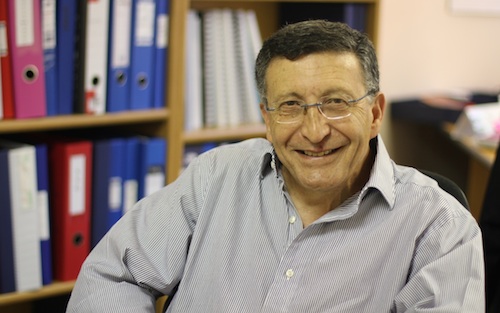
    Bernie Fanaroff, director of SA’s bid to host the SKA, says the project was birthed in the early 1990s when astronomers started talking about the “next big thing” in their field.

    They wanted to be able to observe neutral hydrogen from the birth of stars a few hundred million years after the Big Bang. Neutral hydrogen consists of a single proton orbited by a single electron and is found in the vicinity of stars that are being born.

    A composite dish is lighter and quicker to build than a traditional dish (click to enlarge)

    To do this, scientists need to build a gigantic radio telescope with a collecting area of at least one square kilometre. This telescope also needs to have a high dynamic range, or the ability to see extremely faint objects in the presence of very bright ones.

    And they want to do all of this as cost effectively as possible.

    Fanaroff says SA became involved in the project in 2005 when it submitted its expression of interest to the SKA committee to become one of the countries bidding to host the telescope.

    The country entered the ring alongside the US, China, Canada, Argentina and Australia.

    “Our submission surprised many people because Australia was widely tipped to be the country to host SKA. People were mostly surprised by the quality of our submission,” he says.

    It was at that point that SA became a serious contender to host the project, and was short-listed alongside Australia.

    SA proposed a desolate site in the Karoo, near the towns of Carnarvon and Williston in the Northern Cape. Crucially, the earmarked site has few cellphone towers or radio broadcasts that could cause unwanted interference.

    Keeping the radio waves clean is a must if the project is to receive the purest radio waves from the furthest reaches of the universe.

    The idea is that the SKA site will be linked to a powerful computing facility in Cape Town via fibre-optic lines. The facility, if it is built, will have computing capacity of hundreds of teraflops per second.

    Southern African countries, including Namibia, Botswana, Mozambique, Zambia, Mauritius, Madagascar, Kenya and Ghana, will host outlying stations that connect to the main site in the Karoo, says Fanaroff.

    Fanaroff and SA’s SKA team are putting together a report detailing interference at the proposed site. This will be one of the last submissions to the international SKA committee that will then make a decision on which country will host the telescope.

    The committee is expected to make its final decision by next year.

    In the meantime, SA has not been sitting idly by waiting for a decision. It has started building and testing technology that could be used for the SKA.

    To do this, the department of science & technology has agreed to help fund the development of MeerKat, a precursor to the SKA. On its own, MeerKat will be one of the largest and most powerful telescopes in the world.

    The MeerKat project has already produced some of the most cutting-edge engineering in the field of radio astronomy, and SA engineers are creating low-cost technologies that are up to par with SKA standards.
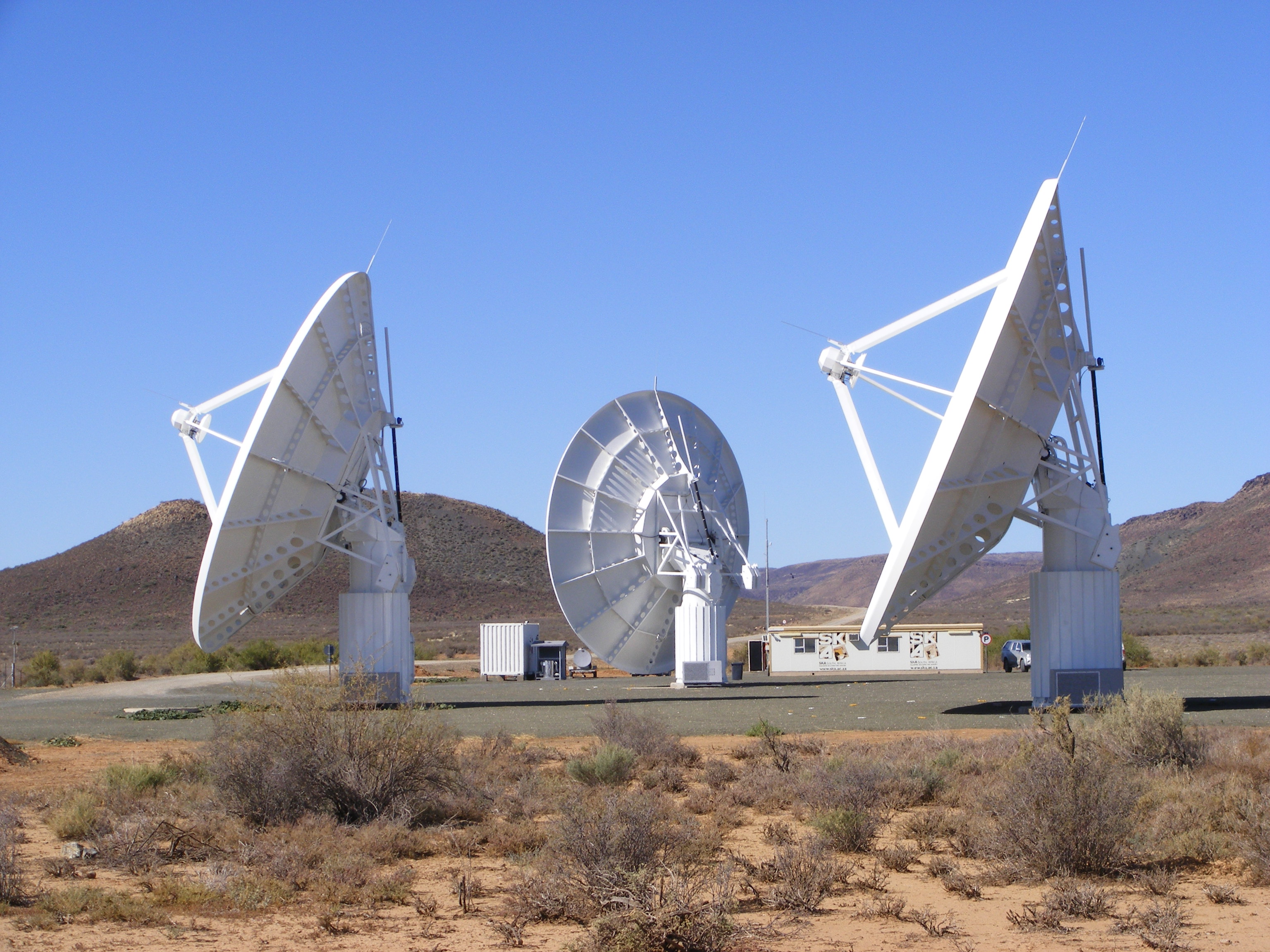
    Three of the Kat-7 dishes on site and ready to start receiving signals (click to enlarge)

    Recently, the team scored a breakthrough in the development of the dishes that will receive the radio signals from space, successfully building and testing a prototype composite dish. Composites are naturally occurring materials that are engineered together to form tightly woven fibres.

    Using composites to build the dishes is a breakthrough for the project because traditionally dishes were made of heavy metal panels that had to be transported one at a time to a site to be put together to work.

    “With composite, we can build the entire dish, without the base, on site and simply lift it up and place it on the bases as needed,” says Fanaroff.

    Not only is this a lightweight solution, it is a cheaper way of building the dishes — and keeping costs down is requirement of the SKA. They can also be built much faster than the traditional structures.

    The next step for the team was to build another six of these dishes and string them together to build a receiver, called an interferometer, the portion of the project called Kat-7.

    According to Fanaroff, the dishes designed in SA for MeerKat will also have less scatter, or noise, that interferes with the readings they receive, a structure that is closer to the final design specifications of the SKA dishes. “This again puts us in good stead to win the bid,” he says.

    MeerKat will comprise 64 of these dishes and should be fully functional within four or five years.

    Even though the project is not nearly finished, astronomers from around the world are already proposing they be chosen as the first scientists to use MeerKat for their projects.

    “More than 43 000 hours, or about five years, of observing time has already been allocated to astronomers who have applied for research time on our telescope,” says Fanaroff.

    One of the first projects for MeerKat will be examining the timing of pulsars, which can be used to develop highly accurate clocks or detect gravitational radiation. Scientists hope to test the limits of Albert Einstein’s general theory of relativity.
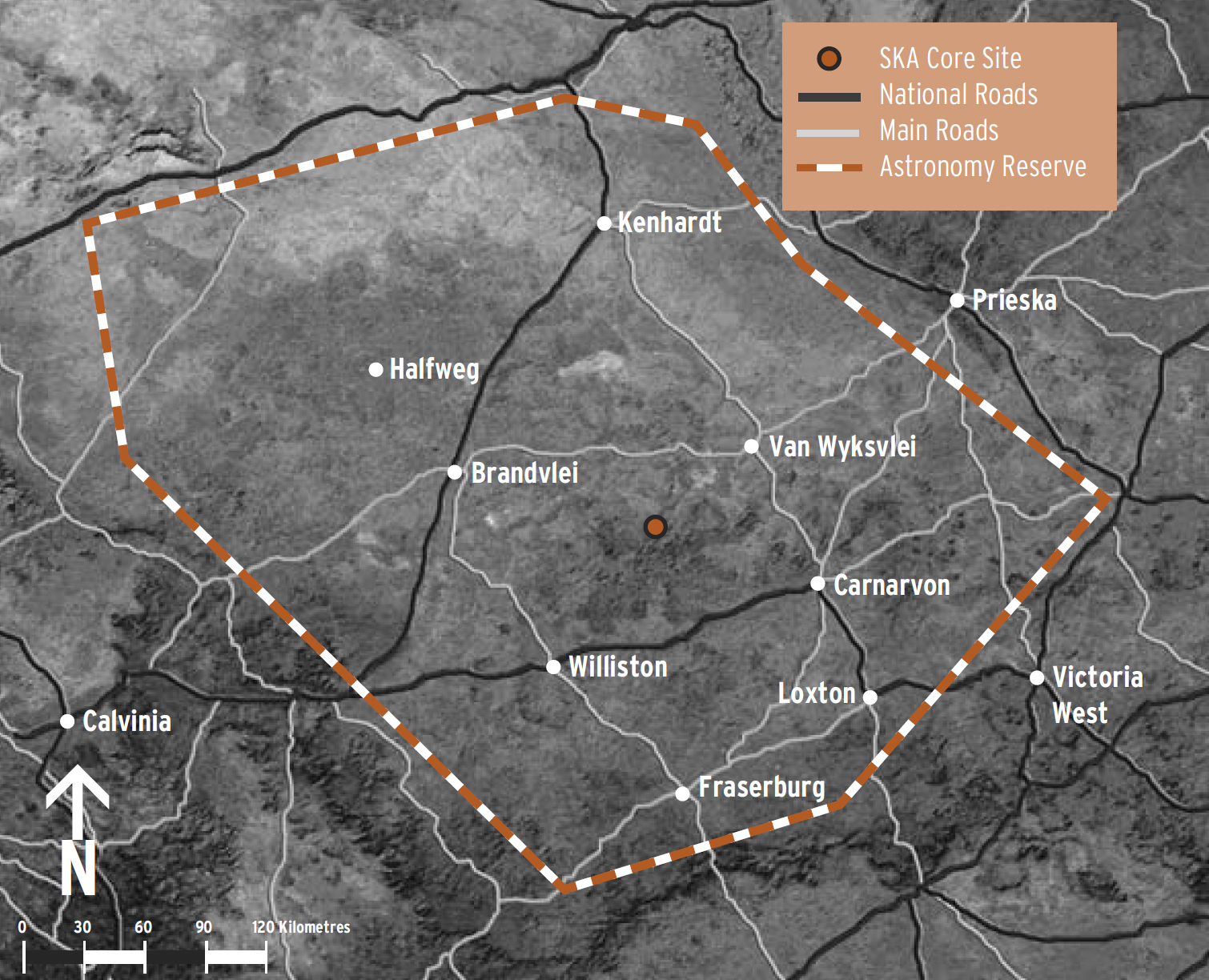
    The SKA site needs to be free of radio interference from cellphone towers and radio and TV broadcasts

    Another MeerKat project will look at the early hydrogen of the universe, but will not look as far back as the SKA will be able to once it’s built.

    Not only is MeerKat in demand, but engineers that have worked on the project have also started to become well known and respected in the global scientific community, says Fanaroff.

    One of the developments that boosted the fame of SA’s engineers was the development of Roach (reconfigurable open architecture computing hardware) motherboards.

    The hardware development was started at Berkley University and has been fine-tuned by SA engineers specifically for the telescope projects. The boards allow easy upgrades when technology changes need to take place in the telescope arrays.

    The boards are also designed to manage extremely fast input and output through their buses (subsystems that transfer data between computer components) and can be programmed using firmware to perform specific functions.

    Fanaroff says SA engineers have also been working on wireless technologies, fast data transport, large networks of sensors, software radios and imaging algorithms.

    He says if SA wins the bid to host the SKA, it would help put the country on the scientific map and boost development in science and astronomy in SA, which in turn would elevate the economy. “This must be a long-term vision of prosperity for the country,” he says.  — Candice Jones, TechCentral

    • Subscribe to our free daily newsletter
    • Follow us on Twitter or on Facebook
    Follow TechCentral on Google News Add TechCentral as your preferred source on Google


    Bernie Fanaroff Kat-7 MeerKAT SKA Square Kilometre Array
    WhatsApp YouTube
    Share. Facebook Twitter LinkedIn WhatsApp Telegram Email Copy Link
    Previous ArticleNews24 feels the heat
    Next Article ZA Tech Show: Episode 146 – ‘Slow’

    Related Posts

    universe

    UCT astronomers uncover vast hidden supercluster behind the Milky Way

    12 March 2026
    A MeerKAT antenna

    MeerKAT detects most powerful natural radio laser ever observed

    19 February 2026
    South Africa's giant SKA telescope clears major technical hurdle

    South Africa’s giant SKA telescope clears major technical hurdle

    8 January 2026
    Company News
    Kaspersky on how to secure a supply chain you do not control

    Kaspersky on how to secure a supply chain you do not control

    13 August 2026
    Build or buy software? AI is rewriting the answer - BBD Software

    Build or buy software? AI is rewriting the answer

    12 August 2026
    Max zoom meets max speed with the new 5G Huawei Pura 90s series

    Max Zoom meets Max Speed with the 5G Huawei Pura 90s series

    11 August 2026
    Opinion
    The author, Jannie van Zyl

    Selling vapour is corporate suicide in slow motion

    16 July 2026
    Brazil's online gambling crackdown is a lesson for South Africa

    How Amazon outmanoeuvred Starlink in South Africa

    15 July 2026
    The Popia problem with agentic AI - Herman Haasbroek

    The Popia problem with agentic AI

    14 July 2026

    Subscribe to Updates

    Get the best South African technology news and analysis delivered to your e-mail inbox every morning.

    Latest Posts
    South Africa's next broadband war may be won by a bank - Capitec

    South Africa’s next broadband war may be won by a bank

    14 August 2026
    Bank robberies, ATM bombings collapse as criminals go digital

    Bank robberies, ATM bombings collapse as criminals go digital

    14 August 2026
    TCS | Herotel CEO Van Zyl Botha on beating Starlink to South Africa

    TCS | Herotel CEO Van Zyl Botha on beating Starlink to South Africa

    14 August 2026
    Blu Label's earnings just fell off a cliff - on paper - Brett Levy Mark Levy

    Blu Label’s earnings just fell off a cliff – on paper

    14 August 2026
    © 2009 - 2026 NewsCentral Media
    Built and maintained by Chronon
    • Cookie policy (ZA)
    • TechCentral – privacy and Popia

    Type above and press Enter to search. Press Esc to cancel.

    Manage consent

    TechCentral uses cookies to enhance its offerings. Consenting to these technologies allows us to serve you better. Not consenting or withdrawing consent may adversely affect certain features and functions of the website.

    Functional Always active
    The technical storage or access is strictly necessary for the legitimate purpose of enabling the use of a specific service explicitly requested by the subscriber or user, or for the sole purpose of carrying out the transmission of a communication over an electronic communications network.
    Preferences
    The technical storage or access is necessary for the legitimate purpose of storing preferences that are not requested by the subscriber or user.
    Statistics
    The technical storage or access that is used exclusively for statistical purposes. The technical storage or access that is used exclusively for anonymous statistical purposes. Without a subpoena, voluntary compliance on the part of your Internet Service Provider, or additional records from a third party, information stored or retrieved for this purpose alone cannot usually be used to identify you.
    Marketing
    The technical storage or access is required to create user profiles to send advertising, or to track the user on a website or across several websites for similar marketing purposes.
    • Manage options
    • Manage services
    • Manage {vendor_count} vendors
    • Read more about these purposes
    View preferences
    • {title}
    • {title}
    • {title}