Close Menu
TechCentralTechCentral

    Subscribe to the newsletter

    Get the best South African technology news and analysis delivered to your e-mail inbox every morning.

    Facebook X (Twitter) YouTube LinkedIn
    WhatsApp Facebook X (Twitter) LinkedIn YouTube
    TechCentralTechCentral
    • News
      Nedbank hires MTN's former tech chief as group CIO - Nikos Angelopoulos

      Nedbank hires MTN’s former tech chief as group CIO

      31 July 2026
      Eskom's diesel bill falls 86% as breakdowns hit eight-year low

      Eskom’s diesel bill falls 86% as breakdowns hit eight-year low

      31 July 2026
      Ramaphosa signs off on taking the grid away from Eskom

      Ramaphosa signs off on taking the grid away from Eskom

      31 July 2026
      Microsoft just had the biggest day in stock market history

      Microsoft just had the biggest day in stock market history

      31 July 2026
      MTN Nigeria's growth engine stalled in second quarter - Karl Toriola

      MTN Nigeria’s growth engine stalled in second quarter

      31 July 2026
    • World
      Meta AI will now tell parents if their teen is in crisis

      Meta AI will now tell parents if their teen is in crisis

      17 July 2026
      IBM shares crash 25% as AI upends software spending - Arvind Krishna

      IBM shares crash 25% as AI upends software spending

      15 July 2026
      Jony Ive's first OpenAI device: an AI smart speaker - Jony Ive and Sam Altman

      Jony Ive’s first OpenAI device: an AI smart speaker

      15 July 2026
      Stripe, Advent in talks to buy PayPal for $53-billion

      Stripe, Advent in talks to buy PayPal for $53-billion

      15 July 2026
      Memory crisis sends smartphone market into steep decline

      Memory crisis sends smartphone market into steep decline

      13 July 2026
    • In-depth
      The plan to stop AI from breaking the world - Google DeepMind CEO Demis Hassabis. Image: John Sears

      The plan to stop AI from breaking the world

      16 July 2026
      The internet has a Strait of Hormuz problem

      The internet has a Strait of Hormuz problem

      15 July 2026
      AI boom sparks rally, frenzy and fear

      AI boom sparks rally, frenzy and fear

      11 June 2026
      Every plug-in hybrid on sale in South Africa, ranked by price - Lamborghini Temerario

      Every plug-in hybrid on sale in South Africa, ranked by price

      7 June 2026
      What Wi-Fi 8 will mean for wireless networks

      What Wi-Fi 8 will mean for wireless networks

      1 June 2026
    • TCS
      TCS+ | Why South African workers must become supervisors of digital labour - Accelera Digital Group Cliff de Wit

      TCS+ | Why South African workers must become supervisors of digital labour

      31 July 2026
      TCS | Rapid deployment rules can't work without municipalities: ACT - Nomvuyiso Batyi

      TCS | Icasa’s rules skip the real bottleneck: ACT

      30 July 2026
      TCS+ | iStore Business on why Apple makes sense for SMEs - Sudesh Pillay and Tamia Nontsikelelo

      TCS+ | iStore Business on why Apple makes sense for SMEs

      30 July 2026
      TCS+ | A smarter approach to cloud for South African businesses - Joel Chacko and Jonathan Oaker

      TCS+ | A smarter approach to cloud for South African businesses

      28 July 2026
      TCS | How Optasia lends billions to people banks can't see - Salvador Anglada

      TCS | How Optasia lends billions to people banks can’t see

      23 July 2026
    • Opinion
      The author, Jannie van Zyl

      Selling vapour is corporate suicide in slow motion

      16 July 2026
      Brazil's online gambling crackdown is a lesson for South Africa

      How Amazon outmanoeuvred Starlink in South Africa

      15 July 2026
      The Popia problem with agentic AI - Herman Haasbroek

      The Popia problem with agentic AI

      14 July 2026
      The author, Fanie van Rooyen

      South Africa can still catch the AI wave – here’s how

      7 July 2026
      The author, Fanie van Rooyen

      The AI utopia South Africa can’t afford

      1 July 2026
    • Company Hubs
      • 1Stream
      • Africa Data Centres
      • AfriGIS
      • Altron Digital Business
      • Altron Document Solutions
      • Altron Group
      • Arctic Wolf
      • Ascent Technology
      • AvertITD
      • BBD
      • Braintree
      • CallMiner
      • CambriLearn
      • CM Telecom
      • Contactable
      • CYBER1 Solutions
      • Digicloud Africa
      • Digimune
      • Domains.co.za
      • ESET
      • Euphoria Telecom
      • HOSTAFRICA
      • Incredible Business
      • iONLINE
      • IQbusiness
      • Iris Network Systems
      • Kaspersky
      • LSD Open
      • Mitel
      • NEC XON
      • Netstar
      • Network Platforms
      • Next DLP
      • Ovations
      • Paracon
      • Paratus
      • Q-KON
      • SevenC
      • SkyWire
      • Solid8 Technologies
      • Telit Cinterion
      • Telviva
      • Tenable
      • Vertiv
      • Videri Digital
      • Vodacom Business
      • Vox
      • Wipro
      • Workday
      • XLink
    • Sections
      • AI and machine learning
      • Banking
      • Broadcasting and Media
      • Cloud services
      • Contact centres and CX
      • Cryptocurrencies
      • Education and skills
      • Electronics and hardware
      • Energy and sustainability
      • Enterprise software
      • Financial services
      • HealthTech
      • Information security
      • Internet and connectivity
      • Internet of Things
      • Investment
      • IT services
      • Lifestyle
      • Policy and regulation
      • Public sector
      • Retail and e-commerce
      • Satellite communications
      • Science
      • SMEs and start-ups
      • Social media
      • Talent and leadership
      • Telecoms
      • Watts & Wheels
    • Events
    • Advertise
    TechCentralTechCentral
    Home » Sections » Internet of Things » Securing the internet of things with NFC technology

    Securing the internet of things with NFC technology

    Promoted | Near-field communication technology is emerging as a crucial tool for securing IoT ecosystems, says Altron Arrow.
    By Altron Arrow30 September 2024
    Twitter LinkedIn Facebook WhatsApp Email Telegram Copy Link
    News Alerts
    WhatsApp

    Securing the internet of things with NFC technologyThe internet of things (IoT) has altered the way businesses collect, analyse and use data – for the better.

    IoT devices – from smart thermostats to industrial sensors – are now integral to modern business operations, offering valuable insights into user behaviour, improving efficiencies and boosting customer experiences.

    On the flip side, as the number of connected devices soars, so do the security risks, which is why protecting IoT ecosystems from advanced cyber adversaries has become a critical priority for organisations.

    IoT security challenges

    IoT devices are prime targets for malicious actors because they widen the attack surface by providing multiple points of entry into networks. And as IoT devices become more ubiquitous, businesses face the mounting challenge of securing them and keep threats at bay. This is particularly true in the consumer product space, where brands need to ensure their digitised products are connected and their identities are verified.

    The stats are alarming. According to Corsearch, the size of the worldwide trade in counterfeit goods might reach US$1.79-trillion by 2030, a whopping 75% increase from a year ago and a growth 3.6 times higher than predicted for the global economy over the same period. It’s clear something must be done, but IoT security requires a multi-layered approach to address vulnerabilities at every level of the network.

    Companies must focus on item-level authentication, tamper detection and data protection to safeguard IoT devices and their users from malicious actors. Traditional security methods are often insufficient to address the complexity and scale of modern IoT environments, leading to the need for more sophisticated solutions that integrate seamlessly into the connected world.

    The power of NFC technology

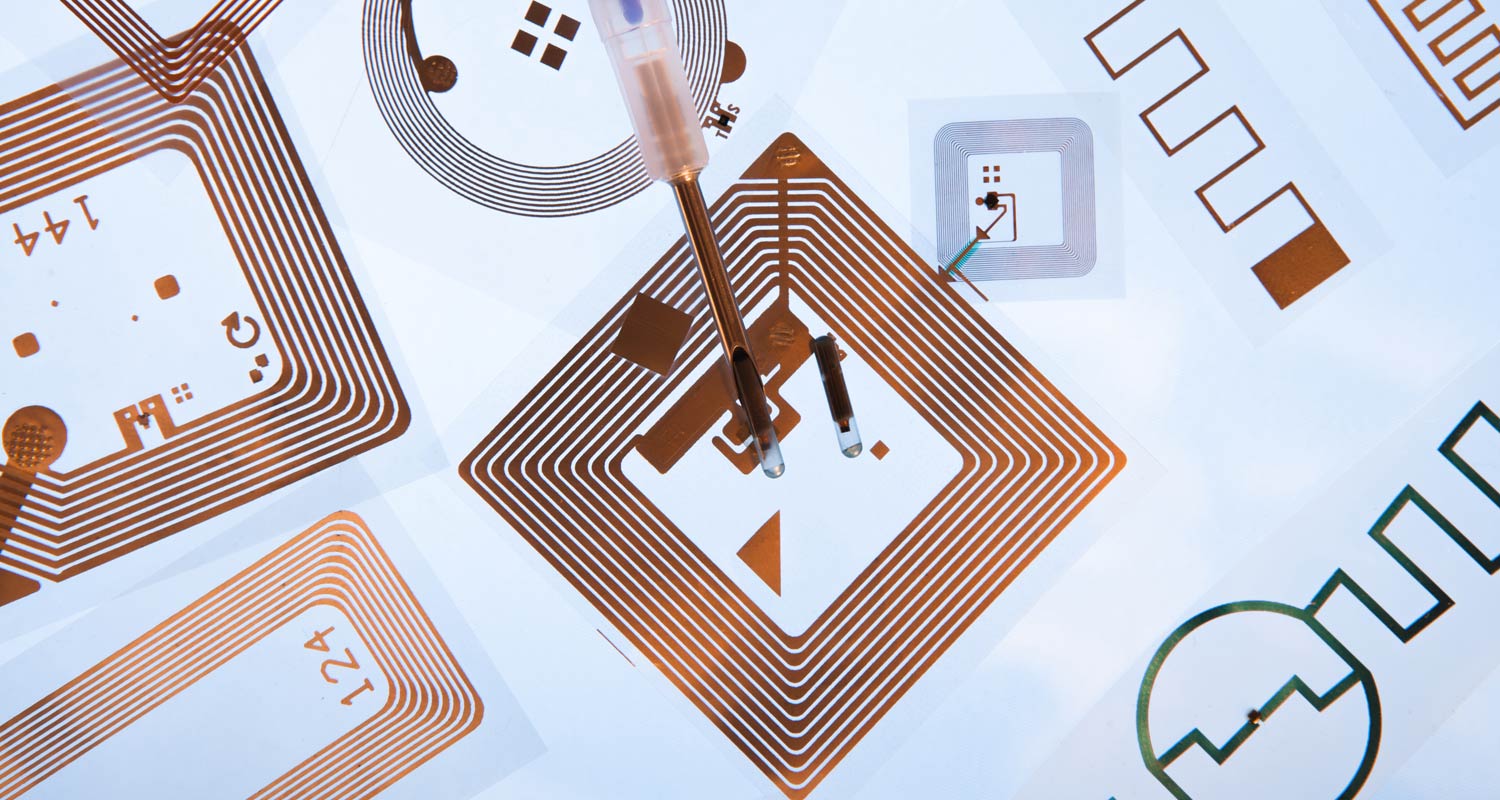
    Near-field communication (NFC) technology is emerging as a crucial tool for securing IoT ecosystems. NFC allows devices to communicate wirelessly over short distances, facilitating secure, real-time data exchange between connected objects. Identiv’s NFC tags with the NXP NTAG 22x chip series offer a robust solution for IoT security, leveraging advanced encryption to authenticate devices, detect tampering and protect data.

    Built on the Advanced Encryption Standard (AES), these tags employ symmetric key encryption so that the same key is used for both encryption and decryption. This design boosts security through advanced anti-counterfeiting measures, tamper detection and even battery-less condition sensing.

    These features make NFC technology an ideal solution for securing IoT devices from a wide range of cyberthreats.
    NFC tags: a gamechanger for IoT security

    Identiv’s NFC-enabled solutions are embedded in billions of everyday objects, from medical devices to consumer goods. By integrating these tags into products, entities can create secure, traceable ecosystems that safeguard the devices as well as their data. These tags offer several key benefits:

    • Invisibility and convenience: NFC tags can be discreetly applied to products, providing an invisible layer of security that cannot be easily tampered with or removed.
    • Enhanced security: The encryption used in these tags adds an extra layer of protection, preventing unauthorised access to devices and the data housed on them.
    • Cost-effective and sustainable: Battery-less sensing capabilities make these tags more cost-efficient and environmentally friendly, cutting the need for frequent maintenance.
    • User-friendly: NFC tags are designed with end users in mind, offering simple, seamless interaction with devices without the need for specialised apps or knowledge.

    By deploying these NFC tags, businesses can ensure that their IoT devices remain secure and resistant to tampering or counterfeiting. The tags can be applied to a slew of different products, such as luxury goods, pharmaceuticals and industrial equipment, offering another layer of security and trust for businesses and consumers.

    A host of use cases

    The use of NFC tags in IoT security extends well beyond product authentication. These tools are versatile and address a wide range of security challenges, including:

    • Cryptosecurity: Cryptosecurity is a vital aspect of securing IoT ecosystems. By using cryptographic algorithms, NFC tags render data unreadable and unalterable by unauthorised parties. Identiv’s NFC tags, armed with the NXP NTAG 22x chip series, provide cryptosecurity by using symmetric encryption to protect data integrity. This protects communication between devices, preventing tampering or manipulation of critical information.
    • Anti-counterfeiting: Counterfeiting is a growing problem in many industries, particularly luxury goods and pharmaceuticals. Embedding NFC security tags into products lets businesses authenticate their goods, to make sure they are the real McCoy and safe for consumers. Product functionality and customer experience are enhanced, too.
    • Supply-chain fraud prevention: The SolarWinds cyberattack shone a light on the vulnerabilities in supply-chain security as well as the need for greater transparency and control. NFC technology is a solution, as it facilitates real-time authentication and monitoring of products throughout the supply chain. Identiv’s solution help prevent fraud by verifying the originality of product details, protecting against message replay attacks, and detecting any tampering instantly.
    • Mutual authentication: Mutual authentication is another critical feature of NFC-enabled security. Both the tag and the reader authenticate each other using a shared encryption key, meaning only authorised devices can access protected data, and unauthorised entities are prevented from accessing or tampering with sensitive information. This feature is particularly valuable for high-value products and industrial systems, where secure communication is key for maintaining operational integrity.

    The future of IoT security

    As IoT ecosystems expand, firms must adopt comprehensive security solutions that can protect their devices, data and customers. Identiv’s solution, brought to South Africa by Altron, are a modern approach to securing the connected world.

    By leveraging advanced encryption and real-time authentication, these tags enable businesses to create trusted, secure environments for their IoT devices.

    Learn more at www.altronarrow.com.

    • Read more articles by Altron Arrow on TechCentral
    • This promoted content was paid for by the party concerned

    Don’t miss:

    Altron Arrow launches Inventory Management as a Service

    Follow TechCentral on Google News Add TechCentral as your preferred source on Google


    Altron Altron Arrow IoT NFC
    WhatsApp YouTube
    Share. Facebook Twitter LinkedIn WhatsApp Telegram Email Copy Link
    Previous ArticleBlueSky welcomes Rayan Peters as CFO
    Next Article UK’s Starmer hits back at Musk as feud simmers

    Related Posts

    Huawei Connect 2026: taking South African AI beyond pilots

    Huawei Connect 2026: taking South African AI beyond pilots

    29 July 2026
    Altron appoints Collin Govender as MD of Altron HealthTech

    Altron appoints Collin Govender as MD of Altron HealthTech

    29 July 2026
    Altron Digital Business study links workplace tech to employee satisfaction - Craig Stewart

    Altron Digital Business study links workplace tech to employee satisfaction

    8 July 2026
    Add A Comment

    Comments are closed.

    Company News
    Domains.co.za launches self-hosted n8n VPS hosting

    Domains.co.za launches self-hosted n8n VPS hosting

    31 July 2026
    Smarter.tech '26 shows why smarter technology begins with context - Obsidian Systems

    Context is the missing piece in enterprise AI: Obsidian

    31 July 2026
    Huawei launches 12 intelligent transport solutions in South Africa - Sam Tang

    Huawei launches 12 intelligent transport solutions in South Africa

    30 July 2026
    Opinion
    The author, Jannie van Zyl

    Selling vapour is corporate suicide in slow motion

    16 July 2026
    Brazil's online gambling crackdown is a lesson for South Africa

    How Amazon outmanoeuvred Starlink in South Africa

    15 July 2026
    The Popia problem with agentic AI - Herman Haasbroek

    The Popia problem with agentic AI

    14 July 2026

    Subscribe to Updates

    Get the best South African technology news and analysis delivered to your e-mail inbox every morning.

    Latest Posts
    Nedbank hires MTN's former tech chief as group CIO - Nikos Angelopoulos

    Nedbank hires MTN’s former tech chief as group CIO

    31 July 2026
    Eskom's diesel bill falls 86% as breakdowns hit eight-year low

    Eskom’s diesel bill falls 86% as breakdowns hit eight-year low

    31 July 2026
    Ramaphosa signs off on taking the grid away from Eskom

    Ramaphosa signs off on taking the grid away from Eskom

    31 July 2026
    TCS+ | Why South African workers must become supervisors of digital labour - Accelera Digital Group Cliff de Wit

    TCS+ | Why South African workers must become supervisors of digital labour

    31 July 2026
    © 2009 - 2026 NewsCentral Media
    Built and maintained by Chronon
    • Cookie policy (ZA)
    • TechCentral – privacy and Popia

    Type above and press Enter to search. Press Esc to cancel.

    Manage consent

    TechCentral uses cookies to enhance its offerings. Consenting to these technologies allows us to serve you better. Not consenting or withdrawing consent may adversely affect certain features and functions of the website.

    Functional Always active
    The technical storage or access is strictly necessary for the legitimate purpose of enabling the use of a specific service explicitly requested by the subscriber or user, or for the sole purpose of carrying out the transmission of a communication over an electronic communications network.
    Preferences
    The technical storage or access is necessary for the legitimate purpose of storing preferences that are not requested by the subscriber or user.
    Statistics
    The technical storage or access that is used exclusively for statistical purposes. The technical storage or access that is used exclusively for anonymous statistical purposes. Without a subpoena, voluntary compliance on the part of your Internet Service Provider, or additional records from a third party, information stored or retrieved for this purpose alone cannot usually be used to identify you.
    Marketing
    The technical storage or access is required to create user profiles to send advertising, or to track the user on a website or across several websites for similar marketing purposes.
    • Manage options
    • Manage services
    • Manage {vendor_count} vendors
    • Read more about these purposes
    View preferences
    • {title}
    • {title}
    • {title}