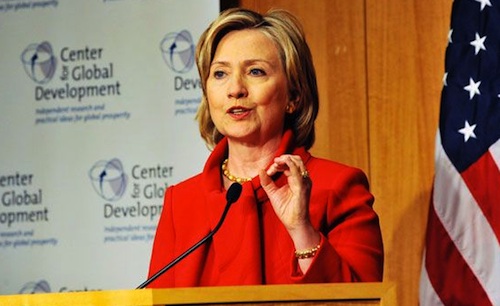
[By Hillary Clinton] In many respects, information has never been so free. There are more ways to spread more ideas to more people than at any moment in history. And even in authoritarian countries, information networks are helping people discover new facts and making governments more accountable.
But technologies with the potential to open up access to government and promote transparency can also be hijacked by governments to crush dissent and deny human rights. In the past year, we’ve seen a spike in threats to the free flow of information. China, Tunisia and Uzbekistan have stepped up their censorship of the Internet.
In Vietnam, access to popular social networking sites has suddenly disappeared. And last Friday in Egypt, 30 bloggers and activists were detained.
So, while it is clear that the spread of these technologies is transforming our world, it is still unclear how that transformation will affect the human rights and the human welfare of the world’s population.
On their own, new technologies do not take sides in the struggle for freedom and progress, but the US does. We stand for a single Internet where all of humanity has equal access to knowledge and ideas. And we recognise that the world’s information infrastructure will become what we and others make of it.
We believe it’s critical that its users are assured certain basic freedoms. Freedom of expression is first among them. This freedom is no longer defined solely by whether citizens can go into the town square and criticise their government without fear of retribution. Blogs, e-mails, social networks and text messages have opened up new forums for exchanging ideas, and created new targets for censorship.
As I speak to you today, government censors somewhere are working furiously to erase my words from the records of history. But history itself has already condemned these tactics.
Two months ago, I was in Germany to celebrate the 20th anniversary of the fall of the Berlin Wall. The leaders gathered at that ceremony paid tribute to the courageous men and women on the far side of that barrier who made the case against oppression by circulating small pamphlets called samizdat.
These leaflets questioned the claims and intentions of dictatorships in the Eastern Bloc and many people paid dearly for distributing them. But their words helped pierce the concrete and concertina wire of the Iron Curtain.
The new iconic infrastructure of our age is the Internet. Instead of division, it stands for connection. But even as networks spread to nations around the globe, virtual walls are cropping up in place of visible walls.
With the spread of these restrictive practices, a new information curtain is descending across much of the world. And beyond this partition, viral videos and blog posts are becoming the samizdat of our day.
As in the dictatorships of the past, governments are targeting independent thinkers who use these tools. In the demonstrations that followed Iran’s presidential elections, grainy cellphone footage of a young woman’s bloody murder provided a digital indictment of the government’s brutality.
We’ve seen reports that when Iranians living overseas posted online criticism of their nation’s leaders, their family members in Iran were singled out for retribution. And despite an intense campaign of government intimidation, brave citizen journalists in Iran continue using technology to show the world and their fellow citizens what is happening inside their country.
In speaking out on behalf of their own human rights, the Iranian people have inspired the world. And their courage is redefining how technology is used to spread truth and expose injustice.
All societies recognise that free expression has its limits. Those who use the Internet to recruit terrorists or distribute stolen intellectual property cannot divorce their online actions from their real world identities.
But these challenges must not become an excuse for governments systematically to violate the rights and privacy of those who use the Internet for peaceful political purposes.
We have every reason to be hopeful about what people can accomplish when they leverage communication networks and connection technologies to achieve progress. But make no mistake — some are and will continue to use global information networks for darker purposes. Violent extremists, criminal cartels, sexual predators and authoritarian governments all seek to exploit these global networks.
As we work to advance freedoms, we must also work against those who use communication networks as tools of disruption and fear. Governments and citizens must have confidence that the networks at the core of their national security and economic prosperity are safe and resilient.
States, terrorists, and those who would act as their proxies must know that the US will protect our networks. Those who disrupt the free flow of information in our society or any other pose a threat to our economy, our government, and our civil society.
Countries or individuals that engage in cyber attacks should face consequences and international condemnation. In an Internet-connected world, an attack on one nation’s networks can be an attack on all. And by reinforcing that message, we can create norms of behaviour among states and encourage respect for the global networked commons.
The US state department is working in more than 40 countries to help individuals silenced by oppressive governments. We are making this issue a priority at the United Nations as well, and we’re including Internet freedom as a component in the first resolution we introduced after returning to the UN Human Rights Council.
We are also supporting the development of new tools that enable citizens to exercise their rights of free expression by circumventing politically motivated censorship. We are providing funds to groups around the world to make sure that those tools get to the people who need them in local languages, and with the training they need to access the Internet safely.
The United States has been assisting in these efforts for some time, with a focus on implementing these programmes as efficiently and effectively as possible. Both the American people and nations that censor the Internet should understand that our government is committed to helping promote Internet freedom.
We want to put these tools in the hands of people who will use them to advance democracy and human rights, to fight climate change and epidemics, to build global support for President Obama’s goal of a world without nuclear weapons, to encourage sustainable economic development that lifts the people at the bottom up.
We feel strongly that principles like information freedom aren’t just good policy, not just somehow connected to our national values, but they are universal and they’re also good for business.
To use market terminology, a publicly listed company in Tunisia or Vietnam that operates in an environment of censorship will always trade at a discount relative to an identical firm in a free society. If corporate decision makers don’t have access to global sources of news and information, investors will have less confidence in their decisions over the long term.
Countries that censor news and information must recognise that from an economic standpoint, there is no distinction between censoring political speech and commercial speech. If businesses in your nations are denied access to either type of information, it will inevitably impact on growth.
Increasingly, US companies are making the issue of Internet and information freedom a greater consideration in their business decisions. I hope that their competitors and foreign governments will pay close attention to this trend.
The most recent situation involving Google has attracted a great deal of interest. And we look to the Chinese authorities to conduct a thorough review of the cyber intrusions that led Google to make its announcement. And we also look for that investigation and its results to be transparent.
The Internet has already been a source of tremendous progress in China, and it is fabulous. There are so many people in China now online. But countries that restrict free access to information or violate the basic rights of Internet users risk walling themselves off from the progress of the next century.
The United States and China have different views on this issue, and we intend to address those differences candidly and consistently in the context of our positive, cooperative, and comprehensive relationship. Ultimately, this issue isn’t just about information freedom; it is about what kind of world we want and what kind of world we will inhabit.
It’s about whether we live on a planet with one Internet, one global community, and a common body of knowledge that benefits and unites us all, or a fragmented planet in which access to information and opportunity is dependent on where you live and the whims of censors.
Information freedom supports the peace and security that provides a foundation for global progress. Historically, asymmetrical access to information is one of the leading causes of interstate conflict. When we face serious disputes or dangerous incidents, it’s critical that people on both sides of the problem have access to the same set of facts and opinions.
As it stands, Americans can consider information presented by foreign governments. We do not block your attempts to communicate with the people in the US. But citizens in societies that practise censorship lack exposure to outside views.
In North Korea, for example, the government has tried to completely isolate its citizens from outside opinions. This lopsided access to information increases both the likelihood of conflict and the probability that small disagreements could escalate.
So I hope that responsible governments with an interest in global stability will work with us to address such imbalances. For companies, this issue is about more than claiming the moral high ground. It really comes down to the trust between firms and their customers.
Consumers everywhere want to have confidence that the Internet companies they rely on will provide comprehensive search results and act as responsible stewards of their own personal information. Firms that earn that confidence of those countries and basically provide that kind of service will prosper in the global marketplace.
Those who lose that confidence of their customers will eventually lose customers. No matter where you live, people want to believe that what they put into the Internet is not going to be used against them.
And censorship should not be in any way accepted by any company from anywhere. And in America, American companies need to make a principled stand. This needs to be part of our national brand. I’m confident that consumers worldwide will reward companies that follow those principles.
We are reinvigorating the Global Internet Freedom Task Force as a forum for addressing threats to Internet freedom around the world, and we are urging US media companies to take a proactive role in challenging foreign governments’ demands for censorship and surveillance.
The private sector has a shared responsibility to help safeguard free expression. And when their business dealings threaten to undermine this freedom, they need to consider what’s right, not simply what’s a quick profit.
We cannot stand by while people are separated from the human family by walls of censorship. And we cannot be silent about these issues simply because we cannot hear the cries.
- Hillary Clinton is US secretary of state
- This speech, delivered on 21 January in Washington DC, has been edited for length
- Subscribe to our free daily newsletter
- Follow us on Twitter or on Facebook