


Close Menu
TechCentralTechCentral

    Subscribe to the newsletter

    Get the best South African technology news and analysis delivered to your e-mail inbox every morning.

    Facebook X (Twitter) YouTube LinkedIn
    WhatsApp Facebook X (Twitter) LinkedIn YouTube
    TechCentralTechCentral
    • News
      SA finally has a broadband map - and it reveals where the gaps are

      SA finally has a broadband map – and it reveals where the gaps are

      31 March 2026
      Bookmakers want banks to cut off offshore online gambling sites

      Bookmakers want banks to cut off offshore online gambling sites

      31 March 2026
      Government steps in as fuel shock hits

      Government steps in as fuel shock hits

      31 March 2026
      Uber commits R5-billion to South Africa amid licensing woes - Deepesh Thomas

      Uber commits R5-billion to South Africa amid licensing woes

      31 March 2026
      'It's done for my industry': the SA director betting everything on AI film - Donovan Marsh

      The SA director betting everything on AI filmmaking

      31 March 2026
    • World

      Apple plans to open Siri to rival AI services

      27 March 2026
      It's official: ads are coming to ChatGPT

      It’s official: ads are coming to ChatGPT

      23 March 2026
      Mystery Chinese AI model revealed to be Xiaomi's

      Mystery Chinese AI model revealed to be Xiaomi’s

      19 March 2026
      A mystery AI model has developers buzzing

      A mystery AI model has developers buzzing

      18 March 2026
      Samsung's trifold gamble ends in retreat

      Samsung’s trifold gamble ends in retreat

      17 March 2026
    • In-depth
      The R18-billion tech giant hiding in plain sight - Jens Montanana

      The R16-billion tech giant hiding in plain sight

      26 March 2026
      The last generation of coders

      The last generation of coders

      18 February 2026
      Sentech is in dire straits

      Sentech is in dire straits

      10 February 2026
      How liberalisation is rewiring South Africa's power sector

      How liberalisation is rewiring South Africa’s power sector

      21 January 2026
      The top-performing South African tech shares of 2025

      The top-performing South African tech shares of 2025

      12 January 2026
    • TCS
      Anoosh Rooplal

      TCS | Anoosh Rooplal on the Post Office’s last stand

      27 March 2026
      Meet the CIO | HealthBridge CTO Anton Fatti on the future of digital health

      Meet the CIO | Healthbridge CTO Anton Fatti on the future of digital health

      23 March 2026
      TCS+ | Arctic Wolf unpacks the evolving threat landscape for SA businesses - Clare Loveridge and Jason Oehley

      TCS+ | Arctic Wolf unpacks the evolving threat landscape for SA businesses

      19 March 2026
      TCS+ | Vox Kiwi: a wireless solution promising a fibre-like experience - Theo van Zyl

      TCS+ | Vox Kiwi: a wireless solution promising a fibre-like experience

      13 March 2026
      TCS+ | Flipping the narrative on AI in the Global South - Josefin Rosén

      TCS+ | Flipping the narrative on AI in the Global South

      13 March 2026
    • Opinion
      The conflict of interest at the heart of PayShap's slow adoption - Cheslyn Jacobs

      The conflict of interest at the heart of PayShap’s slow adoption

      26 March 2026
      South Africa's energy future hinges on getting wheeling right - Aishah Gire

      South Africa’s energy future hinges on getting wheeling right

      10 March 2026
      Hold the doom: the case for a South African comeback - Duncan McLeod

      Apple just dropped a bomb on the Windows world

      5 March 2026
      VC's centre of gravity is shifting - and South Africa is in the frame - Alison Collier

      VC’s centre of gravity is shifting – and South Africa is in the frame

      3 March 2026
      Hold the doom: the case for a South African comeback - Duncan McLeod

      Hold the doom: the case for a South African comeback

      26 February 2026
    • Company Hubs
      • 1Stream
      • Africa Data Centres
      • AfriGIS
      • Altron Digital Business
      • Altron Document Solutions
      • Altron Group
      • Arctic Wolf
      • Ascent Technology
      • AvertITD
      • Braintree
      • CallMiner
      • CambriLearn
      • CYBER1 Solutions
      • Digicloud Africa
      • Digimune
      • Domains.co.za
      • ESET
      • Euphoria Telecom
      • HOSTAFRICA
      • Incredible Business
      • iONLINE
      • IQbusiness
      • Iris Network Systems
      • LSD Open
      • Mitel
      • NEC XON
      • Netstar
      • Network Platforms
      • Next DLP
      • Ovations
      • Paracon
      • Paratus
      • Q-KON
      • SevenC
      • SkyWire
      • Solid8 Technologies
      • Telit Cinterion
      • Telviva
      • Tenable
      • Vertiv
      • Videri Digital
      • Vodacom Business
      • Wipro
      • Workday
      • XLink
    • Sections
      • AI and machine learning
      • Banking
      • Broadcasting and Media
      • Cloud services
      • Contact centres and CX
      • Cryptocurrencies
      • Education and skills
      • Electronics and hardware
      • Energy and sustainability
      • Enterprise software
      • Financial services
      • HealthTech
      • Information security
      • Internet and connectivity
      • Internet of Things
      • Investment
      • IT services
      • Lifestyle
      • Motoring
      • Policy and regulation
      • Public sector
      • Retail and e-commerce
      • Satellite communications
      • Science
      • SMEs and start-ups
      • Social media
      • Talent and leadership
      • Telecoms
    • Events
    • Advertise
    TechCentralTechCentral
    Home » Editor's pick » Tech set to revolutionise transportation

    Tech set to revolutionise transportation

    By The Conversation17 August 2015
    Twitter LinkedIn Facebook WhatsApp Email Telegram Copy Link
    News Alerts
    WhatsApp

    car-640

    Flying cars in The Jetsons and Back to the Future, or Star Trek’s spaceships and teleportation, may have captured the imagination decades ago, but most current methods of transport have been around a long time. Railways were being rolled out rapidly from the 1830s, while the commercial breakthroughs in petrol and diesel engines date to 1876 and 1892 respectively. Even the jet engine that made mass aviation possible can be traced back to Frank Whittle’s first patent in 1932.

    Despite decades of futuristic predictions, modern transport wouldn’t look all that different to someone from the 1950s — certainly not compared to communications or entertainment. So why has there been so little recent innovation in transport? And will the latest batch of proposed driverless cars, levitating trains and electric aircraft actually make a serious breakthrough?

    In part, there hasn’t been a revolution because existing technologies have been able to evolve. Engines have become more efficient, fuel is higher quality, we have lighter materials, more aerodynamic designs and better brakes that mean vehicles can operate safely closer together. However, eventually there will be a limit to these evolutions.

    In any event, transport is not just about technology. It is also about people — and people don’t always like change. We may be locked in to current technology, partly due to habit but also due to economics.

    We have an extensive transport refuelling system based on petrol and diesel. To convert to electricity or, more fancifully, to hydrogen, will involve substantial re-tooling that will be difficult to finance. In the UK, drivers are used to manual transmissions and may be reluctant to learn how to use more automated systems, just as we would be reluctant to re-train to use a different keyboard even if it were more efficient. We are stuck with what we have — the economics of Qwerty.

    Human factors may lead to unintended consequences — one of the ironies of automation is that it can lead to less attention to related tasks. For example, adaptive cruise control can make car drivers less aware of hazards.

    my-world-of-tomorrow-280
    We’re still waiting for the future of the 50s. James Vaughan, CC BY-NC-SA

    Even with full automation, when we still have trouble making all trains driverless, one might suggest driverless cars are a flight of fancy. Innovative aeroplane designs, such as the blended wing, are stymied by the human requirements for a window seat (Nasa has suggested windows could be replaced with real-time video).

    Fancy new inventions have to be accompanied by a business model and the right infrastructure, or else they’ll just languish as prototypes like the pneumatic transit system demonstrated in New York City in the early 1870s and a forerunner to Elon Musk’s proposed Hyperloop. Take flying cars. Even supposing the technology works, where would they land?

    Such a system would only succeed if infrastructure — air traffic control, landing space and so on — was set aside. While flying cars could technically operate from airport to airport, what’s the point? Until there are sufficient numbers to set aside pieces of land or roads for take-off we won’t achieve any of the benefits. And there won’t be sufficient demand until this land is set aside. Catch 22.

    When looking at how technology interacts with wider society it’s helpful to think in terms of three different levels: niches, regimes and landscapes.

    In transport, there are plenty of niche innovations — battery electric vehicles, hydrogen fuel cells, car clubs — but few become mainstream. An exception might be hybrid electric vehicles such the Toyota Prius, but even here the underlying technology may be traced back to a patent registered in 1898 (by Ferdinand Porsche, no less).

    The problem isn’t coming up with new ideas — it’s changing the bigger picture. At regime level, new transport technologies have faced resistance from vested interests such as oil producers and car makers. And the wider landscape has not always favoured major innovations — especially low oil prices.

    With lots of different individual suppliers, transport is also vulnerable to tragedy of the commons-type outcomes and clashes between rival designs and brands. Navigation technologies can only be sold commercially if they benefit the individual consumer.

    However, if we all have access to such technologies, we can be collectively worse off due to congestion — for the greater good, it would be beneficial if sometimes our SatNav sends us on a longer route, but who is knowingly going to buy something like that?
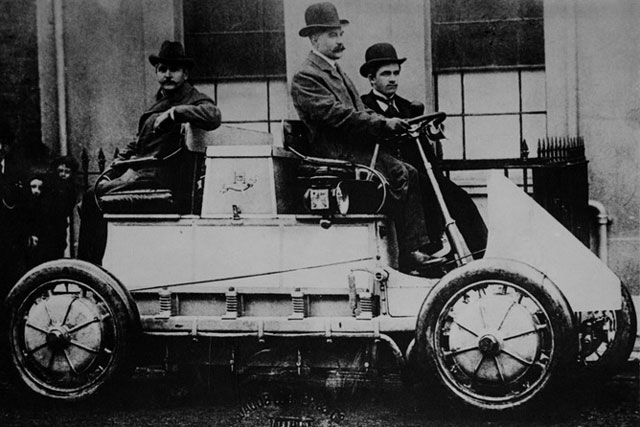
    The first Porsche – and the first hybrid
    The first Porsche – and the first hybrid

    Electric battery technology might have more rapid adoption if the technology was standardised, permitting automated battery swaps. But standardised to whose technology? Magnetic levitation train adoption is limited by the fact they can’t run on traditional rail lines and have only limited overlap with other maglevs.

    In short, despite the fuss over disruptive technologies such as Uber, it is unlikely that transport will have a technology paradigm shift until there is a major landscape change. Of course, with volatile oil prices, limited reserves and sensitive geopolitics, such a change could be just round the corner. But for the moment, the technology push does not seem to be complemented by a societal pull — people might like to watch sci-fi, but they aren’t yet ready to live it.The Conversation

    • John Preston is head of the Transportation Research Group at the University of Southampton; Ben Waterson is lecturer in transportation at the same institution
    • This article was originally published on The Conversation
    Follow TechCentral on Google News Add TechCentral as your preferred source on Google


    Ben Waterson John Preston
    WhatsApp YouTube
    Share. Facebook Twitter LinkedIn WhatsApp Telegram Email Copy Link
    Previous ArticleRobust performance from Adapt IT
    Next Article Internet censorship bill enters next phase
    Company News
    How consumers can identify a true QLED TV

    How consumers can identify a true QLED TV

    30 March 2026
    Kaspersky, Afripol team up to combat African cybercrime

    Kaspersky, Afripol team up to combat African cybercrime

    30 March 2026
    Modernise infrastructure with next-gen compute using HPE VM Essentials - Riaan Swart Tarsus Distribution

    Modernise infrastructure with next-gen compute using HPE VM Essentials

    30 March 2026
    Opinion
    The conflict of interest at the heart of PayShap's slow adoption - Cheslyn Jacobs

    The conflict of interest at the heart of PayShap’s slow adoption

    26 March 2026
    South Africa's energy future hinges on getting wheeling right - Aishah Gire

    South Africa’s energy future hinges on getting wheeling right

    10 March 2026
    Hold the doom: the case for a South African comeback - Duncan McLeod

    Apple just dropped a bomb on the Windows world

    5 March 2026

    Subscribe to Updates

    Get the best South African technology news and analysis delivered to your e-mail inbox every morning.

    Latest Posts
    SA finally has a broadband map - and it reveals where the gaps are

    SA finally has a broadband map – and it reveals where the gaps are

    31 March 2026
    Bookmakers want banks to cut off offshore online gambling sites

    Bookmakers want banks to cut off offshore online gambling sites

    31 March 2026
    Government steps in as fuel shock hits

    Government steps in as fuel shock hits

    31 March 2026
    Uber commits R5-billion to South Africa amid licensing woes - Deepesh Thomas

    Uber commits R5-billion to South Africa amid licensing woes

    31 March 2026
    © 2009 - 2026 NewsCentral Media
    • Cookie policy (ZA)
    • TechCentral – privacy and Popia

    Type above and press Enter to search. Press Esc to cancel.

    Manage consent

    TechCentral uses cookies to enhance its offerings. Consenting to these technologies allows us to serve you better. Not consenting or withdrawing consent may adversely affect certain features and functions of the website.

    Functional Always active
    The technical storage or access is strictly necessary for the legitimate purpose of enabling the use of a specific service explicitly requested by the subscriber or user, or for the sole purpose of carrying out the transmission of a communication over an electronic communications network.
    Preferences
    The technical storage or access is necessary for the legitimate purpose of storing preferences that are not requested by the subscriber or user.
    Statistics
    The technical storage or access that is used exclusively for statistical purposes. The technical storage or access that is used exclusively for anonymous statistical purposes. Without a subpoena, voluntary compliance on the part of your Internet Service Provider, or additional records from a third party, information stored or retrieved for this purpose alone cannot usually be used to identify you.
    Marketing
    The technical storage or access is required to create user profiles to send advertising, or to track the user on a website or across several websites for similar marketing purposes.
    • Manage options
    • Manage services
    • Manage {vendor_count} vendors
    • Read more about these purposes
    View preferences
    • {title}
    • {title}
    • {title}