
Close Menu
TechCentralTechCentral

    Subscribe to the newsletter

    Get the best South African technology news and analysis delivered to your e-mail inbox every morning.

    Facebook X (Twitter) YouTube LinkedIn
    WhatsApp Facebook X (Twitter) LinkedIn YouTube
    TechCentralTechCentral
    • News
      Why Telkom is pouring capex into IT - Serame Taukobong

      Why Telkom is pouring capital spending into IT

      2 June 2026
      Telkom's data growth story still has years to run: CEO

      Telkom’s data growth story still has years to run: CEO

      2 June 2026
      Reserve Bank draws a line on inflation - Lesetja Kganyago. Siphiwe Sibeko/Reuters

      Reserve Bank draws a line on inflation

      2 June 2026

      Clashing judgments leave South Africa’s crypto law unsettled

      2 June 2026
      Telkom's four-year SIU standoff awaits a final ruling

      Telkom’s four-year SIU standoff awaits a final ruling

      2 June 2026
    • World
      Astronomers discover exoplanets with magnetic fields

      Strange winds reveal magnetic fields on distant ‘hot Jupiters’

      2 June 2026
      Nvidia's first CPUs to debut in Windows laptops this week

      Nvidia CPUs to debut in Windows laptops this week

      31 May 2026
      Watch: Bezos rocket erupts in fireball during ground test

      Watch: Bezos rocket erupts in fireball during ground test

      29 May 2026
      AI boom hands Samsung chip workers life-changing bonuses

      AI boom hands Samsung chip workers life-changing bonuses

      27 May 2026
      Luce lit: Ferrari unveils its first electric car

      Luce lit: Ferrari unveils its first electric car

      26 May 2026
    • In-depth
      Alfa's electric rebel - Alfa Romeo Junior Elettrica Veloce

      Alfa’s electric rebel

      29 April 2026
      Africa switches on as Europe dims the lights

      Africa switches on as Europe dims the lights

      9 April 2026
      The biggest untapped EV market on Earth is hiding in plain sight

      The biggest untapped EV market on Earth is hiding in plain sight

      1 April 2026
      AI, cybersecurity power standout year for Datatec - Jens Montanana

      The R16-billion tech giant hiding in plain sight

      26 March 2026
      The last generation of coders

      The last generation of coders

      18 February 2026
    • TCS
      TCS | Charge's R1.8-billion bet on an off-grid EV future - Charge chairman Joubert Roux

      TCS | Charge’s R1.8-billion bet on an off-grid EV future

      18 May 2026
      TCS+ | The Up&Up Group on the hidden cost of AI - Jason Harrison

      TCS+ | The Up&Up Group on the hidden cost of AI

      13 May 2026
      Michael Rossouw

      TCS+ | The retirement decision most South Africans get wrong

      6 May 2026
      TCS | The Cape Town start-up listening for TB with AI - Braden van Breda

      TCS | The Cape Town start-up listening for TB with AI

      4 May 2026

      TCS+ | ‘The ISP for ISPs’: Vox’s shift to wholesale aggregator

      20 April 2026
    • Opinion
      Treasury's crypto crackdown is a betrayal of Mandela's promise - Duncan McLeod

      Treasury’s crypto crackdown is a betrayal of Mandela’s promise

      22 May 2026
      South Africa is sleepwalking into another AI policy failure - Celeste Labuschagne

      South Africa is sleepwalking into another AI policy failure

      20 May 2026
      AI won't fix your culture - it will expose it - Jackie Kennedy

      AI won’t fix your culture – it will expose it

      19 May 2026
      Treasury's crypto crackdown is a betrayal of Mandela's promise - Duncan McLeod

      Free calls, dead voice and Shameel Joosub’s Spanish ghost

      22 April 2026
      The conflict of interest at the heart of PayShap's slow adoption - Cheslyn Jacobs

      The conflict of interest at the heart of PayShap’s slow adoption

      26 March 2026
    • Company Hubs
      • 1Stream
      • Africa Data Centres
      • AfriGIS
      • Altron Digital Business
      • Altron Document Solutions
      • Altron Group
      • Arctic Wolf
      • Ascent Technology
      • AvertITD
      • BBD
      • Braintree
      • CallMiner
      • CambriLearn
      • CM Telecom
      • Contactable
      • CYBER1 Solutions
      • Digicloud Africa
      • Digimune
      • Domains.co.za
      • ESET
      • Euphoria Telecom
      • HOSTAFRICA
      • Incredible Business
      • iONLINE
      • IQbusiness
      • Iris Network Systems
      • Kaspersky
      • LSD Open
      • Mitel
      • NEC XON
      • Netstar
      • Network Platforms
      • Next DLP
      • Ovations
      • Paracon
      • Paratus
      • Q-KON
      • SevenC
      • SkyWire
      • Solid8 Technologies
      • Telit Cinterion
      • Telviva
      • Tenable
      • Vertiv
      • Videri Digital
      • Vodacom Business
      • Wipro
      • Workday
      • XLink
    • Sections
      • AI and machine learning
      • Banking
      • Broadcasting and Media
      • Cloud services
      • Contact centres and CX
      • Cryptocurrencies
      • Education and skills
      • Electronics and hardware
      • Energy and sustainability
      • Enterprise software
      • Financial services
      • HealthTech
      • Information security
      • Internet and connectivity
      • Internet of Things
      • Investment
      • IT services
      • Lifestyle
      • Motoring
      • Policy and regulation
      • Public sector
      • Retail and e-commerce
      • Satellite communications
      • Science
      • SMEs and start-ups
      • Social media
      • Talent and leadership
      • Telecoms
    • Events
    • Advertise
    TechCentralTechCentral
    Home » Science » The amazing camera that can see around corners

    The amazing camera that can see around corners

    By The Conversation9 December 2015
    Twitter LinkedIn Facebook WhatsApp Email Telegram Copy Link
    News Alerts
    WhatsApp

    camera-corner-640

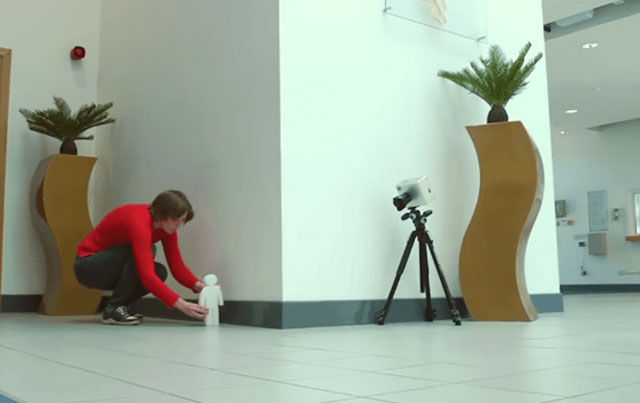
    How can a person see around a blind corner? One answer is to develop X-ray vision. A more mundane approach is to use a mirror. But if neither are an option, a group of scientists led by Genevieve Gariepy has developed a state-of-the-art detector which, with some clever data processing techniques, can turn walls and floors into a “virtual mirror”, giving the power to locate and track moving objects out of direct line of sight.

    The shiny surface of a mirror works by reflecting scattered light from an object at a well-defined angle towards your eye. Because light scattered from different points on the object is reflected at the same angle, your eye sees a clear image of the object. In contrast, a non-reflective surface scatters light randomly in all directions, and creates no clear image.

    However, as the researchers at Heriot-Watt University and the University of Edinburgh recognised, there is a way to tease out information on the object even from apparently random scattered light. Their method, published in Nature Photonics, relies on laser range-finding technology, which measures the distance to an object based on the time it takes a pulse of light to travel to the object, scatter, and travel back to a detector.
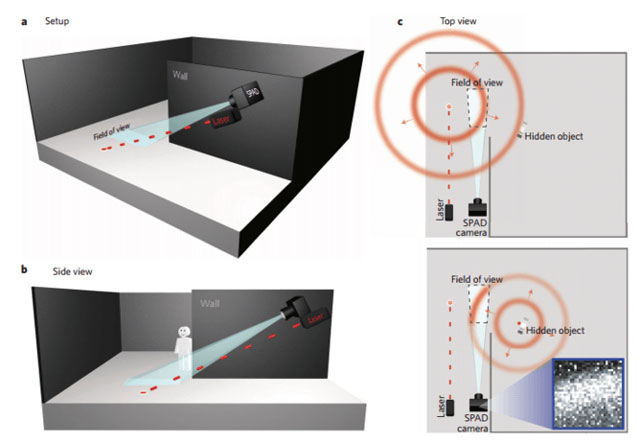
    Laser light fired at the floor is scattered in a spherical wave. It reflects from the hidden object and makes its way back to the SPAD detector, where the noisy data is processed to reveal the hidden object. Gariepy et al./Nature Photonics
    Laser light fired at the floor is scattered in a spherical wave. It reflects from the hidden object and makes its way back to the SPAD detector, where the noisy data is processed to reveal the hidden object. Gariepy et al./Nature Photonics

    In principle, the measurement is quite simple. A laser pulse is bounced off the floor and scatters in all directions. A small fraction of the laser light strikes the object, and the back-scattered light is recorded on a patch of floor — the “virtual mirror” — next to the spot the laser strikes. Because the speed of light is known and constant, by measuring the time interval between the start of the laser pulse and the scattered light reaching the patch of floor, the position of the object can be triangulated.

    However, the devil is in the detail. The timing measurement needs to be accurate to within about 50 thousand billionths of a second (5×10-11, or 50 picoseconds), and the light levels that must be detected are extremely low. Overcoming both of these obstacles requires some serious laser and detector technology. The laser pulses used for the timing measurement are just 10 femtoseconds (10 million-billionths of a second, or 10-15) long, and each pixel in the ultra-sensitive “camera” (known as a single-pixel avalanche diode array, or SPAD) used to image the patch of floor is essentially an ultrafast stopwatch that records the arrival time of the scattered light pulse to within a few hundred-billionths of a second.

    The complications do not end there. Light scattered from the object of interest reaches the virtual mirror of the floor, but so does light scattered from every other object in the vicinity. The success of this technique requires that the two be separated, the “signal” of the hidden object from the background noise of everything else.

    This is achieved by using the fact that the hidden object the device is trying to detect is moving, while other nearby objects are not. Because the moving object generates a signal in the virtual mirror that changes with time, it can be filtered from the constant background signal produced by the stationary objects of the surroundings.
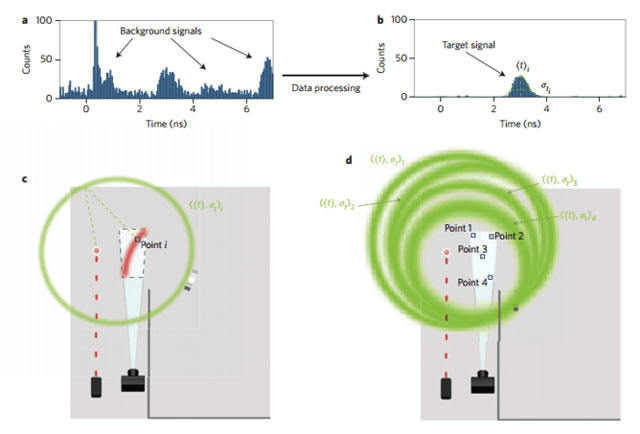
    A histogram is created of photon arrival times for every pixel, which must then be processed to remove background objects from the target object. Gariepy et al/Nature Photonics
    A histogram is created of photon arrival times for every pixel, which must then be processed to remove background objects from the target object. Gariepy et al/Nature Photonics

    The final complication is that the timing measurement for scattered light arriving at a single point on the virtual mirror and recorded by a single pixel in the detector unfortunately doesn’t locate the object to a single unique position. A similar time delay could result from objects located at any number of different positions located an appropriate distance from the virtual mirror.

    While the timing data from a single pixel only locates the object to a range of positions, the range is different for each pixel. However, it turns out that there is only a single position at which the timing condition is satisfied simultaneously for all pixels, and this allows the object to be unambiguously identified from the background signals.

    The prototype camera system allows the object’s position behind the wall to be localised to within a centimetre or two, and by making measurements every few seconds the camera can also detect the speed of a moving object. In contrast to previous methods, which required long data processing times, the new method can track moving objects in real time. At present, it’s limited to locating objects up to 60cm away from the virtual mirror on the floor, but this should improve to around 10m, as well as to more closely detect the shapes of hidden objects as well as their positions.

    So while it’s not quite as promising, or as convenient, as the science-fiction powers of X-ray vision, the study’s authors note that the technology has interesting future applications in areas such as surveillance — to detect a moving person behind a wall, for example — or in car safety systems to detect incoming vehicles approaching around corners.The Conversation

    • Claire Vallance is professor of physical chemistry at the University of Oxford
    • This article was originally published on The Conversation

    Follow TechCentral on Google News Add TechCentral as your preferred source on Google


    Claire Vallance Genevieve Gariepy
    WhatsApp YouTube
    Share. Facebook Twitter LinkedIn WhatsApp Telegram Email Copy Link
    Previous ArticleVodacom walks away from Neotel spectrum
    Next Article Free-to-air broadcasters to feel the squeeze
    Company News
    The hidden infrastructure behind AI - Open Access Data Centres OADC

    The hidden infrastructure behind AI

    2 June 2026
    Addressing the 57% blind spot: Kaspersky on measuring SOC effectiveness

    Addressing the 57% blind spot: Kaspersky on measuring SOC effectiveness

    2 June 2026
    Strike48 report: security leaders wary of AI agents - Maidar Secure

    Strike48 report: security leaders wary of AI agents

    2 June 2026
    Opinion
    Treasury's crypto crackdown is a betrayal of Mandela's promise - Duncan McLeod

    Treasury’s crypto crackdown is a betrayal of Mandela’s promise

    22 May 2026
    South Africa is sleepwalking into another AI policy failure - Celeste Labuschagne

    South Africa is sleepwalking into another AI policy failure

    20 May 2026
    AI won't fix your culture - it will expose it - Jackie Kennedy

    AI won’t fix your culture – it will expose it

    19 May 2026

    Subscribe to Updates

    Get the best South African technology news and analysis delivered to your e-mail inbox every morning.

    Latest Posts
    Why Telkom is pouring capex into IT - Serame Taukobong

    Why Telkom is pouring capital spending into IT

    2 June 2026
    Telkom's data growth story still has years to run: CEO

    Telkom’s data growth story still has years to run: CEO

    2 June 2026
    Reserve Bank draws a line on inflation - Lesetja Kganyago. Siphiwe Sibeko/Reuters

    Reserve Bank draws a line on inflation

    2 June 2026
    Astronomers discover exoplanets with magnetic fields

    Strange winds reveal magnetic fields on distant ‘hot Jupiters’

    2 June 2026
    © 2009 - 2026 NewsCentral Media
    • Cookie policy (ZA)
    • TechCentral – privacy and Popia

    Type above and press Enter to search. Press Esc to cancel.

    Manage consent

    TechCentral uses cookies to enhance its offerings. Consenting to these technologies allows us to serve you better. Not consenting or withdrawing consent may adversely affect certain features and functions of the website.

    Functional Always active
    The technical storage or access is strictly necessary for the legitimate purpose of enabling the use of a specific service explicitly requested by the subscriber or user, or for the sole purpose of carrying out the transmission of a communication over an electronic communications network.
    Preferences
    The technical storage or access is necessary for the legitimate purpose of storing preferences that are not requested by the subscriber or user.
    Statistics
    The technical storage or access that is used exclusively for statistical purposes. The technical storage or access that is used exclusively for anonymous statistical purposes. Without a subpoena, voluntary compliance on the part of your Internet Service Provider, or additional records from a third party, information stored or retrieved for this purpose alone cannot usually be used to identify you.
    Marketing
    The technical storage or access is required to create user profiles to send advertising, or to track the user on a website or across several websites for similar marketing purposes.
    • Manage options
    • Manage services
    • Manage {vendor_count} vendors
    • Read more about these purposes
    View preferences
    • {title}
    • {title}
    • {title}

