
Close Menu
TechCentralTechCentral

    Subscribe to the newsletter

    Get the best South African technology news and analysis delivered to your e-mail inbox every morning.

    Facebook X (Twitter) YouTube LinkedIn
    WhatsApp Facebook X (Twitter) LinkedIn YouTube
    TechCentralTechCentral
    • News
      300 million Sims a year for 60 million South Africans - Ferdi Moolman

      300 million Sims a year for 65 million South Africans

      25 August 2026
      MTN targets 150MW in first phase of AI data centre push

      MTN targets 150MW in first phase of AI data centre push

      25 August 2026
      Pick n Pay puts a TikTok-style shopping feed inside its grocery app

      Pick n Pay puts a TikTok-style shopping feed inside its grocery app

      25 August 2026
      SpaceX wants to launch its AI satellite fleet from a Louisiana swamp

      SpaceX wants to launch its AI satellite fleet from a Louisiana swamp

      25 August 2026
      $4-billion telescope that could rewrite gravity launches on Sunday

      $4-billion telescope that could rewrite gravity launches on Sunday

      25 August 2026
    • World
      Russia building its own Starlink - and faster than expected - Vadym Skibitskyi

      Russia building its own Starlink – and faster than expected

      11 August 2026
      Meta AI will now tell parents if their teen is in crisis

      Meta AI will now tell parents if their teen is in crisis

      17 July 2026
      IBM shares crash 25% as AI upends software spending - Arvind Krishna

      IBM shares crash 25% as AI upends software spending

      15 July 2026
      Jony Ive's first OpenAI device: an AI smart speaker - Jony Ive and Sam Altman

      Jony Ive’s first OpenAI device: an AI smart speaker

      15 July 2026
      Stripe, Advent in talks to buy PayPal for $53-billion

      Stripe, Advent in talks to buy PayPal for $53-billion

      15 July 2026
    • In-depth
      Google DeepMind CEO Demis Hassabis. Image: John Sears

      The plan to stop AI from breaking the world

      16 July 2026
      The internet has a Strait of Hormuz problem

      The internet has a Strait of Hormuz problem

      15 July 2026
      AI boom sparks rally, frenzy and fear

      AI boom sparks rally, frenzy and fear

      11 June 2026
      Every plug-in hybrid on sale in South Africa, ranked by price - Lamborghini Temerario

      Every plug-in hybrid on sale in South Africa, ranked by price

      7 June 2026
      What Wi-Fi 8 will mean for wireless networks

      What Wi-Fi 8 will mean for wireless networks

      1 June 2026
    • TCS
      Watts & Wheels S1E8: 'Tesla lands in Africa, just not here'

      Watts & Wheels S1E8: ‘Tesla lands in Africa, just not here’

      24 August 2026
      Meet the CIO | Discovery's Derek Wilcocks on AI, guardrails and growth

      Meet the CIO | Derek Wilcocks on how AI personalised Vitality

      13 August 2026
      TCS | Money just became native to the internet - Steven Boykey Sidley

      TCS | Money just became native to the internet – Steven Boykey Sidley

      12 August 2026
      TCS+ | Specops' Darren James on continuous trust in an AI world

      TCS+ | Specops’ Darren James on continuous trust in an AI world

      7 August 2026
      TCS+ | How AI is turning hardware into a subscription service - Shane van der Merwe Merchant West

      TCS+ | How AI is turning hardware into a subscription service

      6 August 2026
    • Opinion
      The author, Jannie van Zyl

      Selling vapour is corporate suicide in slow motion

      16 July 2026
      Brazil's online gambling crackdown is a lesson for South Africa

      How Amazon outmanoeuvred Starlink in South Africa

      15 July 2026
      The Popia problem with agentic AI - Herman Haasbroek

      The Popia problem with agentic AI

      14 July 2026
      The author, Fanie van Rooyen

      South Africa can still catch the AI wave – here’s how

      7 July 2026
      The author, Fanie van Rooyen

      The AI utopia South Africa can’t afford

      1 July 2026
    • Company Hubs
      • 1Stream
      • Africa Data Centres
      • AfriGIS
      • Altron Digital Business
      • Altron Document Solutions
      • Altron Group
      • Arctic Wolf
      • Ascent Technology
      • AvertITD
      • BBD
      • Braintree
      • CallMiner
      • CambriLearn
      • CM Telecom
      • Contactable
      • CYBER1 Solutions
      • Digicloud Africa
      • Digimune
      • Domains.co.za
      • ESET
      • Euphoria Telecom
      • HOSTAFRICA
      • Incredible Business
      • iONLINE
      • IQbusiness
      • Iris Network Systems
      • Kaspersky
      • LSD Open
      • Mitel
      • NEC XON
      • Netstar
      • Network Platforms
      • Next DLP
      • Ovations
      • Paracon
      • Paratus
      • Q-KON
      • SevenC
      • SkyWire
      • Solid8 Technologies
      • Telit Cinterion
      • Telviva
      • Tenable
      • Vertiv
      • Videri Digital
      • Vodacom Business
      • Vox
      • Wipro
      • Workday
      • XLink
    • Sections
      • AI and machine learning
      • Banking
      • Broadcasting and Media
      • Cloud services
      • Contact centres and CX
      • Cryptocurrencies
      • Education and skills
      • Electronics and hardware
      • Energy and sustainability
      • Enterprise software
      • Financial services
      • HealthTech
      • Information security
      • Internet and connectivity
      • Internet of Things
      • Investment
      • IT services
      • Lifestyle
      • Policy and regulation
      • Public sector
      • Retail and e-commerce
      • Satellite communications
      • Science
      • SMEs and start-ups
      • Social media
      • Talent and leadership
      • Telecoms
      • Watts & Wheels
    • Events
    • Advertise
    TechCentralTechCentral
    Home » News » Top SA computer scientist on IBM’s chip breakthrough

    Top SA computer scientist on IBM’s chip breakthrough

    One of South Africa’s leading computer scientists weighs on the significance of the first sub-1nm chip.
    By Fanie van Rooyen26 June 2026
    Twitter LinkedIn Facebook WhatsApp Email Telegram Copy Link
    News Alerts
    WhatsApp
    Top SA computer scientist on IBM's chip breakthrough - Francesco Petruccione
    Prof Francesco Petruccione

    IBM this week claimed the first sub-nanometre chip, a generation it calls the 0.7nm, or 7-angstrom, node. It says the design packs nearly 100 billion transistors onto a fingernail-sized surface, about twice the density of its 2nm chip from 2021, with up to 50% more performance or 70% better energy efficiency. Production could begin within five years.

    “This is an important engineering milestone,” said Francesco Petruccione, director of the National Institute for Theoretical and Computational Sciences (NITheCS) and professor of quantum computing at Stellenbosch University. “It shows that chip manufacturers are still finding ways to make computer chips more powerful and more energy-efficient, despite many experts believing that traditional scaling was approaching its limits.”

    For decades, chips improved by shrinking transistors and packing more side by side on a flat sheet of silicon. That approach is hitting the limits of physics. IBM’s answer, a design it calls “nanostack”, stacks transistors on top of one another, like flats in a tower block rather than houses spread across open veld, so the same footprint can now hold far more.

    The real innovation is not simply making transistors smaller, but redesigning how they are arranged in 3D

    IBM has described the redesign, not the shrinking, as the real story. “We’re not just making smaller transistors; we’re reinventing how chips are built,” said IBM Research director Jay Gambetta.

    Petruccione agreed that is the crux: “The real innovation is not simply making transistors smaller, but redesigning how they are arranged in three dimensions, opening a new path for future generations of computing hardware.” Labels like “2nm” and “0.7nm” are names for a generation of technology, not the literal width of a transistor.

    For scale, today’s best laptop processor, Apple’s M3 Max, has about 92 billion transistors across the whole chip; IBM fits a comparable number onto a single fingernail. Chip makers spend such a gain on more speed or lower power, and Petruccione expects both to reach users.

    The impact

    “For consumers, it could eventually translate into faster smartphones and laptops, longer battery life and more capable AI assistants running directly on devices,” he said. “For businesses, the bigger impact is likely to be lower energy costs in data centres and the ability to process much larger AI workloads, making advanced AI applications more affordable and widely available.”


    Better chips go to the heart of the AI boom. “AI progress increasingly depends not only on better algorithms but also on better hardware,” Petruccione said. “Training and running modern AI models require enormous amounts of computational power and electricity. More efficient chips allow us to perform more AI computations using less energy … advances in semiconductor technology are therefore becoming just as important as advances in AI software.”

    A second milestone is aimed even more squarely at AI. Alongside the transistor count, IBM reported a roughly 40% improvement in on-chip SRAM, the fast memory beside the processor. Modern AI models are often held back less by raw compute than by the energy and time spent shuttling data to and from separate memory chips; denser on-chip memory keeps more of it next to the engine doing the work, easing that bottleneck.

    Chip vs brain

    So, how much closer does this take us to the human brain? In raw scale, a little, but less than the headlines suggest. The brain’s estimated 86 billion neurons put IBM’s 100 billion transistors in the same ballpark, but the brain’s real unit of connection is the synapse, and it has on the order of 100 trillion of them, around a thousand times the chip’s transistor count. Doubling density over the earlier 2nm chip only halves the silicon needed to close that gap; you would still need roughly a thousand of these fingernail-sized clusters wired together to match the brain’s connections.

    Read: Honey, I shrunk the chips – inside TSMC’s 2nm breakthrough

    And matching the brain’s scale is not the same as matching the brain. A transistor is a simple on-off switch, whereas a synapse is a living connection that constantly rewires itself. For AI, the distance is shorter: a model’s “size” is often measured in parameters, which loosely do the job synapses do, and the biggest now run into the trillions. GPT-4 was widely reported at around 1.8 trillion, with later models thought larger still, leaving leading models perhaps 10 to 50 times short of the brain’s synapse count rather than a thousand-fold. Chips like this one do not close that gap so much as make the models cheaper and less power-hungry to run, the practical way the new hardware nudges AI forward.
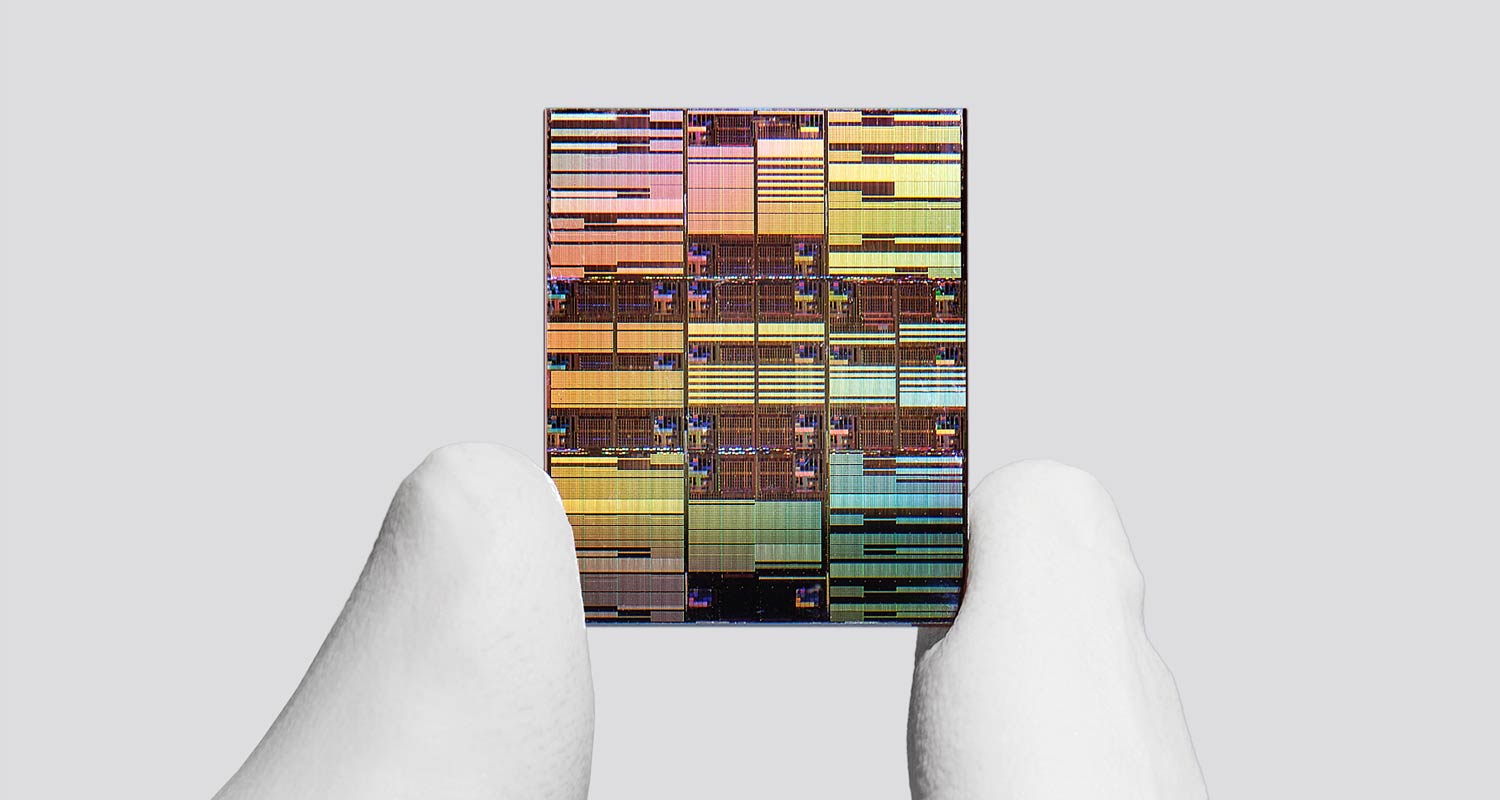
    IBM claims major chip breakthrough

    What South Africa should take from it

    South Africa will not be making leading-edge chips, but Petruccione argues that is not where the opportunity lies. “We can build expertise in designing AI algorithms, developing software, quantum computing, quantum technologies and high-performance computing,” he said. “Future competitiveness will increasingly depend on investing in advanced digital skills, research and human capital. Countries that prepare their workforce for this new era will be far better positioned to benefit from the next wave of technological innovation.”

    IBM has shown “an impressive research prototype, but there is still a significant gap between a laboratory demonstration and high-volume commercial manufacturing”, he said. The five-year timeline is “plausible, but probably many engineering and economic challenges remain”.  — © 2026 NewsCentral Media

    • Subscribe to TechCentral’s daily newsletter
    • Get breaking news alerts on WhatsApp

    Follow TechCentral on Google News Add TechCentral as your preferred source on Google


    Apple Francesco Petruccione IBM Jay Gambetta NITheCS Stellenbosch University
    WhatsApp YouTube
    Share. Facebook Twitter LinkedIn WhatsApp Telegram Email Copy Link
    Previous ArticleTelcos agree plan to tighten Sim registration under Rica
    Next Article Why telecoms resellers are being priced out

    Related Posts

    Your iPhone is about to get a massive upgrade

    Your iPhone is about to get a massive upgrade

    18 August 2026
    South Africa targets 2030 for its first satellite launch from home soil

    South Africa targets 2030 for its first satellite launch from home soil

    13 August 2026
    TCS+ | iStore Business on why Apple makes sense for SMEs - Sudesh Pillay and Tamia Nontsikelelo

    TCS+ | iStore Business on why Apple makes sense for SMEs

    30 July 2026
    Company News
    Copilot is ready. Is your data? Ascent Technology - Microsoft Copilot

    Copilot is ready. Is your data?

    25 August 2026
    Centracom challenges telecoms gender norms - Elizabeth Makudubela

    Centracom challenges telecoms gender norms

    25 August 2026
    From data cabling to leading Lenovo at Pinnacle ICT - Inge Middlemas

    From data cabling to leading Lenovo at Pinnacle ICT

    24 August 2026
    Opinion
    The author, Jannie van Zyl

    Selling vapour is corporate suicide in slow motion

    16 July 2026
    Brazil's online gambling crackdown is a lesson for South Africa

    How Amazon outmanoeuvred Starlink in South Africa

    15 July 2026
    The Popia problem with agentic AI - Herman Haasbroek

    The Popia problem with agentic AI

    14 July 2026

    Subscribe to Updates

    Get the best South African technology news and analysis delivered to your e-mail inbox every morning.

    Latest Posts
    300 million Sims a year for 60 million South Africans - Ferdi Moolman

    300 million Sims a year for 65 million South Africans

    25 August 2026
    MTN targets 150MW in first phase of AI data centre push

    MTN targets 150MW in first phase of AI data centre push

    25 August 2026
    Pick n Pay puts a TikTok-style shopping feed inside its grocery app

    Pick n Pay puts a TikTok-style shopping feed inside its grocery app

    25 August 2026
    SpaceX wants to launch its AI satellite fleet from a Louisiana swamp

    SpaceX wants to launch its AI satellite fleet from a Louisiana swamp

    25 August 2026
    © 2009 - 2026 NewsCentral Media
    Built and maintained by Chronon
    • Cookie policy (ZA)
    • TechCentral – privacy and Popia

    Type above and press Enter to search. Press Esc to cancel.

    Manage consent

    TechCentral uses cookies to enhance its offerings. Consenting to these technologies allows us to serve you better. Not consenting or withdrawing consent may adversely affect certain features and functions of the website.

    Functional Always active
    The technical storage or access is strictly necessary for the legitimate purpose of enabling the use of a specific service explicitly requested by the subscriber or user, or for the sole purpose of carrying out the transmission of a communication over an electronic communications network.
    Preferences
    The technical storage or access is necessary for the legitimate purpose of storing preferences that are not requested by the subscriber or user.
    Statistics
    The technical storage or access that is used exclusively for statistical purposes. The technical storage or access that is used exclusively for anonymous statistical purposes. Without a subpoena, voluntary compliance on the part of your Internet Service Provider, or additional records from a third party, information stored or retrieved for this purpose alone cannot usually be used to identify you.
    Marketing
    The technical storage or access is required to create user profiles to send advertising, or to track the user on a website or across several websites for similar marketing purposes.
    • Manage options
    • Manage services
    • Manage {vendor_count} vendors
    • Read more about these purposes
    View preferences
    • {title}
    • {title}
    • {title}