Close Menu
TechCentralTechCentral

    Subscribe to the newsletter

    Get the best South African technology news and analysis delivered to your e-mail inbox every morning.

    Facebook X (Twitter) YouTube LinkedIn
    WhatsApp Facebook X (Twitter) LinkedIn YouTube
    TechCentralTechCentral
    • News
      Sars maps out the tech stack that will replace VAT returns

      Sars maps out the tech stack that will replace VAT returns

      17 August 2026
      Starlink direct-to-mobile network launched in key Sadc country

      Starlink direct-to-mobile network launched in key Sadc country

      17 August 2026
      Volvo's ES90 has one flaw, and it is not the price - Volvo ES90 review

      Volvo’s ES90 has one flaw, and it is not the price

      17 August 2026
      Africa's moon telescope project will listen for alien technology

      Africa’s moon telescope project will listen for alien technology

      17 August 2026
      Still no end in sight to South Africa's digital migration saga

      Still no end in sight to South Africa’s digital migration saga

      17 August 2026
    • World
      Russia building its own Starlink - and faster than expected - Vadym Skibitskyi

      Russia building its own Starlink – and faster than expected

      11 August 2026
      Meta AI will now tell parents if their teen is in crisis

      Meta AI will now tell parents if their teen is in crisis

      17 July 2026
      IBM shares crash 25% as AI upends software spending - Arvind Krishna

      IBM shares crash 25% as AI upends software spending

      15 July 2026
      Jony Ive's first OpenAI device: an AI smart speaker - Jony Ive and Sam Altman

      Jony Ive’s first OpenAI device: an AI smart speaker

      15 July 2026
      Stripe, Advent in talks to buy PayPal for $53-billion

      Stripe, Advent in talks to buy PayPal for $53-billion

      15 July 2026
    • In-depth
      Google DeepMind CEO Demis Hassabis. Image: John Sears

      The plan to stop AI from breaking the world

      16 July 2026
      The internet has a Strait of Hormuz problem

      The internet has a Strait of Hormuz problem

      15 July 2026
      AI boom sparks rally, frenzy and fear

      AI boom sparks rally, frenzy and fear

      11 June 2026
      Every plug-in hybrid on sale in South Africa, ranked by price - Lamborghini Temerario

      Every plug-in hybrid on sale in South Africa, ranked by price

      7 June 2026
      What Wi-Fi 8 will mean for wireless networks

      What Wi-Fi 8 will mean for wireless networks

      1 June 2026
    • TCS
      Meet the CIO | Discovery's Derek Wilcocks on AI, guardrails and growth

      Meet the CIO | Derek Wilcocks on how AI personalised Vitality

      13 August 2026
      TCS | Money just became native to the internet - Steven Boykey Sidley

      TCS | Money just became native to the internet – Steven Boykey Sidley

      12 August 2026
      TCS+ | Specops' Darren James on continuous trust in an AI world

      TCS+ | Specops’ Darren James on continuous trust in an AI world

      7 August 2026
      TCS+ | How AI is turning hardware into a subscription service - Shane van der Merwe Merchant West

      TCS+ | How AI is turning hardware into a subscription service

      6 August 2026
      TCS+ | Why South African workers must become supervisors of digital labour - Accelera Digital Group Cliff de Wit

      TCS+ | Why South African workers must become supervisors of digital labour

      31 July 2026
    • Opinion
      The author, Jannie van Zyl

      Selling vapour is corporate suicide in slow motion

      16 July 2026
      Brazil's online gambling crackdown is a lesson for South Africa

      How Amazon outmanoeuvred Starlink in South Africa

      15 July 2026
      The Popia problem with agentic AI - Herman Haasbroek

      The Popia problem with agentic AI

      14 July 2026
      The author, Fanie van Rooyen

      South Africa can still catch the AI wave – here’s how

      7 July 2026
      The author, Fanie van Rooyen

      The AI utopia South Africa can’t afford

      1 July 2026
    • Company Hubs
      • 1Stream
      • Africa Data Centres
      • AfriGIS
      • Altron Digital Business
      • Altron Document Solutions
      • Altron Group
      • Arctic Wolf
      • Ascent Technology
      • AvertITD
      • BBD
      • Braintree
      • CallMiner
      • CambriLearn
      • CM Telecom
      • Contactable
      • CYBER1 Solutions
      • Digicloud Africa
      • Digimune
      • Domains.co.za
      • ESET
      • Euphoria Telecom
      • HOSTAFRICA
      • Incredible Business
      • iONLINE
      • IQbusiness
      • Iris Network Systems
      • Kaspersky
      • LSD Open
      • Mitel
      • NEC XON
      • Netstar
      • Network Platforms
      • Next DLP
      • Ovations
      • Paracon
      • Paratus
      • Q-KON
      • SevenC
      • SkyWire
      • Solid8 Technologies
      • Telit Cinterion
      • Telviva
      • Tenable
      • Vertiv
      • Videri Digital
      • Vodacom Business
      • Vox
      • Wipro
      • Workday
      • XLink
    • Sections
      • AI and machine learning
      • Banking
      • Broadcasting and Media
      • Cloud services
      • Contact centres and CX
      • Cryptocurrencies
      • Education and skills
      • Electronics and hardware
      • Energy and sustainability
      • Enterprise software
      • Financial services
      • HealthTech
      • Information security
      • Internet and connectivity
      • Internet of Things
      • Investment
      • IT services
      • Lifestyle
      • Policy and regulation
      • Public sector
      • Retail and e-commerce
      • Satellite communications
      • Science
      • SMEs and start-ups
      • Social media
      • Talent and leadership
      • Telecoms
      • Watts & Wheels
    • Events
    • Advertise
    TechCentralTechCentral
    Home » Sections » Information security » The next cyber battlefield is in orbit – and it’s already under attack

    The next cyber battlefield is in orbit – and it’s already under attack

    Promoted | Snode Technologies leads the call for AI-powered protection as space systems face rising cyber risks.
    By Snode14 October 2025
    Twitter LinkedIn Facebook WhatsApp Email Telegram Copy Link
    News Alerts
    WhatsApp

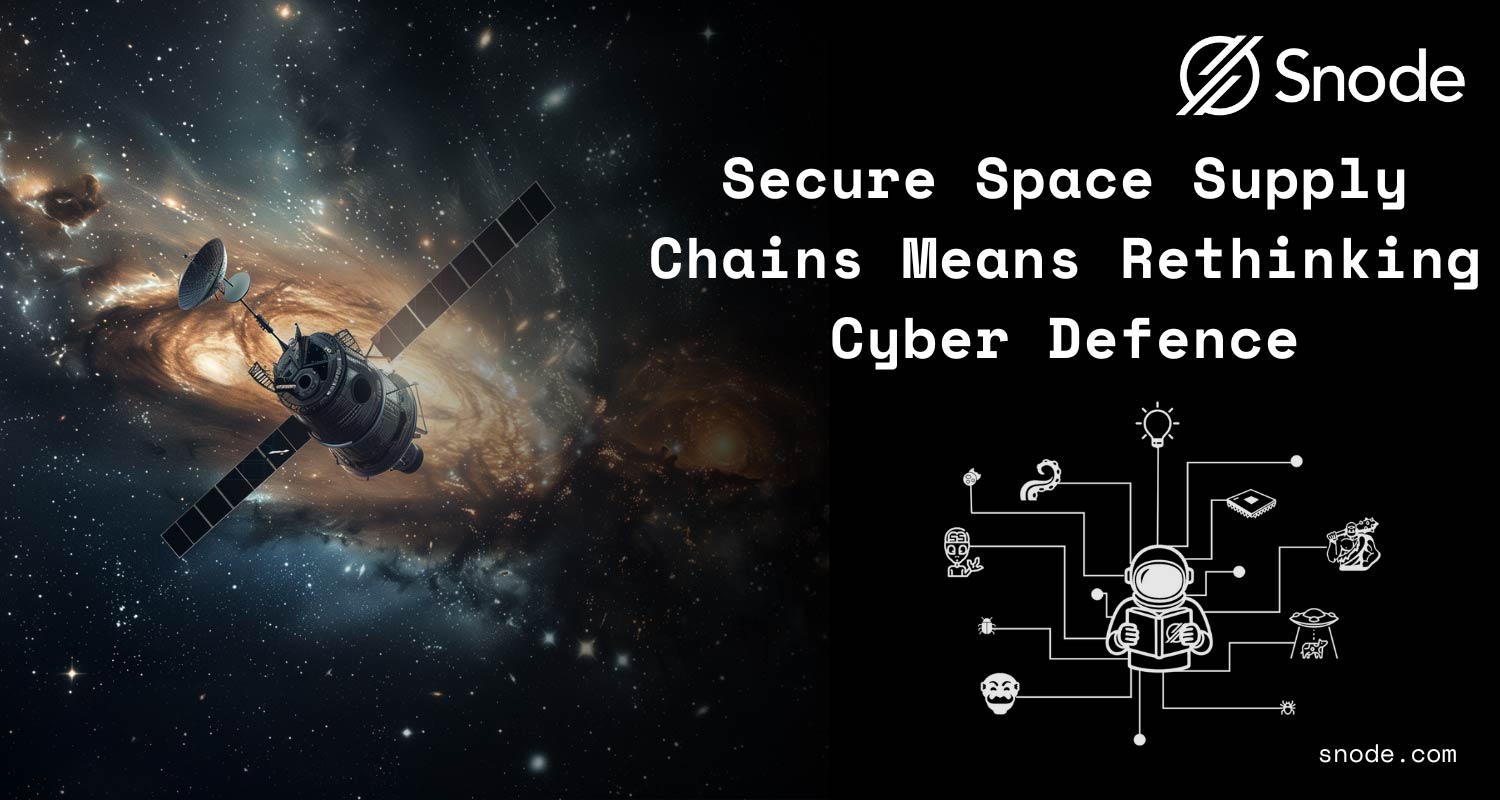
    The next cyber battlefield is in orbit - and it's already under attackIn a recent article with award-winning cyberdefence firm Snode Technologies, we outlined how counterspace threats are demanding alternatives to traditional, Earth-based defence strategies. The conclusion was clear: in orbit, agility is the only winning strategy – but recognising the threat is only the first step. The harder question is this: how do we defend systems that we can’t easily reach, patch or replace?

    Satellites are not like servers in a data centre. Once launched, they may operate for a decade or more with little opportunity for upgrades. Many rely on third-party components with opaque supply chains, with some containing legacy code that no one fully owns or understands. And yet, these satellites remain critical to daily life on Earth. They enable everything from navigation to agriculture to defence.

    Adversaries understand this dependency. Researchers at ETH Zurich have tracked over 120 cases of satellite cyber interference since 2022, ranging from denial-of-service outages to suspected data manipulation. In parallel, electronic attacks such as GPS spoofing have caused navigation blackouts for aircraft and ships. These incidents highlight that space systems are vulnerable not only because of their complexity, but also because their resilience depends on fragile ecosystems with many interlocking parts.

    Nithen Naidoo, CEO of Snode Technologies, sees a different path forward. “The future isn’t as bleak as it may seem. Innovation is already underway. We’re seeing prototypes of machine learning tools that can spot unusual spacecraft behaviour in real time, outperforming older methods and keeping missions on track. The real question is whether we can deploy them quickly enough to stay ahead of the threats in orbit?”

    The satellite supply-chain problem

    Satellites are built from hundreds of interdependent parts sourced from a multitude of suppliers. Once launched, they cannot be recalled for upgrades or repairs; flaws or backdoors become part of the system for their entire lifespan. This makes the supply chain one of the weakest links in space security. An unverified microchip, a compromised software library or an overlooked configuration error can become an entry point for adversaries years after launch. Compounding the risk, satellites frequently outlive their original design life. It is not unusual for missions planned for seven years to stretch to 15. As they age, their security assumptions grow outdated, widening the gap between emerging threats and embedded defences.

    Snode TechnologiesWhen cybersecurity assumptions don’t survive launch

    The supply chain challenge underscores that the logic of terrestrial defence does not easily apply to the nuances of the space industry. On Earth, distance is negligible, patches can be deployed overnight and servers can be replaced. In orbit, none of these safeguards apply.

    A command that executes in milliseconds on a terrestrial network can take minutes when relayed through deep-space links, complicating real-time response. Additionally, satellites are built under strict size, weight and power (SWaP) constraints, leaving little spare capacity for continuous monitoring or defensive redundancy. Additionally, when disruption does occur, it rarely stays contained.

    “In space, there is no such thing as an isolated fault,” explained Naidoo. “A disruption in orbit cascades outward, touching aviation, finance and critical services on Earth. The playbooks that protect networks on Earth don’t apply here; defending space means grappling with interference, fragile supply chains and the unforgiving physics of space.”

    How satellites can learn to defend themselves

    This is where innovation becomes critical. Advances in anomaly detection using AI and machine learning mean that, instead of waiting for human analysts, lightweight onboard systems can learn what “normal” looks like and flag deviations in real time.

    Consider, for example, automated micro-patching. Instead of relying on bulky updates, satellites could apply small, targeted code changes that address vulnerabilities without requiring a full reboot. This approach minimises disruption while extending mission life.

    Another avenue is embedded AI agents that operate like a biological immune system. They detect and respond to threats on the satellite itself, even when disconnected from ground control. Prototypes of autonomous monitoring systems are already in prototype form, and advances in edge computing make it increasingly feasible to deploy them in space.

    Snode TechnologiesWhy South Africa belongs in the space race

    While space security is often framed as the domain of superpowers, nations like South Africa, for example, already manufacture aerospace components, develop secure software and maintain deep expertise in operational technology through industries like mining and energy. These capabilities translate directly into space-grade engineering.

    “When you look at what keeps satellites functioning, the components, code and control systems, these are exactly the areas where South Africa already excels,” said Naidoo.

    Cost efficiency is also an advantage. For many global aerospace firms, sourcing secure, pre-integrated components from partners in emerging markets can be more economical than developing in-house. This positions countries like South Africa not only as users of space infrastructure, but as contributors to its resilience.

    Building cyber counterspace resilience in the fluid now

    The convergence of kinetic, non-kinetic, electronic and cyberthreats creates an environment where attacks can shift domains rapidly, leaving defenders struggling to keep pace. Meeting this challenge requires anticipating threats, simulating scenarios and adapting in real time. That means embedding supply chain assurance, AI-driven monitoring and cross-domain analysis into the heart of space operations.

    Constant rehearsal and red-teaming are equally important. Systems must be stress-tested against unpredictable scenarios before they unfold in reality. Satellites may orbit hundreds of kilometres above Earth, but their failures are felt instantly. Protecting them demands a mindset shift to treating space as a critical infrastructure layer of modern life.

    About Snode Technologies
    Founded in 2016, Snode Technologies is a cybersecurity company specialising in AI- and machine learning-powered technology, combined with specialist-led managed services. The company helps organisations detect, prioritise and respond to cyberthreats in real time. Snode partners closely with clients across sectors to elevate their cyber maturity, reduce operational risk and strengthen decision-making through actionable intelligence. Headquartered in South Africa, Snode continues to expand its global presence while staying true to its core mission: enabling collective, proactive defence through technology and trust.

    • Read more articles by Snode on TechCentral
    • This promoted content was paid for by the party concerned

    Follow TechCentral on Google News Add TechCentral as your preferred source on Google


    Nithen Naidoo Snode Snode Technologies
    WhatsApp YouTube
    Share. Facebook Twitter LinkedIn WhatsApp Telegram Email Copy Link
    Previous ArticleSmall business, big protection: Microsoft Defender & Purview rewrite the security rulebook
    Next Article Apple and Samsung lead smartphone market revival

    Related Posts

    Building digital twins that can be trusted - Snode Technologies - Snode Technologies

    Building digital twins that can be trusted

    5 May 2026
    When the physical world goes online: the new front line of cyber risk - Snode Technologies

    When the physical world goes online: the new front line of cyber risk

    12 December 2025
    Counterspace: why Earth's cyber-defence playbooks don't work in orbit

    Counterspace: why Earth’s cyber-defence playbooks don’t work in orbit

    11 September 2025
    Add A Comment

    Comments are closed.

    Company News
    Avast, AVG and Norton in 2026: smarter security for a new generation of threats

    Avast, AVG and Norton in 2026: smarter security for a new generation of threats

    17 August 2026
    Tech Summit returns to Sandton on 1 September

    Tech Summit returns to Sandton on 1 September

    17 August 2026
    Kaspersky on how to secure a supply chain you do not control

    Kaspersky on how to secure a supply chain you do not control

    13 August 2026
    Opinion
    The author, Jannie van Zyl

    Selling vapour is corporate suicide in slow motion

    16 July 2026
    Brazil's online gambling crackdown is a lesson for South Africa

    How Amazon outmanoeuvred Starlink in South Africa

    15 July 2026
    The Popia problem with agentic AI - Herman Haasbroek

    The Popia problem with agentic AI

    14 July 2026

    Subscribe to Updates

    Get the best South African technology news and analysis delivered to your e-mail inbox every morning.

    Latest Posts
    Sars maps out the tech stack that will replace VAT returns

    Sars maps out the tech stack that will replace VAT returns

    17 August 2026
    Starlink direct-to-mobile network launched in key Sadc country

    Starlink direct-to-mobile network launched in key Sadc country

    17 August 2026
    Volvo's ES90 has one flaw, and it is not the price - Volvo ES90 review

    Volvo’s ES90 has one flaw, and it is not the price

    17 August 2026
    Africa's moon telescope project will listen for alien technology

    Africa’s moon telescope project will listen for alien technology

    17 August 2026
    © 2009 - 2026 NewsCentral Media
    Built and maintained by Chronon
    • Cookie policy (ZA)
    • TechCentral – privacy and Popia

    Type above and press Enter to search. Press Esc to cancel.

    Manage consent

    TechCentral uses cookies to enhance its offerings. Consenting to these technologies allows us to serve you better. Not consenting or withdrawing consent may adversely affect certain features and functions of the website.

    Functional Always active
    The technical storage or access is strictly necessary for the legitimate purpose of enabling the use of a specific service explicitly requested by the subscriber or user, or for the sole purpose of carrying out the transmission of a communication over an electronic communications network.
    Preferences
    The technical storage or access is necessary for the legitimate purpose of storing preferences that are not requested by the subscriber or user.
    Statistics
    The technical storage or access that is used exclusively for statistical purposes. The technical storage or access that is used exclusively for anonymous statistical purposes. Without a subpoena, voluntary compliance on the part of your Internet Service Provider, or additional records from a third party, information stored or retrieved for this purpose alone cannot usually be used to identify you.
    Marketing
    The technical storage or access is required to create user profiles to send advertising, or to track the user on a website or across several websites for similar marketing purposes.
    • Manage options
    • Manage services
    • Manage {vendor_count} vendors
    • Read more about these purposes
    View preferences
    • {title}
    • {title}
    • {title}