Close Menu
TechCentralTechCentral

    Subscribe to the newsletter

    Get the best South African technology news and analysis delivered to your e-mail inbox every morning.

    Facebook X (Twitter) YouTube LinkedIn
    WhatsApp Facebook X (Twitter) LinkedIn YouTube
    TechCentralTechCentral
    • News
      ICT is becoming the centre of gravity at Reunert - Anthonie de Beer and Rob Godlonton

      ICT is becoming the centre of gravity at Reunert

      6 August 2026
      Why Discovery is going slow on AI coding agents - Derek Wilcocks

      Why Discovery is going slow on AI coding agents

      6 August 2026
      Google's Gemini leadership team has left the building - Demis Hassabis

      Google’s Gemini leadership team has left the building

      6 August 2026
      SpaceX shares keep sliding - Elon Musk

      SpaceX shares keep sliding

      6 August 2026
      Solly Malatsi stakes South Africa's AI future on staying neutral

      Solly Malatsi stakes South Africa’s AI future on staying neutral

      5 August 2026
    • World
      Meta AI will now tell parents if their teen is in crisis

      Meta AI will now tell parents if their teen is in crisis

      17 July 2026
      IBM shares crash 25% as AI upends software spending - Arvind Krishna

      IBM shares crash 25% as AI upends software spending

      15 July 2026
      Jony Ive's first OpenAI device: an AI smart speaker - Jony Ive and Sam Altman

      Jony Ive’s first OpenAI device: an AI smart speaker

      15 July 2026
      Stripe, Advent in talks to buy PayPal for $53-billion

      Stripe, Advent in talks to buy PayPal for $53-billion

      15 July 2026
      Memory crisis sends smartphone market into steep decline

      Memory crisis sends smartphone market into steep decline

      13 July 2026
    • In-depth
      The plan to stop AI from breaking the world - Google DeepMind CEO Demis Hassabis. Image: John Sears

      The plan to stop AI from breaking the world

      16 July 2026
      The internet has a Strait of Hormuz problem

      The internet has a Strait of Hormuz problem

      15 July 2026
      AI boom sparks rally, frenzy and fear

      AI boom sparks rally, frenzy and fear

      11 June 2026
      Every plug-in hybrid on sale in South Africa, ranked by price - Lamborghini Temerario

      Every plug-in hybrid on sale in South Africa, ranked by price

      7 June 2026
      What Wi-Fi 8 will mean for wireless networks

      What Wi-Fi 8 will mean for wireless networks

      1 June 2026
    • TCS
      TCS+ | How AI is turning hardware into a subscription service - Shane van der Merwe Merchant West

      TCS+ | How AI is turning hardware into a subscription service

      6 August 2026
      TCS+ | Why South African workers must become supervisors of digital labour - Accelera Digital Group Cliff de Wit

      TCS+ | Why South African workers must become supervisors of digital labour

      31 July 2026
      TCS | Rapid deployment rules can't work without municipalities: ACT - Nomvuyiso Batyi

      TCS | Icasa’s rules skip the real bottleneck: ACT

      30 July 2026
      TCS+ | iStore Business on why Apple makes sense for SMEs - Sudesh Pillay and Tamia Nontsikelelo

      TCS+ | iStore Business on why Apple makes sense for SMEs

      30 July 2026
      TCS+ | A smarter approach to cloud for South African businesses - Joel Chacko and Jonathan Oaker

      TCS+ | A smarter approach to cloud for South African businesses

      28 July 2026
    • Opinion
      The author, Jannie van Zyl

      Selling vapour is corporate suicide in slow motion

      16 July 2026
      Brazil's online gambling crackdown is a lesson for South Africa

      How Amazon outmanoeuvred Starlink in South Africa

      15 July 2026
      The Popia problem with agentic AI - Herman Haasbroek

      The Popia problem with agentic AI

      14 July 2026
      The author, Fanie van Rooyen

      South Africa can still catch the AI wave – here’s how

      7 July 2026
      The author, Fanie van Rooyen

      The AI utopia South Africa can’t afford

      1 July 2026
    • Company Hubs
      • 1Stream
      • Africa Data Centres
      • AfriGIS
      • Altron Digital Business
      • Altron Document Solutions
      • Altron Group
      • Arctic Wolf
      • Ascent Technology
      • AvertITD
      • BBD
      • Braintree
      • CallMiner
      • CambriLearn
      • CM Telecom
      • Contactable
      • CYBER1 Solutions
      • Digicloud Africa
      • Digimune
      • Domains.co.za
      • ESET
      • Euphoria Telecom
      • HOSTAFRICA
      • Incredible Business
      • iONLINE
      • IQbusiness
      • Iris Network Systems
      • Kaspersky
      • LSD Open
      • Mitel
      • NEC XON
      • Netstar
      • Network Platforms
      • Next DLP
      • Ovations
      • Paracon
      • Paratus
      • Q-KON
      • SevenC
      • SkyWire
      • Solid8 Technologies
      • Telit Cinterion
      • Telviva
      • Tenable
      • Vertiv
      • Videri Digital
      • Vodacom Business
      • Vox
      • Wipro
      • Workday
      • XLink
    • Sections
      • AI and machine learning
      • Banking
      • Broadcasting and Media
      • Cloud services
      • Contact centres and CX
      • Cryptocurrencies
      • Education and skills
      • Electronics and hardware
      • Energy and sustainability
      • Enterprise software
      • Financial services
      • HealthTech
      • Information security
      • Internet and connectivity
      • Internet of Things
      • Investment
      • IT services
      • Lifestyle
      • Policy and regulation
      • Public sector
      • Retail and e-commerce
      • Satellite communications
      • Science
      • SMEs and start-ups
      • Social media
      • Talent and leadership
      • Telecoms
      • Watts & Wheels
    • Events
    • Advertise
    TechCentralTechCentral
    Home » Gadgets & Reviews » Samsung Galaxy Tab 2: sophomore slump

    Samsung Galaxy Tab 2: sophomore slump

    By Craig Wilson6 August 2012
    Twitter LinkedIn Facebook WhatsApp Email Telegram Copy Link
    News Alerts
    WhatsApp

    Samsung’s awkwardly named Galaxy Tab 2 10.1 is the Korean manufacturer’s follow-up to the hugely successful Galaxy Tab 10.1, the device that presented the first real competition to Apple’s market-leading iPad.

    However, its follow-up not only fails to match Apple’s latest offering but only incrementally improves upon its predecessor.

    We loved the first Samsung Galaxy Tab. It was everything an Android tablet should be — slim, potent, elegant and responsive — which led us to call it the best Android tablet to date, even if, at the time, the Android app ecosystem still trailed Apple’s.

    Today, Android is a far more developed operating system and the range of applications is much more extensive. The Galaxy Tab 2 runs version 4.0 of Android, also called Ice Cream Sandwich. It’s far better suited to tablets than the Honeycomb version found on the first Galaxy Tab.

    Strangely, Samsung hasn’t boosted the screen resolution from the first version of the Galaxy Tab. The resolution of the 10,1-inch display is still 1 280×800 pixels.

    Although that’s respectable, we’d have liked to see a full HD display on the device, particularly in light of the 2 048×1 536 resolution of the new iPad, which, like it or not, is the device against which rival tablets will be measured.

    A higher resolution would also be welcome in light of the Samsung’s wide-screen aspect ratio, a design decision that makes it better suited to video than the iPad. The two speakers on either side of the screen also suggest Samsung wants to position the Galaxy Tab 2 as a media consumption device, making the lack of improvement to the display all the more disappointing.

    Though the display is unchanged, that tablet itself is very different from its predecessor. Gone are the minimalism and two-tone styling of the original Galaxy Tab in favour of the screen-hugging pair of speakers and a gun-metal grey plastic around the edges and rear with a darker shade of grey covering the panel at the top of the device that houses the SIM and microSD slots and the volume rocker and power button.

    Frankly, the new model isn’t nearly as attractive as its predecessor. It does, however, offer a microSD slot for expansion (up to 32GB), something that was lacking the first time around and, for heavy media consumers, a great way to set the device apart from its closest rival.

    The primary camera remains a 3-megapixel offering, while the front-facing camera is a similarly uninspiring 640×480-pixel model.

    At 9,7mm deep and weighing in at 583g (two grams heavier than the Wi-Fi-only model) the Galaxy Tab 2 feels good in the hand and is no heavier than its main Android rivals and noticeably lighter than the 652g new iPad, even if it is 0,3mm thicker.

    The front speakers may not be the most aesthetically pleasing, particularly when using the device in portrait orientation, but they’re definitely the best sounding speakers we’ve encountered on a tablet. They’re akin to the speaker quality of most laptop speakers — perfectly acceptable at low volumes, tinny at higher levels –an impressive feat considering how little space there is to work with on a tablet.
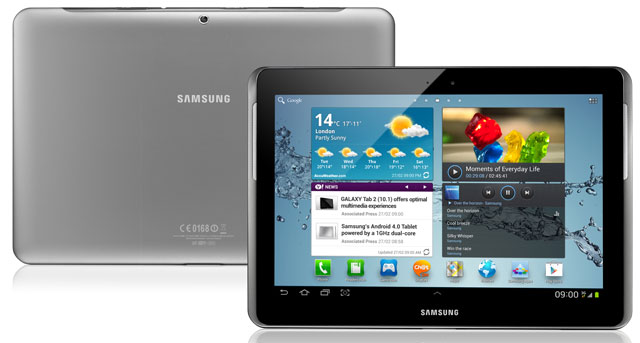
    Annoyingly, Samsung has stuck to its proprietary 30-pin cable for charging and connecting the Galaxy Tab 2 to a laptop or desktop. We’d far rather see a regular, mini- or micro-USB cable, though Samsung claims the cable is necessary for speedy charging.

    Battery life, as with the first Galaxy Tab, is excellent and users can expect in the region of 10 hours of heavy use. All of the usual forms of connectivity — HSPA+, the various Wi-Fi protocols and Bluetooth — are offered, along with DLNA support for streaming media to and from the device.

    One of the most noticeable differences between the first generation Galaxy Tab and the second is the operating system. Ice Cream Sandwich is slick. Widgets, menus and icons look better, and Samsung’s minor tweaks are welcome. These include the ability to take a screenshot via an onscreen button next to the back, home and tasks buttons that are de rigeur in Android. Once you’ve taken a screenshot you can annotate the image or select a portion of it, either by cropping or dynamically selecting a portion of it with Samsung’s lasso-type tool.

    Samsung has opted for a 1GHz dual-core processor and 1GB of RAM in the Galaxy Tab 2, which is respectable, but feels like a cut corner. The tablet handles most things thrown at it, but flicking between home screens produces minor lag, and opening lots of applications can introduce delays to home screen widgets’ updates.

    Aside from the screenshot button, Samsung has also bolstered the toggles in the notification menu to include pretty much everything you could possibly want, from the standards like Wi-Fi and GPS to power saving and driving modes.

    Gone is the horrible drag-to-the-edge-of-the-circle unlock method in favour of an approach where you swipe the lock screen anywhere you like. Users can of course also opt for an unlock pattern or password for added security and to prevent accidental unlocking.

    Another pleasing addition is the arrow in the centre of the menu bar that brings up miniature applications that Samsung thinks users might want to access often. These include an alarm, calculator, e-mail, music player, Samsung’s own S Player, the task manager and a world clock. It’s a great feature and can be used within other apps.

    To be expected, Gmail functionality is superb on the Galaxy Tab 2, as is integration with Google services generally. The built-in e-mail client is excellent, intuitive and works equally well in either orientation. The browser is similarly impressive, though arguably Google’s own Chrome browser application is even better. The tablet supports both Flash and HTML5, something some might consider an advantage over Apple’s iPad.

    Samsung has also tried to encourage users to download content via the company’s own portal using its various “Hub” applications, another advantage over the iPad in the case of SA users who can’t download content from Apple’s iTunes Store.

    All major video and audio formats are supported and the tablet includes an equaliser so that sound can be further tweaked to suit users’ preferences. On the whole, the Galaxy Tab 2 handles media with aplomb and offers attractive interfaces for its consumption, whether it’s audio, video, or photos and other images.

    What the Samsung Galaxy Tab 2 lacks in hardware upgrades it makes up for in the quality of the user experience it offers. Ice Cream Sandwich demonstrates that Android, which arguably has long since surpassed Apple’s iOS operating system when it comes to features and functionality on handsets, might finally be doing so on tablets, too.

    Early Android tablets looked like scaled-up Android phones and lacked the cohesion, consistency and ease-of-use of Apple’s iOS on the iPad. Using the Galaxy Tab 2 is a far more pleasurable and intuitive experience than using its predecessor and Samsung has really considered the device itself when adding its customisations to the software.

    It’s not the most exciting second-generation tablet, but the Samsung Galaxy Tab 2 once again places the Korean electronics giant at the head of the Android table and positions it as the strongest rival to Apple in the computer tablet market. It’s not perfect, but it’s pretty darn good.

    • Only the 32GB, 3G and Wi-Fi model is available in SA. Recommended retail price is R6 599

    Follow TechCentral on Google News Add TechCentral as your preferred source on Google


    Apple Galaxy Tab 2 10.1 Samsung
    WhatsApp YouTube
    Share. Facebook Twitter LinkedIn WhatsApp Telegram Email Copy Link
    Previous Article8ta rethinks prepaid
    Next Article Apple enters Nigeria

    Related Posts

    TCS+ | iStore Business on why Apple makes sense for SMEs - Sudesh Pillay and Tamia Nontsikelelo

    TCS+ | iStore Business on why Apple makes sense for SMEs

    30 July 2026
    Apple's next CEO plants his flag in Hollywood - John Ternus and Tim Cook

    Apple’s next CEO plants his flag in Hollywood

    28 July 2026
    Africa's most popular phones have a tracking problem

    Africa’s most popular phones have a tracking problem

    24 July 2026
    Company News
    What a cloud review reveals about how a company actually runs - LSD Open

    What a cloud review reveals about how a company actually runs

    6 August 2026
    Manufacturing from a garage is now a realistic business plan - MaxLaser

    Manufacturing from a garage is now a realistic business plan

    6 August 2026
    South Africa agrees on a shared language for location - AfriGIS

    South Africa agrees on a shared language for location

    5 August 2026
    Opinion
    The author, Jannie van Zyl

    Selling vapour is corporate suicide in slow motion

    16 July 2026
    Brazil's online gambling crackdown is a lesson for South Africa

    How Amazon outmanoeuvred Starlink in South Africa

    15 July 2026
    The Popia problem with agentic AI - Herman Haasbroek

    The Popia problem with agentic AI

    14 July 2026

    Subscribe to Updates

    Get the best South African technology news and analysis delivered to your e-mail inbox every morning.

    Latest Posts
    ICT is becoming the centre of gravity at Reunert - Anthonie de Beer and Rob Godlonton

    ICT is becoming the centre of gravity at Reunert

    6 August 2026
    Why Discovery is going slow on AI coding agents - Derek Wilcocks

    Why Discovery is going slow on AI coding agents

    6 August 2026
    Google's Gemini leadership team has left the building - Demis Hassabis

    Google’s Gemini leadership team has left the building

    6 August 2026
    SpaceX shares keep sliding - Elon Musk

    SpaceX shares keep sliding

    6 August 2026
    © 2009 - 2026 NewsCentral Media
    Built and maintained by Chronon
    • Cookie policy (ZA)
    • TechCentral – privacy and Popia

    Type above and press Enter to search. Press Esc to cancel.

    Manage consent

    TechCentral uses cookies to enhance its offerings. Consenting to these technologies allows us to serve you better. Not consenting or withdrawing consent may adversely affect certain features and functions of the website.

    Functional Always active
    The technical storage or access is strictly necessary for the legitimate purpose of enabling the use of a specific service explicitly requested by the subscriber or user, or for the sole purpose of carrying out the transmission of a communication over an electronic communications network.
    Preferences
    The technical storage or access is necessary for the legitimate purpose of storing preferences that are not requested by the subscriber or user.
    Statistics
    The technical storage or access that is used exclusively for statistical purposes. The technical storage or access that is used exclusively for anonymous statistical purposes. Without a subpoena, voluntary compliance on the part of your Internet Service Provider, or additional records from a third party, information stored or retrieved for this purpose alone cannot usually be used to identify you.
    Marketing
    The technical storage or access is required to create user profiles to send advertising, or to track the user on a website or across several websites for similar marketing purposes.
    • Manage options
    • Manage services
    • Manage {vendor_count} vendors
    • Read more about these purposes
    View preferences
    • {title}
    • {title}
    • {title}