
Close Menu
TechCentralTechCentral

    Subscribe to the newsletter

    Get the best South African technology news and analysis delivered to your e-mail inbox every morning.

    Facebook X (Twitter) YouTube LinkedIn
    WhatsApp Facebook X (Twitter) LinkedIn YouTube
    TechCentralTechCentral
    • News
      Nedbank: the cash economy won't die until digital ID arrives - Mfundo Nkuhlu

      Nedbank: the cash economy won’t die until digital ID arrives

      22 September 2026
      Warren Wheatley resigns as Africa Bitcoin CEO

      Warren Wheatley resigns as Africa Bitcoin CEO

      22 September 2026
      WeTransfer founder joins Prosus in AI leadership shake-up

      WeTransfer founder joins Prosus in AI leadership shake-up

      22 September 2026
      Bank Zero breaks even as Mukuru migration swells its base - Yatin Narsai

      Bank Zero breaks even as Mukuru migration swells its base

      22 September 2026
      AMD is now worth a trillion dollars - Lisa Su

      AMD is now worth a trillion dollars

      22 September 2026
    • World
      Anthropic weighs new model launch to blunt OpenAI's Astra surge - Anthropic CEO Dario Amodei and OpenAI CEO Sam Altman

      Anthropic weighs new model launch to blunt OpenAI’s Astra surge

      21 September 2026
      Hackers hack hackers: ShinyHunters seizes cl0p's dark web site

      Hackers hack hackers as dark web feud erupts

      21 September 2026
      Film piracy malware is reaching corporate machines

      Film piracy malware is reaching corporate machines

      21 September 2026
      Crypto's big bet fails as US senate sinks Clarity Act

      Crypto’s big bet fails as US senate sinks Clarity Act

      16 September 2026
      'This is not circular': Jensen Huang defends $3.5-billion MediaTek deal

      ‘This is not circular’: Jensen Huang defends $3.5-billion MediaTek deal

      2 September 2026
    • In-depth
      Meta to the AI industry: slow down without us - Mark Zuckerberg

      Meta to the AI industry: slow down without us

      16 September 2026
      Google DeepMind CEO Demis Hassabis. Image: John Sears

      The plan to stop AI from breaking the world

      16 July 2026
      The internet has a Strait of Hormuz problem

      The internet has a Strait of Hormuz problem

      15 July 2026
      AI boom sparks rally, frenzy and fear

      AI boom sparks rally, frenzy and fear

      11 June 2026
      Every plug-in hybrid on sale in South Africa, ranked by price - Lamborghini Temerario

      Every plug-in hybrid on sale in South Africa, ranked by price

      7 June 2026
    • TCS
      TCS | Octotel's Trevor van Zyl on the fibre merger question

      TCS | Octotel’s Trevor van Zyl on the MetroFibre merger question

      16 September 2026
      Meet the CIO | Shoprite's Chris Shortt on what a supermarket becomes

      Meet the CIO | Shoprite’s Chris Shortt on what a supermarket becomes

      9 September 2026
      Rubicon's EV charging network is profitable - and growing fast - Watts & Wheels

      Rubicon’s EV charging network is profitable – and growing fast

      8 September 2026
      Winstone Jordaan on building a national EV charging network

      Winstone Jordaan on building a national EV charging network

      2 September 2026
      Watts & Wheels S1E8: 'Tesla lands in Africa, just not here'

      Watts & Wheels S1E8: ‘Tesla lands in Africa, just not here’

      24 August 2026
    • Opinion
      Regulating AI: apply the laws we have first - Dirk de Vos

      Regulating AI: apply the laws we have first

      21 September 2026
      The end is nigh, and the shares go on sale in October - Duncan McLeod

      The end is nigh, and the shares go on sale in October

      14 September 2026
      The fragile joint in the Capitec machine - Pambos Soteriades

      The R197-billion market the banks can’t reach

      25 August 2026
      South African tech's compounding debt problem - Jannie van Zyl

      Management consulting as we know it is over

      21 August 2026
      South African tech's compounding debt problem - Jannie van Zyl

      The most dangerous customer is the quiet one

      10 August 2026
    • Company Hubs
      • 1Stream
      • Africa Data Centres
      • AfriGIS
      • Altron Digital Business
      • Altron Document Solutions
      • Altron Group
      • Arctic Wolf
      • Ascent Technology
      • AvertITD
      • BBD
      • Braintree
      • CallMiner
      • CambriLearn
      • CM.com
      • Contactable
      • CYBER1 Solutions
      • Digicloud Africa
      • Digimune
      • Domains.co.za
      • ESET
      • Euphoria Telecom
      • HOSTAFRICA
      • Incredible Business
      • iONLINE
      • IQbusiness
      • Iris Network Systems
      • Kaspersky
      • LSD Open
      • Mitel
      • NEC XON
      • Netstar
      • Network Platforms
      • Next DLP
      • Ovations
      • Paracon
      • Paratus
      • Q-KON
      • SevenC
      • SkyWire
      • Solid8 Technologies
      • Telit Cinterion
      • Telviva
      • Tenable
      • Vertiv
      • Videri Digital
      • Vodacom Business
      • Vox
      • Wipro
      • Workday
      • XLink
    • Sections
      • AI and machine learning
      • Banking
      • Broadcasting and Media
      • Cloud services
      • Contact centres and CX
      • Cryptocurrencies
      • Education and skills
      • Electronics and hardware
      • Energy and sustainability
      • Enterprise software
      • Financial services
      • HealthTech
      • Information security
      • Internet and connectivity
      • Internet of Things
      • Investment
      • IT services
      • Lifestyle
      • Policy and regulation
      • Public sector
      • Retail and e-commerce
      • Satellite communications
      • Science
      • SMEs and start-ups
      • Social media
      • Talent and leadership
      • Telecoms
      • Watts & Wheels
    • Events
    • Advertise
    TechCentralTechCentral
    Home » Company News » You can’t keep a good thing down: China bans crypto (again)

    You can’t keep a good thing down: China bans crypto (again)

    By Altify28 September 2021
    Twitter LinkedIn Facebook WhatsApp Email Telegram Copy Link
    Get breaking news on WhatsApp

    For those well-versed in the world of crypto, a Chinese cryptocurrency ban has almost become a right of passage, with one seemingly popping up every four years or so. In fact, before the latest crackdown, China banned different crypto-related activities in 2013, 2017 and as recently as May 2021.

    What does the new ban entail?

    On Friday, 24 September, the People’s Bank of China declared all crypto-related activities illegal, including services such as digital-asset trading, order matching, token issuance and derivatives trading. In addition, overseas crypto exchanges providing services in mainland China were also declared illegal and must be immediately halted.

    Why does China want to ban crypto?

    A ban, by definition, can only be done once. Every ban thereafter just shows an inability to stop it in the first place.

    Due to crypto’s peer-to-peer design and decentralised nature, bitcoin – and, in turn, cryptocurrencies — are difficult to ban. After issuing its fourth ban on cryptocurrencies and related activities, China is discovering this the hard way.

    It’s no surprise that China would want to outlaw crypto money. The Chinese have always enjoyed a top-down, centralised currency that they can control. This type of control is the exact opposite of what bitcoin, and many other cryptocurrencies, are trying to achieve; bitcoin stands for decentralisation and individual choice, outside of the control of governments.

    Secondly, the Chinese government is looking to release the digital yuan — a central bank digital currency. This ban could be just in time to reduce the digital yuan’s competitors and allow for the central bank to control money flows at an even more efficient level using blockchain technology.

    What effect will this ban have?

    Although it is difficult to know the full effect this ban will have on the cryptocurrency market, history and current price action seem to be favouring the side of it being a “non-event”.

    China has been at the forefront of banning multiple tech innovations through the years, but that hasn’t stopped these companies from conquering the world. Twitter, Facebook, Google and some of the most used services in the world today all have something in common: They have all been banned by China at various times.

    “Actually, Chinese technology bans have proven to be quite a good buy signal,” says Brett Hope Robertson, investment analyst at Cape Town-based crypto investment platform Revix.
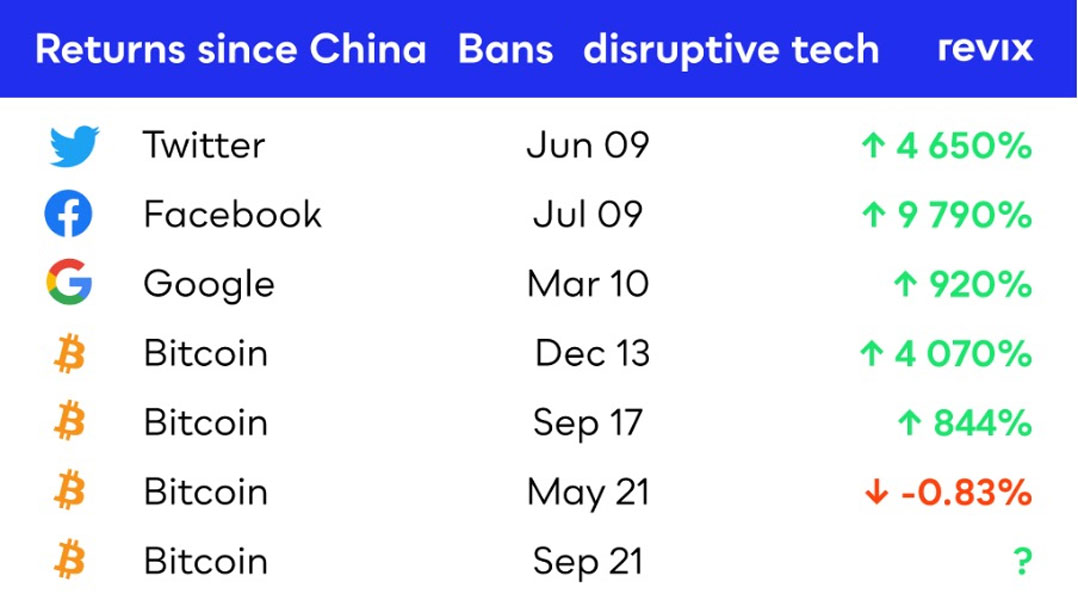
    “When looking at returns, we see Chinese bans on disruptive tech do little to stop them from becoming one of the best investments of the Internet age,” Robertson says

    Google and Facebook have gone on to become the third and sixth biggest companies in the world by market value. While history doesn’t repeat, it does often rhyme, and these bitcoin bans might just show the world how important this cryptocurrency could become.

    How did the market respond to the ban?

    The recent Chinese ban on cryptocurrencies might be the harshest one yet regarding outlawing cryptocurrencies from China altogether. Yet, ironically, it has been accompanied by the most subdued reaction in bitcoin’s price of all the previous bans.
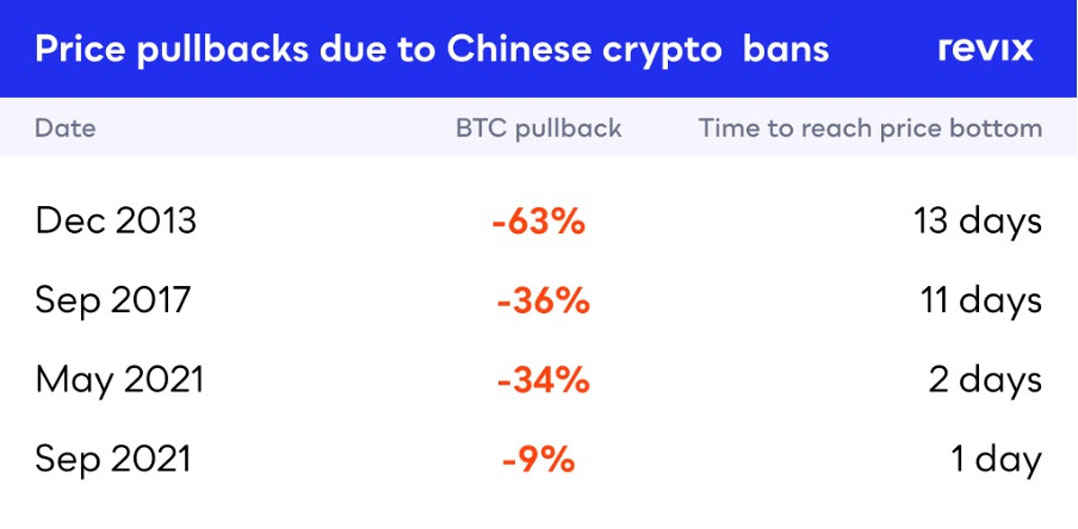
    We can see that not only was this a smaller reaction, but for the time being it seems it has only taken one day for the bottom to be locked in.

    Is this time different?

    In the world of investing, muttering the words “this time is different” is usually seen as a financial faux pas. Finance believes in cycles, history and patterns — therefore believing that this time is somehow different usually ends up in you being wrong.

    While this time may look different, it’s much the same. A Chinese ban has impacted the price of cryptocurrencies, only to soon recover.

    Yet, unlike the previous bans, it seems the market hasn’t responded much at all. It appears the market is viewing China as the country that cried wolf too many times, or even better, it just doesn’t appear to be phased about China outlawing cryptocurrencies at all.

    Either way, this could be the first time we see immediate resistance from the cryptocurrency market — showing the true strength of crypto.

    Where is the money flowing next?

    Interestingly, after the China news caused a pullback in prices, money has been flowing into many decentralised exchange cryptocurrencies such as uniswap (up 30%) and sushi (up 23%).

    This is because Chinese traders are now looking for new ways to gain access to cryptocurrencies, and they have found it through decentralised exchanges where users don’t need to pass any KYC/AML (know your customer and anti-money laundering) checks to verify an identity or adhere to any stringent regulation.

    Other smart contract-enabled blockchains have shown strength as many decentralised apps are built on top of them. Polkadot was up 7% from China’s pullback lows.

    Where can I get exposure to decentralised exchanges and blockchains?

    Cape Town-based crypto investment platform Revix, which is backed by JSE-listed Sabvest, offers access to polkadot, uniswap, solana, cardano and ethereum — cryptocurrencies that have benefitted from the Chinese crypto ban.

    On the Revix platform, you can also buy bitcoin and ready-made “crypto bundles”. These crypto bundles enable you to effortlessly own an equally weighted basket of the world’s largest and, by default, most successful cryptocurrencies without having to build and manage a crypto portfolio yourself. They’re like the JSE Top40 or S&P 500 but for crypto.

    You can get started with as little as R500. Sign-up is quick and effortless, and you can withdraw your funds at any time.

    Head over to www.revix.com to learn more.

    About Revix
    Revix brings simplicity, trust and great customer service when investing in cryptocurrencies. Its easy-to-use online platform enables anyone to securely own the world’s top cryptocurrencies in just a few clicks. Revix guides new clients through the sign-up process to their first deposit and first investment. Once set up, most customers manage their own portfolio but can access support from the Revix team at any time.

    Remember, cryptocurrencies are high-risk investments. You should not invest more than you can afford to lose, and before investing, please take into consideration your level of experience, investment objectives and seek independent financial advice if necessary.

    This article is intended for informational purposes only. The views expressed are opinions, not facts, and should not be construed as investment advice or recommendations. This article is not an offer, nor the solicitation of an offer, to buy or sell any cryptocurrency. To learn more, visit www.revix.com.

    • This promoted content was paid for by the party concerned

    Add TechCentral as a preferred source on GoogleFollow TechCentral on Google NewsGet breaking news on WhatsApp


    Bitcoin Brett Hope Robertson ether PBOC People's Bank of China Revix
    WhatsApp YouTube
    Share. Facebook Twitter LinkedIn WhatsApp Telegram Email Copy Link
    Previous ArticleGuide to getting your small business online in 2021
    Next Article Businesses operations need a new operating model to become digital leaders

    Related Posts

    Bitcoin roars back to life after Trump pushes Clarity Act - DOnald Trump

    Bitcoin roars back to life after Trump pushes Clarity Act

    20 August 2026
    Bitcoin at $65 000: stalled, or simply early?

    Bitcoin at $65 000: stalled, or simply early?

    22 July 2026
    Quantum computers are coming for bitcoin

    Quantum computers are coming for bitcoin

    9 July 2026
    Add A Comment

    Comments are closed.

    Company News
    How agentic AI is transforming South African security operations - Maidar Secure Strike48

    How agentic AI is transforming South African security operations

    22 September 2026
    Closing the AI impact gap - Jason Molesworth and Biase De Gregorio - iqbusiness

    Closing the AI impact gap

    22 September 2026
    Sigfox looks to bridge IoT and AI

    Sigfox South Africa looks to bridge IoT and AI

    22 September 2026
    Opinion
    Regulating AI: apply the laws we have first - Dirk de Vos

    Regulating AI: apply the laws we have first

    21 September 2026
    The end is nigh, and the shares go on sale in October - Duncan McLeod

    The end is nigh, and the shares go on sale in October

    14 September 2026
    The fragile joint in the Capitec machine - Pambos Soteriades

    The R197-billion market the banks can’t reach

    25 August 2026

    Subscribe to Updates

    Get the best South African technology news and analysis delivered to your e-mail inbox every morning.

    Latest Posts
    Nedbank: the cash economy won't die until digital ID arrives - Mfundo Nkuhlu

    Nedbank: the cash economy won’t die until digital ID arrives

    22 September 2026
    How agentic AI is transforming South African security operations - Maidar Secure Strike48

    How agentic AI is transforming South African security operations

    22 September 2026
    Closing the AI impact gap - Jason Molesworth and Biase De Gregorio - iqbusiness

    Closing the AI impact gap

    22 September 2026
    Sigfox looks to bridge IoT and AI

    Sigfox South Africa looks to bridge IoT and AI

    22 September 2026
    © 2009 - 2026 NewsCentral Media
    Built and maintained by Chronon
    • Cookie policy (ZA)
    • TechCentral – privacy and Popia

    Type above and press Enter to search. Press Esc to cancel.

    Manage consent

    TechCentral uses cookies to enhance its offerings. Consenting to these technologies allows us to serve you better. Not consenting or withdrawing consent may adversely affect certain features and functions of the website.

    Functional Always active
    The technical storage or access is strictly necessary for the legitimate purpose of enabling the use of a specific service explicitly requested by the subscriber or user, or for the sole purpose of carrying out the transmission of a communication over an electronic communications network.
    Preferences
    The technical storage or access is necessary for the legitimate purpose of storing preferences that are not requested by the subscriber or user.
    Statistics
    The technical storage or access that is used exclusively for statistical purposes. The technical storage or access that is used exclusively for anonymous statistical purposes. Without a subpoena, voluntary compliance on the part of your Internet Service Provider, or additional records from a third party, information stored or retrieved for this purpose alone cannot usually be used to identify you.
    Marketing
    The technical storage or access is required to create user profiles to send advertising, or to track the user on a website or across several websites for similar marketing purposes.
    • Manage options
    • Manage services
    • Manage {vendor_count} vendors
    • Read more about these purposes
    View preferences
    • {title}
    • {title}
    • {title}