Close Menu
TechCentralTechCentral

    Subscribe to the newsletter

    Get the best South African technology news and analysis delivered to your e-mail inbox every morning.

    Facebook X (Twitter) YouTube LinkedIn
    WhatsApp Facebook X (Twitter) LinkedIn YouTube
    TechCentralTechCentral
    • News
      Digital authoritarianism grows as African states normalise internet blackouts

      Digital authoritarianism grows as African states normalise internet blackouts

      19 December 2025
      Starlink satellite anomaly creates debris in rare orbital mishap

      Starlink satellite anomaly creates debris in rare orbital mishap

      19 December 2025
      TechCentral's South African Newsmakers of 2025

      TechCentral’s South African Newsmakers of 2025

      18 December 2025
      Malatsi buries Post Office's long-dead monopoly

      Malatsi buries Post Office monopoly the market ignored

      18 December 2025
      China races to crack EUV as chip war with the West intensifies

      China races to crack EUV lithography as chip war with the West intensifies

      18 December 2025
    • World
      Trump space order puts the moon back at centre of US, China rivalry - US President Donald Trump

      Trump space order puts the moon back at centre of US, China rivalry

      19 December 2025
      Warner Bros slams the door on Paramount

      Warner Bros slams the door on Paramount

      17 December 2025
      X moves to block bid to revive Twitter brand

      X moves to block bid to revive Twitter brand

      17 December 2025
      Oracle’s AI ambitions face scrutiny on earnings miss

      Oracle’s AI ambitions face scrutiny on earnings miss

      11 December 2025
      China will get Nvidia H200 chips - but not without paying Washington first

      China will get Nvidia H200 chips – but not without paying Washington first

      9 December 2025
    • In-depth
      Black Friday goes digital in South Africa as online spending surges to record high

      Black Friday goes digital in South Africa as online spending surges to record high

      4 December 2025
      Canal+ plays hardball - and DStv viewers feel the pain

      Canal+ plays hardball – and DStv viewers feel the pain

      3 December 2025
      Jensen Huang Nvidia

      So, will China really win the AI race?

      14 November 2025
      Valve's Linux console takes aim at Microsoft's gaming empire

      Valve’s Linux console takes aim at Microsoft’s gaming empire

      13 November 2025
      iOCO's extraordinary comeback plan - Rhys Summerton

      iOCO’s extraordinary comeback plan

      28 October 2025
    • TCS
      TCS+ | Africa's digital transformation - unlocking AI through cloud and culture - Cliff de Wit Accelera Digital Group

      TCS+ | Cloud without culture won’t deliver AI: Accelera’s Cliff de Wit

      12 December 2025
      TCS+ | How Cloud on Demand helps partners thrive in the AWS ecosystem - Odwa Ndyaluvane and Xenia Rhode

      TCS+ | How Cloud On Demand helps partners thrive in the AWS ecosystem

      4 December 2025
      TCS | MTN Group CEO Ralph Mupita on competition, AI and the future of mobile

      TCS | Ralph Mupita on competition, AI and the future of mobile

      28 November 2025
      TCS | Dominic Cull on fixing South Africa's ICT policy bottlenecks

      TCS | Dominic Cull on fixing South Africa’s ICT policy bottlenecks

      21 November 2025
      TCS | BMW CEO Peter van Binsbergen on the future of South Africa's automotive industry

      TCS | BMW CEO Peter van Binsbergen on the future of South Africa’s automotive industry

      6 November 2025
    • Opinion
      Netflix, Warner Bros deal raises fresh headaches for MultiChoice - Duncan McLeod

      Netflix, Warner Bros deal raises fresh headaches for MultiChoice

      5 December 2025
      BIN scans, DDoS and the next cybercrime wave hitting South Africa's banks - Entersekt Gerhard Oosthuizen

      BIN scans, DDoS and the next cybercrime wave hitting South Africa’s banks

      3 December 2025
      Your data, your hardware: the DIY AI revolution is coming - Duncan McLeod

      Your data, your hardware: the DIY AI revolution is coming

      20 November 2025
      Zero Carbon Charge founder Joubert Roux

      The energy revolution South Africa can’t afford to miss

      20 November 2025
      It's time for a new approach to government IT spend in South Africa - Richard Firth

      It’s time for a new approach to government IT spend in South Africa

      19 November 2025
    • Company Hubs
      • Africa Data Centres
      • AfriGIS
      • Altron Digital Business
      • Altron Document Solutions
      • Altron Group
      • Arctic Wolf
      • AvertITD
      • Braintree
      • CallMiner
      • CambriLearn
      • CYBER1 Solutions
      • Digicloud Africa
      • Digimune
      • Domains.co.za
      • ESET
      • Euphoria Telecom
      • Incredible Business
      • iONLINE
      • IQbusiness
      • Iris Network Systems
      • LSD Open
      • NEC XON
      • Netstar
      • Network Platforms
      • Next DLP
      • Ovations
      • Paracon
      • Paratus
      • Q-KON
      • SevenC
      • SkyWire
      • Solid8 Technologies
      • Telit Cinterion
      • Tenable
      • Vertiv
      • Videri Digital
      • Vodacom Business
      • Wipro
      • Workday
      • XLink
    • Sections
      • AI and machine learning
      • Banking
      • Broadcasting and Media
      • Cloud services
      • Contact centres and CX
      • Cryptocurrencies
      • Education and skills
      • Electronics and hardware
      • Energy and sustainability
      • Enterprise software
      • Financial services
      • Information security
      • Internet and connectivity
      • Internet of Things
      • Investment
      • IT services
      • Lifestyle
      • Motoring
      • Public sector
      • Retail and e-commerce
      • Satellite communications
      • Science
      • SMEs and start-ups
      • Social media
      • Talent and leadership
      • Telecoms
    • Events
    • Advertise
    TechCentralTechCentral
    Home » World » How HP designed a laptop with a 32-hour battery

    How HP designed a laptop with a 32-hour battery

    By Editor20 March 2012
    Twitter LinkedIn Facebook WhatsApp Email Telegram Copy Link
    News Alerts
    WhatsApp
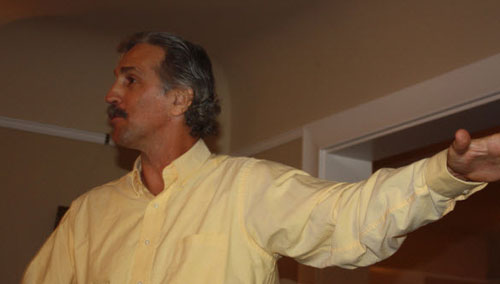
    John Wozniak

    When Hewlett-Packard engineers begin designing a new laptop, they bring in the battery experts like John Wozniak on the very first day. That’s part of what enabled HP to create a laptop with a 32-hour battery life.

    And that also tells you how important energy efficiency has become in modern electronics, where the demand for thin, powerful and lightweight devices is putting an enormous amount of stress on battery technologists. The battery has been called “the most humble and unsexy of inventions”. But it will likely be one of the most important technology battlegrounds of the future. Batteries are a US$50bn industry, and that could become bigger with more breakthroughs. People are far more productive when they don’t have to hunt down outlets to charge a laptop.

    Wozniak, HP’s battery guru, has to deal with requests from all sides. Industrial designers want thin batteries in thin laptops. Marketing people also want lighter weight. But engineers like Wozniak can only show the designers what they have to currently work with and what they might have in the near future.

    “It depends on the timing of the launch,” Wozniak said at a press event at HP’s original garage headquarters in Palo Alto, California. “We’ll tool up and produce a couple of different options. It’s like a puzzle game, and you see what kind of battery is going to fit with a certain kind of design.”

    HP created a 32-hour solution last year for the launch of its HP EliteBook 8460p laptop for business users. To get to 32 hours, you had to add an HP BB09 ultra-extended life notebook battery, which attaches to the bottom of the laptop. That adds more than a pound to the weight. Some new solutions can push the life of a laptop to 36 hours.

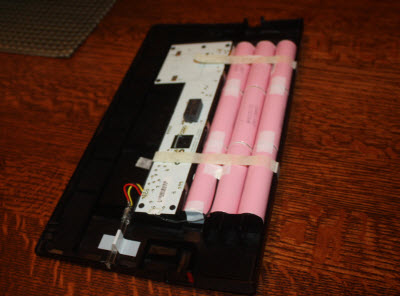
    I’m trying one of those out right now. The standard battery gives the machine about 10 or so hours of life, according to the meter HP provided. But the life goes way up if you snap on the extended battery pack. That battery pack has nine cells (the pink cylinders pictured below) in it and adds the equivalent of 100 watt hours, which is the legal limit; any more and HP would have to ship it as dangerous goods. Once you snap it on, the notebook has about 200 watt hours of battery life.
    “It comes with a price of added weight,” Wozniak said.

    While improving battery efficiency is important to getting longer laptop battery life, the improvement has been gradual. So HP has focused on better power management for its laptops, turning the power down or powering components off when not in use.

    If you keep the operation on a light level, with six or seven watts usage, then you can stretch the battery life out to 28 or 32 hours, Wozniak said. You can do that by reducing the number of times your laptop sends out wireless signals and by reducing the screen brightness.

    Replacing a hard drive with a solid state flash memory drive also helps. HP found it could improve battery life by 18% on the HP EliteBook 8460p when it used flash memory instead of a hard drive.

    HP also used Intel’s Sandy Bridge integrated graphics — combining a microprocessor and graphics on the same chip — rather than a standalone graphics chip. That saved another 26% in power savings.

    While processor speeds and storage capacity keep racing ahead, Wozniak said batteries are getting about 3-5% better each year in energy density, or the amount of energy produced by a battery in a given space. Plenty of attempts have been made to stretch that out. But the disappointments are myriad.

    Wozniak said a silver zinc battery showed promise, with 40% better energy density. But the chemistry of the battery broke down after just 40 or 50 charges. To satisfy consumers, rechargeable batteries should last for hundreds or thousands of charges.

    Some technologies have tried replacing carbon graphite anodes with silicon anodes, since silicon can store more energy. But the problem is that it swells in size. The silicon has to be encapsulated in carbon, offsetting some of the gains.

    Batteries produce hydrogen gas when they are charging, resulting in the swelling. And since hydrogen is explosive, the risk of a fire or explosion is very real when it comes to battery operation. Batteries can corrode over time as well and leak dangerous chemicals.

    That’s why the circuitry around a battery, which can help measure its charge and improve its efficiency, has to be physically separated from the battery itself.

    Lithium ion batteries are the rechargeable types used in laptops; they’re lighter than other kids of batteries and come in a variety of shapes. They’re powerful, but the cell’s capacity diminishes over time. The batteries can also get hot when they’re in use.

    Some battery cells are round and others are flat, or prismatic.

    “This has been familiar in the history of energy,” Wozniak said. “There are theoretical disruptive technologies. I don’t know what the next one is. There are a lot of new chemistries. The Holy Grail for the battery industry is to have a non-flammable electrolyte.”

    The electrolyte is the chemical solution (either wet or dry) that causes a reaction that produces electrons. HP itself once did its own fuel cell battery replacement technology research, but it sold that business off. Now Wozniak stays in close touch with the suppliers that manufacture cells.

    Right now, the thinnest battery cell size is about 2,8mm, with the total battery thickness at 5mm. The thinnest Ultrabooks (the thin, fast computers Intel is promoting this year) are about 18mm thick for 13-inch models and 21mm for 14-inch and larger displays. Intel requires that the battery lives be at least five hours.

    Wozniak believes that the cells can be brought down to 2,5mm without too many trade-offs in energy density.

    The biggest consumers of energy in laptops and tablets today are the displays. Touchscreens take more energy than normal displays.

    HP also put ambient light sensors on all of its EliteBook models. Those sensors adjust the display brightness based on how much light is available in a room. Toward the end of the year, Wozniak expects to see Ultrabooks that operate on 5W of power, compared to 25W for many laptops in the past.

    “[Battery life is] going to get better and better, because a lot of resources are going into solving it,” Wozniak said.  — Dean Takahashi, VentureBeat

    • Subscribe to our free daily newsletter
    • Follow us on Twitter or on Google+ or on Facebook
    • Visit our sister website, SportsCentral (still in beta)


    Hewlett-Packard HP John Wozniak
    Subscribe to TechCentral Subscribe to TechCentral
    Share. Facebook Twitter LinkedIn WhatsApp Telegram Email Copy Link
    Previous ArticleSA’s Internet economy to swell to R103bn by 2016
    Next Article Chatting up a storm

    Related Posts

    TCS + | HP's AI future - how on-device intelligence is redefining work in Africa Ertug Ayik

    TCS + | HP’s AI future – how on-device intelligence is redefining work in Africa

    4 September 2025
    Datacentrix Showcase 2024: journey into the future of technology and sustainability - CEO Ahmed Mahomed

    Datacentrix Showcase 2024: journey into the future of technology and sustainability

    1 August 2024

    Apple sees big jump in Mac shipments

    10 July 2024
    Company News
    Why TechCentral is the most powerful platform for reaching IT decision makers

    Why TechCentral is the most powerful platform for reaching IT decision makers

    17 December 2025
    Business trends to watch in 2026 - Domains.co.za

    Business trends to watch in 2026

    17 December 2025
    MTN Zambia launches world's first 4G cloud smartphone solution - Huawei

    MTN Zambia launches world’s first 4G cloud smartphone solution

    17 December 2025
    Opinion
    Netflix, Warner Bros deal raises fresh headaches for MultiChoice - Duncan McLeod

    Netflix, Warner Bros deal raises fresh headaches for MultiChoice

    5 December 2025
    BIN scans, DDoS and the next cybercrime wave hitting South Africa's banks - Entersekt Gerhard Oosthuizen

    BIN scans, DDoS and the next cybercrime wave hitting South Africa’s banks

    3 December 2025
    Your data, your hardware: the DIY AI revolution is coming - Duncan McLeod

    Your data, your hardware: the DIY AI revolution is coming

    20 November 2025

    Subscribe to Updates

    Get the best South African technology news and analysis delivered to your e-mail inbox every morning.

    Latest Posts
    Digital authoritarianism grows as African states normalise internet blackouts

    Digital authoritarianism grows as African states normalise internet blackouts

    19 December 2025
    Starlink satellite anomaly creates debris in rare orbital mishap

    Starlink satellite anomaly creates debris in rare orbital mishap

    19 December 2025
    Trump space order puts the moon back at centre of US, China rivalry - US President Donald Trump

    Trump space order puts the moon back at centre of US, China rivalry

    19 December 2025
    TechCentral's South African Newsmakers of 2025

    TechCentral’s South African Newsmakers of 2025

    18 December 2025
    © 2009 - 2025 NewsCentral Media
    • Cookie policy (ZA)
    • TechCentral – privacy and Popia

    Type above and press Enter to search. Press Esc to cancel.

    Manage consent

    TechCentral uses cookies to enhance its offerings. Consenting to these technologies allows us to serve you better. Not consenting or withdrawing consent may adversely affect certain features and functions of the website.

    Functional Always active
    The technical storage or access is strictly necessary for the legitimate purpose of enabling the use of a specific service explicitly requested by the subscriber or user, or for the sole purpose of carrying out the transmission of a communication over an electronic communications network.
    Preferences
    The technical storage or access is necessary for the legitimate purpose of storing preferences that are not requested by the subscriber or user.
    Statistics
    The technical storage or access that is used exclusively for statistical purposes. The technical storage or access that is used exclusively for anonymous statistical purposes. Without a subpoena, voluntary compliance on the part of your Internet Service Provider, or additional records from a third party, information stored or retrieved for this purpose alone cannot usually be used to identify you.
    Marketing
    The technical storage or access is required to create user profiles to send advertising, or to track the user on a website or across several websites for similar marketing purposes.
    • Manage options
    • Manage services
    • Manage {vendor_count} vendors
    • Read more about these purposes
    View preferences
    • {title}
    • {title}
    • {title}