Close Menu
TechCentralTechCentral

    Subscribe to the newsletter

    Get the best South African technology news and analysis delivered to your e-mail inbox every morning.

    Facebook X (Twitter) YouTube LinkedIn
    WhatsApp Facebook X (Twitter) LinkedIn YouTube
    TechCentralTechCentral
    • News
      Plenty of software developer jobs, few applicants: Pnet flags skills gap - Anja Bates

      South Africa is running out of software developers

      16 January 2026
      Iran takes on Starlink in high-stakes bid to silence dissent

      Iran takes on Starlink in high-stakes bid to silence dissent

      16 January 2026
      Consumer demand driving a shift in online payments

      Shoppers forcing merchants to adopt new digital payment methods

      15 January 2026
      Big solar and energy storage projects going live across South Africa

      Big solar and energy storage projects going live across South Africa

      15 January 2026
      Wikipedia moves to monetise AI giants' reliance on its content

      Wikipedia moves to monetise AI giants’ reliance on its content

      15 January 2026
    • World
      Uganda shuts down internet ahead of pivotal election

      Uganda shuts down internet ahead of pivotal election

      14 January 2026
      Work begins on what will be Africa's biggest airport

      Work begins on what will be Africa’s biggest airport

      13 January 2026
      India seeks unprecedented access to smartphone software - Narendra Modi

      India seeks unprecedented access to smartphone software

      12 January 2026
      Samsung forecasts record operating profit as AI demand sends memory chip prices sharply higher worldwide - TM Roh

      Samsung cashes in on AI data centre boom as memory prices soar

      8 January 2026
      EU pressure mounts on Musk's X over AI 'undressing' images - Wolfram Weimer

      EU pressure mounts on Musk’s X over AI ‘undressing’ images

      7 January 2026
    • In-depth
      Digital authoritarianism grows as African states normalise internet blackouts

      Digital authoritarianism grows as African states normalise internet blackouts

      19 December 2025
      TechCentral's South African Newsmakers of 2025

      TechCentral’s South African Newsmakers of 2025

      18 December 2025
      Black Friday goes digital in South Africa as online spending surges to record high

      Black Friday goes digital in South Africa as online spending surges to record high

      4 December 2025
      DStv dodges channel blackout in last-minute deal with Warner Bros

      Canal+ plays hardball – and DStv viewers feel the pain

      3 December 2025
      Jensen Huang Nvidia

      So, will China really win the AI race?

      14 November 2025
    • TCS
      TCS+ | Africa's digital transformation - unlocking AI through cloud and culture - Cliff de Wit Accelera Digital Group

      TCS+ | Cloud without culture won’t deliver AI: Accelera’s Cliff de Wit

      12 December 2025
      TCS+ | How Cloud on Demand helps partners thrive in the AWS ecosystem - Odwa Ndyaluvane and Xenia Rhode

      TCS+ | How Cloud On Demand helps partners thrive in the AWS ecosystem

      4 December 2025
      TCS | MTN Group CEO Ralph Mupita on competition, AI and the future of mobile

      TCS | Ralph Mupita on competition, AI and the future of mobile

      28 November 2025
      TCS | Dominic Cull on fixing South Africa's ICT policy bottlenecks

      TCS | Dominic Cull on fixing South Africa’s ICT policy bottlenecks

      21 November 2025
      TCS | BMW CEO Peter van Binsbergen on the future of South Africa's automotive industry

      TCS | BMW CEO Peter van Binsbergen on the future of South Africa’s automotive industry

      6 November 2025
    • Opinion
      ANC's attack on Solly Malatsi shows how BEE dogma trumps economic reality - Duncan McLeod

      ANC’s attack on Solly Malatsi shows how BEE dogma trumps economic reality

      14 December 2025
      Netflix, Warner Bros deal raises fresh headaches for MultiChoice - Duncan McLeod

      Netflix, Warner Bros deal raises fresh headaches for MultiChoice

      5 December 2025
      BIN scans, DDoS and the next cybercrime wave hitting South Africa's banks - Entersekt Gerhard Oosthuizen

      BIN scans, DDoS and the next cybercrime wave hitting South Africa’s banks

      3 December 2025
      ANC's attack on Solly Malatsi shows how BEE dogma trumps economic reality - Duncan McLeod

      Your data, your hardware: the DIY AI revolution is coming

      20 November 2025
      Zero Carbon Charge founder Joubert Roux

      The energy revolution South Africa can’t afford to miss

      20 November 2025
    • Company Hubs
      • Africa Data Centres
      • AfriGIS
      • Altron Digital Business
      • Altron Document Solutions
      • Altron Group
      • Arctic Wolf
      • AvertITD
      • Braintree
      • CallMiner
      • CambriLearn
      • CYBER1 Solutions
      • Digicloud Africa
      • Digimune
      • Domains.co.za
      • ESET
      • Euphoria Telecom
      • Incredible Business
      • iONLINE
      • IQbusiness
      • Iris Network Systems
      • LSD Open
      • NEC XON
      • Netstar
      • Network Platforms
      • Next DLP
      • Ovations
      • Paracon
      • Paratus
      • Q-KON
      • SevenC
      • SkyWire
      • Solid8 Technologies
      • Telit Cinterion
      • Tenable
      • Vertiv
      • Videri Digital
      • Vodacom Business
      • Wipro
      • Workday
      • XLink
    • Sections
      • AI and machine learning
      • Banking
      • Broadcasting and Media
      • Cloud services
      • Contact centres and CX
      • Cryptocurrencies
      • Education and skills
      • Electronics and hardware
      • Energy and sustainability
      • Enterprise software
      • Financial services
      • Information security
      • Internet and connectivity
      • Internet of Things
      • Investment
      • IT services
      • Lifestyle
      • Motoring
      • Public sector
      • Retail and e-commerce
      • Satellite communications
      • Science
      • SMEs and start-ups
      • Social media
      • Talent and leadership
      • Telecoms
    • Events
    • Advertise
    TechCentralTechCentral
    Home » Top » Google to offer new AI chip in the cloud

    Google to offer new AI chip in the cloud

    By Agency Staff17 May 2017
    Twitter LinkedIn Facebook WhatsApp Email Telegram Copy Link
    News Alerts
    WhatsApp
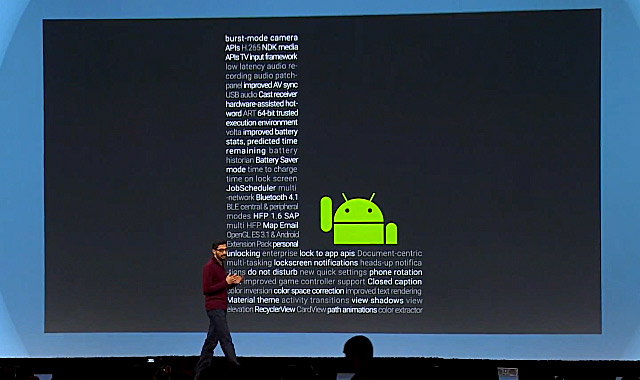
    Google CEO Sundar Pichai

    At the I/O developer conference last year, Google debuted its first chip. The company kept the component mostly for internal artificial intelligence needs. On Wednesday, version two arrived — and Google is selling this one.

    CEO Sundar Pichai announced the new chip on Wednesday during a keynote address at the company’s annual I/O event. Normally, the gathering focuses on mobile software. This year’s spotlight on hardware underscores Pichai’s effort to transform the search giant into an “AI-first” company and a real cloud computing contender.

    Companies will be able to purchase the hardware, called cloud tensor processing units (TPUs), through a Google Cloud service. Google hopes it will quicken the pace of AI advancements. And despite official statements to the contrary, it may also threaten Intel and Nvidia, the main suppliers of powerful semiconductors that run large processing tasks.

    “This is basically a supercomputer for machine learning,” Urs Hölzle, Google’s veteran technical chief, said. Machine learning, a method for deciphering patterns in reams of data, is behind Google’s recent progress on voice recognition, text translation and search rankings.

    But the approach cost a lot, and sucked up computing time in Google’s data centres. The latest chip was designed to address these issues, and executives said they saw dramatic improvements after putting the component to work on these internal tasks.

    Google wouldn’t divulge the chip’s price, what company manufactures it, or when the related cloud service goes on sale. Google still purchases processors from Intel and Nvidia. But by relying more on in-house designs, Google could trim its multi-billion-dollar annual computing bill.

    Google plans more chips like this, and sees the components as essential for success in the cloud — a key part of its push to make money beyond digital advertising.

    “The field is rapidly evolving,” Hölzle said. “For us, it’s very important to advance machine learning for our own purposes and to be the best cloud.”

    During his morning keynote, Pichai also introduced a flurry of machine learning updates for Google’s products, including a photo editing tool and new features for its digital assistant. He also unveiled a new Web portal housing all of the company’s artificial intelligence efforts.

    Google’s cloud business grew by more than 80% last year, according to estimates from Synergy Research Group. But Amazon Web Services still has over 40% of the public cloud market, and continues to expand at a steady clip. Google is third, according to industry estimates.

    To gain share, Google is leaning on its AI prowess. The cloud TPU chip won’t be sold to Dell and other makers of servers that power traditional corporate data centres. To get the benefits, customers will have to sign up for a Google cloud service and run their software tasks and store their data on Google’s equipment. If companies get on board, Google insists, they can plumb their own data for unseen efficiency gains and profit.

    AWS and number two player Microsoft make similar cases. So Google’s pitch stresses performance. A single cloud TPU device, composed of four chips, is nearly 12 000 times faster than IBM’s Deep Blue supercomputer, the famous chess victor from 1997, Hölzle said. Google is stringing 64 of the devices into “pods” that sit in its data centres.

    Google unveiled its chip at last year’s I/O conference, so why does it need another? First, the company is going up against rivals that develop and deliver faster processors on an annual cadence. To lock in customers, it must match that pace.

    In addition, the original chip only worked for “inference”, processing data that’s already packaged in mathematical models. It’s akin to compressing large photos into tiny digital formats. For instance, a company could turn an algorithm for voice recognition into an app using inference chips.

    To create an algorithm from just raw voices, you need lots of data to train AI software. That takes massive computing power, forcing coders to wait days or weeks to see results. Google’s second chip speeds up the training process. In internal tests, it cut the time in half compared to commercially available graphic processing units, known as GPUs.

    Nvidia, the dominant GPU manufacturer, recently announced a new chip, called Volta, that handles training data like Google’s cloud TPU. An eight-chip Volta module will sell for $149 000 starting in the third quarter.

    Google is less experienced at selling chips, so it’s being cautious about commercial deployment. “When you have something that’s really new, some of the tools occasionally break. You want to reach a certain level of maturity,” Hölzle said. “We’re probably going to have a lot more demand than we can satisfy.”

    Excessive demand inspired the creation of TPUs in the first place, according to company lore. Six years ago, Google saw an uptick in voice searches on phones. Just three minutes of conversation a day, per Android phone user, would have doubled the number of data centres Google needed, based on its technology at the time. TPUs were designed to handle the extra volume more efficiently.

    The second-generation chip accelerated Google’s own research. For its translation efforts, Google previously ignored more than 80% of its data at the training stage, according to Jeff Dean, who leads a Google AI research unit called Brain. With its new chip, they can use all the information. That means better trained and potentially more accurate AI software.

    The new chip may let researchers use image data that currently sits unused because of high computing costs, according to Fei-Fei Li, an AI expert who runs a machine learning group inside Google’s Cloud business division. Image classification is one of the machine learning tools Fi’s team is offering cloud clients, and the new chip will make this more accessible and usable.

    eBay used Google’s cloud to develop ShopBot software that identifies items snapped on smartphone cameras. Today’s image recognition systems have around 10% accuracy, said RJ Pittman, eBay’s chief product officer. The new cloud TPU, which eBay has not yet tested, could eventually increase accuracy to more than 90%, he added.

    Companies like eBay want AI to tag every physical product in existence. Li imagines businesses that may want to map every square inch on earth or each minute part of a human cell.

    Amazon and Microsoft have their own AI-powered cloud services, too, though, and both have committed to buy Nvidia’s Volta chips. Nvidia’s data centre sales surged 186% during the first quarter. “Nvidia is not standing still,” said Pittman from eBay, which also buys Nvidia GPUs.

    Hölzle dismissed a direct rivalry. Nvidia’s chips are built for more general-purpose tasks, he said, while Google’s focus solely on machine learning.

    That won’t calm Intel and Nvidia investors, who worry about in-house chip-making efforts by their largest customers — data centre operators like Google. Analysts are concerned that revenue and profitability at the two companies, both at historically high levels, may be dented. Even if Google doesn’t succeed in commercialising its own chips, it’s in a better position to negotiate on price.

    Google isn’t restricting cloud customers to its own chips. It has Intel and Nvidia processors running inside its data centres. Google’s pushing a Lego-like model — corporate customers can choose their combination of software and hardware, and rent storage and computing power by the minute. It has to be flexible if it’s going to catch AWS and Microsoft.

    “Down the road, we make actually pick the hardware for you that minimises your cost or maximises your turnaround time or whatever you tell us is important to you,” Hölzle said. “It becomes invisible to you.”  — (c) 2017 Bloomberg LP



    Amazon Web Services AWS Google Intel Microsoft Nvidia Sundar Pichai
    Subscribe to TechCentral Subscribe to TechCentral
    Share. Facebook Twitter LinkedIn WhatsApp Telegram Email Copy Link
    Previous ArticlePodcast | Dominic White on WannaCry
    Next Article Mobile voice prices have halved since 2013

    Related Posts

    Wikipedia moves to monetise AI giants' reliance on its content

    Wikipedia moves to monetise AI giants’ reliance on its content

    15 January 2026
    Alphabet tops $4-trillion valuation

    Alphabet tops $4-trillion valuation

    13 January 2026
    India seeks unprecedented access to smartphone software - Narendra Modi

    India seeks unprecedented access to smartphone software

    12 January 2026
    Company News
    Learn before you leap with Binance: why crypto education matters - Hannes Wessels

    Learn before you leap with Binance: why crypto education matters

    15 January 2026
    Why enterprises are turning to Cohesity for cyber resilience - Axiz

    Why enterprises are turning to Cohesity for cyber resilience

    15 January 2026
    Breaking free from legacy thinking in banks: AI, automation and the agentic operating model - Steve Burke iqbusiness

    Breaking free from legacy thinking in banks: AI, automation and the agentic operating model

    15 January 2026
    Opinion
    ANC's attack on Solly Malatsi shows how BEE dogma trumps economic reality - Duncan McLeod

    ANC’s attack on Solly Malatsi shows how BEE dogma trumps economic reality

    14 December 2025
    Netflix, Warner Bros deal raises fresh headaches for MultiChoice - Duncan McLeod

    Netflix, Warner Bros deal raises fresh headaches for MultiChoice

    5 December 2025
    BIN scans, DDoS and the next cybercrime wave hitting South Africa's banks - Entersekt Gerhard Oosthuizen

    BIN scans, DDoS and the next cybercrime wave hitting South Africa’s banks

    3 December 2025

    Subscribe to Updates

    Get the best South African technology news and analysis delivered to your e-mail inbox every morning.

    Latest Posts
    Plenty of software developer jobs, few applicants: Pnet flags skills gap - Anja Bates

    South Africa is running out of software developers

    16 January 2026
    Iran takes on Starlink in high-stakes bid to silence dissent

    Iran takes on Starlink in high-stakes bid to silence dissent

    16 January 2026
    Consumer demand driving a shift in online payments

    Shoppers forcing merchants to adopt new digital payment methods

    15 January 2026
    Big solar and energy storage projects going live across South Africa

    Big solar and energy storage projects going live across South Africa

    15 January 2026
    © 2009 - 2026 NewsCentral Media
    • Cookie policy (ZA)
    • TechCentral – privacy and Popia

    Type above and press Enter to search. Press Esc to cancel.

    Manage consent

    TechCentral uses cookies to enhance its offerings. Consenting to these technologies allows us to serve you better. Not consenting or withdrawing consent may adversely affect certain features and functions of the website.

    Functional Always active
    The technical storage or access is strictly necessary for the legitimate purpose of enabling the use of a specific service explicitly requested by the subscriber or user, or for the sole purpose of carrying out the transmission of a communication over an electronic communications network.
    Preferences
    The technical storage or access is necessary for the legitimate purpose of storing preferences that are not requested by the subscriber or user.
    Statistics
    The technical storage or access that is used exclusively for statistical purposes. The technical storage or access that is used exclusively for anonymous statistical purposes. Without a subpoena, voluntary compliance on the part of your Internet Service Provider, or additional records from a third party, information stored or retrieved for this purpose alone cannot usually be used to identify you.
    Marketing
    The technical storage or access is required to create user profiles to send advertising, or to track the user on a website or across several websites for similar marketing purposes.
    • Manage options
    • Manage services
    • Manage {vendor_count} vendors
    • Read more about these purposes
    View preferences
    • {title}
    • {title}
    • {title}