Close Menu
TechCentralTechCentral

    Subscribe to the newsletter

    Get the best South African technology news and analysis delivered to your e-mail inbox every morning.

    Facebook X (Twitter) YouTube LinkedIn
    WhatsApp Facebook X (Twitter) LinkedIn YouTube
    TechCentralTechCentral
    • News
      Luno cutting a fifth of its workforce - South Africa not spared

      Luno cutting a fifth of its workforce – South Africa not spared

      28 July 2026
      The tech master plan for the Cape Winelands Airport

      The tech master plan for the Cape Winelands Airport

      28 July 2026
      Canal+ concedes MultiChoice turnaround is not won - Maxime Saada

      Canal+ concedes MultiChoice turnaround is not won

      28 July 2026
      Canal+ bought out Showmax minority shareholder before killing it

      Canal+ bought out Showmax minority shareholder before killing it

      28 July 2026
      DStv's subscriber count has gone dark

      DStv’s subscriber count has gone dark

      28 July 2026
    • World
      Meta AI will now tell parents if their teen is in crisis

      Meta AI will now tell parents if their teen is in crisis

      17 July 2026
      IBM shares crash 25% as AI upends software spending - Arvind Krishna

      IBM shares crash 25% as AI upends software spending

      15 July 2026
      Jony Ive's first OpenAI device: an AI smart speaker - Jony Ive and Sam Altman

      Jony Ive’s first OpenAI device: an AI smart speaker

      15 July 2026
      Stripe, Advent in talks to buy PayPal for $53-billion

      Stripe, Advent in talks to buy PayPal for $53-billion

      15 July 2026
      Memory crisis sends smartphone market into steep decline

      Memory crisis sends smartphone market into steep decline

      13 July 2026
    • In-depth
      The plan to stop AI from breaking the world - Google DeepMind CEO Demis Hassabis. Image: John Sears

      The plan to stop AI from breaking the world

      16 July 2026
      The internet has a Strait of Hormuz problem

      The internet has a Strait of Hormuz problem

      15 July 2026
      AI boom sparks rally, frenzy and fear

      AI boom sparks rally, frenzy and fear

      11 June 2026
      Every plug-in hybrid on sale in South Africa, ranked by price - Lamborghini Temerario

      Every plug-in hybrid on sale in South Africa, ranked by price

      7 June 2026
      What Wi-Fi 8 will mean for wireless networks

      What Wi-Fi 8 will mean for wireless networks

      1 June 2026
    • TCS
      TCS+ | A smarter approach to cloud for South African businesses - Joel Chacko and Jonathan Oaker

      TCS+ | A smarter approach to cloud for South African businesses

      28 July 2026
      TCS | How Optasia lends billions to people banks can't see - Salvador Anglada

      TCS | How Optasia lends billions to people banks can’t see

      23 July 2026
      The rands-and-cents case for electric trucks - William Kelly Watts & Wheels with Wills

      The rands-and-cents case for electric trucks

      20 July 2026
      Watts & Wheels S1E7: 'Ferrari's EV breaks the internet'

      Watts & Wheels S1E7: ‘Ferrari’s EV breaks the internet’

      8 July 2026
      TCS | Pick n Pay's Enrico Ferigolli on Penny, the AI that shops for you

      TCS | Pick n Pay’s Enrico Ferigolli on Penny, the AI that shops for you

      2 July 2026
    • Opinion
      Selling vapour is corporate suicide in slow motion - Jannie van Zyl

      Selling vapour is corporate suicide in slow motion

      16 July 2026
      Brazil's online gambling crackdown is a lesson for South Africa

      How Amazon outmanoeuvred Starlink in South Africa

      15 July 2026
      The Popia problem with agentic AI - Herman Haasbroek

      The Popia problem with agentic AI

      14 July 2026
      The author, Fanie van Rooyen

      South Africa can still catch the AI wave – here’s how

      7 July 2026
      The author, Fanie van Rooyen

      The AI utopia South Africa can’t afford

      1 July 2026
    • Company Hubs
      • 1Stream
      • Africa Data Centres
      • AfriGIS
      • Altron Digital Business
      • Altron Document Solutions
      • Altron Group
      • Arctic Wolf
      • Ascent Technology
      • AvertITD
      • BBD
      • Braintree
      • CallMiner
      • CambriLearn
      • CM Telecom
      • Contactable
      • CYBER1 Solutions
      • Digicloud Africa
      • Digimune
      • Domains.co.za
      • ESET
      • Euphoria Telecom
      • HOSTAFRICA
      • Incredible Business
      • iONLINE
      • IQbusiness
      • Iris Network Systems
      • Kaspersky
      • LSD Open
      • Mitel
      • NEC XON
      • Netstar
      • Network Platforms
      • Next DLP
      • Ovations
      • Paracon
      • Paratus
      • Q-KON
      • SevenC
      • SkyWire
      • Solid8 Technologies
      • Telit Cinterion
      • Telviva
      • Tenable
      • Vertiv
      • Videri Digital
      • Vodacom Business
      • Vox
      • Wipro
      • Workday
      • XLink
    • Sections
      • AI and machine learning
      • Banking
      • Broadcasting and Media
      • Cloud services
      • Contact centres and CX
      • Cryptocurrencies
      • Education and skills
      • Electronics and hardware
      • Energy and sustainability
      • Enterprise software
      • Financial services
      • HealthTech
      • Information security
      • Internet and connectivity
      • Internet of Things
      • Investment
      • IT services
      • Lifestyle
      • Policy and regulation
      • Public sector
      • Retail and e-commerce
      • Satellite communications
      • Science
      • SMEs and start-ups
      • Social media
      • Talent and leadership
      • Telecoms
      • Watts & Wheels
    • Events
    • Advertise
    TechCentralTechCentral
    Home » In-depth » Windows 10: what’s in a number?

    Windows 10: what’s in a number?

    By The Conversation1 October 2014
    Twitter LinkedIn Facebook WhatsApp Email Telegram Copy Link
    News Alerts
    WhatsApp
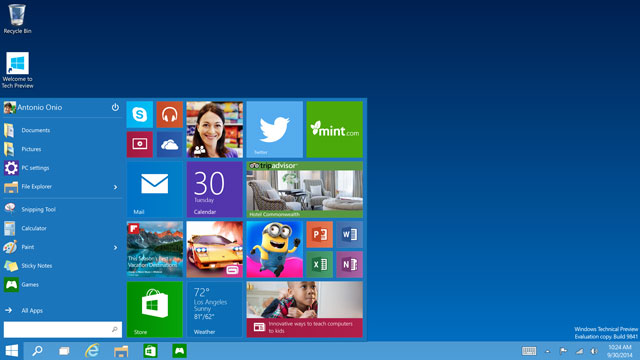
    It's back! The Windows Start button returns in the next version of the operating system
    It’s back! The Windows Start menu returns in the next version of the operating system

    The name came as a surprise, although it wasn’t the surprise watchers had been expecting: the latest version of Microsoft Windows had been codenamed Threshold, and it was thought this would become its official name, rather than the more predictable Windows 9. As it happened, Microsoft jumped straight to a round number and called it Windows 10.

    But what’s in a name, anyway? Presumably the world’s most overwhelmingly popular computer operating system can bring more to the table.

    The first taste of Windows 10, as is often the case with yet-to-be-released products, focuses more on the superficial than how the operating system handles the computer’s processor, memory, input/output and other hardware devices. Such matters were quietly ignored for the time being, although the technical preview of Windows 10, which will soon be available for those who sign up to the Windows Insider programme, will reveal more about what’s changed under the hood.

    Superficial or not, what every Windows user wants to know is whether the sweeping changes to the interface introduced in Windows 8 in 2012 have been dealt with to their satisfaction.

    The Windows 8 interface built around large tiles was designed with touchscreen computers in mind, perhaps under the impression that they would be commonplace in years to come. Not so. And so the familiar Start menu introduced with Windows 95 and which disappeared in Windows 8 returns. Hardly a revolutionary act, but one that will have many breathing a sigh of relief. At least some users will now know where to start.

    Microsoft was boldly chasing cutting-edge design with Windows 8, with its design language (originally called Metro) stripping away the embossed edges and drop shadows from windows ahead of rivals, including Apple. The flat design remains — from the background icons to the start bar, Windows 10 is flatter than ever.

    While the tile-based look of Windows 8 is gone, it has not been entirely removed. Instead it emerges from the side of the Start menu, combining the two approaches, like a blend of Windows 7 and Windows 8. The app-based approach of Windows 8 is also retained, with apps launching in windows as would any program. The alerts that apps can produce have been collected into a central Notification Centre.

    Microsoft has attempted to replicate the multiple desktops approach possible with other operating systems such as Mac OS X and Linux. Windows 10 will introduce this approach, calling them virtual desktops, with a range of customisation options available for each.

    Early rumours suggested Windows 10 would do away with the unpopular Charms bar altogether, but it seems it rather be hidden further. The Charms bar was an innovation of Windows 8 that aimed to help users quickly access common, context-dependent actions available to them on any given screen, such as for searching and sharing. Useful for touchscreen users, it got in the way for those using keyboard and mouse that make up the vast majority of Windows users.

    Perhaps one of the biggest changes is the effort to finally deliver on Windows 8’s promise to combine the many versions of Windows that exist for different platforms — smartphones, tablets, touchscreens, laptops and desktops, running different processor architectures such as Intel x86 and ARM.

    Microsoft is aiming squarely for that with an ambitious feature called Continuum, which will detect the processor architecture and device characteristics such as screen size and peripherals and change the interface accordingly. Unplug a keyboard, and touchscreen buttons to help navigate appear. Plug it back in, and the familiar Start button and menu reappears.

    An even more substantial step-change is Microsoft’s decision to move away from producing monolithic, periodic updates, released as point versions (Windows 8 to Windows 8.1, for example) or as service packs. Instead, it seems the company will adopt the “release early, release often” approach of the open-source movement and introduce regular, rolling upgrades. In one sense — as Microsoft itself has alluded to — this will be the final “version” of Windows, one that is perpetually updated. Windows as a service, if you like.

    Is it worth it?
    Windows 10’s announcement comes with all the usual claims of improved stability, higher security, better power management, more personalisation, and so on. All this is yet to be seen. Windows 10 must offer something for desktop and laptop users, and especially for the enterprise corporate users who make up much of the company’s profits. Certainly, the promise of design once, run on all platforms that a unified Windows architecture offers will be great news for developers.

    As operating systems for mobile and desktop devices converge, feature lists become harder to differentiate. If Microsoft follows through and delivers a unified Windows architecture across multiple platforms, it may well turn out to be a better prediction than those that led to the design choices in Windows 8.The Conversation

    • Hongji Yang is professor and deputy director at the Centre of Creative Computing at Bath Spa University
    • This article was originally published on The Conversation

    Follow TechCentral on Google News Add TechCentral as your preferred source on Google


    Microsoft Windows 10
    WhatsApp YouTube
    Share. Facebook Twitter LinkedIn WhatsApp Telegram Email Copy Link
    Previous ArticleReserve Bank must pay Shuttleworth R250m
    Next Article Trust to get Shuttleworth’s R250m

    Related Posts

    Why Africa's cloud needs more than one path - Africa Data Centres

    Why Africa’s cloud needs more than one path

    23 July 2026
    Core opens Microsoft Surface reseller programme to South African SMEs - John Press

    Core opens Microsoft Surface reseller programme to South African SMEs

    17 July 2026
    The plan to stop AI from breaking the world - Google DeepMind CEO Demis Hassabis. Image: John Sears

    The plan to stop AI from breaking the world

    16 July 2026
    Company News
    Neill Nortje appointed as country manager of Paratus Zambia

    Neill Nortje appointed as country manager of Paratus Zambia

    28 July 2026
    iONLINE launches eSim for IoT to keep device fleets connected anywhere

    iONLINE launches eSim for IoT to keep device fleets connected anywhere

    28 July 2026
    Cybercriminals are hacking trust

    Cybercriminals are hacking trust

    27 July 2026
    Opinion
    Selling vapour is corporate suicide in slow motion - Jannie van Zyl

    Selling vapour is corporate suicide in slow motion

    16 July 2026
    Brazil's online gambling crackdown is a lesson for South Africa

    How Amazon outmanoeuvred Starlink in South Africa

    15 July 2026
    The Popia problem with agentic AI - Herman Haasbroek

    The Popia problem with agentic AI

    14 July 2026

    Subscribe to Updates

    Get the best South African technology news and analysis delivered to your e-mail inbox every morning.

    Latest Posts
    Luno cutting a fifth of its workforce - South Africa not spared

    Luno cutting a fifth of its workforce – South Africa not spared

    28 July 2026
    The tech master plan for the Cape Winelands Airport

    The tech master plan for the Cape Winelands Airport

    28 July 2026
    TCS+ | A smarter approach to cloud for South African businesses - Joel Chacko and Jonathan Oaker

    TCS+ | A smarter approach to cloud for South African businesses

    28 July 2026
    Neill Nortje appointed as country manager of Paratus Zambia

    Neill Nortje appointed as country manager of Paratus Zambia

    28 July 2026
    © 2009 - 2026 NewsCentral Media
    Built and maintained by Chronon
    • Cookie policy (ZA)
    • TechCentral – privacy and Popia

    Type above and press Enter to search. Press Esc to cancel.

    Manage consent

    TechCentral uses cookies to enhance its offerings. Consenting to these technologies allows us to serve you better. Not consenting or withdrawing consent may adversely affect certain features and functions of the website.

    Functional Always active
    The technical storage or access is strictly necessary for the legitimate purpose of enabling the use of a specific service explicitly requested by the subscriber or user, or for the sole purpose of carrying out the transmission of a communication over an electronic communications network.
    Preferences
    The technical storage or access is necessary for the legitimate purpose of storing preferences that are not requested by the subscriber or user.
    Statistics
    The technical storage or access that is used exclusively for statistical purposes. The technical storage or access that is used exclusively for anonymous statistical purposes. Without a subpoena, voluntary compliance on the part of your Internet Service Provider, or additional records from a third party, information stored or retrieved for this purpose alone cannot usually be used to identify you.
    Marketing
    The technical storage or access is required to create user profiles to send advertising, or to track the user on a website or across several websites for similar marketing purposes.
    • Manage options
    • Manage services
    • Manage {vendor_count} vendors
    • Read more about these purposes
    View preferences
    • {title}
    • {title}
    • {title}