
Close Menu
TechCentralTechCentral

    Subscribe to the newsletter

    Get the best South African technology news and analysis delivered to your e-mail inbox every morning.

    Facebook X (Twitter) YouTube LinkedIn
    WhatsApp Facebook X (Twitter) LinkedIn YouTube
    TechCentralTechCentral
    • News
      Malatsi withdraws AI policy after fictitious sources scandal - Solly Malatsi

      Malatsi withdraws AI policy after fictitious sources scandal

      26 April 2026
      How AI could quietly hollow out South Africa's job market

      How AI could quietly hollow out South Africa’s job market

      26 April 2026
      SpaceX bets the rocket farm on AI

      SpaceX bets the rocket farm on AI

      26 April 2026
      Withdraw AI policy, Malatsi told as fake citations row grows - Solly Malatsi

      Withdraw AI policy, Malatsi told, as fake citations row grows

      26 April 2026
      The remarkable turnaround at Intel

      The remarkable turnaround at Intel

      26 April 2026
    • World
      More organic compounds detected on Mars - Nasa Curiosity rover

      More organic compounds detected on Mars

      21 April 2026
      Adobe bets on AI agents to fend off cheaper rivals

      Adobe bets on AI agents to fend off cheaper rivals

      16 April 2026
      Google poised to lose ad crown to Meta

      Google poised to lose ad crown to Meta

      14 April 2026
      Grand Theft Data - hackers hit Rockstar Games - Grand Theft Auto

      Grand Theft Data – hackers hit Rockstar Games

      14 April 2026
      UK PM Keir Starmer declares war on doomscrolling

      UK PM Keir Starmer declares war on doomscrolling

      13 April 2026
    • In-depth
      Africa switches on as Europe dims the lights

      Africa switches on as Europe dims the lights

      9 April 2026
      The biggest untapped EV market on Earth is hiding in plain sight

      The biggest untapped EV market on Earth is hiding in plain sight

      1 April 2026
      The R18-billion tech giant hiding in plain sight - Jens Montanana

      The R16-billion tech giant hiding in plain sight

      26 March 2026
      The last generation of coders

      The last generation of coders

      18 February 2026
      Sentech is in dire straits

      Sentech is in dire straits

      10 February 2026
    • TCS

      TCS+ | ‘The ISP for ISPs’: Vox’s shift to wholesale aggregator

      20 April 2026
      TCS | Werner Lindemann on how AI is rewriting the infosec rulebook

      TCS | Werner Lindemann on how AI is rewriting the infosec rulebook

      15 April 2026
      TCS | Donovan Marsh on AI and the future of filmmaking

      TCS | Donovan Marsh on AI and the future of filmmaking

      7 April 2026
      TCS+ | Vodacom Business moves to crack the SME tech gap - Andrew Fulton, Sannesh Beharie

      TCS+ | Vodacom Business moves to crack the SME tech gap

      7 April 2026
      TCS | MTN's Divysh Joshi on the strategy behind Pi - Divyesh Joshi

      TCS | MTN’s Divyesh Joshi on the strategy behind Pi

      1 April 2026
    • Opinion
      The conflict of interest at the heart of PayShap's slow adoption - Cheslyn Jacobs

      The conflict of interest at the heart of PayShap’s slow adoption

      26 March 2026
      South Africa's energy future hinges on getting wheeling right - Aishah Gire

      South Africa’s energy future hinges on getting wheeling right

      10 March 2026
      Hold the doom: the case for a South African comeback - Duncan McLeod

      Apple just dropped a bomb on the Windows world

      5 March 2026
      R230-million in the bag for Endeavor's third Harvest Fund - Alison Collier

      VC’s centre of gravity is shifting – and South Africa is in the frame

      3 March 2026
      Hold the doom: the case for a South African comeback - Duncan McLeod

      Hold the doom: the case for a South African comeback

      26 February 2026
    • Company Hubs
      • 1Stream
      • Africa Data Centres
      • AfriGIS
      • Altron Digital Business
      • Altron Document Solutions
      • Altron Group
      • Arctic Wolf
      • Ascent Technology
      • AvertITD
      • BBD
      • Braintree
      • CallMiner
      • CambriLearn
      • CYBER1 Solutions
      • Digicloud Africa
      • Digimune
      • Domains.co.za
      • ESET
      • Euphoria Telecom
      • HOSTAFRICA
      • Incredible Business
      • iONLINE
      • IQbusiness
      • Iris Network Systems
      • Kaspersky
      • LSD Open
      • Mitel
      • NEC XON
      • Netstar
      • Network Platforms
      • Next DLP
      • Ovations
      • Paracon
      • Paratus
      • Q-KON
      • SevenC
      • SkyWire
      • Solid8 Technologies
      • Telit Cinterion
      • Telviva
      • Tenable
      • Vertiv
      • Videri Digital
      • Vodacom Business
      • Wipro
      • Workday
      • XLink
    • Sections
      • AI and machine learning
      • Banking
      • Broadcasting and Media
      • Cloud services
      • Contact centres and CX
      • Cryptocurrencies
      • Education and skills
      • Electronics and hardware
      • Energy and sustainability
      • Enterprise software
      • Financial services
      • HealthTech
      • Information security
      • Internet and connectivity
      • Internet of Things
      • Investment
      • IT services
      • Lifestyle
      • Motoring
      • Policy and regulation
      • Public sector
      • Retail and e-commerce
      • Satellite communications
      • Science
      • SMEs and start-ups
      • Social media
      • Talent and leadership
      • Telecoms
    • Events
    • Advertise
    TechCentralTechCentral
    Home » Sections » AI and machine learning » Assessing AI readiness is paramount to execution

    Assessing AI readiness is paramount to execution

    Promoted | Before implementing an artificial intelligence strategy, it pays to assess your organisation’s AI readiness.
    By Mark Nasila21 August 2023
    Twitter LinkedIn Facebook WhatsApp Email Telegram Copy Link
    News Alerts
    WhatsApp
    Decision intelligence is essential in implementing AI, says FNB's Mark Nasila
    The author, FNB’s Mark Nasila

    Before implementing an artificial intelligence strategy, it pays to assess your organisation’s AI readiness.

    Take, for instance, commercial air travel. Having the passengers, crew and pilots on boards, along with the luggage and catering supplies, isn’t enough to fly. Pilots conduct a flight readiness review (FRR) before every flight where they assess their readiness to start and execute flight tests or operations. This includes a self-assessment tool, known as the I’m Safe checklist, to evaluate their physical and mental health status before a flight. This checklist determines the overall preparedness for a flight, as well as flight control systems and other hardware checks.

    Like flight, AI offers huge potential, but there are also checks and measures required to make sure it operates as intended. Due to its inherent complexity and new organisational requirements, adopting AI can be challenging. Assessing an organisation’s readiness is crucial for successful AI adoption and leveraging its business value.

    Between 60% and 80% of AI projects fail. What sets the remaining successful implementations apart?

    Despite many organisations including AI in their strategic plans, the majority of AI initiatives fail to meet expectations and provide real value. This is often due to a lack of foundational support for AI capabilities, resulting in isolated projects that do not integrate well with business operations.

    According to a Forbes report from 2022, between 60% and 80% of AI projects fail. What sets the remaining successful implementations apart? They only go ahead when AI organisational readiness has been confirmed.

    The AI Readiness Assessment is a thorough toolset that aids organisations in understanding the AI landscape and evaluating their preparedness for AI integration across diverse sectors, and can be applied to the private sector, too. The framework emphasises the organisation’s dual roles as both promoters of technological growth and users of AI in public services.

    Organisations, nations and other AI users are at various stages in their AI evolution, necessitating careful evaluation to determine their specific needs and capabilities for digital infrastructure, governance and a supportive community.

    Some of the existing frameworks used to measure AI readiness include:

    AI Readiness Index by AI Singapore

    AI Singapore has also developed the AI Readiness Index (AIRI), a tool to gauge an organisation’s preparedness to embrace and apply AI technologies. It’s proven so successful it’s since been adopted by 29 other countries.

    This index assesses readiness across five pillars: organisational, ethics and governance, business value, data, and infrastructure. Under each pillar are four levels of AI readiness: AI unaware, AI aware, AI ready, and AI competent. For instance, when assessing organisational AI readiness, it may emerge that the organisation has a rudimentary knowledge of AI (AI aware) but doesn’t have the capabilities, skills or resources to implement it.

    Assessing readiness in these sectors can help a business identify blind spots and address them before embarking on a potential costly AI implementation strategy that may otherwise fail.
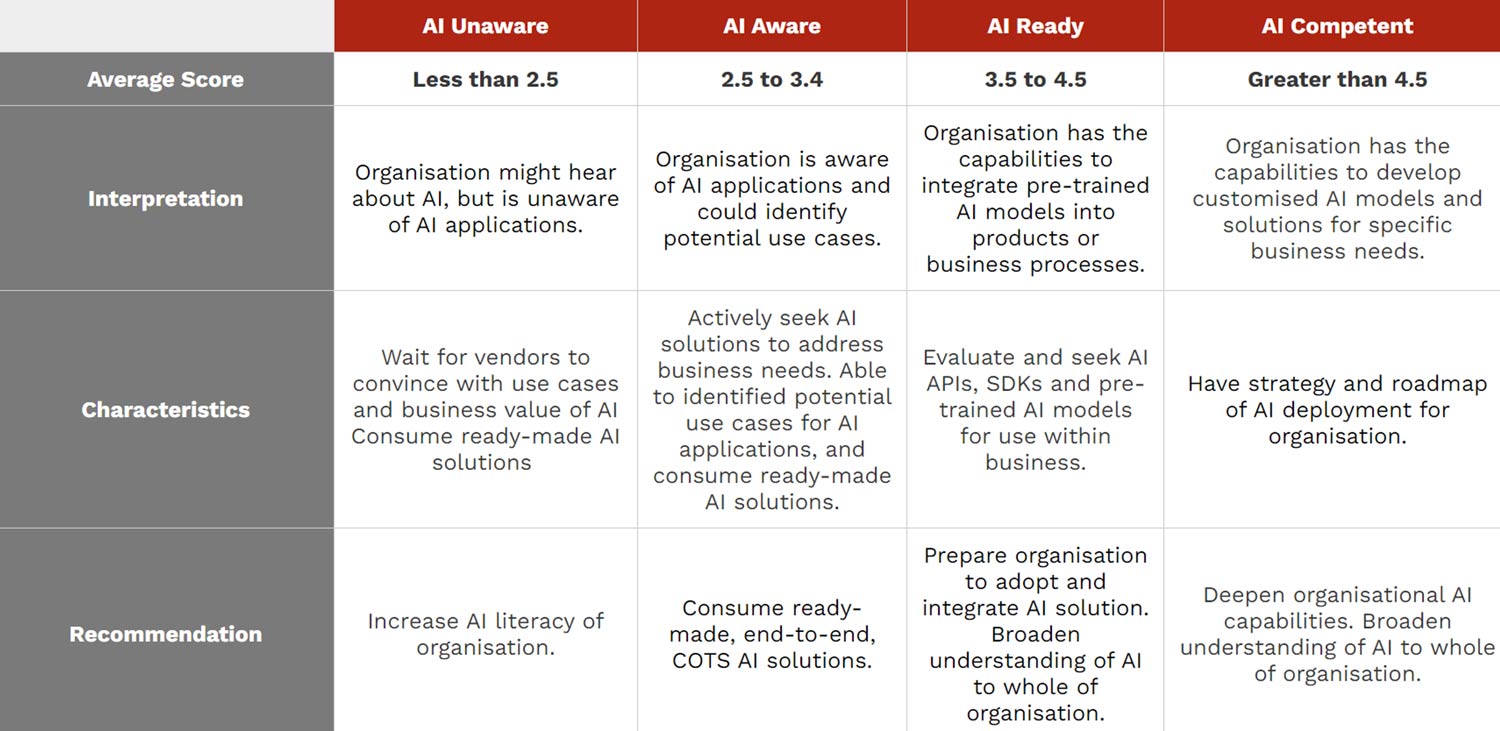
    What each of the levels means. Source: AI Readiness Index (AIRI) – AI Singapore

    AIRI by Antonio Grasso

    Grasso’s approach features four pillars and nine dimensions. The four pillars are: organisational readiness, business value readiness, data readiness and structural readiness. Let’s break each of these down.
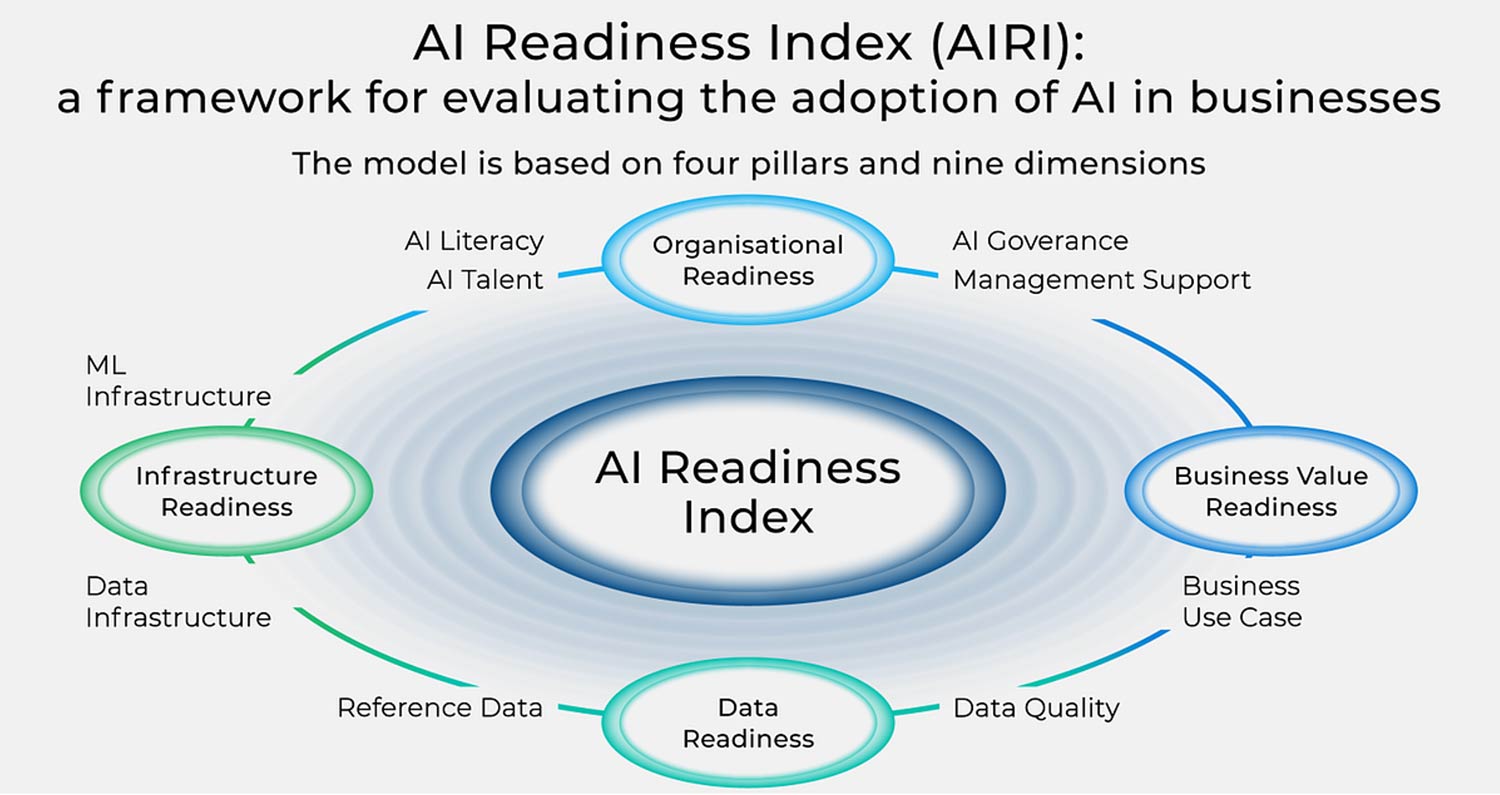
    Source: Antonio Grasso – AI Readiness Index (AIRI)
    • Organisational readiness: Organisational readiness involves assessing if a company is prepared to adopt AI. This stage analyses the readiness of the company’s human resources, its skills and attitudes across four dimensions: AI literacy, AI talent, AI governance and management support, which verifies if the management is ready to back AI initiatives by providing the necessary resources for in-house development. The objective of this stage is to comprehend whether the organisation has the essential foundation to commence the journey towards AI implementation.
    • Business value readiness: In this stage, the key dimension is considering business use cases: have practical, real-world applications been established? Recognising the areas that will be influenced by innovation and the specific use cases in advance can make the process of adopting AI more efficient. It can be helpful to consider the value proposition, that is, to identify where AI will bring the greatest efficiency. For instance, if the goal is to enhance customer service, an intelligent virtual assistant could be implemented. By identifying these elements beforehand, the implementation steps can be outlined more effectively, thereby improving overall process efficiency.
    • Data readiness: To succeed with AI, an organisation needs the right input data. This stage assesses an organisation’s preparedness to manage the data that will be used to feed the algorithms.
    • Data quality: Does the organisation have procedures to ensure the completeness and accuracy of the collected data?
    • Reference data: Does a unique, standardised reference exist for the data?
    • Structural readiness: This asks if your organisation has the infrastructure to support data storage, retrieval, and AI model training. It requires assessing two dimensions
      • Data infrastructure: Including servers, storage, organisational processes and data management policies, often associated with data governance.
      • Machine learning infrastructure: Covering human resources, processes and tools needed for machine learning models, also known as AI infrastructure or MLOps, which ensures reliable and efficient model deployment and maintenance.
    • Final assessment: To create a final score, points are assigned for each of the above categories using the assessment table below.
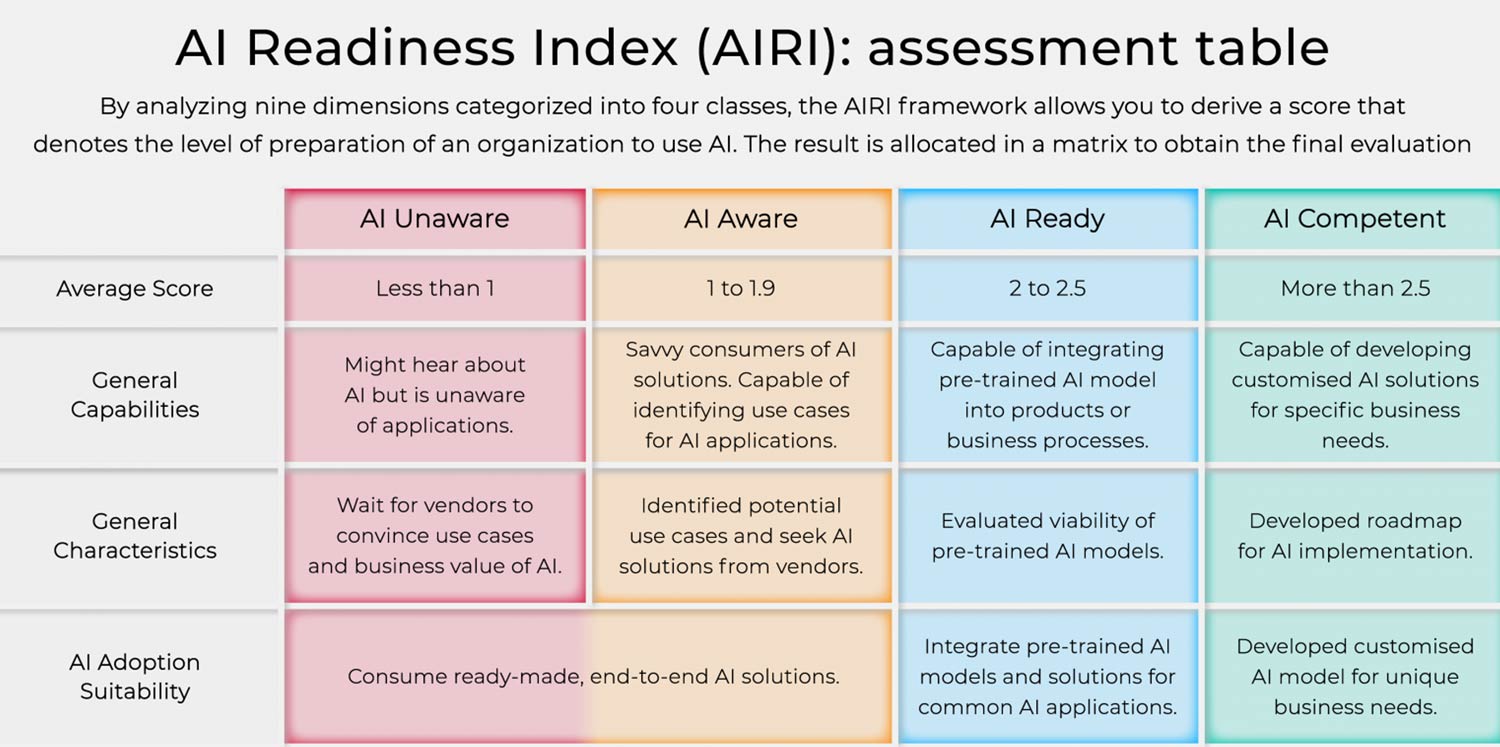
    Source: Antonio Grasso – AI Readiness Index (AIRI)

    UNDP and Oxford Insights AI readiness assessment for countries

    Evaluating a country’s AI readiness is a crucial initial step towards adoption that can help lessen potential risks. The UNDP AI Readiness Assessment is a comprehensive toolkit that enables governments to grasp an overview of the AI scene and evaluate their AI preparedness across different sectors. This framework mainly considers governments as facilitators of tech advancement and AI users in the public sector, with an emphasis on ethical considerations surrounding AI use.
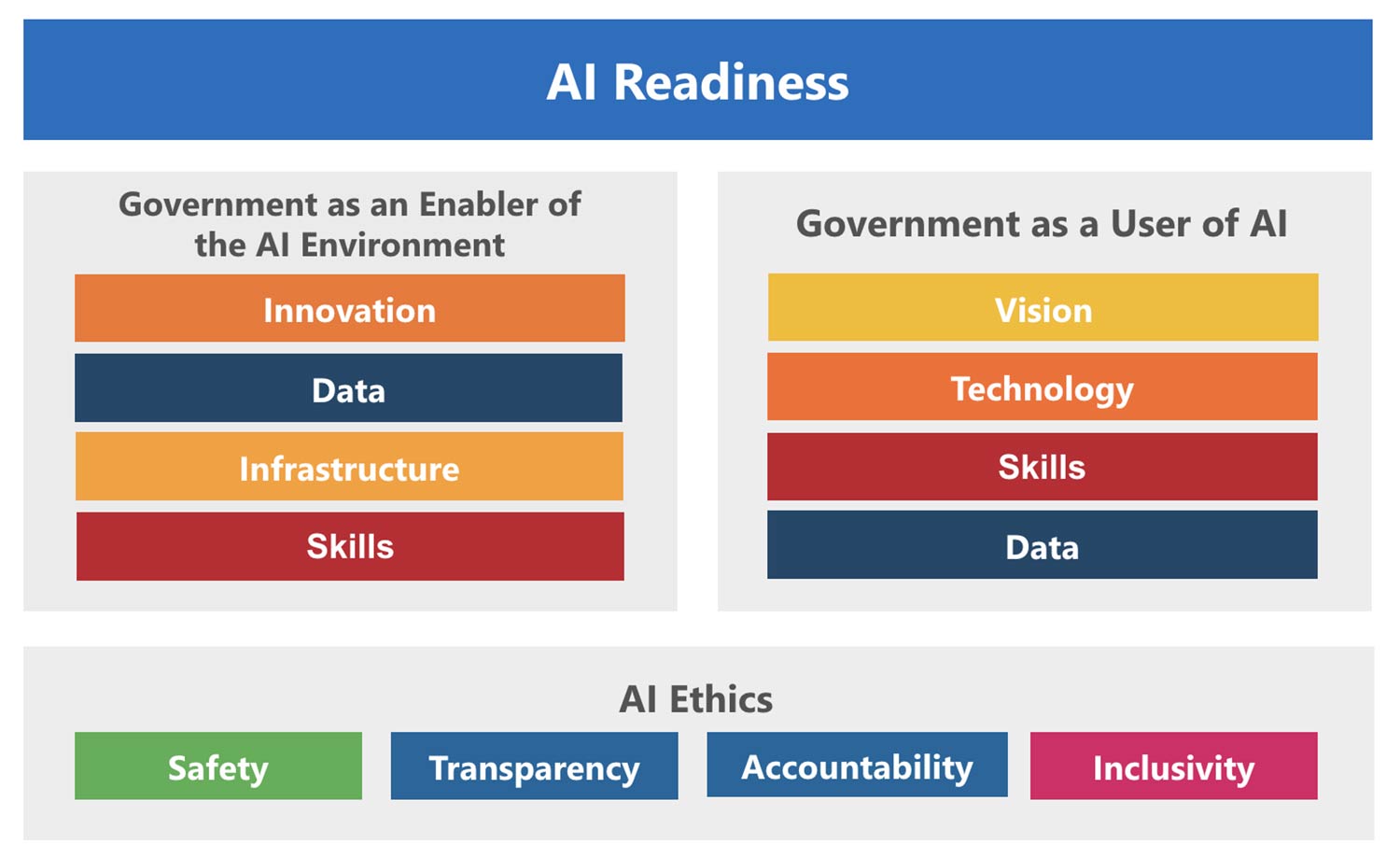
    Source: Yasmine Hamdar, et al. (Are countries ready for AI? How they can ensure ethical and responsible adoption?, 2023)

    Key elements needed for ethical AI development and implementation, such as policies, infrastructure and skills, are highlighted in the assessment. These are significant for countries as they deploy AI technologies at a national level to achieve sustainable development goals.

    Using a qualitative approach, the assessment utilises surveys, key informant interviews and workshops with civil servants to gain a more profound understanding of a country’s AI ecosystem. It offers governments important insights and recommendations on implementing ethical and effective AI regulations, including how AI ethics and values can be integrated into existing frameworks. Importantly, this globally applicable UN tool is available particularly for governments at any stage of their AI journey.

    Deloitte’s AI readiness for government

    With reference to Deloitte’s AI readiness framework – If the goal is to move beyond pilot stages, it’s beneficial to consider several interconnected areas to evaluate AI readiness. These include:

    • Strategy: To develop an AI vision that aligns with organisational objectives);
    • People: Organisations might struggle with sourcing necessary technical skills and helping current employees develop AI skills;
    • Processes: Defining processes, controls and governance systems to facilitate successful AI implementation;
    • Data: AI’s efficacy relies on the quality of data it’s built on, and it demands a lot of data;
    • Technology and platforms: Procuring and developing suitable AI technology and platforms to operationalise AI assets, including considerations relating to vendors and interoperability; and
    • The ethical implications of this transformative ability: To implement mechanisms to comprehend and counteract AI bias, encourage fairness and transparency, and embed values and integrity into AI initiatives).

    These six areas are crucial as all of them will likely need attention and modification during an agency’s AI journey. They can help establish a starting point for your readiness to undertake this journey.
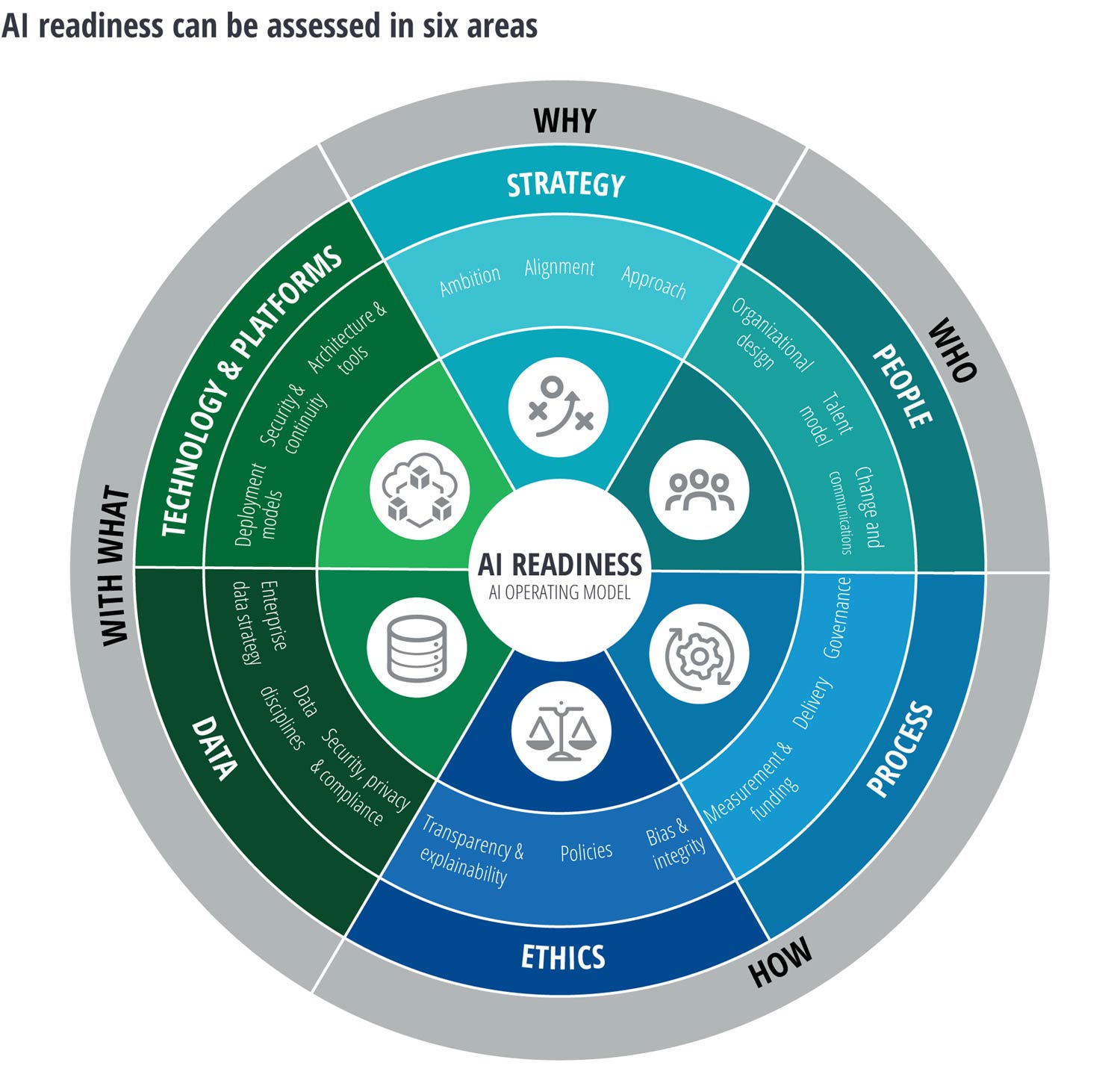
    Source: Van Buren E, et al. (Deloitte Insights – AI readiness for government, 2020)
    Source: Van Buren E, et al. (Deloitte Insights – AI readiness for government, 2020)

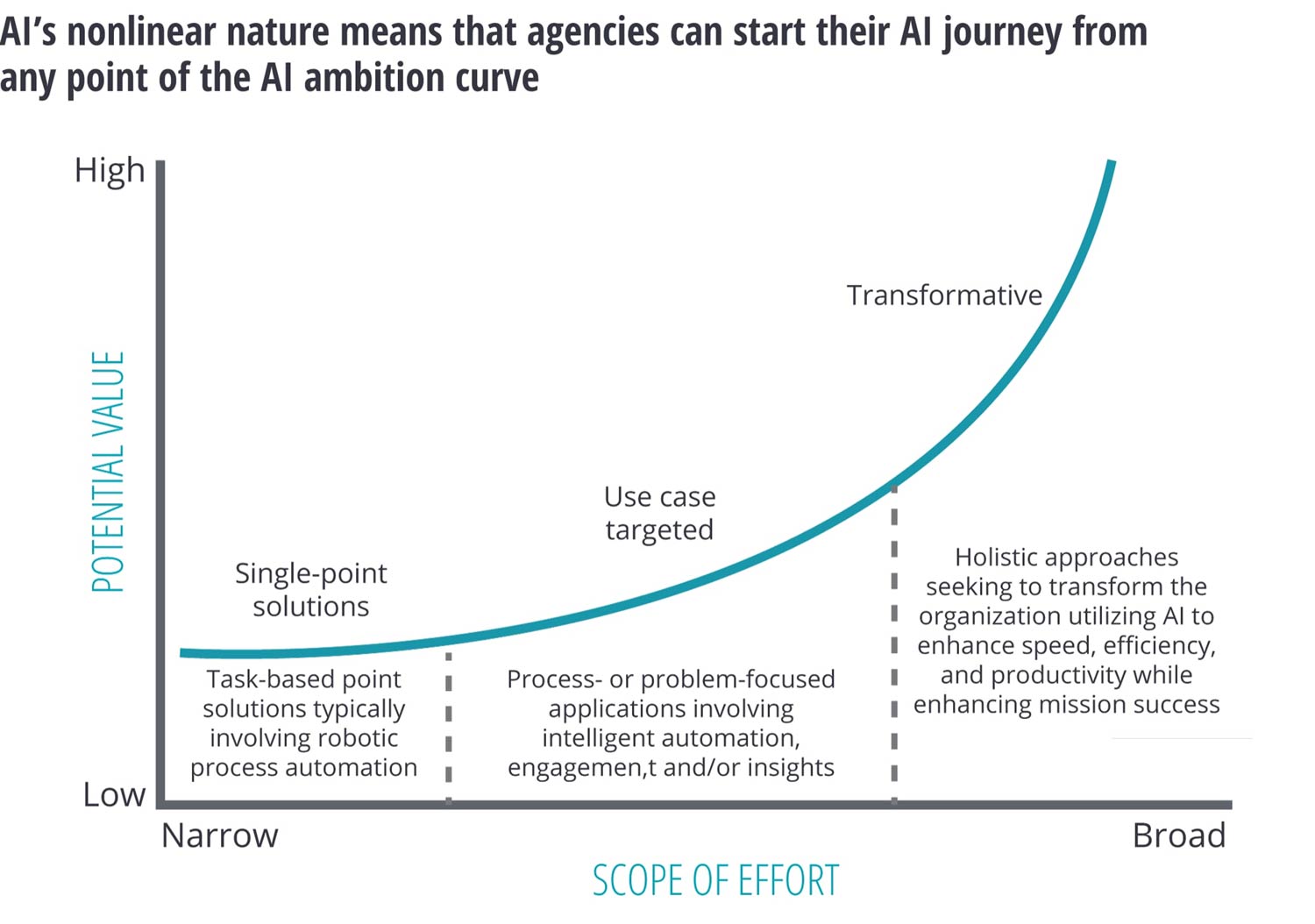
    According to Deloitte’s AI readiness framework, all six areas mentioned should be considered in AI initiatives. However, the level of effort required depends on the organisation’s current state and the ambition for AI adoption. Ambition levels can be classified as:

    • Narrow, single-point solutions;
    • Process- or problem-focused use cases; and
    • AI-fuelled transformation with the potential for the highest value and significant change.

    Narrow solutions demand less effort, automating simple processes in standardised back-office areas, freeing up staff for more meaningful tasks and generating quick efficiencies. When multiple opportunities such as these exist, they can collectively deliver significant value.

    Without an AI readiness assessment, an organisation can end up doing proofs of concept and other initiatives without understanding why they’re failing. Assessing readiness, meanwhile, allows an organisation to identify any gaps in its capabilities and address them before implementing an AI strategy.

    • The author, Prof Mark Nasila, is FNB chief risk office chief data and analytics officer
    • Read more articles by Mark Nasila on TechCentral
    • This promoted content was paid for by the party concerned

    Follow TechCentral on Google News Add TechCentral as your preferred source on Google


    FNB Mark Nasila
    WhatsApp YouTube
    Share. Facebook Twitter LinkedIn WhatsApp Telegram Email Copy Link
    Previous ArticleE-commerce businesses need a future-proofed platform
    Next Article Red Hat Summit Connect Johannesburg is a highlight on SA’s IT calendar – here’s why

    Related Posts

    FNB CEO Harry Kellan steps down after just two years

    FNB CEO Harry Kellan steps down after just two years

    30 March 2026
    Optasia wants to do for banks what it did for telcos - Salvador Anglada

    Optasia wants to do for banks what it did for telcos

    24 March 2026
    FNB launches eWallet on WhatsApp as it overhauls service

    FNB launches eWallet on WhatsApp as it overhauls service

    11 March 2026
    Add A Comment

    Comments are closed.

    Company News
    Cybersecurity in the age of AI: why speed and trust now define resilience - iqbusiness

    Cybersecurity in the AI age: speed and trust define resilience

    24 April 2026
    Security by design is the channel's strongest pitch - Othelo Vieira

    Security by design is the channel’s strongest pitch

    23 April 2026
    Your brand is invisible to the AI that's choosing your competitor - Michelle Losco

    Your brand is invisible to the AI that’s choosing your competitor

    23 April 2026
    Opinion
    The conflict of interest at the heart of PayShap's slow adoption - Cheslyn Jacobs

    The conflict of interest at the heart of PayShap’s slow adoption

    26 March 2026
    South Africa's energy future hinges on getting wheeling right - Aishah Gire

    South Africa’s energy future hinges on getting wheeling right

    10 March 2026
    Hold the doom: the case for a South African comeback - Duncan McLeod

    Apple just dropped a bomb on the Windows world

    5 March 2026

    Subscribe to Updates

    Get the best South African technology news and analysis delivered to your e-mail inbox every morning.

    Latest Posts
    Malatsi withdraws AI policy after fictitious sources scandal - Solly Malatsi

    Malatsi withdraws AI policy after fictitious sources scandal

    26 April 2026
    How AI could quietly hollow out South Africa's job market

    How AI could quietly hollow out South Africa’s job market

    26 April 2026
    SpaceX bets the rocket farm on AI

    SpaceX bets the rocket farm on AI

    26 April 2026
    Withdraw AI policy, Malatsi told as fake citations row grows - Solly Malatsi

    Withdraw AI policy, Malatsi told, as fake citations row grows

    26 April 2026
    © 2009 - 2026 NewsCentral Media
    • Cookie policy (ZA)
    • TechCentral – privacy and Popia

    Type above and press Enter to search. Press Esc to cancel.

    Manage consent

    TechCentral uses cookies to enhance its offerings. Consenting to these technologies allows us to serve you better. Not consenting or withdrawing consent may adversely affect certain features and functions of the website.

    Functional Always active
    The technical storage or access is strictly necessary for the legitimate purpose of enabling the use of a specific service explicitly requested by the subscriber or user, or for the sole purpose of carrying out the transmission of a communication over an electronic communications network.
    Preferences
    The technical storage or access is necessary for the legitimate purpose of storing preferences that are not requested by the subscriber or user.
    Statistics
    The technical storage or access that is used exclusively for statistical purposes. The technical storage or access that is used exclusively for anonymous statistical purposes. Without a subpoena, voluntary compliance on the part of your Internet Service Provider, or additional records from a third party, information stored or retrieved for this purpose alone cannot usually be used to identify you.
    Marketing
    The technical storage or access is required to create user profiles to send advertising, or to track the user on a website or across several websites for similar marketing purposes.
    • Manage options
    • Manage services
    • Manage {vendor_count} vendors
    • Read more about these purposes
    View preferences
    • {title}
    • {title}
    • {title}