Close Menu
TechCentralTechCentral

    Subscribe to the newsletter

    Get the best South African technology news and analysis delivered to your e-mail inbox every morning.

    Facebook X (Twitter) YouTube LinkedIn
    WhatsApp Facebook X (Twitter) LinkedIn YouTube
    TechCentralTechCentral
    • News
      Charge to switch on first N3 off-grid EV stations in May - Joubert Roux

      Charge to switch on first N3 off-grid EV stations in May

      23 April 2026
      Middle-class South Africa is ditching streaming for AI

      Middle-class South Africa is ditching streaming for AI

      23 April 2026
      Mythos forces South African banks onto high alert - Graham Lee

      Mythos forces South African banks onto high alert

      23 April 2026
      Free calls, dead voice and Shameel Joosub's Spanish ghost

      Free calls, dead voice and Shameel Joosub’s Spanish ghost

      22 April 2026
      Capitec CEO Graham Lee

      Capitec blows up MVNO pricing with free on-net calls

      22 April 2026
    • World
      More organic compounds detected on Mars - Nasa Curiosity rover

      More organic compounds detected on Mars

      21 April 2026
      Adobe bets on AI agents to fend off cheaper rivals

      Adobe bets on AI agents to fend off cheaper rivals

      16 April 2026
      Google poised to lose ad crown to Meta

      Google poised to lose ad crown to Meta

      14 April 2026
      Grand Theft Data - hackers hit Rockstar Games - Grand Theft Auto

      Grand Theft Data – hackers hit Rockstar Games

      14 April 2026
      UK PM Keir Starmer declares war on doomscrolling

      UK PM Keir Starmer declares war on doomscrolling

      13 April 2026
    • In-depth
      Africa switches on as Europe dims the lights

      Africa switches on as Europe dims the lights

      9 April 2026
      The biggest untapped EV market on Earth is hiding in plain sight

      The biggest untapped EV market on Earth is hiding in plain sight

      1 April 2026
      The R18-billion tech giant hiding in plain sight - Jens Montanana

      The R16-billion tech giant hiding in plain sight

      26 March 2026
      The last generation of coders

      The last generation of coders

      18 February 2026
      Sentech is in dire straits

      Sentech is in dire straits

      10 February 2026
    • TCS

      TCS+ | ‘The ISP for ISPs’: Vox’s shift to wholesale aggregator

      20 April 2026
      TCS | Werner Lindemann on how AI is rewriting the infosec rulebook

      TCS | Werner Lindemann on how AI is rewriting the infosec rulebook

      15 April 2026
      TCS | Donovan Marsh on AI and the future of filmmaking

      TCS | Donovan Marsh on AI and the future of filmmaking

      7 April 2026
      TCS+ | Vodacom Business moves to crack the SME tech gap - Andrew Fulton, Sannesh Beharie

      TCS+ | Vodacom Business moves to crack the SME tech gap

      7 April 2026
      TCS | MTN's Divysh Joshi on the strategy behind Pi - Divyesh Joshi

      TCS | MTN’s Divyesh Joshi on the strategy behind Pi

      1 April 2026
    • Opinion
      The conflict of interest at the heart of PayShap's slow adoption - Cheslyn Jacobs

      The conflict of interest at the heart of PayShap’s slow adoption

      26 March 2026
      South Africa's energy future hinges on getting wheeling right - Aishah Gire

      South Africa’s energy future hinges on getting wheeling right

      10 March 2026
      Hold the doom: the case for a South African comeback - Duncan McLeod

      Apple just dropped a bomb on the Windows world

      5 March 2026
      R230-million in the bag for Endeavor's third Harvest Fund - Alison Collier

      VC’s centre of gravity is shifting – and South Africa is in the frame

      3 March 2026
      Hold the doom: the case for a South African comeback - Duncan McLeod

      Hold the doom: the case for a South African comeback

      26 February 2026
    • Company Hubs
      • 1Stream
      • Africa Data Centres
      • AfriGIS
      • Altron Digital Business
      • Altron Document Solutions
      • Altron Group
      • Arctic Wolf
      • Ascent Technology
      • AvertITD
      • BBD
      • Braintree
      • CallMiner
      • CambriLearn
      • CYBER1 Solutions
      • Digicloud Africa
      • Digimune
      • Domains.co.za
      • ESET
      • Euphoria Telecom
      • HOSTAFRICA
      • Incredible Business
      • iONLINE
      • IQbusiness
      • Iris Network Systems
      • Kaspersky
      • LSD Open
      • Mitel
      • NEC XON
      • Netstar
      • Network Platforms
      • Next DLP
      • Ovations
      • Paracon
      • Paratus
      • Q-KON
      • SevenC
      • SkyWire
      • Solid8 Technologies
      • Telit Cinterion
      • Telviva
      • Tenable
      • Vertiv
      • Videri Digital
      • Vodacom Business
      • Wipro
      • Workday
      • XLink
    • Sections
      • AI and machine learning
      • Banking
      • Broadcasting and Media
      • Cloud services
      • Contact centres and CX
      • Cryptocurrencies
      • Education and skills
      • Electronics and hardware
      • Energy and sustainability
      • Enterprise software
      • Financial services
      • HealthTech
      • Information security
      • Internet and connectivity
      • Internet of Things
      • Investment
      • IT services
      • Lifestyle
      • Motoring
      • Policy and regulation
      • Public sector
      • Retail and e-commerce
      • Satellite communications
      • Science
      • SMEs and start-ups
      • Social media
      • Talent and leadership
      • Telecoms
    • Events
    • Advertise
    TechCentralTechCentral
    Home » Header » HTC: the mobile brand from nowhere

    HTC: the mobile brand from nowhere

    By Editor8 April 2012
    Twitter LinkedIn Facebook WhatsApp Email Telegram Copy Link
    News Alerts
    WhatsApp
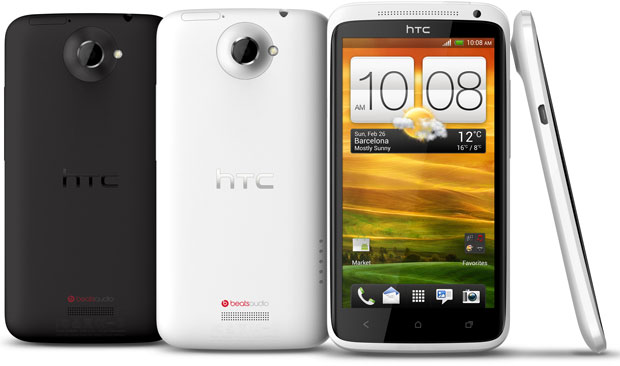
    The One X, HTC's new flagship smartphone

    “Ideas so simple,” reads a cartoon on an elevator door, “that they feel like the completion of a thought,” continues its twin. Similar doodles adorn the walls of HTC’s headquarters in Taoyuan, near Taipei, and business cards carried by the smartphone-maker’s staff. John Wang, the chief marketing officer, lays out a set of four: concentric circles with a smiley in the middle, denoting a focus on the customer; an arrow from A to B, for simplicity; a magnet, for “hidden power”; and a parcel, for “pleasant surprises”.

    Meaning what, in practice? Wang shows off the camera in HTC’s new range of smartphones, the One series, which goes on sale this month. It is super-fast, focuses and shoots in a fifth of a second, takes photos in rapid succession and does away with cumbersome switching between stills and video: you can take snaps while filming or replaying. The engineering is hard, but hidden. The camera is easy to use. It is a pleasant surprise.

    Last year, however, HTC produced an unpleasant one: sales and profits plummeted in the fourth quarter (see chart). In the first two months of 2012, revenue was a staggering 45% down on last year. In February, Winston Yung, the chief financial officer, admitted that HTC had “dropped the ball”. Analysts mused that last year’s products were not its best: perhaps fast growth caused a loss of concentration. And the competition, from Apple’s iPhone 4S and Samsung’s Galaxy S2, was ferocious.
    Mobile-phone brands can flower and fade quickly. On 29 March, Research In Motion, the Canadian maker of the BlackBerry, the latest to wilt, announced a quarterly loss, the departure of senior executives and a “comprehensive review”.
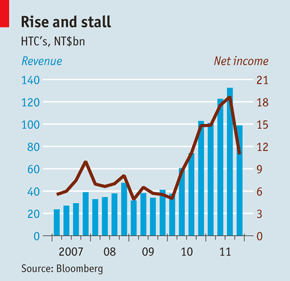
    No firm has bloomed as suddenly as HTC. Until 2006, when it started selling phones under its own name, it had no brand to speak of. Yet now only Apple and Samsung sell more “high-end” smartphones (costing US$300 or more). In America, it sold more smartphones than anybody else in the third quarter of 2011, according to Canalys, a research firm.

    This month, two things will happen that HTC hopes will revive it. It will start selling a new crop of phones and step up its efforts in China, a market it entered only in July 2010. IDC, a research firm, says China will become the world’s biggest market for smartphones this year. Others reckon it already is.

    Founded in 1997, HTC began as one of many Taiwanese firms that design and make things that are sold under others’ brands — in its case, brands belonging to mobile-phone operators and computer-makers. In 2000, it produced the iPAQ, a personal digital assistant, for Compaq, a firm bought by Hewlett-Packard in 2002. HTC’s original name was High Tech Computer, which is as anonymous as it gets.

    It won a reputation for excellent engineering. But it wanted more, and began to invest more in innovation before eventually creating its own brand. It set up a unit called Magic Labs, which was charged with coming up with lots of ideas, even if most were quickly discarded. (Wang was its “chief innovation wizard”. He still has a few of those business cards, too.) From this came, notably, the HTC Touch, a touch-screen device that appeared in 2007, at about the same time as Apple’s first iPhone. Wang admits to feeling “terrible” when the iPhone appeared, but he says he soon felt “at ease”. Because “HTC had a very weak brand back then”, take-up of the new phones would have been slower had Apple not made touch-screens cool.

    Spectacular growth came hand in hand with that of Android, Google’s mobile operating system. HTC latched on to this early, making the first Android smartphones, despite an earlier tie-up with Microsoft. Like everyone else, it has caught shrapnel in the patent wars. In December, America’s International Trade Commission ruled that some HTC devices had infringed an Apple patent and should be banned from America from 19 April. HTC says a redesign will deal with the objection.

    Patent wars may not have halted it, but it has stumbled nonetheless. Pierre Ferragu of Sanford C Bernstein, an investment bank, links its decline to the “tyranny of the flagship”: the tendency for top-of-the-range phones to scoop a disproportionate share of the market. Ferragu reckons that in the fourth quarter of 2011, 30% of volume, 52% of sales and 87% of operating profits were accounted for by iPhones and Samsung’s Galaxy S2 alone. He expects these ratios to fall and thinks that HTC is best placed to gain.

    Yung promised that growth would resume when new products appeared. There are reasons to be cheerful. The One phones were well received when HTC showed them off at Mobile World Congress, an industry jamboree, in Barcelona in February. Deals with 140 operators and distributors around the world should help get them into consumers’ hands.
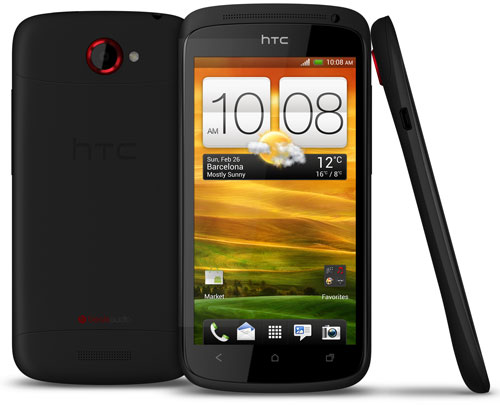
    The new HTC One S

    In China, explains Ray Yam, the head of HTC’s business there, the company started later than in richer parts of the word largely because the country’s mobile infrastructure was iffy. These days 10-15% of users have 3G, a figure expected to rise rapidly; and more people have access to Wi-Fi, in public places if not at home. HTC has taken about 10% of the market for smartphones costing more than 2 000 yuan (about $300). It is time for a further push.

    So HTC is launching its first national marketing campaign. It will also open many more “shops in shops” — booths run by manufacturers in electronics stores in which they jostle for custom. HTC has 2 300 so far; Yam expects there to be 4 000 by the end of the year and 6 000-7 000 eventually. (He reckons Apple has 3 500 and that Nokia and Samsung have 9 000 each.) HTC is also introducing phones tailored for the Chinese market. Last month, the Triumph, the first phone in China with the newest version of Windows, went on sale. Also coming is the Desire, which has the latest incarnation of Android and can switch between operators with incompatible standards.

    Here’s to China
    “This year is a very important one for HTC,” says Yan Siqing, chief operating officer of China Telling Telecom, which distributes around 15% of the country’s mobile phones. Yan, whose firm works mainly with global brands, including HTC, says HTC grew rapidly in China last year, despite its late start, because it provided a “good user experience”. People know the brand and like the phones. “Its main competitor in [China] is Samsung. Apple is higher up and for now there’s no way to compete with them.” Nokia is another strong brand but its Windows phone is still new. That gives HTC “time for growth”.

    HTC has a good chance of bouncing back this year. Ben Wood of CCS Insight, a research firm, thinks it “has pulled it back with these new products”, but he adds that the firm is only as good as its latest device. The market changes fast.

    That means HTC will have to keep turning out hits. Others have seen it rise from anonymity to omnipresence and want to follow: Huawei and ZTE, two Chinese hopefuls, are far behind but hungry. HTC cannot yet rely on other sources of income: its tablet, the Flyer, has not yet flown. Apple, Samsung and the rest have alternative means of support. They also have many more billions to throw at marketing. HTC prefers to let its products do the talking. It seems confident that people will listen.  — (c) 2012 The Economist

    Follow TechCentral on Google News Add TechCentral as your preferred source on Google


    Android Apple China Telling Telecom Google HTC John Wang Microsoft Nokia Ray Yam Samsung Winston Yung Yan Siqing
    WhatsApp YouTube
    Share. Facebook Twitter LinkedIn WhatsApp Telegram Email Copy Link
    Previous ArticleZA Tech Show: Episode 205 — ‘Fool me once’
    Next Article Report paints bleak picture of ICT in SA

    Related Posts

    Middle-class South Africa is ditching streaming for AI

    Middle-class South Africa is ditching streaming for AI

    23 April 2026
    The AI agent race is on - and Google wants to win it - Sundar Pichai

    The AI agent race is on – and Google wants to win it

    22 April 2026
    RAM price relief? SK Hynix plans $13-billion Korean fab

    RAM price relief? SK Hynix plans $13-billion Korean fab

    22 April 2026
    Company News
    Security by design is the channel's strongest pitch - Othelo Vieira

    Security by design is the channel’s strongest pitch

    23 April 2026
    Your brand is invisible to the AI that's choosing your competitor - Michelle Losco

    Your brand is invisible to the AI that’s choosing your competitor

    23 April 2026
    How AnyDesk is redefining remote access for African enterprises

    How AnyDesk is redefining remote access for African enterprises

    22 April 2026
    Opinion
    The conflict of interest at the heart of PayShap's slow adoption - Cheslyn Jacobs

    The conflict of interest at the heart of PayShap’s slow adoption

    26 March 2026
    South Africa's energy future hinges on getting wheeling right - Aishah Gire

    South Africa’s energy future hinges on getting wheeling right

    10 March 2026
    Hold the doom: the case for a South African comeback - Duncan McLeod

    Apple just dropped a bomb on the Windows world

    5 March 2026

    Subscribe to Updates

    Get the best South African technology news and analysis delivered to your e-mail inbox every morning.

    Latest Posts
    Charge to switch on first N3 off-grid EV stations in May - Joubert Roux

    Charge to switch on first N3 off-grid EV stations in May

    23 April 2026
    Middle-class South Africa is ditching streaming for AI

    Middle-class South Africa is ditching streaming for AI

    23 April 2026
    Security by design is the channel's strongest pitch - Othelo Vieira

    Security by design is the channel’s strongest pitch

    23 April 2026
    Your brand is invisible to the AI that's choosing your competitor - Michelle Losco

    Your brand is invisible to the AI that’s choosing your competitor

    23 April 2026
    © 2009 - 2026 NewsCentral Media
    • Cookie policy (ZA)
    • TechCentral – privacy and Popia

    Type above and press Enter to search. Press Esc to cancel.

    Manage consent

    TechCentral uses cookies to enhance its offerings. Consenting to these technologies allows us to serve you better. Not consenting or withdrawing consent may adversely affect certain features and functions of the website.

    Functional Always active
    The technical storage or access is strictly necessary for the legitimate purpose of enabling the use of a specific service explicitly requested by the subscriber or user, or for the sole purpose of carrying out the transmission of a communication over an electronic communications network.
    Preferences
    The technical storage or access is necessary for the legitimate purpose of storing preferences that are not requested by the subscriber or user.
    Statistics
    The technical storage or access that is used exclusively for statistical purposes. The technical storage or access that is used exclusively for anonymous statistical purposes. Without a subpoena, voluntary compliance on the part of your Internet Service Provider, or additional records from a third party, information stored or retrieved for this purpose alone cannot usually be used to identify you.
    Marketing
    The technical storage or access is required to create user profiles to send advertising, or to track the user on a website or across several websites for similar marketing purposes.
    • Manage options
    • Manage services
    • Manage {vendor_count} vendors
    • Read more about these purposes
    View preferences
    • {title}
    • {title}
    • {title}