Close Menu
TechCentralTechCentral

    Subscribe to the newsletter

    Get the best South African technology news and analysis delivered to your e-mail inbox every morning.

    Facebook X (Twitter) YouTube LinkedIn
    WhatsApp Facebook X (Twitter) LinkedIn YouTube
    TechCentralTechCentral
    • News
      Mastercard bets billions on the tech that could eat its lunch - Prakriti Singh

      Mastercard bets billions on the tech that could eat its lunch

      21 July 2026
      From care homes to production lines, the robots are coming

      From care homes to production lines, the robots are coming

      21 July 2026
      Remote work in South Africa hits record high

      Remote work in South Africa hits record high

      21 July 2026
      China weighs blocking the West from its best AI

      China weighs blocking the West from its best AI

      21 July 2026
      Openserve hits back in fibre ISP row

      Openserve hits back in fibre ISP row

      20 July 2026
    • World
      Meta AI will now tell parents if their teen is in crisis

      Meta AI will now tell parents if their teen is in crisis

      17 July 2026
      IBM shares crash 25% as AI upends software spending - Arvind Krishna

      IBM shares crash 25% as AI upends software spending

      15 July 2026
      Jony Ive's first OpenAI device: an AI smart speaker - Jony Ive and Sam Altman

      Jony Ive’s first OpenAI device: an AI smart speaker

      15 July 2026
      Stripe, Advent in talks to buy PayPal for $53-billion

      Stripe, Advent in talks to buy PayPal for $53-billion

      15 July 2026
      Memory crisis sends smartphone market into steep decline

      Memory crisis sends smartphone market into steep decline

      13 July 2026
    • In-depth
      The plan to stop AI from breaking the world - Google DeepMind CEO Demis Hassabis. Image: John Sears

      The plan to stop AI from breaking the world

      16 July 2026
      The internet has a Strait of Hormuz problem

      The internet has a Strait of Hormuz problem

      15 July 2026
      AI boom sparks rally, frenzy and fear

      AI boom sparks rally, frenzy and fear

      11 June 2026
      Every plug-in hybrid on sale in South Africa, ranked by price - Lamborghini Temerario

      Every plug-in hybrid on sale in South Africa, ranked by price

      7 June 2026
      What Wi-Fi 8 will mean for wireless networks

      What Wi-Fi 8 will mean for wireless networks

      1 June 2026
    • TCS
      Watts & Wheels S1E7: 'Ferrari's EV breaks the internet'

      Watts & Wheels S1E7: ‘Ferrari’s EV breaks the internet’

      8 July 2026
      TCS+ | How Tracker is turning vehicle data into business strategy - Silvia Schollenberger

      TCS+ | How Tracker is turning vehicle data into business strategy

      1 July 2026
      TCS+ | IBM Bob: an AI-powered 'development partner' for the enterprise - David Spurway

      TCS+ | IBM Bob: an AI-powered development partner for the enterprise

      30 June 2026
      Watts & Wheels S1E6: 'A flawless Alfa and a bakkie that divides'

      Watts & Wheels S1E6: ‘A flawless Alfa and a bakkie that divides’

      17 June 2026
      Watts & Wheels S1E6: 'A flawless Alfa and a bakkie that divides'

      Watts & Wheels S1E5: ‘A Bentley of the bush and a car that swims’

      8 June 2026
    • Opinion
      Selling vapour is corporate suicide in slow motion - Jannie van Zyl

      Selling vapour is corporate suicide in slow motion

      16 July 2026
      Brazil's online gambling crackdown is a lesson for South Africa

      How Amazon outmanoeuvred Starlink in South Africa

      15 July 2026
      The Popia problem with agentic AI - Herman Haasbroek

      The Popia problem with agentic AI

      14 July 2026
      The author, Fanie van Rooyen

      South Africa can still catch the AI wave – here’s how

      7 July 2026
      The author, Fanie van Rooyen

      The AI utopia South Africa can’t afford

      1 July 2026
    • Company Hubs
      • 1Stream
      • Africa Data Centres
      • AfriGIS
      • Altron Digital Business
      • Altron Document Solutions
      • Altron Group
      • Arctic Wolf
      • Ascent Technology
      • AvertITD
      • BBD
      • Braintree
      • CallMiner
      • CambriLearn
      • CM Telecom
      • Contactable
      • CYBER1 Solutions
      • Digicloud Africa
      • Digimune
      • Domains.co.za
      • ESET
      • Euphoria Telecom
      • HOSTAFRICA
      • Incredible Business
      • iONLINE
      • IQbusiness
      • Iris Network Systems
      • Kaspersky
      • LSD Open
      • Mitel
      • NEC XON
      • Netstar
      • Network Platforms
      • Next DLP
      • Ovations
      • Paracon
      • Paratus
      • Q-KON
      • SevenC
      • SkyWire
      • Solid8 Technologies
      • Telit Cinterion
      • Telviva
      • Tenable
      • Vertiv
      • Videri Digital
      • Vodacom Business
      • Wipro
      • Workday
      • XLink
    • Sections
      • AI and machine learning
      • Banking
      • Broadcasting and Media
      • Cloud services
      • Contact centres and CX
      • Cryptocurrencies
      • Education and skills
      • Electronics and hardware
      • Energy and sustainability
      • Enterprise software
      • Financial services
      • HealthTech
      • Information security
      • Internet and connectivity
      • Internet of Things
      • Investment
      • IT services
      • Lifestyle
      • Policy and regulation
      • Public sector
      • Retail and e-commerce
      • Satellite communications
      • Science
      • SMEs and start-ups
      • Social media
      • Talent and leadership
      • Telecoms
      • Watts & Wheels
    • Events
    • Advertise
    TechCentralTechCentral
    Home » Opinion » Craig Wilson » Is that a phone in your pocket, or…?

    Is that a phone in your pocket, or…?

    By Editor28 June 2011
    Twitter LinkedIn Facebook WhatsApp Email Telegram Copy Link
    News Alerts
    WhatsApp

    [By Craig Wilson]

    The first cellular phones were cumbersome, ungainly things that required strong arms and frequent access to a power point. Then the great shrink happened. By the end of the 1990s, phones had evolved from briefcase-sized to pocket-sized to change-pocket sized. And then, just as suddenly, the shrinking stopped.

    In the heady early days of cellular phones, smaller really did seem to equate to better. The then leaders in the field — Ericsson, Motorola, Nokia, Siemens – constantly tried to outdo each other with progressively smaller phones. First, the external antennas vanished, then the spaces between keys did likewise, and finally the clamshell design took off.

    At first, when consumers were only using cellular phones to make calls and, later, to send SMS messages, the argument for smaller handsets seemed a valid one. After all, cellular phones were meant to be mobile.

    Early in the new millennium, however, it became clear that with improvements to screen technology, graphical user interfaces, and increasingly efficient input methods like predictive text, cellular phones were destined for far loftier things than merely calling and sending text messages.

    In the early 2000s, the Internet had already begun moving from the realm of novelty to necessity, and consumers expected cellphone manufacturers to follow suit. Two further developments, the rise of social media and the increasing prevalence of touch-based displays in consumer devices, sounded the death knell for micro-phones.

    Suddenly, consumers wanted to consume text and graphical content on their phones without having to scroll every three lines, and with consumer demands came larger, brighter, more colourful screens.
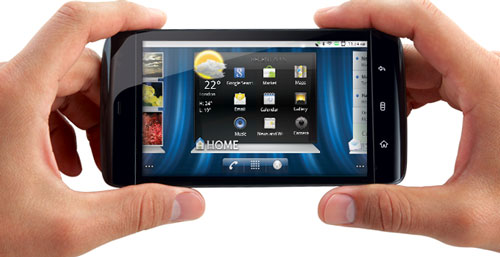
    The Dell Streak ... is it a tablet or is it a phone?

    With the advent of the iPhone in 2007, it seemed that rival manufacturers had implicitly agreed that the optimal screen-size for a phone was about 3,5 inches — after all, if that was good enough for Apple (a company that makes only one handset, in stark contrast to the dozens of different models Nokia puts out every year) it was probably good enough for everyone else.

    Screens continue to grow in size, while handsets get slimmer and slimmer. For a while, a 4-inch display was innovative, then it was 4,3 inches, and now some manufacturers are trying to make 5-inch screens de rigeur.

    Dell’s 5-inch Streak is fittingly called a “tablet phone” because, after all, that seems to be where things are heading. With most tablets accepting Sim cards for 3G connectivity purposes, there have been murmurs since the first iPad about the inevitability of phones and tablets eventually merging.

    The problem is that pressing an iPad to your ear is guaranteed to make you look like an idiot. Arguably, a 7-inch tablet like Samsung’s Galaxy Tab or HTC’s Flyer would make you look marginally less idiotic, but only marginally.

    The same pragmatism and usability demands that stopped cellphones from shrinking seem likely to prevent them from becoming tablets with phone functionality. A huge phone is no more practical than a tiny one. A tiny one is portable, but can’t deliver content, while overly large ones favour content at the cost of portability.

    Some critics have said tablets are essentially crippled phones and are simply a way for the likes of Apple to make (even) more money. But tablets fulfil a different purpose. Despite its sizeable screen, I’d far rather read a magazine or news site on my tablet than my phone, but I’d rather use my phone for GPS than my tablet.

    Similarly, while it’s possible to view and even edit documents on most smartphones, it’s an undeniably more pleasant experience to do so on a tablet. If you’ve ever tried to type a long overdue e-mail missive to far-flung family members on your phone you’ll doubtless agree with me.

    Perhaps I’m mistaken and phones and tablets are destined to merge. Perhaps LED screens will become so thin and flexible that a phone could fold out to become a tablet. Or perhaps the size of future handsets will be decided by the fashion industry – because, after all, the practical definition of a mobile phone is this: it fits in a pocket.

    • Craig Wilson is a senior journalist at TechCentral
    • Subscribe to our free daily newsletter
    • Follow us on Twitter or on Facebook

    Follow TechCentral on Google News Add TechCentral as your preferred source on Google


    Craig Wilson Dell Ericsson Motorola Nokia Siemens
    WhatsApp YouTube
    Share. Facebook Twitter LinkedIn WhatsApp Telegram Email Copy Link
    Previous ArticleiBurst to take broadband into rural areas
    Next Article SA broadband a ‘tragic story’ – Koos Bekker

    Related Posts

    Dell guns for MacBook Neo with low-cost laptop

    Dell guns for MacBook Neo with low-cost laptop

    1 June 2026
    AI demand sparks 'chipflation' warning

    AI is eating the world’s memory – and we’re all going to pay the price

    22 January 2026
    First Technology Western Cape delivers the tools - and intelligence - behind modern business - Dell Technologies

    First Technology Western Cape delivers the tools – and intelligence – behind modern business

    29 December 2025
    Company News
    Cloud adoption is done. Execution is the new frontier - Cloud on Demand

    Cloud adoption is done. Execution is the new frontier

    21 July 2026
    Data poisoning in AI models: what businesses need to know - Domains.co.za

    Data poisoning in AI models: what businesses need to know

    21 July 2026
    The AI-led industrial revolution has begun - CallMiner Bruce McMahon

    The AI-led industrial revolution has begun

    20 July 2026
    Opinion
    Selling vapour is corporate suicide in slow motion - Jannie van Zyl

    Selling vapour is corporate suicide in slow motion

    16 July 2026
    Brazil's online gambling crackdown is a lesson for South Africa

    How Amazon outmanoeuvred Starlink in South Africa

    15 July 2026
    The Popia problem with agentic AI - Herman Haasbroek

    The Popia problem with agentic AI

    14 July 2026

    Subscribe to Updates

    Get the best South African technology news and analysis delivered to your e-mail inbox every morning.

    Latest Posts
    Mastercard bets billions on the tech that could eat its lunch - Prakriti Singh

    Mastercard bets billions on the tech that could eat its lunch

    21 July 2026
    From care homes to production lines, the robots are coming

    From care homes to production lines, the robots are coming

    21 July 2026
    Cloud adoption is done. Execution is the new frontier - Cloud on Demand

    Cloud adoption is done. Execution is the new frontier

    21 July 2026
    Data poisoning in AI models: what businesses need to know - Domains.co.za

    Data poisoning in AI models: what businesses need to know

    21 July 2026
    © 2009 - 2026 NewsCentral Media
    Built and maintained by Chronon
    • Cookie policy (ZA)
    • TechCentral – privacy and Popia

    Type above and press Enter to search. Press Esc to cancel.

    Manage consent

    TechCentral uses cookies to enhance its offerings. Consenting to these technologies allows us to serve you better. Not consenting or withdrawing consent may adversely affect certain features and functions of the website.

    Functional Always active
    The technical storage or access is strictly necessary for the legitimate purpose of enabling the use of a specific service explicitly requested by the subscriber or user, or for the sole purpose of carrying out the transmission of a communication over an electronic communications network.
    Preferences
    The technical storage or access is necessary for the legitimate purpose of storing preferences that are not requested by the subscriber or user.
    Statistics
    The technical storage or access that is used exclusively for statistical purposes. The technical storage or access that is used exclusively for anonymous statistical purposes. Without a subpoena, voluntary compliance on the part of your Internet Service Provider, or additional records from a third party, information stored or retrieved for this purpose alone cannot usually be used to identify you.
    Marketing
    The technical storage or access is required to create user profiles to send advertising, or to track the user on a website or across several websites for similar marketing purposes.
    • Manage options
    • Manage services
    • Manage {vendor_count} vendors
    • Read more about these purposes
    View preferences
    • {title}
    • {title}
    • {title}