
Close Menu
TechCentralTechCentral

    Subscribe to the newsletter

    Get the best South African technology news and analysis delivered to your e-mail inbox every morning.

    Facebook X (Twitter) YouTube LinkedIn
    WhatsApp Facebook X (Twitter) LinkedIn YouTube
    TechCentralTechCentral
    • News
      Koos Bekker sells R2.5-billion in Naspers and Prosus shares

      Koos Bekker sells R2.5-billion in Naspers and Prosus shares

      23 December 2025
      Tribunal clears Vumatel's takeover of Herotel - with conditions

      Tribunal clears Vumatel’s takeover of Herotel – with conditions

      23 December 2025
      Wiocc subsidiary OADC cleared to buy NTT data centres in South Africa

      Wiocc subsidiary OADC cleared to buy NTT data centres in South Africa

      23 December 2025
      Netflix launches Afcon football show, hinting at bigger sports ambitions

      Netflix launches Afcon football show, hinting at bigger sports ambitions

      23 December 2025
      Digital authoritarianism grows as African states normalise internet blackouts

      Digital authoritarianism grows as African states normalise internet blackouts

      19 December 2025
    • World
      Trump space order puts the moon back at centre of US, China rivalry - US President Donald Trump

      Trump space order puts the moon back at centre of US, China rivalry

      19 December 2025
      Warner Bros slams the door on Paramount

      Warner Bros slams the door on Paramount

      17 December 2025
      X moves to block bid to revive Twitter brand

      X moves to block bid to revive Twitter brand

      17 December 2025
      Oracle’s AI ambitions face scrutiny on earnings miss

      Oracle’s AI ambitions face scrutiny on earnings miss

      11 December 2025
      China will get Nvidia H200 chips - but not without paying Washington first

      China will get Nvidia H200 chips – but not without paying Washington first

      9 December 2025
    • In-depth
      Black Friday goes digital in South Africa as online spending surges to record high

      Black Friday goes digital in South Africa as online spending surges to record high

      4 December 2025
      Canal+ plays hardball - and DStv viewers feel the pain

      Canal+ plays hardball – and DStv viewers feel the pain

      3 December 2025
      Jensen Huang Nvidia

      So, will China really win the AI race?

      14 November 2025
      Valve's Linux console takes aim at Microsoft's gaming empire

      Valve’s Linux console takes aim at Microsoft’s gaming empire

      13 November 2025
      iOCO's extraordinary comeback plan - Rhys Summerton

      iOCO’s extraordinary comeback plan

      28 October 2025
    • TCS
      TCS+ | Africa's digital transformation - unlocking AI through cloud and culture - Cliff de Wit Accelera Digital Group

      TCS+ | Cloud without culture won’t deliver AI: Accelera’s Cliff de Wit

      12 December 2025
      TCS+ | How Cloud on Demand helps partners thrive in the AWS ecosystem - Odwa Ndyaluvane and Xenia Rhode

      TCS+ | How Cloud On Demand helps partners thrive in the AWS ecosystem

      4 December 2025
      TCS | MTN Group CEO Ralph Mupita on competition, AI and the future of mobile

      TCS | Ralph Mupita on competition, AI and the future of mobile

      28 November 2025
      TCS | Dominic Cull on fixing South Africa's ICT policy bottlenecks

      TCS | Dominic Cull on fixing South Africa’s ICT policy bottlenecks

      21 November 2025
      TCS | BMW CEO Peter van Binsbergen on the future of South Africa's automotive industry

      TCS | BMW CEO Peter van Binsbergen on the future of South Africa’s automotive industry

      6 November 2025
    • Opinion
      Netflix, Warner Bros deal raises fresh headaches for MultiChoice - Duncan McLeod

      Netflix, Warner Bros deal raises fresh headaches for MultiChoice

      5 December 2025
      BIN scans, DDoS and the next cybercrime wave hitting South Africa's banks - Entersekt Gerhard Oosthuizen

      BIN scans, DDoS and the next cybercrime wave hitting South Africa’s banks

      3 December 2025
      Your data, your hardware: the DIY AI revolution is coming - Duncan McLeod

      Your data, your hardware: the DIY AI revolution is coming

      20 November 2025
      Zero Carbon Charge founder Joubert Roux

      The energy revolution South Africa can’t afford to miss

      20 November 2025
      It's time for a new approach to government IT spend in South Africa - Richard Firth

      It’s time for a new approach to government IT spend in South Africa

      19 November 2025
    • Company Hubs
      • Africa Data Centres
      • AfriGIS
      • Altron Digital Business
      • Altron Document Solutions
      • Altron Group
      • Arctic Wolf
      • AvertITD
      • Braintree
      • CallMiner
      • CambriLearn
      • CYBER1 Solutions
      • Digicloud Africa
      • Digimune
      • Domains.co.za
      • ESET
      • Euphoria Telecom
      • Incredible Business
      • iONLINE
      • IQbusiness
      • Iris Network Systems
      • LSD Open
      • NEC XON
      • Netstar
      • Network Platforms
      • Next DLP
      • Ovations
      • Paracon
      • Paratus
      • Q-KON
      • SevenC
      • SkyWire
      • Solid8 Technologies
      • Telit Cinterion
      • Tenable
      • Vertiv
      • Videri Digital
      • Vodacom Business
      • Wipro
      • Workday
      • XLink
    • Sections
      • AI and machine learning
      • Banking
      • Broadcasting and Media
      • Cloud services
      • Contact centres and CX
      • Cryptocurrencies
      • Education and skills
      • Electronics and hardware
      • Energy and sustainability
      • Enterprise software
      • Financial services
      • Information security
      • Internet and connectivity
      • Internet of Things
      • Investment
      • IT services
      • Lifestyle
      • Motoring
      • Public sector
      • Retail and e-commerce
      • Satellite communications
      • Science
      • SMEs and start-ups
      • Social media
      • Talent and leadership
      • Telecoms
    • Events
    • Advertise
    TechCentralTechCentral
    Home » Sections » Electronics and hardware » SA-born Google VP John Solomon on the future of Chromebooks

    SA-born Google VP John Solomon on the future of Chromebooks

    By Duncan McLeod24 November 2021
    Twitter LinkedIn Facebook WhatsApp Email Telegram Copy Link
    News Alerts
    WhatsApp
    John Solomon

    South African-born John Solomon, now a vice president at Google and GM of the company’s ChromeOS operating system, sat down for a conversation with TechCentral editor Duncan McLeod on the future of Chromebooks and ChromeOS.

    Solomon, who is visiting South Africa from California, where he now lives, believes Google is on “the right side of history” with the ChromeOS project, particularly as app developers increasingly move from client-side applications to the Web.

    This is an edited and shortened version of the conversation between Solomon and McLeod.

    Duncan McLeod: You grew up in South Africa. Take us through the journey that took you from your childhood in Mpumalanga to working for Google in Silicon Valley.

    John Solomon: Yes, I grew up outside Nelspruit. I went to Stellenbosch for my undergraduate in engineering and ended up later getting an MBA in the US. For family reasons, I settled there. I came back to South Africa in the 1990s for a while but settled again in the US around 1998 with a career in technology, working at Apple for a few years, and before that at HP.

    I joined Google because I was excited about the opportunity to have a bigger impact. Google is really interested in making significant changes and significant impact to markets. Growing up in South Africa, I learnt to have a holistic view of thinking about things. And Google is very interested in that sort of approach, so I thought there was a good fit.

    And the other thing about Google, which I was attracted to, is its healthy disregard for the status quo, believing that if you have better technology, a better approach, then you can change things. It might take a long time and may need some patience, but you can do it. And that’s really what we’re doing with the Chrome operating system.

    McLeod: ChromeOS has been around for, what, 10 years now?

    Solomon: Yes, and it was a bit of a sleuth project for a while, or maybe not a sleuth project, but a niche offering for, I’d say, seven of those 10 years. It had a really good product market fit in education and was immediately very successful in North America, primarily.

    Education continues to be central to its success. It’s sort of our “anchor tenant”. But we recognised that what had worked in North America in education was actually broadly applicable to many use cases, both globally, and in other fields. And so we started expanding it.
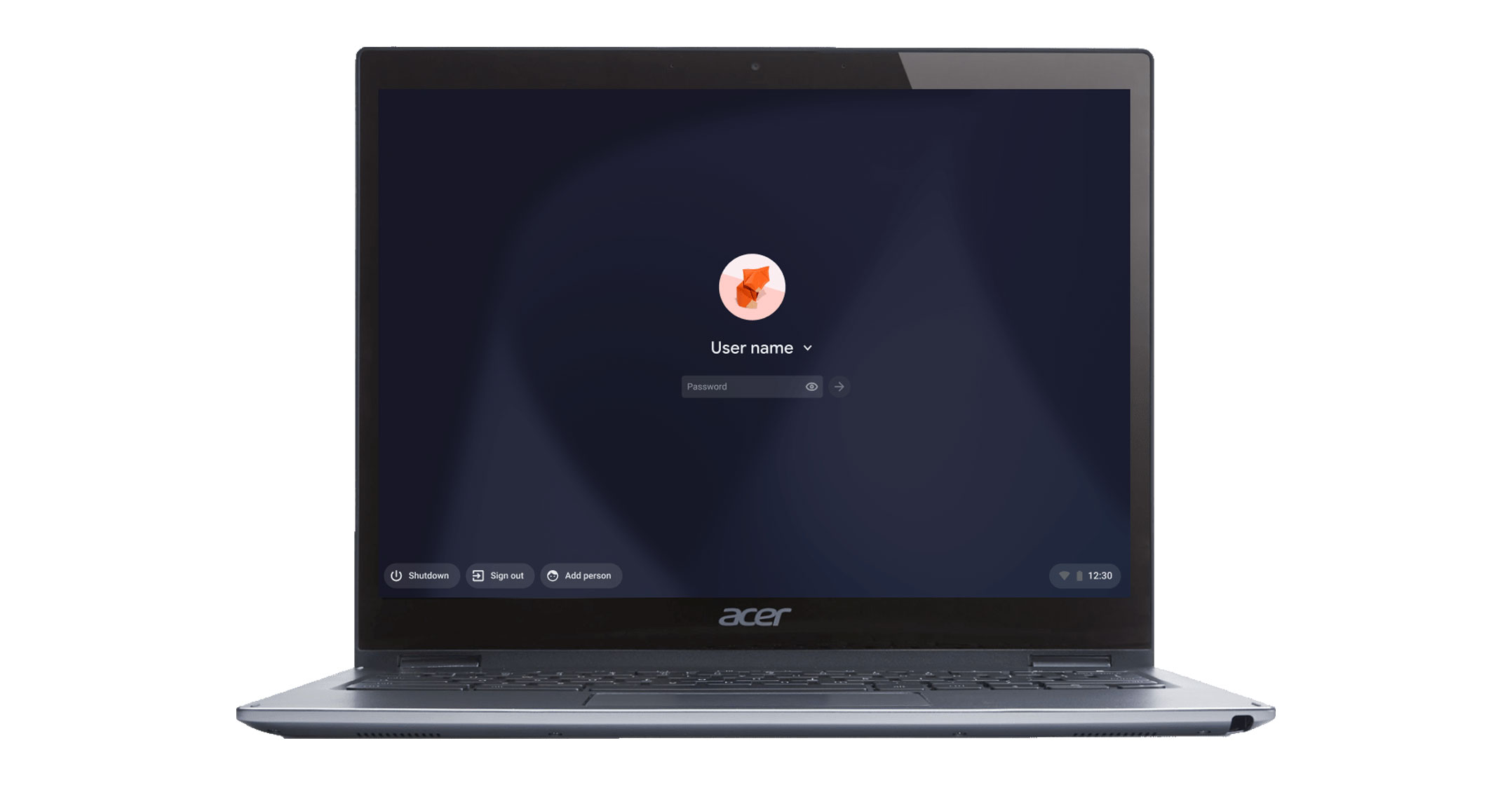
    A Chromebook made by Acer. Image: Google

    McLeod: If you were to describe ChromeOS today, what would you say is its market appeal? Why would a business, or an ordinary consumer, get a Chrome OS device versus a Mac or a Windows PC?

    Solomon: The fundamental value proposition is very simple. It’s really around security. The product is inherently more secure in the way it’s been designed from the ground up with things like secure boot and sandboxing. It’s no coincidence that there’s never been a ransomware attack through a Chromebook. We didn’t have any legacy in how we how we put together the architecture.

    Second is simplicity, just the fact that you can boot up in six seconds and it just always works. So, you have the simplicity and speed that comes with that. It provides an attractive value proposition, particularly for, say, a company that is looking to equip its field workers, and they need a device that is robust, eminently secure and reliable. Chromebooks are very hard to beat.

    Also, applications are moving, as you know, from clients – Win32 (Windows) applications – to the Web. This started many years ago, but it has accelerated. Major developers – Adobe, even Microsoft – are putting more of their resources into Web-based applications.

    When Google first kind of conceived the idea, we were a little bit ahead of our time. But what’s happening now is that more and more app developers are embracing the Web.

    So, in terms of use cases, you’re able to use a Chromebook now for an incredibly broad set of use cases. Think about the consumer use of it. It’s around productivity, media consumption and creativity.

    In productivity, you have the Google Workspace productivity applications. You have (Microsoft) Office on the Web, so you can do all your productivity stuff on a Chromebook perfectly well.

    If you think about media consumption, applications like Netflix, Spotify; most of these applications now run offline. Netflix has invested a lot in a great offline application.

    Creativity is the one that is most nascent. If you’re a high-end video editor, I’m not going to recommend a Chromebook to you. But it’s changing. There’s obviously Google Photos, which is a capable product. And we’re seeing more and more (creative apps on ChromeOS). Developers building for the Web first, and so we feel like we are on the right side of history in terms of the evolution of technology.

    McLeod: Would you say Chromebooks are for people who have a specific function in the business context and that if you’re a power user who needs access to a whole bunch of powerful software tools, the Chromebook is probably not for you yet?

    Solomon: That could be true, although I will tell you that at Google, for example, which has a significant number of power users and knowledge workers, they use Chromebooks as their daily driver. But we are not a company that has a lot of legacy. We’ve built our software stack to be cloud based. A company that has a lot of on-prem, client-side-heavy applications, maybe it’s not the right product. But we have bridging solutions. For example, you can run Parallels on a Chromebook (Parallels is virtualisation software). Many of our enterprise customers use virtualisation, whether it’s Citrix or VMware or any of the big virtualisation providers. We have had large wins in big banks in the US that have deployed Chromebooks for their retail branches, and they run bank apps that are not cloud based using virtualisation software. They either virtualise the whole desktop, or they virtualise the application.
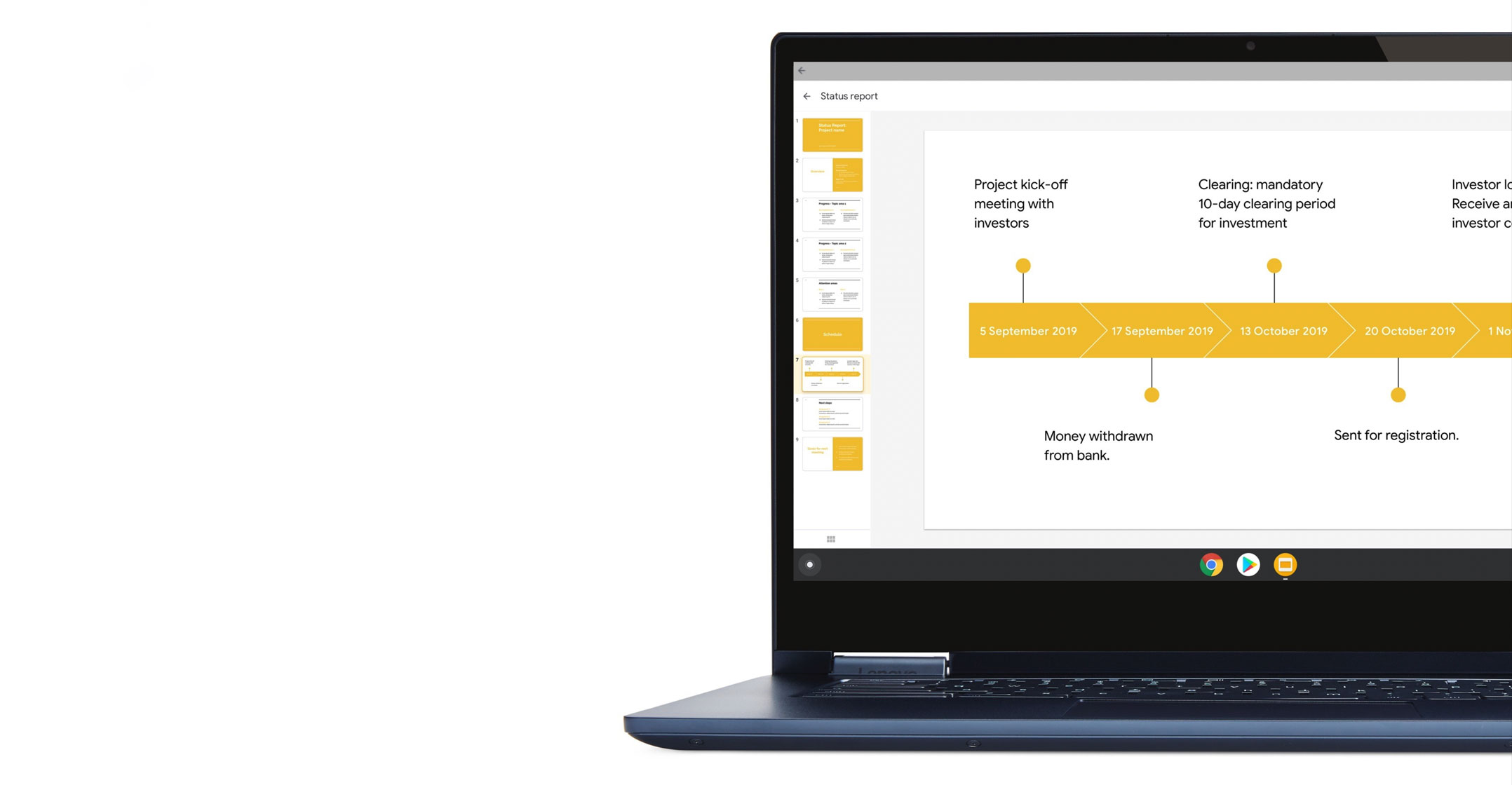
    A Chromebook in action. Image: Google

    McLeod: Given your background, growing up in South Africa, what is the future of Chromebooks in emerging markets?

    Solomon: I’m glad you asked that question — I was hoping you would. There are a couple of ways of thinking about it. In some ways, there’s an analogy with mobile phones. Just like landlines were skipped over by many people in emerging markets, we see an opportunity… And we see this starting to happen in places like Indonesia, which is a great example, and certainly we see South Africa as another good example where we think users will skip over legacy computing and go straight to Chromebooks.

    Now obviously connectivity is a challenge, but we’ve designed the product to work well with intermittent access. All the Workspace apps, for example, work well offline.

    Obviously, connectivity does need to be available at least intermittently, but we only see connectivity pricing coming down over time. Obviously, it will take time, but we don’t see it as an inhibitor to Chromebook adoption.

    McLeod: What sort of market share do Chromebooks have worldwide and what’s the outlook for growing that share?

    Solomon: It’s at, I believe 10.5%, according to IDC – that’s the latest, third-quarter number. And in each market, it’s really a function of time in the market. If you look at the US or Canada or the UK, it’s closer to 20% market share.

    Covid provided a tailwind for the Chromebook business, because people needed an easy-to-deploy, relatively affordable product so they could work or study from home. What’s interesting is that growth is continuing post-pandemic – not at the same rate, but we didn’t expect that.

    McLeod: I would like to touch on the hardware side of things. Google doesn’t make its own Chromebook hardware, although it did in the past. Is that something you might reconsider, especially since the company makes its own smartphones – Pixel devices?

    Solomon: I can’t comment about future products, of course. But it’s always something that we would consider. Currently, though, the ecosystem of OEMs (hardware manufacturers like HP and Acer) is building fantastic products, and so our focus and energy is to help them. We actually do a reference design, but it’s what the OEMs use essentially to build their products. We put a tremendous amount of engineering effort into it. Unlike Windows, which has a very loose reference design and architecture, where OEMs can do pretty much what they want, when an OEM builds a Chromebook, there’s a tremendous amount of Google IP in the product.

    All the designs, and in fact all the components, are approved by Google and they can’t ship the devices without that approval. We have a close hold on the ecosystem, but in a positive way.

    McLeod: There’s so much interesting stuff happening in semiconductors – Apple’s M1 chip, for example. Google is obviously developing its own chip designs for smartphones. Nvidia is trying to buy ARM. There is so much happening, but what’s the impact of all of this for Chromebooks ultimately?

    Solomon: A great question. It’s very interesting. We think this is healthy for the computing ecosystem in terms of breaking new barriers in performance per watt. At the end of the day, that’s what you want: You want a high-performance system that doesn’t use a lot of power.

    You have Apple, Intel, AMD, MediaTek, Qualcomm – big companies investing very heavily in this… There’s tremendous capital being injected into the market. There’s a lot of innovation, and it’s early days to say how it’s all going to play out. But the net benefit is going to be the user who will be getting more performant products at a lower price, which is really exciting.

    McLeod: Which chip architecture is most used in Chromebooks today?

    Solomon: Historically it’s been Intel. We still believe that Intel and x86 is a great architecture, but it used to be 90%-plus of Chromebooks shipped were Intel; now it’s more like in the 70% range. There’s been a lot of growth of ARM-based devices, particularly from MediaTek, but also from Qualcomm.

    McLeod: You might not be able to answer this question, but is Google exploring the possibility of developing its own silicon for Chromebooks?

    Solomon: Yeah, I can’t answer that question, but we are seeing great innovation from the ecosystem (of chip companies). And I think that for the foreseeable future, we’re very confident that the SoCs (systems on a chip) that the ecosystem is providing will be really good for Chromebooks.  – © 2021 NewsCentral Media


    Apple ChromeOS Google John Solomon MediaTek Microsoft Qualcomm
    Subscribe to TechCentral Subscribe to TechCentral
    Share. Facebook Twitter LinkedIn WhatsApp Telegram Email Copy Link
    Previous ArticleEskom failures leave South Africa set for years of power cuts
    Next Article Fintech Crossfin sold in R1.5-billion deal

    Related Posts

    TechCentral's International Newsmakers of 2025

    TechCentral’s International Newsmakers of 2025

    17 December 2025
    OpenAI launches GPT-5.2 after 'code red' push to counter Google. Shelby Tauber/Reuters

    OpenAI launches GPT-5.2 after ‘code red’ push to counter Google

    12 December 2025
    OpenAI warns new models pose high cybersecurity risk

    OpenAI warns new models pose high cybersecurity risk

    11 December 2025
    Company News
    Why TechCentral is the most powerful platform for reaching IT decision makers

    Why TechCentral is the most powerful platform for reaching IT decision makers

    17 December 2025
    Business trends to watch in 2026 - Domains.co.za

    Business trends to watch in 2026

    17 December 2025
    MTN Zambia launches world's first 4G cloud smartphone solution - Huawei

    MTN Zambia launches world’s first 4G cloud smartphone solution

    17 December 2025
    Opinion
    Netflix, Warner Bros deal raises fresh headaches for MultiChoice - Duncan McLeod

    Netflix, Warner Bros deal raises fresh headaches for MultiChoice

    5 December 2025
    BIN scans, DDoS and the next cybercrime wave hitting South Africa's banks - Entersekt Gerhard Oosthuizen

    BIN scans, DDoS and the next cybercrime wave hitting South Africa’s banks

    3 December 2025
    Your data, your hardware: the DIY AI revolution is coming - Duncan McLeod

    Your data, your hardware: the DIY AI revolution is coming

    20 November 2025

    Subscribe to Updates

    Get the best South African technology news and analysis delivered to your e-mail inbox every morning.

    Latest Posts
    Koos Bekker sells R2.5-billion in Naspers and Prosus shares

    Koos Bekker sells R2.5-billion in Naspers and Prosus shares

    23 December 2025
    Tribunal clears Vumatel's takeover of Herotel - with conditions

    Tribunal clears Vumatel’s takeover of Herotel – with conditions

    23 December 2025
    Wiocc subsidiary OADC cleared to buy NTT data centres in South Africa

    Wiocc subsidiary OADC cleared to buy NTT data centres in South Africa

    23 December 2025
    Netflix launches Afcon football show, hinting at bigger sports ambitions

    Netflix launches Afcon football show, hinting at bigger sports ambitions

    23 December 2025
    © 2009 - 2025 NewsCentral Media
    • Cookie policy (ZA)
    • TechCentral – privacy and Popia

    Type above and press Enter to search. Press Esc to cancel.

    Manage consent

    TechCentral uses cookies to enhance its offerings. Consenting to these technologies allows us to serve you better. Not consenting or withdrawing consent may adversely affect certain features and functions of the website.

    Functional Always active
    The technical storage or access is strictly necessary for the legitimate purpose of enabling the use of a specific service explicitly requested by the subscriber or user, or for the sole purpose of carrying out the transmission of a communication over an electronic communications network.
    Preferences
    The technical storage or access is necessary for the legitimate purpose of storing preferences that are not requested by the subscriber or user.
    Statistics
    The technical storage or access that is used exclusively for statistical purposes. The technical storage or access that is used exclusively for anonymous statistical purposes. Without a subpoena, voluntary compliance on the part of your Internet Service Provider, or additional records from a third party, information stored or retrieved for this purpose alone cannot usually be used to identify you.
    Marketing
    The technical storage or access is required to create user profiles to send advertising, or to track the user on a website or across several websites for similar marketing purposes.
    • Manage options
    • Manage services
    • Manage {vendor_count} vendors
    • Read more about these purposes
    View preferences
    • {title}
    • {title}
    • {title}