
Close Menu
TechCentralTechCentral

    Subscribe to the newsletter

    Get the best South African technology news and analysis delivered to your e-mail inbox every morning.

    Facebook X (Twitter) YouTube LinkedIn
    WhatsApp Facebook X (Twitter) LinkedIn YouTube
    TechCentralTechCentral
    • News
      Pepkor builds R21-billion fintech giant - and plans to list it - Pieter Erasmus

      Pepkor builds R21-billion fintech giant – and plans to list it

      22 July 2026
      Samsung Fold8 series unveiled as folding phone war looms

      Samsung Fold8 series unveiled as folding phone war looms

      22 July 2026
      Everything you wanted to know about EVs but were afraid to ask

      Everything you wanted to know about EVs but were afraid to ask

      22 July 2026
      Bitcoin at $65 000: stalled, or simply early?

      Bitcoin at $65 000: stalled, or simply early?

      22 July 2026
      Smart ID renewals go mobile - Absa CEO Kenny Fihla with home affairs minister Leon Schreiber

      Smart ID renewals go mobile

      22 July 2026
    • World
      Meta AI will now tell parents if their teen is in crisis

      Meta AI will now tell parents if their teen is in crisis

      17 July 2026
      IBM shares crash 25% as AI upends software spending - Arvind Krishna

      IBM shares crash 25% as AI upends software spending

      15 July 2026
      Jony Ive's first OpenAI device: an AI smart speaker - Jony Ive and Sam Altman

      Jony Ive’s first OpenAI device: an AI smart speaker

      15 July 2026
      Stripe, Advent in talks to buy PayPal for $53-billion

      Stripe, Advent in talks to buy PayPal for $53-billion

      15 July 2026
      Memory crisis sends smartphone market into steep decline

      Memory crisis sends smartphone market into steep decline

      13 July 2026
    • In-depth
      The plan to stop AI from breaking the world - Google DeepMind CEO Demis Hassabis. Image: John Sears

      The plan to stop AI from breaking the world

      16 July 2026
      The internet has a Strait of Hormuz problem

      The internet has a Strait of Hormuz problem

      15 July 2026
      AI boom sparks rally, frenzy and fear

      AI boom sparks rally, frenzy and fear

      11 June 2026
      Every plug-in hybrid on sale in South Africa, ranked by price - Lamborghini Temerario

      Every plug-in hybrid on sale in South Africa, ranked by price

      7 June 2026
      What Wi-Fi 8 will mean for wireless networks

      What Wi-Fi 8 will mean for wireless networks

      1 June 2026
    • TCS
      The rands-and-cents case for electric trucks - William Kelly Watts & Wheels with Wills

      The rands-and-cents case for electric trucks

      20 July 2026
      Watts & Wheels S1E7: 'Ferrari's EV breaks the internet'

      Watts & Wheels S1E7: ‘Ferrari’s EV breaks the internet’

      8 July 2026
      TCS+ | How Tracker is turning vehicle data into business strategy - Silvia Schollenberger

      TCS+ | How Tracker is turning vehicle data into business strategy

      1 July 2026
      TCS+ | IBM Bob: an AI-powered 'development partner' for the enterprise - David Spurway

      TCS+ | IBM Bob: an AI-powered development partner for the enterprise

      30 June 2026
      Watts & Wheels S1E6: 'A flawless Alfa and a bakkie that divides'

      Watts & Wheels S1E6: ‘A flawless Alfa and a bakkie that divides’

      17 June 2026
    • Opinion
      Selling vapour is corporate suicide in slow motion - Jannie van Zyl

      Selling vapour is corporate suicide in slow motion

      16 July 2026
      Brazil's online gambling crackdown is a lesson for South Africa

      How Amazon outmanoeuvred Starlink in South Africa

      15 July 2026
      The Popia problem with agentic AI - Herman Haasbroek

      The Popia problem with agentic AI

      14 July 2026
      The author, Fanie van Rooyen

      South Africa can still catch the AI wave – here’s how

      7 July 2026
      The author, Fanie van Rooyen

      The AI utopia South Africa can’t afford

      1 July 2026
    • Company Hubs
      • 1Stream
      • Africa Data Centres
      • AfriGIS
      • Altron Digital Business
      • Altron Document Solutions
      • Altron Group
      • Arctic Wolf
      • Ascent Technology
      • AvertITD
      • BBD
      • Braintree
      • CallMiner
      • CambriLearn
      • CM Telecom
      • Contactable
      • CYBER1 Solutions
      • Digicloud Africa
      • Digimune
      • Domains.co.za
      • ESET
      • Euphoria Telecom
      • HOSTAFRICA
      • Incredible Business
      • iONLINE
      • IQbusiness
      • Iris Network Systems
      • Kaspersky
      • LSD Open
      • Mitel
      • NEC XON
      • Netstar
      • Network Platforms
      • Next DLP
      • Ovations
      • Paracon
      • Paratus
      • Q-KON
      • SevenC
      • SkyWire
      • Solid8 Technologies
      • Telit Cinterion
      • Telviva
      • Tenable
      • Vertiv
      • Videri Digital
      • Vodacom Business
      • Vox
      • Wipro
      • Workday
      • XLink
    • Sections
      • AI and machine learning
      • Banking
      • Broadcasting and Media
      • Cloud services
      • Contact centres and CX
      • Cryptocurrencies
      • Education and skills
      • Electronics and hardware
      • Energy and sustainability
      • Enterprise software
      • Financial services
      • HealthTech
      • Information security
      • Internet and connectivity
      • Internet of Things
      • Investment
      • IT services
      • Lifestyle
      • Policy and regulation
      • Public sector
      • Retail and e-commerce
      • Satellite communications
      • Science
      • SMEs and start-ups
      • Social media
      • Talent and leadership
      • Telecoms
      • Watts & Wheels
    • Events
    • Advertise
    TechCentralTechCentral
    Home » In-depth » Why Telkom went nuclear on mobile

    Why Telkom went nuclear on mobile

    By Duncan McLeod24 July 2016
    Twitter LinkedIn Facebook WhatsApp Email Telegram Copy Link
    News Alerts
    WhatsApp

    phone-user-640

    Telkom has signalled it’s ready for a serious fight with its bigger rivals, this week taking the wraps off aggressively priced, 4G/LTE data-led mobile packages for both prepaid and contract customers that look set to have its bigger rivals scrambling for a response.

    The new packages, called “FreeMe”, are meant to help Telkom’s mobile arm, which has finally reached breakeven after years of investment, increase its market share, which currently stands at just 2,6%, according to independent research.

    Signalling a significant market shift away from the voice paradigm of the past, Telkom’s new mobile packages are led by data and include an unlimited mobile data and voice option (for calls to all South African networks; fair-use limit of 3 000 minutes) for R999/month. SMSes – up to 50 a day – are thrown in for free on all packages.

    All FreeMe packages, even the entry-level R99/month option that includes 1GB of data and free texts, offer free on-network calls to Telkom fixed lines and mobile numbers (with a 3 000-minute a month fair-use restriction to stop abuse).

    Other packages include all the above benefits plus data for R149/month (2GB), R299 (5GB), R399 (10GB), R599 (20GB) and R999 (unlimited). The 20GB and unlimited options also include free calls to all South African networks (not only on-net calls), with a fair-use policy of 1 500 minutes and 3 000 minutes a month respectively.

    In a break with bigger rivals Vodacom and MTN, Telkom is also cosying up to so-called over-the-top providers: messaging and voice-over-Internet protocol (VoIP) calls in WhatsApp, BlackBerry Messenger and Viber on the new plans are zero-rated, meaning they won’t come off a user’s data allocation. In effect, then, calls made over the Internet using these apps are completely free of charge to both prepaid and contract users. Telkom intends adding Skype and FaceTime zero-rating only later as integration of the Microsoft- and Apple-owned platforms is more complex.
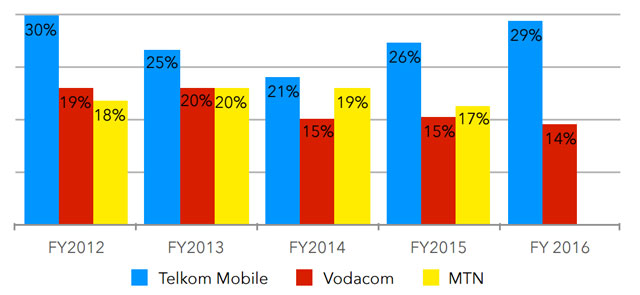
    Post-paid percentage of total subscribers. Source: Research ICT Africa
    Post-paid percentage of total subscribers. Source: Research ICT Africa

    Attila Vitai, who heads Telkom’s consumer and small business division, said the company wants to be the consumer champion and embracing the likes of WhatsApp and Viber was an essential step in doing this. It’s a change in tack by Telkom, whose regulatory team had previously voiced concern, along with Vodacom and MTN, about the impact of over-the-top providers on the operators’ ability to invest in their networks. The big players have called for the providers to face the same stringent regulations that they do.

    Rejigging of radio frequency spectrum is key to Telkom achieving success with the new packages. It is “re-farming”, or reallocating, most of the spectrum it has access to at 1,8GHz from 2G to 4G/LTE. It’s retaining just enough spectrum in the band to continue to serve the few hundred thousand customers who have only 2G devices. Telkom also has access to a big chunk of LTE spectrum at 2,3GHz, but it intends using this for fixed-wireless solutions exclusively in future.

    “We are tapping into global trends where people increasingly use a data service to communicate, even for voice,” said Vitai.

    He said it’s the first time a South African operator has championed both the cause of prepaid and contract users at the same time.

    “We are very conscious that there is disquiet that prepaid customers pay a lot more per megabyte and per minute. Now, if you sign up for a contract, you pay a fixed monthly fee, and if you buy prepaid, the bundle size is the same, but has a 30-day validity,” Vitai said.

    There is also no long-term contract tie-in, provided a consumer goes for a Sim-only option or buys their phone upfront. If they elect to take a phone subsidy, they will then be locked in over an agreed period of time while they pay it back, he said.

    Investment per subscriber in rand. Source: Research ICT Africa
    Investment per subscriber in rand. Source: Research ICT Africa

    As an additional sweetener, both prepaid and contract users get free, unlimited data access at 6 000 Wi-Fi hotspots around the country.

    Independent analysis published this week by Research ICT Africa shows that Vodacom controls 37,7% of the South African mobile telecommunications market, followed closely by MTN at 36%. Cell C is third at 23%, with Telkom languishing at 2,6%.

    But although Vodacom has had a successful year, and MTN has invested heavily in its network to catch up with its bigger rival, it’s Telkom that is best positioned for growth, Research ICT Africa said.

    “Telkom Mobile has been especially successful with a strong contract segment: its post-paid share is higher than Vodacom’s and MTN’s. Launched in 2011, within five years it has seen an average total subscriber growth rate of 54,6%/year to 2,7m and has succeeded in reducing its Ebitda loss by 94% between its 2015 and 2016 financial years to just R43m, bringing the operator close to breaking even in the fourth quarter of 2015.” (Ebitda, a measure of operating profit, is short for earnings before interest, tax, depreciation and amortisation.)

    Research ICT Africa said Telkom Mobile’s product offering has been “especially dynamic”, even before the introduction this week of the “FreeMe” plans.

    Attila Vitai
    Attila Vitai

    “It has offered its post-paid consumers Sim-only contracts and month-to-month payments starting in early 2015 when Vodacom, MTN and Cell C did not offer such flexibility.

    “It also offers some of the lowest call rates and the lowest data rates in the country (measured by a 1GB basket and cost per megabyte),” it said.

    In the 2016 financial year, Telkom Mobile contributed 12% to Telkom group revenue, “solidifying the group’s place as an integrated telecoms service provider”.

    Although Telkom Mobile has by far the smallest share of the market, it has had an outsized impact, Research ICT Africa said.

    “Subscriber behaviour suggests that it has had the largest impact in the contract segment where Telkom Mobile is gaining most of its subscribers: it has grown from 579 125 contract subscribers in the 2015 financial year to 794 272 contract subscribers in 2016.”

    However, this is still only a fraction of the 4,9m contract subscribers belonging to Vodacom and the 5,2m to MTN.

    Per subscriber, Telkom Mobile’s investment is roughly on par with Vodacom’s. However, in absolute terms, its investment is only R660m (2016 financial year) whereas Vodacom and MTN are investing in the billions. “This shows that its scale remains minuscule in the mobile market.”

    • A shortened version of this article was originally published in the Sunday Times
    • See also: Telkom detonates bomb on mobile rivals and Telkom just turned SA telecoms on its head

    Follow TechCentral on Google News Add TechCentral as your preferred source on Google


    Attila Vitai BBM Cell C FaceTime FreeMe MTN Research ICT Africa Skype Telkom Telkom FreeMe Viber Vodacom WhatsApp
    WhatsApp YouTube
    Share. Facebook Twitter LinkedIn WhatsApp Telegram Email Copy Link
    Previous ArticleNaspers hikes CEO’s pay as profit rises
    Next Article Meet the SA youngsters taking on WhatsApp

    Related Posts

    Openserve hits back in fibre ISP row

    Openserve hits back in fibre ISP row

    20 July 2026
    Best network, worst vibes: the puzzle of SA telecoms

    Best network, worst vibes: the puzzle of SA telecoms

    20 July 2026
    Amazon Leo all set for South African launch - From left, Maziv CEO Dietlof Mare, communications minister Solly Malatsi, Herotel CEO Van Zyl Botha and Amazon's David Zapolsky

    Amazon Leo all set for South African launch

    15 July 2026
    Company News
    Samsung's new Galaxy Z series: foldables, perfected

    Samsung’s new Galaxy Z series: foldables, perfected

    22 July 2026
    Is your cloud PBX a hacker's back door? Centracom

    Is your cloud PBX a hacker’s back door?

    22 July 2026

    Africa’s biggest entrepreneurship gathering heads for Cape Town

    22 July 2026
    Opinion
    Selling vapour is corporate suicide in slow motion - Jannie van Zyl

    Selling vapour is corporate suicide in slow motion

    16 July 2026
    Brazil's online gambling crackdown is a lesson for South Africa

    How Amazon outmanoeuvred Starlink in South Africa

    15 July 2026
    The Popia problem with agentic AI - Herman Haasbroek

    The Popia problem with agentic AI

    14 July 2026

    Subscribe to Updates

    Get the best South African technology news and analysis delivered to your e-mail inbox every morning.

    Latest Posts
    Pepkor builds R21-billion fintech giant - and plans to list it - Pieter Erasmus

    Pepkor builds R21-billion fintech giant – and plans to list it

    22 July 2026
    Samsung Fold8 series unveiled as folding phone war looms

    Samsung Fold8 series unveiled as folding phone war looms

    22 July 2026
    Everything you wanted to know about EVs but were afraid to ask

    Everything you wanted to know about EVs but were afraid to ask

    22 July 2026
    Bitcoin at $65 000: stalled, or simply early?

    Bitcoin at $65 000: stalled, or simply early?

    22 July 2026
    © 2009 - 2026 NewsCentral Media
    Built and maintained by Chronon
    • Cookie policy (ZA)
    • TechCentral – privacy and Popia

    Type above and press Enter to search. Press Esc to cancel.

    Manage consent

    TechCentral uses cookies to enhance its offerings. Consenting to these technologies allows us to serve you better. Not consenting or withdrawing consent may adversely affect certain features and functions of the website.

    Functional Always active
    The technical storage or access is strictly necessary for the legitimate purpose of enabling the use of a specific service explicitly requested by the subscriber or user, or for the sole purpose of carrying out the transmission of a communication over an electronic communications network.
    Preferences
    The technical storage or access is necessary for the legitimate purpose of storing preferences that are not requested by the subscriber or user.
    Statistics
    The technical storage or access that is used exclusively for statistical purposes. The technical storage or access that is used exclusively for anonymous statistical purposes. Without a subpoena, voluntary compliance on the part of your Internet Service Provider, or additional records from a third party, information stored or retrieved for this purpose alone cannot usually be used to identify you.
    Marketing
    The technical storage or access is required to create user profiles to send advertising, or to track the user on a website or across several websites for similar marketing purposes.
    • Manage options
    • Manage services
    • Manage {vendor_count} vendors
    • Read more about these purposes
    View preferences
    • {title}
    • {title}
    • {title}